Online Gambling Market Overview: Growth Dynamics and Competitive Landscape
Global Online Gambling Market Overview
Online gambling industry, also known as iGaming, has transformed from a niche digital alternative into a mainstream global online entertainment market driven by rising internet and mobile penetration, and significant regulatory shifts. Online gambling covers a wide range of games, including online casinos, sports betting, poker, lotteries, and live dealer games. The demand for digital platforms continues to expand among consumers compared to conventional land-based gambling venues.
Industry estimates indicate that the global online gambling market is valued at $80 billion, with steady year-on-year growth. Expansion is particularly strong in regulated regions where consumer trust, secure payment systems, and clear legal frameworks support long-term adoption.
The online gambling market is broadly segmented by product type, platform, payment method, and geography.
- Online casino games (slots, table games, live dealer)
- Online sports betting
- Poker and card-based games
- Online lotteries and bingo
Key iGaming Market Drivers
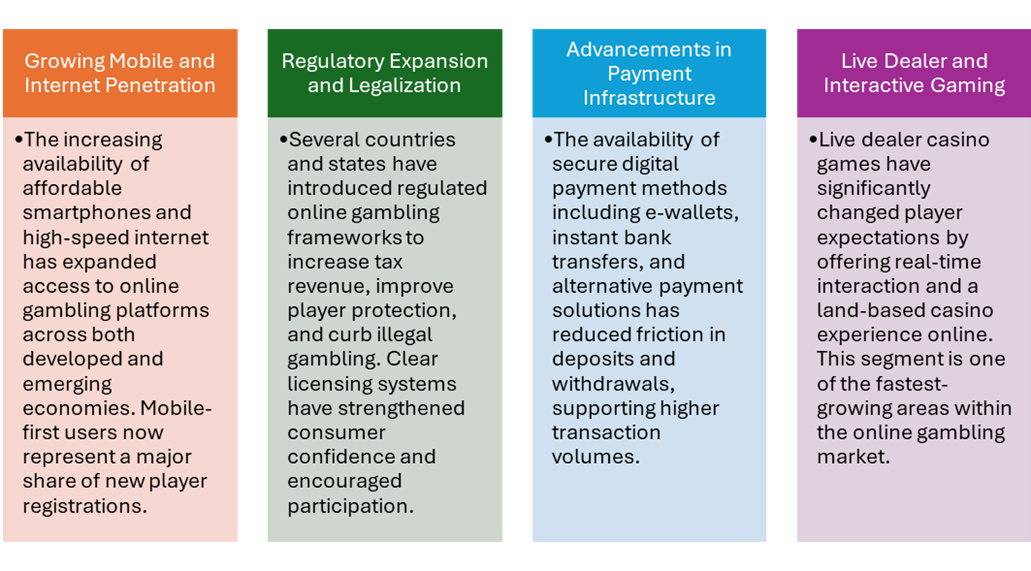
Product Trends
- Mobile Casino Continues to Lead Growth Opportunities - Mobile casinos remain the strongest growth engine within online gambling. Market participants consistently rank it ahead of mobile sports betting and live betting, citing higher engagement frequency, broader game variety, and better monetization per user. The shift toward mobile-first entertainment, combined with improvements in app performance and payment speed, has reinforced mobile casinos’ leading position in short-term growth outlooks.
- AI-Enhanced Gambling Moves Closer to the Core - AI-driven applications within online gambling continue to build momentum, marking several consecutive periods of increasing relevance. Although mobile and live casino products still dominate growth rankings, AI-enhanced gambling features such as personalization, dynamic odds, fraud detection, and user behavior analysis are now approaching the top tier. Among newer product concepts, AI stands out as one of the few areas showing sustained upward movement, with potential to play a larger role in future market development.
- Virtual Gambling Remains a Niche Segment - Virtual gambling is currently viewed as having limited growth potential. Despite high-profile hardware launches and interest in immersive technologies, adoption remains constrained. Devices such as mixed-reality headsets have not yet translated into measurable demand for virtual casino experiences, keeping this segment on the periphery of the broader online gambling market.
- Crypto-Related Gambling Faces Growth Constraints - Crypto-based gambling platforms have produced some high-performing operators; however, overall growth expectations for the segment remain cautious. Regulatory uncertainty, volatility in digital assets, and limited mainstream adoption continue to restrict expansion. As a result, crypto-related gambling is not widely seen as a major growth driver in the near term.
- Bingo Continues to Lose Strategic Relevance - Bingo remains a stable but low-growth product and is no longer a central focus for most operators. It has consistently ranked at the lower end of growth potential assessments and is increasingly excluded from forward-looking product strategies. Market attention has largely shifted toward formats with stronger engagement and monetization dynamics.
Competitive Landscape
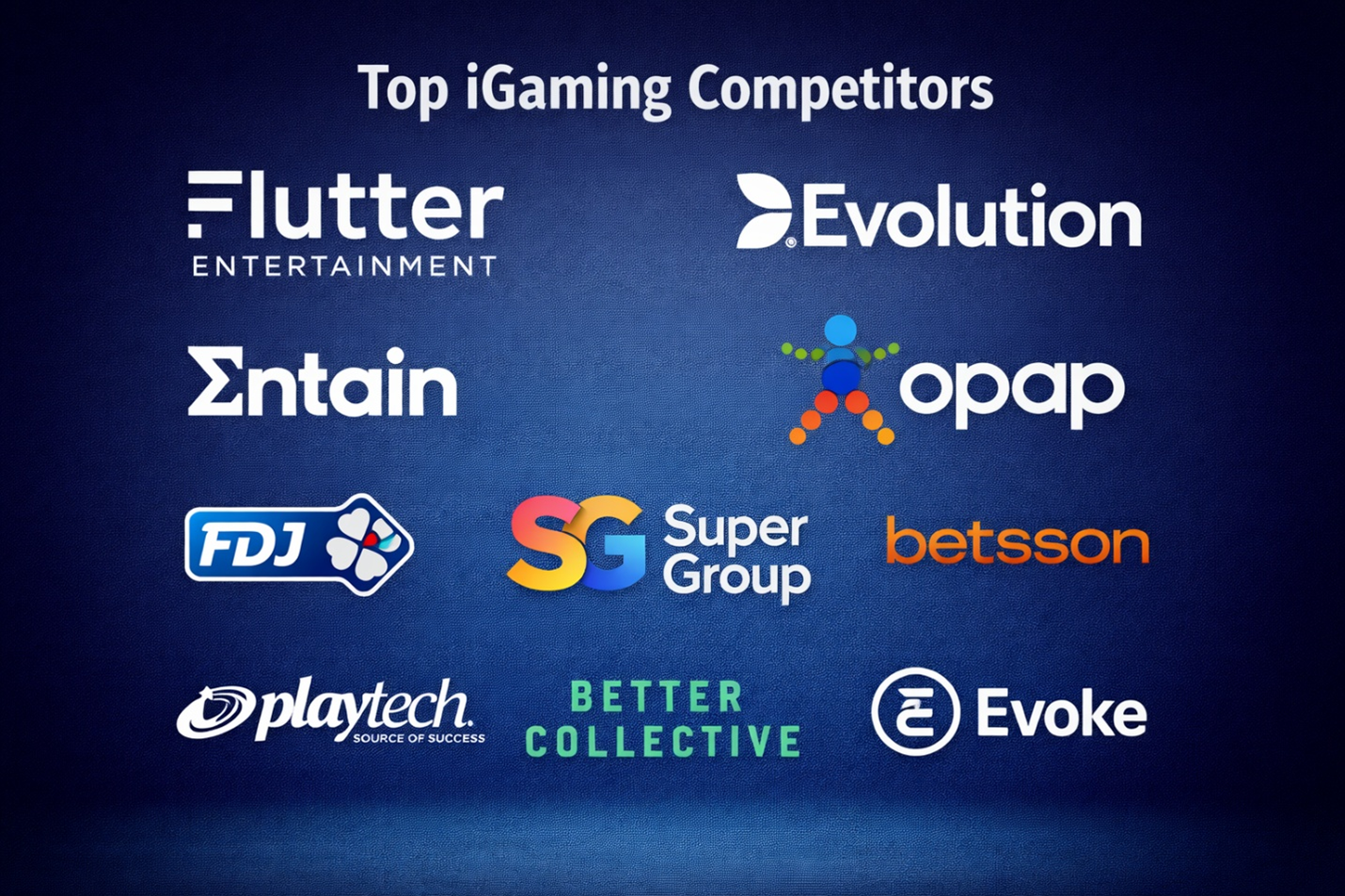
The online gambling market comprises a combination of large multinational operators and regionally focused specialists, including Flutter Entertainment, Evolution, Entain, OPAP, FDJ, Super Group, Betsson, Playtech, Better Collective, and Evoke. Competitive positioning is driven by the breadth and quality of game portfolios, platform stability and scalability, speed and security of payment processing, customer service capabilities, and adherence to local regulatory frameworks. Strategic partnerships with game studios and technology providers are central to product innovation, market differentiation, and sustain competitive advantage.
Market competition is increasingly shifting toward:
- Platform stability and uptime
- Responsible gambling tools
- Faster payouts and transparent terms
- Localized content and payment options
Conclusion
The global online gambling market has reached a stage of structural maturity, supported by sustained digital adoption, expanding regulatory clarity, and continuous product innovation. Growth is increasingly concentrated in regulated jurisdictions, where transparent frameworks, secure payment systems, and responsible gambling standards have strengthened consumer confidence and long-term participation.
From a product perspective, mobile casino platforms remain the primary growth driver, reflecting changing user behavior and improvements in mobile performance and payments. At the same time, AI-enabled capabilities are becoming integral to platform operations, influencing personalization, risk management, and operational efficiency. In contrast, segments such as virtual gambling, crypto-based platforms, and bingo are expected to play a more limited role in near- to medium-term market expansion.