India's Electronics Manufacturing Industry: Emerging Opportunities and the Road to Market Entry
India's electronics manufacturing industry is emerging as a significant driver of industrial growth, export development and technological advancement. Supported by rising domestic demand, government initiatives and increasing integration with global supply chains, the sector is creating opportunities for manufacturers, component suppliers, technology companies and investors.
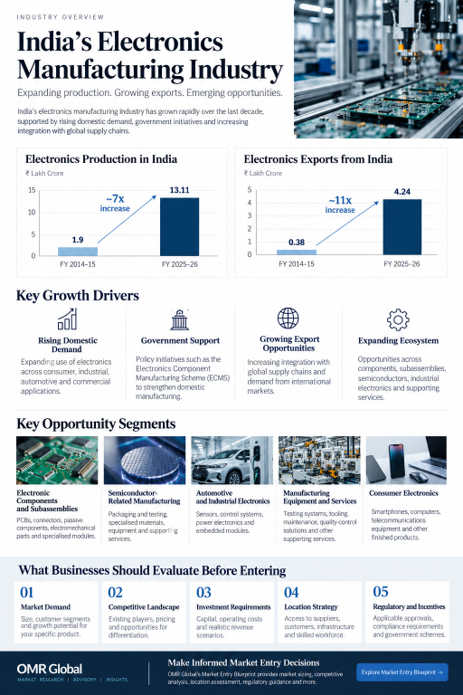
According to the Government of India, electronics production increased from INR1.9 lakh crore in FY 2014–15 to INR13.11 lakh crore in FY 2025–26. Electronics exports also grew from approximately INR38,000 crore to INR4.24 lakh crore during the same period. This expansion highlights India's growing role in electronics manufacturing and its ambitions to strengthen domestic production capabilities.
As the industry evolves, the opportunity extends beyond assembling finished electronic products. Businesses are increasingly exploring electronic components, subassemblies, industrial electronics, automotive applications and other segments that support the wider manufacturing ecosystem.
However, entering this expanding market requires more than identifying a growing industry. Businesses must understand where demand exists, how competition is structured and which opportunities align with their investment capacity and operational capabilities.
India's Electronics Manufacturing Sector: Key Growth Drivers
Several factors are contributing to the growth of electronics manufacturing in India.
Rising Domestic Demand
Electronics have become integral to consumer, commercial and industrial applications. Smartphones, computers, telecommunications equipment, automotive systems and industrial automation solutions contribute to demand across multiple product categories.
This demand creates opportunities for both finished-product manufacturers and businesses supplying components, materials, equipment and specialised manufacturing services. For prospective entrants, identifying the right product category and target customer segment is essential to translating broad industry growth into a viable business opportunity.
Government Initiatives and Manufacturing Support
The Government of India has introduced initiatives to encourage domestic manufacturing, strengthen supply chains and attract investment into electronics production.
The Electronics Component Manufacturing Scheme (ECMS), notified in April 2025, aims to develop domestic capabilities across selected electronic components, subassemblies and related manufacturing activities. Such initiatives reflect the policy focus on increasing domestic value addition and strengthening India's position in electronics supply chains.
Businesses considering investment should evaluate the latest scheme guidelines, eligibility conditions and applicable requirements before factoring potential incentives into their financial plans.
Expanding Export Potential
India's growing electronics production base is creating opportunities for companies seeking to serve international markets. Export-oriented manufacturers may benefit from access to global demand, provided they can meet buyer requirements for quality, cost competitiveness, delivery reliability and technical compliance.
Entering export markets also requires a clear understanding of target countries, customer qualification processes, logistics, applicable regulations and competing manufacturing locations. Market-specific research can help businesses assess these factors before committing resources.
Emerging Business Opportunities in Electronics Manufacturing
The development of India's electronics ecosystem presents opportunities across several segments of the value chain.
Electronic components and subassemblies: Components such as printed circuit boards, connectors, electromechanical parts and specialised modules support a wide range of electronic products. Businesses can investigate opportunities by assessing domestic demand, import dependence, existing manufacturing capacity and customer requirements.
Semiconductor-related manufacturing: India's semiconductor initiatives have increased interest in packaging and testing, specialised materials, equipment and supporting manufacturing services. These segments can involve substantial capital requirements, technical complexity and demanding customer qualification processes, making detailed feasibility assessment particularly important.
Automotive and industrial electronics: Electronics are increasingly important in vehicle systems, industrial automation, control equipment and power applications. Manufacturers with relevant engineering capabilities may explore specialised products designed for specific industrial or automotive customers.
Manufacturing equipment and support services: As production capacity expands, businesses may find opportunities in testing systems, tooling, maintenance, quality-control solutions and other services required by electronics manufacturers.
The commercial potential of these segments varies considerably. Companies should evaluate individual product markets rather than assume that growth across the overall electronics industry guarantees demand or profitability in every category.
Challenges Businesses Must Consider Before Entering the Market
Despite the sector's expansion, electronics manufacturing presents several operational and commercial challenges.
Capital investment can be substantial, particularly for businesses requiring specialised machinery, testing infrastructure, production facilities and working capital. The availability of skilled personnel, reliable suppliers and suitable industrial infrastructure can also influence operating costs and production efficiency.
Competition is another important consideration. Established domestic and international manufacturers may benefit from economies of scale, established customer relationships and technical expertise. New entrants must identify a clear competitive advantage, whether through specialised products, cost efficiency, customer service or access to underserved market segments.
Supply-chain dependencies, quality requirements and regulatory obligations can further affect market entry decisions. Depending on the product, businesses may need to assess certifications, factory approvals, environmental requirements and sector-specific compliance obligations.
These considerations make it important to evaluate a specific manufacturing opportunity before making significant investment commitments.
The Role of Market Research in Electronics Manufacturing
A structured market assessment helps businesses move from general industry interest to a more informed entry strategy.
The process begins with defining the target product, intended applications and customer segments. Businesses can then estimate market size, assess demand trends and identify the customers most likely to require their products.
Competitive analysis provides another important perspective. Understanding existing manufacturers, their positioning, product offerings and pricing can help identify gaps and evaluate whether a proposed business can establish a defensible position.
Location assessment is equally relevant. Access to suppliers, customers, skilled labour, industrial infrastructure and logistics networks can influence both the initial investment and long-term operating economics.
Finally, businesses should examine investment requirements, potential risks, applicable regulations and relevant government schemes. Financial scenarios can help assess how changes in costs, production volumes, capacity utilisation and customer acquisition timelines may affect the business case.
Together, these insights provide a more structured basis for deciding whether to enter a market, refine a proposed business model or investigate alternative opportunities.
Supporting Informed Market Entry Decisions with OMR Global
For businesses exploring India's electronics manufacturing industry, OMR Global's Market Entry Blueprint offers a structured approach to evaluating market opportunities before committing significant resources.
The service combines market sizing, competitive analysis, location assessment, regulatory and licensing research, and government scheme guidance. Depending on the selected plan, the assessment can also incorporate revenue projections, scenario analysis and risk considerations.
By bringing these elements together, the Market Entry Blueprint helps businesses examine the commercial realities of a proposed market entry or expansion. It is designed to support more informed decisions by highlighting relevant opportunities, competitive conditions and factors that may affect business viability.
Whether a company is considering electronic component manufacturing, evaluating a new production location or exploring expansion into a new geographical market, a structured assessment can help clarify the questions that need to be answered before investment decisions are made.
Conclusion
India's electronics manufacturing industry offers a broad range of opportunities as domestic production capabilities expand and supply chains continue to evolve. From components and subassemblies to industrial applications and supporting services, businesses can explore multiple avenues for participation.
Realising these opportunities, however, requires a clear understanding of the target market, competitive landscape, investment requirements and operating environment.
For manufacturers, entrepreneurs and investors, market research provides a practical starting point for evaluating these factors and developing an informed entry strategy.
Explore OMR Global's Market Entry Blueprint to assess your target market, understand the competitive landscape and make more informed market entry decisions.