A Blueprint for AI Supplier Capability RFIs: Moving Beyond Market Hype
As enterprises accelerate investments in artificial intelligence, procurement and sourcing teams are facing a growing challenge: separating real AI capability from polished marketing narratives. The surge in AI vendors has created a crowded ecosystem where many suppliers promise transformational outcomes, but few provide measurable evidence of scalability, governance, interoperability, or business value.
According to insights from Orion Market Research, organizations that rely on generic Request for Information (RFI) templates often struggle to identify vendors with proven operational maturity. This has increased the risk of AI-washing, a practice where suppliers exaggerate or misrepresent their AI capabilities to secure enterprise contracts.
Why Traditional RFIs Fail in AI Procurement
Traditional supplier evaluation frameworks were designed for conventional software procurement. AI platforms, however, require a much deeper level of technical, operational, and governance assessment.
Many enterprise RFIs still focus heavily on:
- Brand recognition
- Generic capability statements
- Demonstration presentations
- High-level innovation claims
These approaches rarely uncover critical operational realities such as:
- Model retraining frequency
- Data lineage transparency
- AI governance controls
- Bias mitigation mechanisms
- Infrastructure scalability
- Explainability capabilities
- Integration readiness
- Cybersecurity maturity
Without structured AI-specific evaluation criteria, procurement teams risk selecting vendors that cannot support long-term enterprise adoption.
The Rise of AI-Washing in Enterprise Procurement
The rapid commercialization of generative AI has intensified competitive pressure across the technology landscape. As a result, many suppliers now market rule-based automation or basic analytics tools as “AI-powered” solutions.
This trend has made it increasingly difficult for sourcing leaders to:
- Validate genuine machine learning capability
- Differentiate proprietary AI from third-party integrations
- Assess production-level deployment experience
- Verify responsible AI practices
- Evaluate long-term vendor sustainability
Industry analysts at Orion Market Research emphasize that procurement leaders must adopt evidence-driven RFI structures that prioritize measurable technical depth over marketing language.
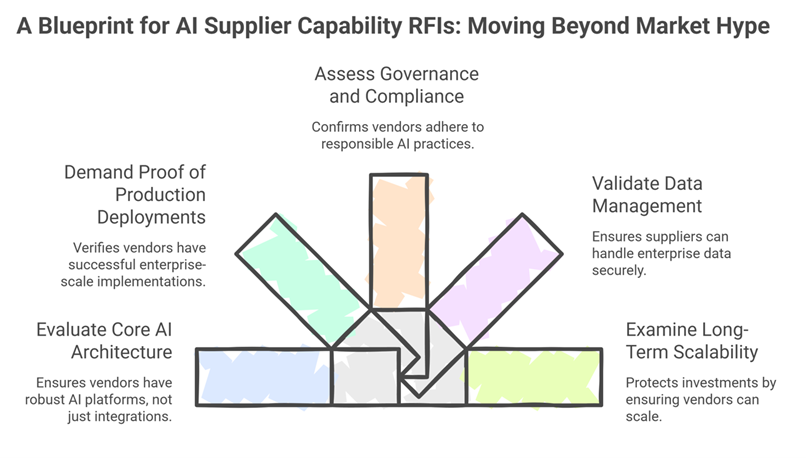
A Blueprint for Effective AI Supplier Capability RFIs
To move beyond market hype, enterprises should redesign RFIs around operational intelligence, governance validation, and measurable performance benchmarks.
- Evaluate Core AI Architecture
RFIs should request detailed information regarding:
- Model development frameworks
- Training methodologies
- Cloud infrastructure dependencies
- API ecosystem compatibility
- Real-time inference capabilities
- Multi-model orchestration support
This helps organizations distinguish between true AI platforms and surface-level integrations.
- Demand Proof of Production Deployments
Vendors should provide:
- Industry-specific implementation case studies
- Enterprise-scale deployment metrics
- Performance benchmarks
- Client adoption statistics
- Uptime and latency measurements
Procurement teams should prioritize documented operational outcomes instead of conceptual demonstrations.
- Assess Governance and Compliance Readiness
Responsible AI governance has become a strategic procurement requirement. Effective RFIs should evaluate:
- AI explainability frameworks
- Bias monitoring protocols
- Data privacy controls
- Regulatory compliance readiness
- Audit trail capabilities
- Human oversight mechanisms
This is particularly important for regulated industries, including healthcare, BFSI, manufacturing, and public sector operations.
- Validate Data Management Capabilities
AI performance depends heavily on data quality and governance maturity. RFIs should include assessment criteria for:
- Data ingestion processes
- Metadata management
- Data lineage tracking
- Synthetic data usage
- Data retention policies
- Security architecture
Organizations must ensure suppliers can support enterprise-scale data operations securely and consistently.
- Examine Long-Term Scalability
Many AI vendors succeed in pilot projects but fail during enterprise-wide scaling. Supplier RFIs should therefore assess:
- Infrastructure elasticity
- Multi-region deployment capability
- MLOps maturity
- Continuous model monitoring
- Resource optimization frameworks
- Support and maintenance structures
Scalability validation is essential for protecting long-term AI investments.
Why Strategic RFIs Matter More Than Ever
AI procurement decisions now influence:
- Operational efficiency
- Regulatory exposure
- Customer experience
- Competitive differentiation
- Cybersecurity posture
- Digital transformation outcomes
Poor supplier selection can lead to implementation delays, budget overruns, compliance risks, and failed transformation initiatives.
A structured AI supplier capability RFI acts as a safeguard against inflated claims while improving procurement transparency and supplier accountability.
Conclusion
The AI supplier landscape is evolving rapidly, but enterprise procurement cannot rely on marketing claims alone. Organizations need structured, evidence-driven RFIs that uncover operational maturity, governance readiness, and long-term scalability.
Businesses that adopt robust AI supplier evaluation frameworks will be better positioned to reduce procurement risk, eliminate AI-washing, and achieve sustainable digital transformation outcomes.
With specialized procurement intelligence and RFI/RFP outsourcing expertise, Orion Market Research continues to support enterprises in building smarter, more resilient AI sourcing strategies.