Audit-Ready Procurement: Why Manual Documentation Fails Internal Governance
In today’s increasingly regulated business environment, procurement teams are facing mounting pressure to deliver transparency, traceability, and accountability across every sourcing decision. From vendor onboarding and contract approvals to risk assessments and policy validations, procurement documentation has become a critical component of enterprise governance. Yet many organizations continue relying on fragmented spreadsheets, email chains, and manually maintained records that expose them to compliance gaps, audit failures, and operational risk.
As enterprises expand across global markets and digital ecosystems, procurement is no longer viewed as a purely administrative function. It has become a strategic governance mechanism directly tied to financial controls, regulatory compliance, cybersecurity assurance, ESG reporting, and enterprise risk management. This shift is driving organizations to reassess whether their current procurement documentation practices are truly audit-ready.
The Growing Governance Burden on Procurement Teams
Modern procurement operations must satisfy far more than cost optimization objectives. Internal audit teams, compliance officers, legal departments, and executive leadership now require procurement processes that can withstand regulatory scrutiny and support defensible decision-making.
Organizations are increasingly expected to maintain:
- Complete sourcing documentation trails
- Standardized approval workflows
- Vendor due diligence records
- Procurement policy adherence logs
- Risk evaluation documentation
- Contract lifecycle transparency
- Change management records
- Real-time compliance visibility
When documentation is handled manually, maintaining consistency across these requirements becomes extremely difficult. Missing approvals, undocumented vendor changes, outdated specifications, and incomplete evaluation records can quickly create governance vulnerabilities that escalate during audits.
Why Manual Procurement Documentation Creates Compliance Risks
Manual procurement systems often evolve organically over time without centralized governance structures. Different teams maintain records in different formats, departments follow inconsistent workflows, and documentation becomes scattered across disconnected platforms.
This fragmentation creates several governance challenges:
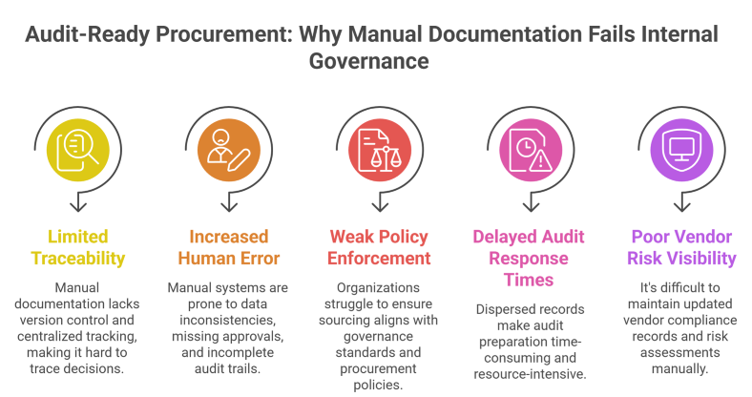
- Limited Traceability
Auditors require clear evidence showing how procurement decisions were made, who approved them, and whether policies were followed. Manual documentation frequently lacks version control, timestamp validation, and centralized tracking capabilities.
- Increased Human Error
Procurement teams managing large sourcing volumes manually are more likely to encounter data inconsistencies, duplicate records, missing approvals, and incomplete audit trails. Even minor documentation errors can trigger compliance concerns during internal reviews.
- Weak Policy Enforcement
Without structured procurement frameworks, organizations struggle to ensure that sourcing activities consistently align with internal governance standards, regulatory obligations, and procurement policies.
- Delayed Audit Response Times
When procurement records are dispersed across emails, spreadsheets, PDFs, and local storage systems, preparing for audits becomes time-consuming and resource-intensive. Compliance teams often spend weeks reconstructing procurement histories.
- Poor Vendor Risk Visibility
Manual documentation processes make it difficult to maintain updated vendor compliance records, cybersecurity certifications, insurance documentation, and risk assessments across supplier networks.
Procurement Governance Is Becoming a Strategic Priority
As regulatory expectations continue to rise, enterprises are shifting toward procurement models designed around defensibility and operational transparency. Audit-ready procurement frameworks are increasingly viewed as essential for protecting organizational integrity and reducing financial exposure.
Industries such as healthcare, BFSI, manufacturing, energy, telecom, retail, and technology are especially vulnerable to procurement governance failures because of strict regulatory oversight and complex supplier ecosystems.
Organizations that modernize procurement documentation practices gain several advantages:
- Faster audit preparation
- Improved internal controls
- Reduced compliance risk
- Better supplier accountability
- Stronger contract governance
- Enhanced operational visibility
- More reliable procurement reporting
- Greater executive confidence in sourcing decisions
These benefits are becoming central to enterprise resilience strategies as businesses navigate expanding regulatory complexity and stakeholder scrutiny.
The Role of Procurement Intelligence in Audit Readiness
Modern enterprises require procurement systems capable of producing structured, standardized, and compliance-aligned sourcing documentation. This is where procurement intelligence and research-driven sourcing support are becoming increasingly valuable.
By leveraging advanced procurement research methodologies, organizations can improve:
- Requirement clarity
- Vendor evaluation frameworks
- Documentation consistency
- Risk assessment structures
- Compliance mapping
- Governance alignment
- Procurement defensibility
This transition allows procurement teams to move beyond reactive documentation management toward proactive governance enablement.
Why Enterprises Are Turning to Research-Driven Procurement Support
Organizations seeking stronger governance outcomes are increasingly partnering with procurement intelligence firms capable of supporting audit-ready sourcing frameworks.
Orion Market Research provides market intelligence, procurement research support, supplier analysis, and strategic sourcing insights that help organizations improve procurement clarity and governance readiness.
As procurement ecosystems become more data-intensive and compliance-driven, businesses require deeper market visibility and more structured sourcing intelligence to reduce ambiguity within procurement documentation.
This growing demand is accelerating the adoption of:
- Centralized procurement governance models
- Digital sourcing workflows
- Structured vendor intelligence systems
- Compliance-oriented procurement frameworks
- Risk-based supplier evaluation methodologies
Strengthening Procurement Defensibility Through Better Documentation
Audit-ready procurement is no longer optional for enterprises operating in highly regulated and competitive markets. Internal governance expectations continue to evolve alongside regulatory requirements, cybersecurity standards, and financial accountability pressures.
Organizations that continue relying heavily on manual procurement documentation face increasing exposure to operational inefficiencies, compliance penalties, audit delays, and governance breakdowns.
Businesses investing in structured procurement intelligence, standardized sourcing documentation, and defensible procurement frameworks are positioning themselves for stronger compliance performance, greater operational resilience, and more sustainable enterprise governance.
To explore deeper procurement intelligence trends, governance-focused sourcing strategies, and compliance-driven procurement research, visit Orion Market Research Official Website.