Beyond the Algorithm: Assessing the Infrastructure Maturity of AI Vendors
Why AI Infrastructure Maturity Has Become a Critical Procurement Priority
As enterprises accelerate investments in generative AI, autonomous systems, and large-scale machine learning platforms, the conversation around vendor selection is rapidly shifting. Organizations are no longer evaluating AI vendors solely on model accuracy or innovation claims. Instead, CIOs, procurement leaders, and risk management teams are increasingly focusing on infrastructure maturity as the defining factor for long-term AI success.
According to insights from Orion Market Research, businesses adopting enterprise AI solutions face growing operational risks linked to scalability limitations, unstable deployment environments, data governance gaps, and inadequate disaster recovery frameworks. As AI adoption expands across healthcare, banking, manufacturing, retail, and cybersecurity sectors, infrastructure resilience is becoming central to enterprise-grade procurement decisions.
Why Infrastructure Maturity Matters More Than Model Performance
Many AI vendors market sophisticated algorithms and breakthrough capabilities. However, enterprises deploying AI at scale often discover that operational weaknesses emerge far beyond the algorithm layer. Infrastructure immaturity can result in service disruptions, compliance failures, rising infrastructure costs, security vulnerabilities, and unpredictable system latency.
Modern AI procurement teams are increasingly evaluating vendors on factors such as:
- Multi-cloud deployment readiness
- GPU scalability and orchestration capabilities
- Data governance architecture
- Real-time monitoring and observability
- Cybersecurity resilience
- AI workload redundancy systems
- Model rollback and recovery mechanisms
- Compliance with global regulatory frameworks
- Infrastructure automation maturity
- Energy efficiency and compute optimization
Organizations seeking sustainable AI transformation now recognize that a powerful model without stable infrastructure creates long-term operational exposure.
The Rise of Infrastructure-Led AI Vendor Evaluation
Industry analysts at Orion Market Research observe that enterprise RFPs are evolving significantly. Traditional software procurement frameworks focused heavily on features and licensing structures. AI procurement frameworks now prioritize operational continuity and platform resilience.
This evolution is especially important for industries operating under strict compliance and uptime requirements, including:
- Financial services
- Healthcare diagnostics
- Telecommunications
- Critical infrastructure
- Government technology systems
- Supply chain automation
- Enterprise cybersecurity platforms
For these sectors, infrastructure instability can directly impact business continuity, customer trust, and regulatory standing.
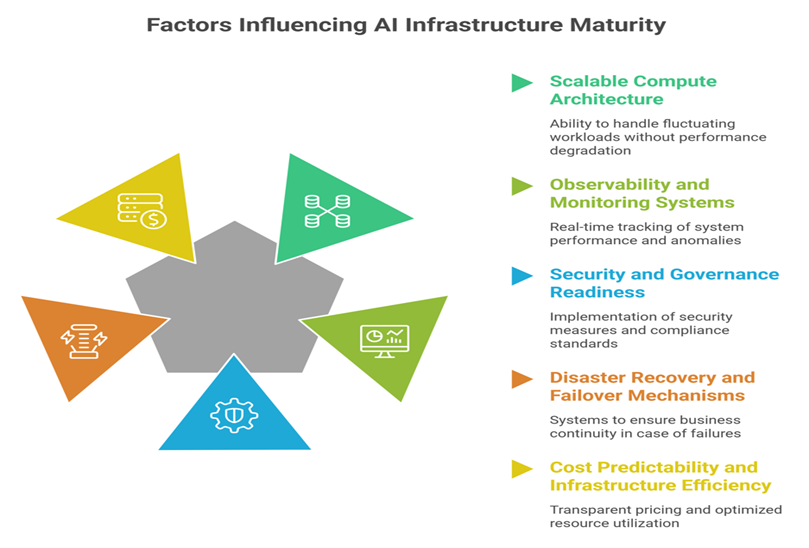
Key Indicators of AI Infrastructure Maturity
Technology leaders are increasingly adopting structured vendor evaluation models to assess operational readiness. Several indicators are emerging as essential benchmarks during AI supplier selection processes.
- Scalable Compute Architecture
AI vendors must demonstrate the ability to support fluctuating enterprise workloads without degrading performance. Mature providers typically maintain elastic GPU provisioning systems, optimized workload balancing, and distributed compute frameworks capable of supporting large-scale inference operations.
- Observability and Monitoring Systems
Infrastructure maturity includes deep observability capabilities that enable organizations to monitor latency, throughput, resource utilization, and system anomalies in real time. Enterprises now prioritize vendors offering advanced telemetry dashboards and automated alert systems.
- Security and Governance Readiness
As AI systems process increasingly sensitive data, infrastructure governance has become a board-level concern. Mature AI vendors implement zero-trust architectures, encryption standards, identity access controls, and secure model deployment pipelines.
- Disaster Recovery and Failover Mechanisms
Operational resilience requires vendors to maintain automated backup systems, geographic redundancy, and rapid failover capabilities. Procurement teams are placing increased emphasis on recovery time objectives and incident response transparency.
- Cost Predictability and Infrastructure Efficiency
Uncontrolled infrastructure costs remain a major challenge in enterprise AI deployments. Mature vendors provide transparent compute consumption reporting, workload optimization tools, and scalable pricing frameworks that reduce financial unpredictability.
Operational Risk Management Is Reshaping Enterprise AI Procurement
Enterprises are moving beyond experimentation phases and demanding measurable operational accountability from AI vendors. Procurement leaders increasingly seek evidence that suppliers can maintain stable production environments under enterprise-scale pressure.
Research insights from Orion Market Research indicate that operational risk management is becoming one of the fastest-growing decision factors influencing AI RFP outcomes. Vendor selection committees now include cross-functional stakeholders from cybersecurity, infrastructure operations, legal compliance, finance, and enterprise architecture teams.
This shift reflects a broader industry realization that AI transformation requires operational engineering excellence alongside algorithmic innovation.
Building Smarter AI RFP Frameworks
Organizations aiming to reduce implementation risk are redesigning their AI procurement strategies around infrastructure validation. Modern RFP frameworks increasingly include:
- Infrastructure stress-testing requirements
- SLA guarantees for inference performance
- Compliance reporting obligations
- Data residency specifications
- GPU utilization transparency
- Downtime accountability metrics
- Infrastructure audit readiness
- Vendor DevOps maturity assessments
- Model lifecycle governance standards
These additions help enterprises distinguish between AI vendors focused on scalable enterprise delivery and those driven primarily by market hype.
The Competitive Advantage of Infrastructure Transparency
AI vendors that openly demonstrate infrastructure maturity are gaining stronger enterprise trust. Transparent architecture documentation, operational metrics visibility, and compliance certifications now play a major role in accelerating enterprise deal cycles.
Technology buyers increasingly prefer vendors capable of providing:
- Detailed architecture roadmaps
- Infrastructure reliability benchmarks
- Independent security certifications
- Real-time service status visibility
- Transparent uptime performance reporting
- Responsible AI governance frameworks
This transparency strengthens procurement confidence and reduces enterprise onboarding friction.
Continues Supporting Enterprise AI Decision-Making
As the global AI platform ecosystem expands, enterprises require deeper intelligence into vendor operational capabilities, infrastructure readiness, and long-term scalability potential. Orion Market Research continues to provide market intelligence, procurement insights, competitive benchmarking, and strategic analysis that help organizations navigate rapidly evolving AI infrastructure landscapes.
Through extensive research across AI platforms, cloud ecosystems, enterprise automation technologies, and intelligent infrastructure markets, Orion Market Research supports businesses in building more resilient and future-ready procurement strategies.
Conclusion
The future of enterprise AI procurement will be defined not only by algorithmic sophistication but by infrastructure reliability, operational resilience, and scalable deployment readiness. As organizations invest more aggressively in AI transformation, infrastructure maturity is becoming a decisive factor in reducing operational risk and ensuring sustainable performance. Enterprises that integrate infrastructure-focused evaluation criteria into their AI RFP frameworks will be better positioned to identify trustworthy vendors, avoid costly deployment failures, and achieve long-term strategic value from AI investments.