5 Ways the Conversational AI Market Will Shape BFSI in 2026
Conversational AI industry was valued at $14.7 billion in 2025 and is projected to reach $132.0 billion by 2035, growing at a CAGR of 24.2% during 2026-2035. Conversational AI is rapidly becoming part of daily operations across banking, financial services, and insurance (BFSI).
Executives are always under constant pressure to control costs, respond faster, and maintain consistent customer experience across all digital channels. Conversational systems built on artificial intelligence (AI) and natural language processing (NLP) support those goals.
From an industry standpoint, BFSI remains one of the most disciplined adopters of conversational technologies.
Access a sample industry outlook here: https://www.omrglobal.com/request-sample/conversational-ai-market
Why BFSI Matters to the Conversational AI Market
BFSI institutions deal with high volumes of routine customer interactions every day. Balance checks, service requests, policy queries, and compliance-related questions follow predictable patterns, making them suitable for chatbots, virtual agents, and voice assistants.
Unlike consumer-facing industries, BFSI adoption is usually tied to clear efficiency metrics. Industry observers often note that intelligent virtual assistant (IVA) deployments deliver stronger results when they are connected to core banking and insurance systems, rather than operating in isolation.
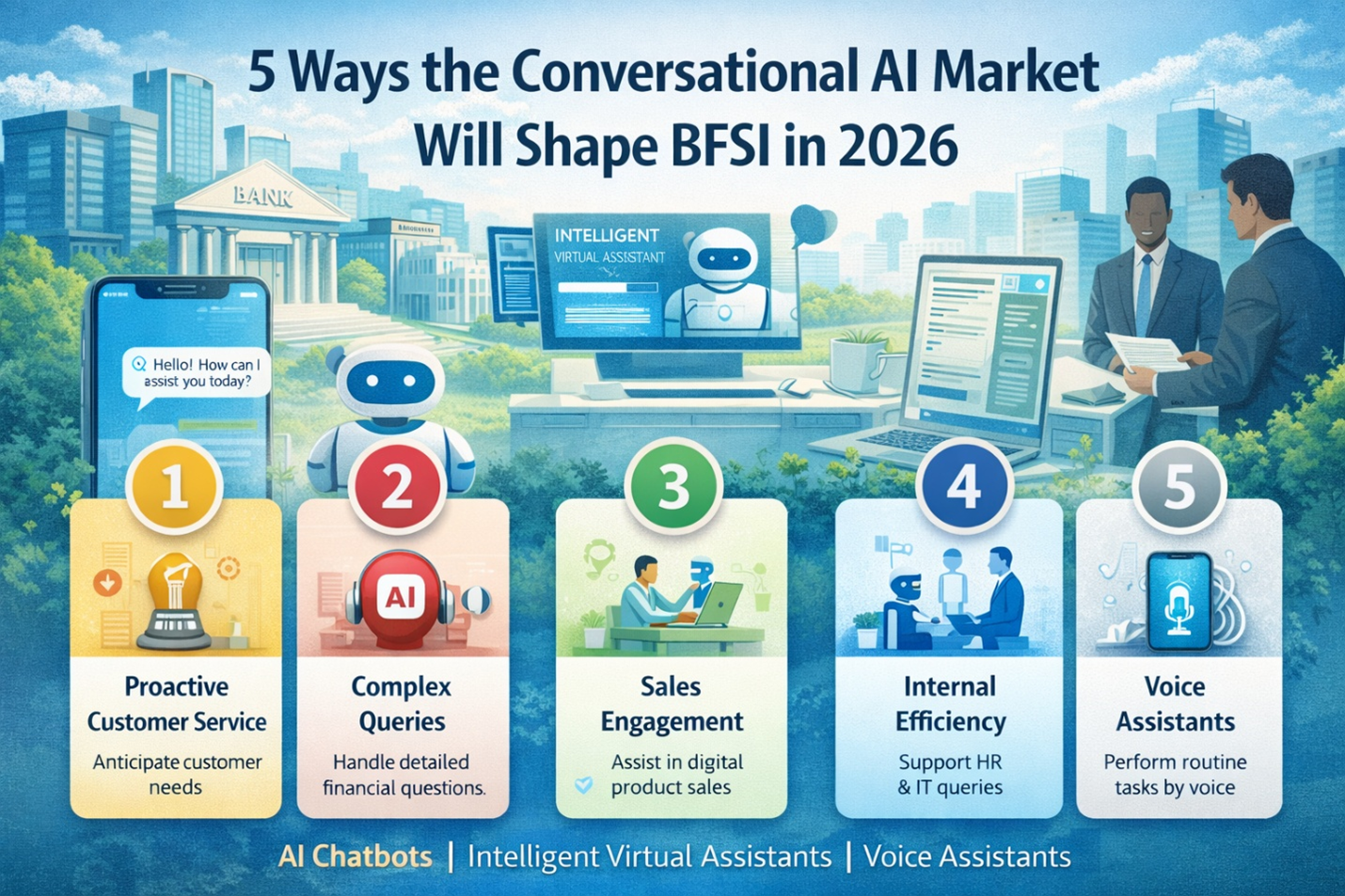
- Customer Service Will Become More Proactive
Customer service in BFSI is moving away from purely reactive models. By 2026, conversational platforms will increasingly anticipate customer needs based on transaction behavior and account activity.
Typical examples include:
- Alerts for unusual spending patterns
- Timely reminders linked to loan or policy milestones
- Service prompts based on recent account activity
This approach improves customer experience while reducing inbound service volume. For institutions, it helps balance service quality with operational efficiency.
- Intelligent Virtual Assistants Will Handle Broader Queries
Early chatbots were limited to scripted responses. That limitation is fading. Intelligent virtual assistants are now being designed to manage more detailed and context-driven conversations.
In BFSI, this includes:
- Explaining recent transactions or fees
- Guiding customers through claims or service requests
- Supporting basic dispute handling
As NLP capabilities improve, IVAs will rely less on handoffs to human agents. This leads to faster resolution and more consistent service outcomes.
- Conversational AI Market Will Influence BFSI Sales Engagement
Sales interactions in BFSI are becoming more conversational and less transactional. Customers increasingly prefer digital guidance over branch visits or long call queues.
Conversational platforms are being used to:
- Help customers compare financial products
- Pre-screen eligibility for loans or insurance
- Identify cross-selling opportunities based on usage patterns
Rather than replacing relationship managers, these tools act as filters, ensuring that human teams focus on higher-intent conversations.
- Internal Teams Will See Practical Efficiency Gains
The impact of conversational tools extends beyond customer-facing use cases. Many BFSI institutions are deploying virtual agents internally to support employees.
Common internal applications include:
- HR policy and payroll queries
- IT support requests
- Compliance and process-related guidance
From an operational view, this reduces pressure on shared service teams and shortens response times across departments.
- Voice Assistants Will Find Specific BFSI Use Cases
Text-based chat still dominates, but voice assistants are gaining traction in select BFSI scenarios. As speech recognition improves, voice interactions are becoming more reliable for routine tasks.
Emerging use cases include:
- Voice-based balance inquiries
- Payment confirmations
- Secure authentication steps
Industry logic suggests that voice adoption will grow fastest in mobile-first markets and regions with limited branch access.
Governance and Compliance Will Guide Adoption Pace
BFSI adoption always comes with regulatory expectations. Data security, audit trails, and transparency remain critical considerations.
Institutions are focusing on:
- Controlled deployment environments
- Clear escalation paths to human agents
- Well-documented interaction logic
This cautious approach may slow rollout, but it supports long-term scalability and trust.
Outlook: Steady Growth with Clear Business Impact
The Conversational AI market within BFSI is expanding with a clear purpose. Growth is driven by cost optimization, service consistency, and scalable customer experience rather than experimentation.
By 2026, conversational platforms are likely to be embedded into everyday BFSI workflows, supporting both customer-facing and internal processes.
Conclusion: Long-Term Role of the Conversational AI Market in BFSI
The Conversational AI market is set to play a lasting role in shaping BFSI operations over the next few years. Intelligent virtual assistants, chatbots, and voice assistants are moving closer to the core of service delivery and decision support.
Success will depend less on technological sophistication and more on how well these tools align with business processes and regulatory expectations.
OMR Global continues to track real-world adoption trends, use cases, and market dynamics within the Conversational AI market, offering data-driven insights for stakeholders across BFSI and related industries.