Defining the Undefinable: Best Practices for Writing SLAs in Managed IT Services RFPs
Why SLA Clarity Has Become a Business-Critical Requirement
As enterprises continue accelerating cloud adoption, hybrid infrastructure management, cybersecurity modernization, and remote workforce enablement, managed IT service providers are playing a larger operational role than ever before. However, many organizations still struggle with one recurring issue during vendor selection and outsourcing engagements: poorly defined Service Level Agreements (SLAs) in Managed IT Services RFPs.
From uptime guarantees and response times to escalation protocols and cybersecurity incident management, vague SLA language often creates long-term operational risks, hidden costs, vendor disputes, and service delivery gaps. Industry analysts increasingly point out that organizations investing in structured SLA frameworks during the RFP stage achieve stronger governance, better vendor accountability, and higher IT service continuity. To address these challenges, Orion Market Research is highlighting emerging best practices that help procurement leaders, CIOs, IT sourcing teams, and enterprise decision-makers build more measurable, outcome-driven SLA structures within managed IT services RFPs.
The Growing Complexity of Managed IT Services Procurement
Modern IT outsourcing contracts now extend far beyond traditional helpdesk support. Today’s managed services environments often include:
- Multi-cloud infrastructure management
- Network monitoring and optimization
- Cybersecurity operations
- Data backup and disaster recovery
- Endpoint management
- AI-enabled IT operations
- DevOps support
- Compliance reporting
- Unified communications support
As service ecosystems become increasingly interconnected, businesses can no longer rely on generic SLA templates that fail to reflect operational realities. Instead, organizations require SLA frameworks aligned with business continuity goals, risk thresholds, scalability requirements, and digital transformation objectives.
This shift is driving demand for more specialized RFP outsourcing support services capable of translating business expectations into technically enforceable service agreements.
Key Challenges Organizations Face While Writing IT Service SLAs
Many organizations entering managed IT procurement initiatives encounter several recurring SLA-related obstacles:
- Undefined Performance Metrics
Organizations frequently use ambiguous terminology such as “high availability” or “rapid response” without assigning measurable thresholds.
- Misaligned Business Priorities
Critical systems often receive the same SLA weighting as non-essential services, leading to inefficient support prioritization.
- Incomplete Incident Escalation Structures
Without clearly defined escalation pathways, organizations experience slower resolution times during outages or cybersecurity incidents.
- Lack of Reporting Transparency
Many RFPs fail to specify reporting frequency, KPI visibility, compliance dashboards, or audit requirements.
- Limited Vendor Accountability
Weak penalty clauses and unclear remediation structures reduce service provider accountability.
These challenges demonstrate why SLA optimization has become a strategic procurement priority across the IT and telecom sector.
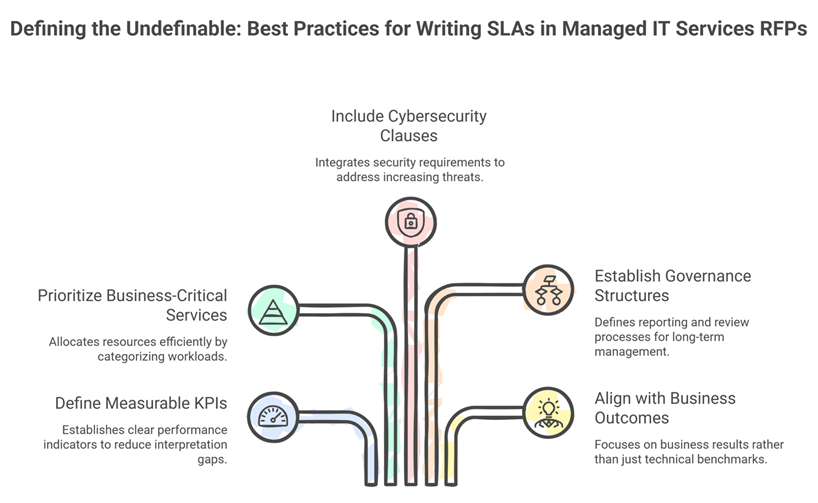
Best Practices for Writing Strong Managed IT Services SLAs
Industry experts recommend several practical approaches for developing stronger SLA frameworks during the RFP process.
- Define Measurable KPIs
Organizations should establish quantifiable performance indicators, including:
- System uptime percentages
- Mean Time to Resolution (MTTR)
- First response time
- Ticket resolution accuracy
- Security incident response time
- Backup recovery objectives
- Network latency thresholds
Clear metrics reduce interpretation gaps between buyers and vendors.
- Prioritize Business-Critical Services
Not all systems require identical SLA coverage. Enterprises should categorize workloads based on operational impact and define service tiers accordingly.
Examples include:
- Mission-critical infrastructure
- Customer-facing applications
- Internal collaboration systems
- Development environments
This improves cost optimization while maintaining operational resilience.
- Include Cybersecurity-Specific SLA Clauses
With cyber threats increasing globally, organizations are embedding security-focused requirements directly into managed IT services RFPs, including:
- Threat detection response times
- Vulnerability remediation windows
- Patch management timelines
- Security monitoring coverage
- Compliance reporting obligations
Security SLAs are now considered essential rather than optional.
- Establish Governance and Reporting Structures
Effective SLAs should define:
- Review meeting schedules
- Reporting formats
- Audit procedures
- Governance responsibilities
- Continuous improvement mechanisms
This strengthens long-term vendor relationship management.
- Align SLAs with Business Outcomes
Organizations increasingly prefer outcome-based SLAs instead of purely technical benchmarks. Examples include:
- Reduced downtime impact
- Improved employee productivity
- Faster customer support availability
- Enhanced digital experience reliability
Outcome-driven SLAs create stronger alignment between IT performance and business objectives.
Why Businesses Are Outsourcing RFP Development
As managed IT ecosystems become more specialized, enterprises are increasingly partnering with external research and procurement advisory firms to improve RFP quality and vendor evaluation accuracy.
Professional RFP outsourcing services help organizations:
- Develop structured SLA frameworks
- Improve vendor comparability
- Reduce procurement risks
- Accelerate sourcing timelines
- Increase contractual transparency
- Strengthen negotiation leverage
This trend is especially prominent among enterprises managing large-scale digital transformation projects, multi-vendor IT environments, and global infrastructure modernization programs.
The Future of SLA-Centric IT Procurement
As IT outsourcing models evolve, SLA structures are expected to become more dynamic, predictive, and analytics-driven. Future RFP frameworks may increasingly incorporate:
- AI-driven service monitoring metrics
- Predictive uptime analytics
- Experience-level agreements (XLAs)
- Real-time performance dashboards
- Automated compliance reporting
Organizations that modernize SLA development practices today will be better positioned to manage future infrastructure complexity, cybersecurity risks, and digital service expectations.
For enterprises planning managed IT services procurement initiatives, investing in strategic SLA optimization during the RFP stage can significantly improve operational efficiency, vendor performance, and long-term business continuity outcomes.