Drafting the Enterprise LLM RFP: 5 Non-Negotiable Latency and Throughput KPIs
Critical Performance Metrics Reshaping Enterprise Generative AI Procurement
As enterprises accelerate investments in Generative AI platforms, procurement leaders are facing a growing challenge: how to draft Request for Proposal (RFP) documents that accurately define Large Language Model (LLM) performance expectations. From customer support automation to AI-assisted analytics and enterprise search, organizations now require measurable latency and throughput benchmarks before onboarding AI vendors.
Orion Market Research emphasizes that modern enterprise AI procurement can no longer rely on vague performance claims such as “fast inference” or “scalable deployment.” Instead, enterprises must define precise Key Performance Indicators (KPIs) within Enterprise LLM RFPs to ensure predictable service delivery, infrastructure efficiency, and long-term ROI.
According to procurement specialists and AI sourcing consultants, poorly structured Generative AI RFPs often led to unexpected compute costs, unstable user experiences, API bottlenecks, and vendor performance disputes after deployment.
Why Latency and Throughput KPIs Matter in Enterprise LLM Procurement
Enterprise buyers evaluating Generative AI vendors must assess more than model accuracy. Operational performance metrics directly impact customer experience, productivity, compliance readiness, and infrastructure scalability.
In procurement environments, latency and throughput KPIs help organizations:
- Define acceptable AI response performance
- Benchmark vendors objectively
- Improve SLA enforceability
- Reduce deployment risks
- Optimize GPU infrastructure utilization
- Support high-volume enterprise workloads
- Enable scalable AI adoption strategies
For organizations outsourcing RFP development and technical procurement documentation, KPI standardization has become essential for achieving procurement transparency and vendor accountability.
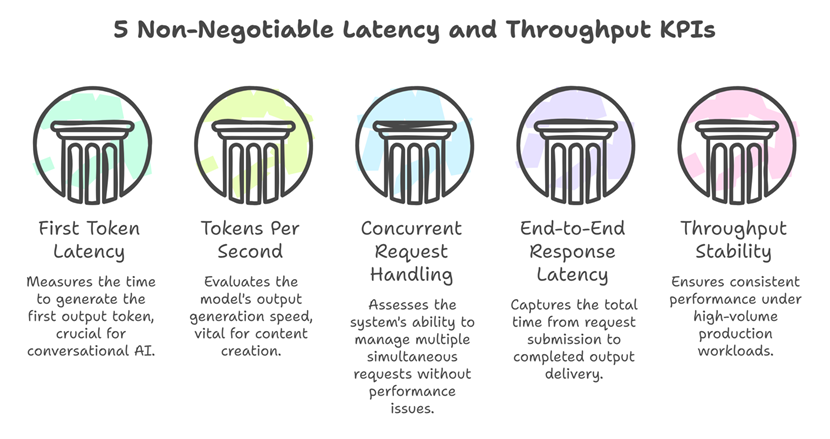
5 Non-Negotiable Latency and Throughput KPIs for Enterprise LLM RFPs
- First Token Latency (FTL)
First Token Latency measures the time between a user request and the generation of the first output token. This KPI is especially important in conversational AI, virtual assistants, and customer-facing applications where response perception directly affects user satisfaction.
Enterprise RFPs should clearly specify:
- Maximum acceptable FTL thresholds
- Performance expectations under peak load
- Regional latency requirements
- GPU utilization assumptions
Organizations drafting enterprise-grade Generative AI RFPs increasingly demand sub-second first token response benchmarks for real-time applications.
- Tokens Per Second (TPS)
Tokens Per Second evaluates the model’s output generation speed. High TPS is critical for applications involving:
- Long-form content generation
- Automated reporting
- AI coding assistants
- Enterprise document summarization
- Workflow automation
A well-structured AI RFP should define:
- Minimum TPS guarantees
- Batch inference expectations
- Multi-user concurrency requirements
- Context window performance conditions
By incorporating TPS metrics into procurement documents, enterprises can better compare vendors offering different model architectures and infrastructure strategies.
- Concurrent Request Handling Capacity
Generative AI systems deployed at enterprise scale must support thousands of simultaneous requests without performance degradation.
Procurement teams should include:
- Peak concurrency benchmarks
- Queue handling policies
- Traffic burst tolerance
- Auto-scaling expectations
- Horizontal scaling capabilities
Without concurrency KPIs, organizations risk infrastructure bottlenecks during production rollout.
- End-to-End Response Latency
End-to-End Latency measures the total response time from request submission to completed output delivery. This KPI captures:
- Network delays
- Inference processing
- Middleware performance
- API gateway overhead
- Streaming completion time
Enterprise AI sourcing documents should establish:
- Median latency thresholds
- P95 and P99 latency requirements
- Geographic deployment conditions
- Performance testing methodologies
This metric is increasingly becoming a mandatory procurement requirement in regulated and customer-facing industries.
- Throughput Stability Under Load
Many vendors demonstrate strong AI performance in low-volume test environments but fail to maintain stability during enterprise-scale deployment.
RFPs should therefore require:
- Sustained throughput guarantees
- Load testing documentation
- GPU resource allocation details
- Infrastructure redundancy disclosures
- Performance degradation thresholds
This KPI helps enterprises identify vendors capable of supporting long-term production workloads without unpredictable slowdowns.
The Growing Need for Specialized AI RFP Drafting Services
As enterprise AI procurement becomes more technical, organizations are increasingly outsourcing RFP development to specialized research and procurement support firms.
Orion Market Research Generative AI Research Solutions supports enterprises by developing:
- Enterprise LLM RFP frameworks
- AI vendor evaluation matrices
- SLA-driven procurement templates
- KPI benchmarking models
- Technical sourcing documentation
- Vendor capability assessment criteria
These services help procurement leaders translate complex AI infrastructure requirements into structured, vendor-comparable RFP documentation.
Best Practices for Writing Enterprise AI Procurement Documents
Industry experts recommend the following practices when drafting Generative AI RFPs:
- Define Measurable SLAs
Avoid ambiguous language. Use quantifiable latency and throughput metrics aligned with operational goals.
- Include Load Testing Requirements
Request third-party benchmarking reports and real-world inference testing data.
- Standardize Evaluation Criteria
Use weighted scoring models to compare AI vendors consistently.
- Specify Infrastructure Assumptions
Clarify whether performance expectations apply to:
- Dedicated GPU environments
- Shared cloud infrastructure
- On-premise deployments
- Hybrid AI architectures
- Require Scalability Evidence
Demand proof of enterprise deployment success under high-volume production environments.
Enterprise AI Procurement Is Becoming KPI-Driven
As organizations scale Generative AI adoption, procurement teams are under pressure to ensure performance reliability before vendor onboarding. Latency and throughput KPIs are now foundational components of enterprise AI sourcing strategies.
Companies that fail to define measurable AI performance standards during the RFP phase often face:
- Cost overruns
- SLA disputes
- User dissatisfaction
- Infrastructure instability
- Deployment delays
Conversely, organizations using KPI-driven procurement frameworks are better positioned to achieve scalable, reliable, and compliant AI deployments.