Ingestible Sensors Market to Reach $2.17 Billion by 2035 Driven by AI Integration
Ingestible sensors market was valued at $987.3 million in 2024 and is projected to reach $2,174.8 million by 2035, growing at a CAGR of 8.3% during the forecast period (2026-2035).The ingestible sensors market is gaining momentum due to rising demand for non-invasive diagnostics, real-time patient monitoring, improved medication adherence, and the growing shift toward personalized and remote healthcare. Among these drivers, artificial intelligence (AI) integration stands out as the strongest growth catalyst, as it transforms ingestible sensors from passive data-collecting devices into intelligent systems capable of real-time analysis, predictive insights, and clinically actionable decision support.
Browse the full report description of “Ingestible Sensors Market Size, Share & Trends Analysis Report by Sensor Type (Temperature Sensor, Pressure Sensor, pH Sensor, and Image Sensor) and by Application (Medical, Sports & Fitness, and Others), Forecast Period (2026-2035)” at https://www.omrglobal.com/industry-reports/ingestible-sensors-market
The Digital pills contain integrated sensors that allow monitoring of the course of pharmacotherapy through an interaction with the software of, e.g., tablets and smartphones.
And as per the National Center for Biotechnology Information Digital pills improve treatment adherence and efficiency in the field of mental health and behavioral modifications, such as schizophrenia, bipolar I disorder, attention deficit and hyperactivity disorder, drug abuse, smoking, pain, insomnia, and many others. And integration of AI is further advancing this technology. As, these “Smart Pills” go beyond simple data collection; they analyze information in real-time within the gastrointestinal (GI) tract to deliver predictive health insights, enabling earlier interventions and personalized treatment strategies.
Earlier, sensors had to stream raw data to a phone or the cloud for processing, which drained batteries and caused lag. But "Edge AI" now allows the smart pill to process information locally on its own microchip. And due to this now sensor can instantly decide to take a high-resolution photo or increase gas-sensing frequency only when it detects a "red flag" (like a spike in ammonia or a specific pH drop).
Apart from this Convolutional Neural Networks (CNNs) are AI systems trained on millions of medical images to recognize the "visual fingerprints" of diseases—such as the specific color of an ulcer or the shape of a polyp—that a human might miss due to fatigue. A leading real-world example is AnX Robotica’s NaviCam ProScan, which uses this AI to scan through the thousands of images captured by a "pill camera." Instead of a doctor spending nearly an hour watching a video of healthy tissue, the AI instantly highlights only the suspicious areas.
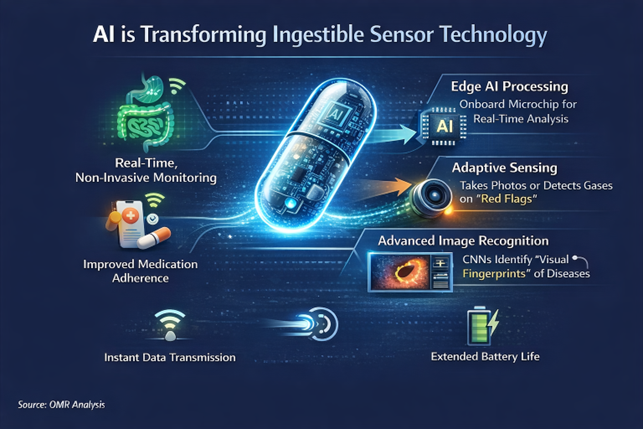
Collectively, AI is fundamentally changing the landscape of ingestible sensor technology, transforming smart pills from passive data collectors into intelligent, decision-making diagnostic tools. By enabling real-time edge processing, adaptive sensing, and advanced image recognition, AI significantly improves diagnostic accuracy, reduces data overload, and enhances clinical efficiency.
Key Product Launches in the Ingestible Sensor Market
- In May?2025, Imec, showcased a highly miniaturized ingestible sensor prototype for gut health monitoring at the ITF World 2025 event. The sensor—only 1?cm long and 0.75?cm wide—provides real?time measurements of redox balance, pH, and temperature throughout the gastrointestinal tract.
- In June?2025, Atmo Biosciences announced that it has received 510(k) clearance from the U.S. Food and Drug Administration (FDA) for its Atmo Gas Capsule System. This ingestible capsule measures regional and whole?gut transit times and is designed to help healthcare providers diagnose gut motility disorders (such as gastroparesis and slow transit constipation) without radiation or cumbersome procedures.
Market Coverage
- The market number available for – 2025-2035
- Base year- 2025
- Forecast period- 2026-2035
- Segment Covered-
- Sensor Type
- Application
- Competitive Landscape – CapsoVision, Inc., Koninklijke Philips N.V. (Philips Healthcare), Medtronic plc, Olympus Corp. and Proteus Digital Health, Inc.
Key questions addressed by the report.
- What is the market growth rate?
- Which segment and region dominate the market in the base year?
- Which segment and region will project the fastest growth in the market?
- Who is the leader in the market?
- How are players addressing challenges to sustain growth?
- Where is the investment opportunity?
Global Ingestible Sensor Market Report Segment
By Sensor Type
- Temperature Sensor
- Pressure Sensor
- pH Sensor
- Image Sensor
By Application
- Medical
- Sports & Fitness
- Others
Global Ingestible Sensor Market Report Segment by Region
North America
- United States
- Canada
Europe
- UK
- Germany
- Italy
- Spain
- France
- Russia
- Rest of Europe
Asia-Pacific
- China
- India
- Japan
- South Korea
- Australia and New Zealand
- ASEAN Economies
- Rest of Asia-Pacific
Rest of the World
- Latin America
- Middle East & Africa
To learn more about this report request a sample copy @ https://www.omrglobal.com/request-sample/ingestible-sensors-market