GPU Scarcity and Procurement: Strategies for Securing AI Compute Capacity
The Global AI Compute Bottleneck Is Reshaping Enterprise Procurement
The rapid acceleration of artificial intelligence adoption has created unprecedented demand for high-performance GPU infrastructure. From large language models and generative AI systems to enterprise automation and predictive analytics, organizations across industries are competing for limited compute resources. As a result, GPU scarcity has emerged as one of the most critical operational and strategic challenges in the AI ecosystem.
Data centers, hyperscalers, cloud providers, and enterprise technology leaders are increasingly facing procurement delays, inflated infrastructure costs, and constrained deployment timelines. For organizations investing heavily in AI transformation, securing reliable compute capacity is no longer an IT concern alone; it has become a board-level procurement priority.
According to insights from Orion Market Research, enterprises that fail to establish resilient GPU sourcing strategies risk delayed AI rollouts, reduced innovation velocity, and long-term competitive disadvantages in rapidly evolving markets.
Why GPU Scarcity Has Become a Major Enterprise Risk
The AI boom has significantly disrupted traditional semiconductor supply-demand cycles. Advanced GPUs used for AI training and inference require specialized manufacturing capabilities, high-bandwidth memory integration, and sophisticated packaging technologies. Simultaneously, demand from sectors such as healthcare, finance, autonomous mobility, cybersecurity, retail, and telecommunications continues to surge.
Several interconnected factors are driving ongoing GPU shortages:
- Explosive enterprise adoption of generative AI applications
- Increasing training requirements for foundation models
- Global semiconductor supply chain vulnerabilities
- Export controls and geopolitical trade restrictions
- Long lead times for advanced AI accelerators
- Power and cooling constraints in modern data centers
For procurement teams managing AI initiatives, these constraints create substantial operational uncertainty. Organizations dependent on reactive purchasing strategies often encounter project delays, unpredictable pricing structures, and limited vendor availability.
The Shift From Hardware Procurement to AI Capacity Strategy
Traditional procurement frameworks focused primarily on hardware acquisition. However, AI infrastructure sourcing now requires a broader capacity-planning approach that incorporates scalability, energy efficiency, deployment flexibility, and long-term availability.
Forward-looking enterprises are increasingly adopting multi-dimensional procurement strategies that include:
Multi-Cloud GPU Diversification
Relying on a single hyperscaler can expose organizations to pricing volatility and regional availability limitations. Enterprises are now diversifying GPU workloads across multiple cloud providers to improve resilience and workload portability.
This strategy helps organizations:
- Reduce dependency risks
- Improve negotiating leverage
- Enhance regional compute accessibility
- Optimize workload-specific infrastructure allocation
Hybrid Infrastructure Models
Many organizations are combining on-premise GPU clusters with cloud-based burst capacity to achieve operational flexibility. Hybrid deployment models allow enterprises to maintain baseline compute availability while scaling dynamically during peak AI training cycles.
This model is especially valuable for:
- Financial institutions
- Healthcare analytics providers
- Manufacturing AI platforms
- Large-scale enterprise automation projects
Long-Term GPU Reservation Agreements Are Becoming Essential
As AI infrastructure markets tighten, enterprises are increasingly shifting toward long-term reservation contracts with cloud and colocation providers. These agreements provide guaranteed access to compute capacity over extended periods and reduce exposure to spot-market volatility.
Key benefits include:
- Predictable infrastructure costs
- Priority allocation during shortages
- Improved deployment planning
- Enhanced supply continuity
Organizations that negotiate long-term GPU commitments early are often better positioned to scale AI operations without disruption.
Industry analysts at Orion Market Research observe that proactive reservation strategies are rapidly becoming a competitive differentiator in enterprise AI procurement.
The Rising Importance of AI Infrastructure RFIs and RFPs
GPU scarcity has also transformed enterprise procurement documentation. Traditional infrastructure RFPs are no longer sufficient for evaluating AI compute vendors effectively.
Modern AI procurement teams now prioritize:
- GPU allocation guarantees
- Scalability commitments
- Cluster orchestration capabilities
- Energy efficiency benchmarks
- Latency and throughput performance
- Regional availability transparency
- Supply chain resilience frameworks
- Cooling and power redundancy metrics
Well-structured AI infrastructure RFIs and RFPs enable organizations to identify vendors capable of supporting long-term AI growth rather than short-term hardware delivery alone.
This shift is driving increased demand for specialized market intelligence and procurement advisory services that help enterprises assess vendor maturity, infrastructure readiness, and operational scalability.
Colocation Providers Are Emerging as Strategic AI Partners
The growing pressure on hyperscale cloud availability has elevated the role of colocation and AI-focused data center providers. Many enterprises are now leveraging colocation facilities to deploy dedicated GPU clusters closer to operational workloads.
Advantages of colocation-based AI infrastructure include:
- Greater infrastructure control
- Reduced latency
- Customizable power density
- Dedicated cooling optimization
- Improved compliance management
- Flexible hardware deployment strategies
As AI models become increasingly compute-intensive, colocation ecosystems are expected to play a larger role in enterprise AI scalability planning.
Energy Efficiency and Sustainability Are Influencing Procurement Decisions
GPU-intensive workloads consume substantial amounts of electricity, making energy optimization a critical procurement consideration. Organizations are increasingly evaluating vendors based on:
- Power Usage Effectiveness (PUE)
- Renewable energy integration
- Cooling innovation
- Carbon reduction commitments
- Sustainable infrastructure roadmaps
AI infrastructure procurement is no longer solely about compute performance. Sustainability metrics now influence investment decisions, vendor selection, and long-term operational planning.
Research insights from Orion Market Research indicate that environmentally optimized AI data centers are gaining stronger enterprise preference across global markets.
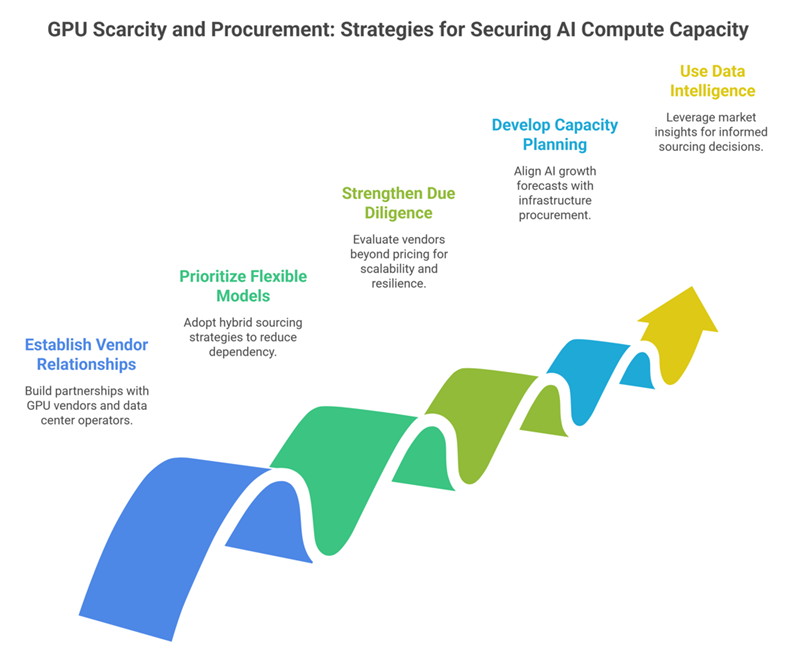
Best Practices for Enterprises Navigating GPU Procurement Challenges
Organizations seeking to secure long-term AI compute capacity should consider the following strategic actions:
- Establish Early Vendor Relationships
Building partnerships with GPU vendors, hyperscalers, and data center operators before demand spikes can improve access to future allocations.
- Prioritize Flexible Procurement Models
Hybrid sourcing strategies reduce dependency on single infrastructure providers and improve operational agility.
- Strengthen AI Infrastructure Due Diligence
Procurement teams should evaluate vendors beyond pricing by assessing scalability, resilience, energy efficiency, and supply chain stability.
- Develop Forecast-Based Capacity Planning
Enterprises that align AI growth forecasts with infrastructure procurement cycles are better positioned to avoid deployment disruptions.
- Use Data-Driven Procurement Intelligence
Market intelligence, benchmarking insights, and infrastructure trend analysis help organizations make more informed AI sourcing decisions.
Conclusion
GPU scarcity is redefining enterprise AI infrastructure strategy. Organizations that continue relying on traditional procurement approaches may struggle to secure the computing capacity necessary for sustainable AI growth. As competition for advanced AI infrastructure intensifies, enterprises must adopt proactive sourcing models, strengthen vendor evaluation frameworks, and integrate long-term capacity planning into procurement operations.
Businesses that successfully align AI strategy with infrastructure resilience will be better equipped to scale innovation, optimize operational efficiency, and maintain competitive advantage in the evolving AI economy.