Multi-Cloud Spending Is Rising Faster Than Optimization Strategies Can Keep Up
Enterprises Are Expanding Across Clouds Faster Than They Can Control Costs
The rapid acceleration of enterprise digital transformation is driving organizations toward multi-cloud ecosystems at an unprecedented pace. Businesses are increasingly adopting combinations of public cloud, private cloud, hybrid infrastructure, and edge computing environments to improve scalability, resilience, and application performance. However, while cloud adoption continues to rise, optimization strategies are failing to mature at the same speed.
Industry leaders are now facing a growing imbalance between cloud investment and operational efficiency. Multi-cloud spending is increasing across sectors, including BFSI, healthcare, manufacturing, retail, telecom, and government services, yet many enterprises still lack unified visibility into infrastructure utilization, workload distribution, cost governance, and cloud performance benchmarking.
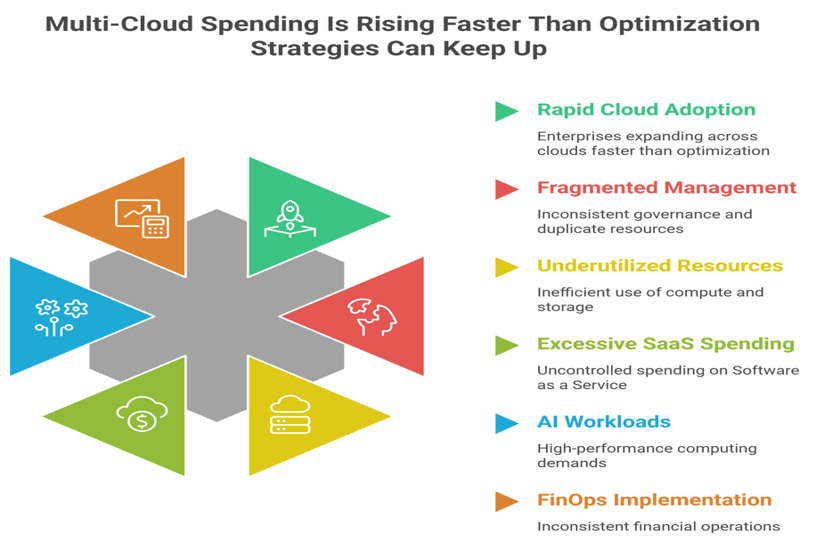
According to market intelligence observations, organizations are struggling with fragmented cloud management frameworks, inconsistent governance policies, duplicate resource provisioning, and unpredictable operational expenditures. As enterprises scale workloads across multiple providers, the complexity of maintaining cost-efficient architectures is becoming a significant strategic challenge.
Multi-Cloud Complexity Is Creating a New Layer of Financial Risk
Enterprises initially embraced multi-cloud strategies to avoid vendor lock-in, improve business continuity, and increase workload flexibility. However, the operational realities of managing distributed cloud environments are exposing major inefficiencies.
Many organizations are now dealing with:
- Underutilized compute resources
- Inefficient data transfer routing
- Rising storage redundancy costs
- Poor workload orchestration visibility
- Excessive SaaS integration spending
- Shadow IT expansion across departments
- Unoptimized Kubernetes and container deployments
- Inconsistent FinOps implementation
As cloud ecosystems expand, enterprises are discovering that infrastructure scalability without optimization discipline can rapidly increase operational complexity. CIOs and cloud transformation leaders are now under pressure to justify escalating cloud expenditures while maintaining performance reliability and compliance readiness.
This trend is increasing demand for deeper market intelligence related to cloud cost optimization platforms, cloud governance frameworks, AI-driven infrastructure monitoring, and next-generation FinOps strategies.
Optimization Is Becoming More Important Than Cloud Adoption Itself
The market is shifting from “cloud-first” strategies toward “cloud-efficient” strategies. Organizations are beginning to realize that simply expanding cloud presence no longer guarantees agility or competitive advantage.
Instead, enterprises are prioritizing:
- Real-time cloud cost visibility
- Intelligent workload placement
- AI-enabled infrastructure monitoring
- Automated resource scaling
- Cloud-native observability tools
- Multi-cloud security governance
- Sustainable cloud utilization practices
- Predictive infrastructure analytics
Businesses that fail to optimize their cloud environments risk long-term budget inflation, delayed transformation outcomes, and reduced operational agility.
This evolving landscape is encouraging enterprises to seek strategic research and market forecasting support to better understand infrastructure trends, vendor ecosystems, pricing models, and optimization opportunities before committing to large-scale cloud investments.
AI and Data-Intensive Workloads Are Accelerating Cloud Spending Pressure
The rise of AI adoption, machine learning workloads, generative AI applications, and large-scale data processing is further intensifying multi-cloud spending challenges. AI infrastructure requires high-performance computing, advanced storage architectures, low-latency networking, and scalable GPU environments, all of which significantly increase cloud expenditure if not managed efficiently.
Organizations deploying AI across fragmented cloud ecosystems are encountering difficulties in balancing performance requirements with cost optimization objectives. This is creating a stronger demand for cloud infrastructure intelligence capable of identifying scalable and financially sustainable deployment models.
Technology leaders are increasingly seeking data-backed insights into:
- GPU infrastructure allocation trends
- AI workload optimization strategies
- Cloud vendor pricing shifts
- Regional data center expansion
- Hybrid cloud adoption patterns
- Edge-cloud integration opportunities
- Cloud sustainability benchmarks
As AI-driven digital transformation expands globally, optimization strategies are becoming essential for maintaining long-term infrastructure efficiency.
Cloud Governance and FinOps Are Emerging as Strategic Priorities
The growing complexity of multi-cloud operations is driving a stronger enterprise focus on FinOps and cloud governance frameworks. Organizations are investing in cross-functional governance models that align finance, procurement, operations, and engineering teams to improve infrastructure accountability.
FinOps practices are helping enterprises improve:
- Budget forecasting accuracy
- Resource allocation efficiency
- Cost anomaly detection
- Vendor contract optimization
- Cloud utilization transparency
- Infrastructure ROI measurement
However, many enterprises are still in the early stages of FinOps maturity. This gap is increasing the importance of market intelligence providers capable of delivering actionable insights into cloud optimization technologies, competitive benchmarking, and infrastructure investment trends.
Why Market Intelligence Is Becoming Essential for Cloud Transformation Decisions
As multi-cloud ecosystems continue evolving, enterprises require more than internal operational dashboards. They need external intelligence capable of identifying broader infrastructure trends, emerging technologies, competitive positioning, and future optimization opportunities.
Strategic market intelligence enables organizations to:
- Evaluate evolving cloud vendor landscapes
- Identify optimization investment priorities
- Understand industry-specific cloud adoption trends
- Benchmark operational efficiency against competitors
- Forecast future infrastructure spending patterns
- Assess AI-driven cloud transformation opportunities
Businesses that integrate market intelligence into their cloud transformation strategies are better positioned to make scalable, cost-efficient, and future-ready infrastructure decisions.
Supporting Smarter Cloud Infrastructure Planning
Orion Market Research delivers comprehensive market intelligence and strategic research solutions that help enterprises understand evolving cloud infrastructure trends, multi-cloud optimization opportunities, AI infrastructure demand patterns, and emerging FinOps strategies.
By analyzing technology adoption trends, competitive landscapes, investment flows, and infrastructure innovation, Orion Market Research supports organizations in building more informed cloud transformation roadmaps aligned with operational efficiency and long-term scalability goals.
Conclusion
Multi-cloud adoption is no longer the primary challenge for enterprises as optimization has become the defining factor of successful cloud transformation. As cloud ecosystems grow increasingly complex and AI workloads continue driving infrastructure expansion, organizations that fail to implement effective optimization strategies risk escalating operational costs and reduced business agility. Enterprises are now recognizing the importance of combining cloud modernization initiatives with data-driven market intelligence to achieve sustainable growth, infrastructure efficiency, and competitive advantage in an increasingly digital economy.