Performance-Based Contracting in Energy: Translating Grid Requirements into Watertight RFPs
As Global Energy Systems Modernize, Procurement Accuracy Has Become a Strategic Priority
The transition toward decentralized power generation, renewable integration, smart grid technologies, and energy storage systems has transformed how utilities and energy operators approach procurement. Across the global energy and power sector, organizations are increasingly adopting performance-based contracting models to ensure suppliers deliver measurable operational outcomes rather than simply meeting technical delivery milestones.
Industry experts at Orion Market Research highlight that poorly structured Requests for Proposals (RFPs) continue to create major implementation risks in energy infrastructure projects. Ambiguous performance indicators, inconsistent grid compliance terminology, and unclear service-level expectations often lead to disputes, delays, cost escalations, and underperforming assets.
As utilities expand investments in grid modernization, transmission upgrades, renewable integration, battery storage, and digital energy infrastructure, the demand for watertight RFP frameworks has accelerated significantly.
Why Performance-Based Contracting Is Becoming Essential in Energy Procurement
Traditional procurement models in the energy industry primarily focused on equipment delivery and installation costs. However, modern utilities now require vendors to demonstrate long-term operational efficiency, reliability, uptime guarantees, cybersecurity resilience, emissions performance, and grid stability support.
Performance-based contracting aligns supplier accountability with measurable business and operational outcomes, such as:
- Grid reliability improvement
- Renewable integration efficiency
- Reduced transmission losses
- Demand response optimization
- Asset uptime guarantees
- Energy efficiency benchmarks
- Regulatory compliance adherence
- Lifecycle cost reduction
- Predictive maintenance performance
This shift requires procurement teams to create highly structured RFPs capable of translating technical grid requirements into quantifiable contractual obligations.
According to procurement specialists at Orion Market Research, organizations increasingly seek external RFP outsourcing expertise to strengthen bid evaluation frameworks, supplier comparability, and performance enforcement mechanisms.
The Growing Complexity of Energy Sector RFP Development
Modern energy procurement projects involve highly specialized technical requirements that cannot be addressed through generic sourcing documentation.
Utilities and energy developers must now account for:
- Grid interoperability standards
- Renewable intermittency challenges
- Power quality thresholds
- SCADA integration requirements
- Cybersecurity compliance
- Carbon reduction targets
- Grid balancing capabilities
- Storage efficiency ratios
- Smart metering compatibility
- Demand forecasting accuracy
Without clear performance definitions, suppliers may interpret technical expectations differently, resulting in inconsistent proposals that are difficult to evaluate objectively.
This has created a major need for standardized, engineering-focused RFP drafting strategies that reduce ambiguity while improving supplier accountability.
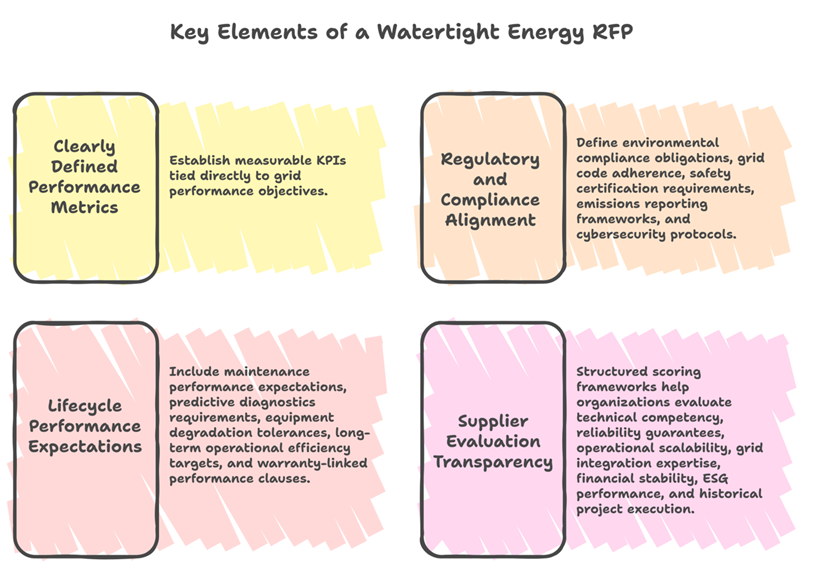
Key Elements of a Watertight Energy RFP
Energy engineering professionals increasingly emphasize that effective RFPs should combine operational precision with measurable performance accountability.
- Clearly Defined Performance Metrics
Effective RFPs establish measurable KPIs tied directly to grid performance objectives. Examples include:
- Transformer efficiency percentages
- Power availability thresholds
- Energy storage discharge efficiency
- System response times
- Renewable integration capacity
- Grid stabilization metrics
- Mean time between failures (MTBF)
When metrics are clearly quantified, procurement teams can compare supplier capabilities with greater consistency.
- Regulatory and Compliance Alignment
Energy projects must comply with evolving regional and international standards. Strong RFPs define:
- Environmental compliance obligations
- Grid code adherence
- Safety certification requirements
- Emissions reporting frameworks
- Cybersecurity protocols
Embedding compliance requirements into procurement documentation reduces future legal and operational risks.
- Lifecycle Performance Expectations
Modern energy contracts increasingly focus on long-term operational outcomes rather than short-term installation success.
High-quality RFPs should therefore include:
- Maintenance performance expectations
- Predictive diagnostics requirements
- Equipment degradation tolerances
- Long-term operational efficiency targets
- Warranty-linked performance clauses
- Supplier Evaluation Transparency
Supplier scoring methodologies must remain objective and technically defensible.
Structured scoring frameworks help organizations evaluate:
- Technical competency
- Reliability guarantees
- Operational scalability
- Grid integration expertise
- Financial stability
- ESG performance
- Historical project execution
Procurement leaders increasingly use weighted evaluation models to reduce subjectivity during vendor selection.
The Role of RFP Outsourcing in Energy Infrastructure Procurement
The growing complexity of energy procurement has led many organizations to outsource RFP development to specialized research and procurement advisory firms.
By leveraging external RFP expertise, energy companies can:
- Improve technical documentation quality
- Accelerate procurement timelines
- Enhance supplier response accuracy
- Reduce contractual ambiguity
- Strengthen bid evaluation consistency
- Improve project risk management
- Increase vendor accountability
At Orion Market Research, analysts and procurement specialists support organizations in developing performance-driven RFP frameworks tailored to utility modernization, renewable energy projects, transmission infrastructure, battery storage systems, and smart grid deployments.
Industry Collaboration Is Driving Better Procurement Standards
Energy engineering communities, procurement forums, and infrastructure discussion platforms are increasingly discussing the need for standardized performance-based procurement methodologies.
Guest contributions, technical whitepapers, procurement benchmarking studies, and industry collaboration initiatives continue to shape best practices for:
- Renewable energy sourcing
- Utility vendor evaluation
- Grid modernization procurement
- EPC contractor selection
- Battery storage acquisition
- Smart infrastructure contracting
As energy systems become more interconnected and performance-sensitive, procurement documentation quality is emerging as a critical competitive advantage.
Strengthening Procurement Outcomes Through Smarter RFP Strategy
The future of energy infrastructure procurement will depend heavily on an organization’s ability to define operational expectations with clarity, precision, and measurable accountability.
Performance-based contracting offers utilities and energy operators a practical pathway toward improved reliability, stronger supplier accountability, reduced lifecycle costs, and enhanced grid resilience.
However, these benefits can only be achieved when procurement documentation accurately translates engineering requirements into enforceable contractual frameworks.
To address these evolving challenges, organizations are increasingly partnering with experienced RFP outsourcing specialists such as Orion Market Research to design technically robust, evaluation-ready, and performance-focused procurement strategies that support long-term energy infrastructure success.