Pharmaceutical Contract Manufacturing Market Growth and Strategic Imperatives
The pharmaceutical contract manufacturing market is expanding rapidly. In 2024, the segment was valued at approximately USD 201 billion and is forecast to reach USD 549 billion by 2035 at a compound annual growth rate (CAGR) of 9.6%.
Key market dynamics include:
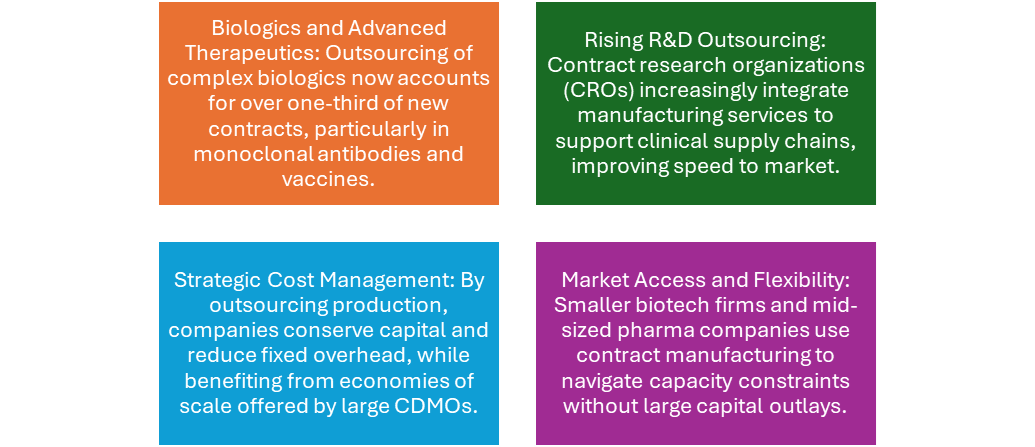
- Outsourcing for Cost Efficiency: Nearly 72% of pharmaceutical companies outsource manufacturing to CDMOs to reduce capital expenditure and focus on R&D.
- Biologics and Complex Drugs: Biologic therapies, biosimilars, and high-potency APIs are major sources of outsourcing growth due to their manufacturing complexity and regulatory demands.
- Global Demand Distribution: Asia-Pacific and North America lead outsourcing demand, with the former providing cost advantages and the latter driving innovation-intensive contracts.
Industry observers note that companies like AbbVie and Pfizer have significantly leveraged external manufacturing networks to scale production efficiently. By aligning with CMOs and CDMOs that specialize in certain drug types or modalities, these firms maintain agility in shifting market conditions.
Primary Growth Factors
Industry Challenges
Despite strong expansion, the market faces explicit challenges that influence strategic planning:
- Regulatory and Quality Compliance: Contract manufacturers must meet stringent FDA, EMA, and global GMP standards. Roughly 30–39% of outsourcing entities cite regulatory complexity as a key constraint that can delay approvals.
- Supply Chain Vulnerabilities: Raw material shortages, trade barriers, and reliance on limited suppliers complicate supply continuity, pushing firms to diversify sourcing.
- Capacity and Technology Integration: Integrating continuous manufacturing and automated quality systems requires both capital and specialized talent, which remains in short supply.
- Intellectual Property Protection: Ensuring secure handling proprietary processes is a paramount concern for innovators, especially in biotech and novel therapies.
In 2024, Thermo Fisher Scientific, a significant contract manufacturer, faced recurrent regulatory scrutiny at one of its key facilities, highlighting how quality control issues can escalate risk for client companies.
Addressing Cost, Supply Chain, and Quality Challenges
For pharmaceutical companies, CROs, CDMOs, and biotech firms, partnering with the right contract manufacturing experts can help mitigate core operational challenges:
- Cost Optimization: Outsourcing production and development workflows enables firms to convert fixed manufacturing costs into variable expenses, aligning costs with development milestones and market demand.
- Resilient Supply Chains: Strategic diversification of contract partners across geographies reduces risk exposure from regional disruptions and raw material constraints.
- Quality and Compliance Expertise: Leveraging established CDMOs with robust quality management systems ensures adherence to global standards, minimizing regulatory risk and accelerating product approvals.
By aligning with trusted manufacturing partners, companies can redirect internal investment toward innovation and market expansion rather than capital-intensive facility build-outs.
Conclusion
The pharmaceutical contract manufacturing market is evolving beyond simple outsourcing to become a strategic engine for growth, differentiation, and operational resilience. As global demand for complex therapies and biologics rises, effective partnerships with CMOs and CDMOs will be decisive for managing cost structures, navigating supply chain complexity, and meeting quality expectations. For decision-makers in pharma, biotechnology, and research organizations, understanding these dynamics is essential for competitive positioning in an increasingly interconnected ecosystem; how will your organization adapt its manufacturing strategy to harness these market forces?