Scaling Economics: How to Model Token Consumption in AI RFQs
Need for Financial Transparency in Enterprise AI Procurement
As enterprises accelerate investments in generative AI platforms, procurement leaders and CFOs are facing a critical challenge: accurately forecasting token consumption and controlling long-term operational costs in AI Requests for Quotation (RFQs). Orion Market Research has released new strategic insights explaining how organizations can build financially transparent AI RFQs that eliminate hidden consumption risks and improve vendor accountability.
The rapid adoption of large language models (LLMs), multimodal AI systems, and enterprise copilots has transformed AI procurement from a technology discussion into a financial governance issue. While many organizations focus on model performance and innovation, insufficient attention is being paid to token economics — the primary cost driver behind enterprise-scale AI deployments.
According to Orion Market Research, unclear token pricing structures, unpredictable inference usage, and inconsistent vendor reporting standards are creating major budgeting challenges for finance and procurement teams worldwide.
Why Token Consumption Modeling Matters in AI RFQs
Token-based pricing has become the default commercial structure across AI platforms. However, many enterprise RFQs still fail to define measurable consumption assumptions, resulting in unexpected operating expenses after deployment.
Without standardized token forecasting frameworks, enterprises risk:
- Underestimating total AI operational expenditure
- Selecting vendors with non-transparent pricing structures
- Experiencing budget overruns during scale expansion
- Facing difficulties in ROI measurement
- Encountering hidden costs linked to prompt engineering, retrieval augmentation, and API orchestration
Orion Market Research explains that token consumption modeling should now be treated as a core procurement requirement rather than a technical afterthought.
Key Financial Variables CFOs Must Include in AI RFQs
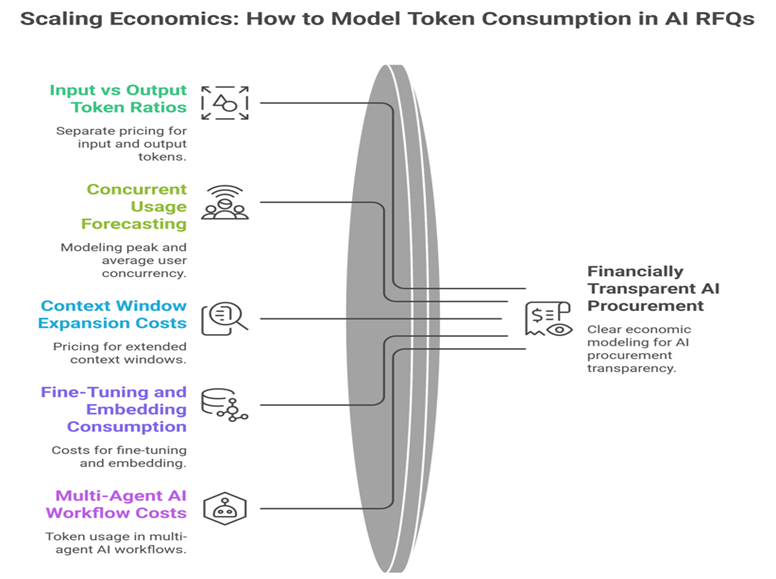
To improve procurement transparency, Orion Market Research recommends incorporating the following financial metrics into AI RFQs:
- Input vs Output Token Ratios
AI platforms often charge differently for prompt input and generated output. RFQs should request separate pricing disclosures for:
- Input token costs
- Output token costs
- Context window utilization
- Cached token discounts
- Concurrent Usage Forecasting
Enterprise AI systems frequently support thousands of simultaneous users. Procurement teams must model:
- Peak concurrency volumes
- Average daily interactions
- Seasonal usage spikes
- Department-level demand variability
- Context Window Expansion Costs
Larger context windows improve AI performance but significantly increase consumption. RFQs should require vendors to disclose:
- Pricing impact of extended context windows
- Retrieval augmentation overhead
- Long-document processing costs
- Fine-Tuning and Embedding Consumption
Many organizations overlook secondary token expenses associated with:
- Model fine-tuning
- Vector embedding generation
- Knowledge indexing
- Continuous retraining cycles
- Multi-Agent AI Workflow Costs
Advanced enterprise AI deployments increasingly involve orchestrated AI agents. Procurement documentation should define:
- Cross-agent communication token usage
- Recursive reasoning consumption
- API chaining overhead
- Autonomous workflow escalation costs
Building Financially Transparent AI Procurement Frameworks
Orion Market Research emphasizes that modern AI RFQs should evolve beyond traditional feature comparisons. Instead, procurement frameworks must include detailed economic modeling methodologies capable of supporting long-term financial planning.
Effective AI RFQs should include:
- Standardized token benchmarking scenarios
- Workload simulation requirements
- Consumption sensitivity analysis
- Vendor cost escalation assumptions
- Performance-to-cost efficiency scoring
By incorporating these requirements early in the sourcing cycle, enterprises can improve vendor comparability and reduce procurement risk.
The Growing Demand for AI RFQ Outsourcing Services
As AI procurement becomes more technically and financially complex, organizations are increasingly seeking specialized RFQ outsourcing support to improve sourcing accuracy and vendor evaluation quality.
Orion Market Research helps enterprises:
- Design AI-focused RFQs and RFPs
- Develop token consumption forecasting models
- Benchmark AI vendor pricing structures
- Create financially transparent procurement documentation
- Evaluate enterprise AI scalability risks
- Improve procurement governance for generative AI initiatives
The company’s AI procurement intelligence framework enables finance teams, sourcing leaders, and procurement strategists to make data-driven vendor selection decisions aligned with operational and budgetary objectives.
Supporting Smarter Enterprise AI Investments
Industry experts believe that token economics will become one of the most important evaluation factors in enterprise AI sourcing over the next five years. Organizations that fail to establish clear consumption governance models may face significant operational inefficiencies as AI usage scales.
Orion Market Research continues to support enterprises with strategic procurement research, RFQ optimization frameworks, supplier evaluation methodologies, and sourcing intelligence tailored to emerging AI technologies.
Businesses seeking to improve AI procurement transparency and optimize enterprise RFQ development strategies can explore additional insights and advisory support through Orion Market Research.