Total Cost of Ownership (TCO) for AI: Power, Cooling, and Latency Are Redefining Infrastructure ROI
The global race toward enterprise AI adoption is accelerating at an unprecedented pace. Organizations are investing heavily in large language models, generative AI systems, AI copilots, intelligent automation, and real-time analytics to gain a competitive advantage. However, as AI deployments scale, enterprises are discovering that model performance alone is no longer the primary determinant of success. The real challenge lies in understanding the Total Cost of Ownership (TCO) associated with AI infrastructure.
From GPU-intensive workloads to advanced cooling architectures and ultra-low latency networking requirements, AI infrastructure is becoming one of the most capital-intensive technology investments enterprises have ever faced. Businesses are now seeking deeper operational visibility into the hidden costs of AI implementation before committing to large-scale deployments.
According to insights from Orion Market Research, enterprises that fail to accurately model AI infrastructure TCO often encounter escalating operational expenditures, underutilized compute resources, and unpredictable scalability constraints. As a result, procurement leaders, CIOs, infrastructure architects, and data center operators are shifting focus from raw AI capability toward long-term infrastructure ROI optimization.
Why AI TCO Has Become a Strategic Business Metric
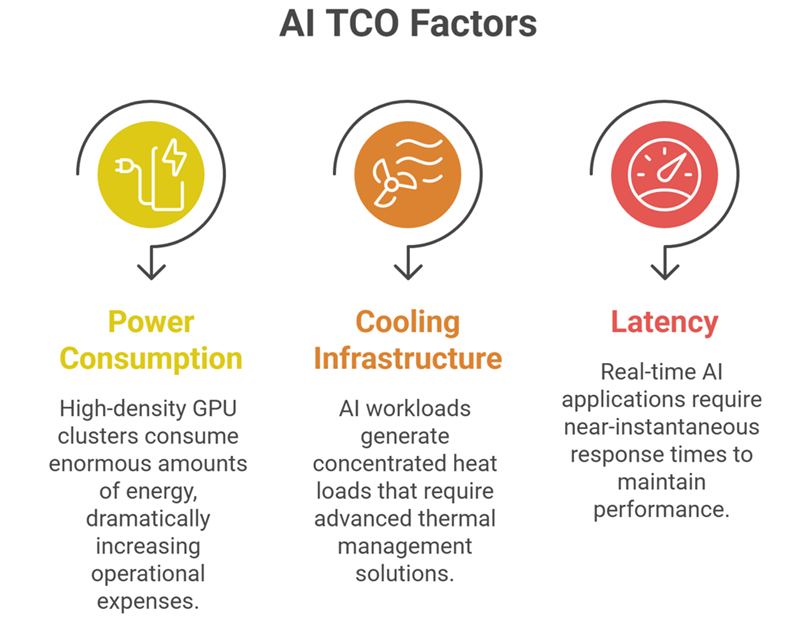
Traditional IT infrastructure planning primarily focused on server acquisition, software licensing, and storage expansion. AI environments introduce an entirely different operational equation. High-density GPU clusters consume enormous amounts of power, generate significant heat, and demand ultra-fast interconnects to maintain inference and training efficiency.
Organizations deploying enterprise AI systems must now account for:
- GPU power consumption across training and inference workloads
- Advanced liquid cooling and thermal management systems
- Latency-sensitive networking infrastructure
- AI workload orchestration and utilization efficiency
- Downtime risk and operational resiliency
- Energy pricing volatility
- Edge-to-cloud data movement costs
- Regulatory and sustainability compliance
These factors collectively determine the real Total Cost of Ownership for AI infrastructure.
Businesses increasingly recognize that selecting an AI platform without evaluating operational costs can create long-term financial exposure. Infrastructure decisions made today directly impact future scalability, service reliability, and enterprise profitability.
Power Consumption: The Largest Hidden AI Expense
Power has rapidly emerged as one of the most critical variables in enterprise AI economics. Modern GPU clusters require exponentially higher energy density than conventional enterprise servers. AI training environments running continuously can consume megawatts of electricity, dramatically increasing operational expenses.
As enterprises scale generative AI initiatives, power-related challenges include:
- Rising utility costs
- Power distribution limitations
- Data center rack density constraints
- Backup power redundancy requirements
- Sustainability reporting obligations
- Carbon footprint management
Organizations are now prioritizing energy-efficient AI architectures that balance computational performance with operational sustainability. Procurement teams are increasingly evaluating vendors not only on AI performance benchmarks but also on watts-per-inference efficiency metrics.
This shift is transforming AI infrastructure sourcing strategies across industries, including healthcare, financial services, manufacturing, retail, and telecommunications.
Cooling Infrastructure Is Now a Core AI Investment
Cooling systems are becoming central to AI infrastructure planning. Traditional air-cooling methods are often insufficient for high-density GPU environments. AI workloads generate concentrated heat loads that require advanced thermal management solutions to maintain performance stability and hardware longevity.
Many enterprises are transitioning toward:
- Liquid cooling systems
- Immersion cooling technologies
- Hybrid thermal architectures
- Intelligent airflow optimization
- AI-driven environmental monitoring
Without effective cooling infrastructure, enterprises face increased risks of hardware degradation, performance throttling, and operational downtime.
Infrastructure leaders are therefore incorporating cooling efficiency into AI RFP frameworks to evaluate long-term deployment viability. Organizations that proactively optimize thermal efficiency can significantly reduce operational expenditures while extending infrastructure lifecycle value.
Latency Is Directly Impacting AI Business Outcomes
Latency has become a mission-critical KPI in enterprise AI operations. Real-time AI applications such as fraud detection, autonomous systems, intelligent customer service, predictive maintenance, and industrial automation require near-instantaneous response times.
Even minor latency inefficiencies can negatively affect:
- User experience
- Inference speed
- Decision-making accuracy
- Operational productivity
- Revenue generation
- Customer satisfaction
To reduce latency, enterprises are investing in:
- Edge AI infrastructure
- High-speed networking fabrics
- Regional AI compute hubs
- Low-latency data pipelines
- Distributed inference architectures
As AI adoption matures, infrastructure optimization is increasingly viewed as a business performance strategy rather than merely an IT concern.
Enterprises Are Redesigning AI RFP Frameworks Around TCO
Modern AI procurement strategies are evolving beyond model capabilities and benchmark testing. Enterprises now require vendors to demonstrate measurable infrastructure efficiency and operational transparency.
Key AI RFP evaluation areas increasingly include:
- Energy efficiency benchmarks
- Cooling compatibility requirements
- Latency optimization architecture
- Infrastructure scalability planning
- GPU utilization efficiency
- Cost-per-token analysis
- Data center resiliency
- Sustainability alignment
Organizations are demanding that AI infrastructure vendors provide clearer visibility into operational economics before deployment approval.
This procurement transformation is creating new opportunities for infrastructure intelligence providers and market research firms capable of delivering actionable insights into AI operational performance.
Orion Market Research Supports Smarter AI Infrastructure Decisions
Orion Market Research continues to provide in-depth market intelligence, AI infrastructure analysis, and strategic procurement insights for enterprises navigating complex AI transformation initiatives.
Its research capabilities help organizations evaluate:
- AI infrastructure investment trends
- GPU supply chain dynamics
- Energy-efficient AI deployment models
- Data center modernization strategies
- AI vendor benchmarking
- Operational cost optimization frameworks
- AI infrastructure scalability risks
By delivering data-driven intelligence, Orion Market Research empowers enterprises to make informed AI sourcing and infrastructure investment decisions that align with long-term operational excellence goals.
Conclusion
As enterprise AI adoption accelerates, organizations can no longer afford to evaluate AI investments based solely on model performance or deployment speed. The true success of AI initiatives depends on a comprehensive understanding of Total Cost of Ownership (TCO), including the long-term impact of power consumption, cooling infrastructure, and latency optimization. Businesses that prioritize infrastructure efficiency, operational scalability, and energy-aware procurement strategies will be better positioned to maximize AI ROI while minimizing financial and operational risks. With increasing pressure to deliver high-performance AI systems sustainably and cost-effectively, enterprises are turning to trusted market intelligence providers like Orion Market Research for actionable insights, infrastructure benchmarking, and strategic guidance that support smarter AI sourcing and future-ready operational excellence.