Why AI Procurement Failures Are Becoming a Boardroom Risk in 2026
As enterprises accelerate investments in generative AI, autonomous systems, enterprise copilots, AI infrastructure, and predictive analytics, procurement failures are no longer being viewed as operational inefficiencies alone. In 2026, AI procurement decisions are rapidly becoming a board-level governance issue due to their direct impact on cybersecurity exposure, regulatory compliance, infrastructure scalability, financial accountability, and enterprise-wide digital transformation success.
Organizations are now committing multi-million-dollar budgets toward AI ecosystems that involve cloud infrastructure providers, GPU suppliers, AI software vendors, data management platforms, cybersecurity frameworks, model governance tools, and third-party integration partners. However, many enterprises continue to rely on traditional procurement methods that were designed for conventional IT sourcing rather than highly interconnected AI environments. This disconnect is creating substantial risks that extend beyond procurement teams and directly affect executive leadership accountability.
The Growing Cost of AI Procurement Misalignment
AI procurement failures often begin with poorly defined technical requirements, incomplete vendor evaluation criteria, unclear scalability expectations, or underestimated infrastructure dependencies. These issues may appear minor during the procurement stage, but they frequently evolve into enterprise-wide operational problems after deployment.
In many organizations, procurement teams are approving AI contracts without fully assessing:
- Long-term GPU availability risks
- Vendor lock-in exposure
- AI model governance capabilities
- Data privacy compliance obligations
- Infrastructure scalability limitations
- Cross-platform integration challenges
- Hidden operational costs
- Regulatory reporting requirements
As a result, CIOs and executive boards are increasingly facing delayed AI rollouts, budget overruns, compliance investigations, cybersecurity vulnerabilities, and failed digital transformation initiatives.
By 2026, enterprise AI failures are expected to draw greater scrutiny from investors, regulators, and audit committees because AI systems now influence critical business operations, customer engagement, financial forecasting, supply chain automation, and strategic decision-making.
Why Boards Are Becoming Directly Involved
AI investments are no longer isolated technology initiatives. They are enterprise transformation programs with strategic implications across every department. Boards are becoming more involved because failed AI procurement decisions can create measurable financial and reputational consequences.
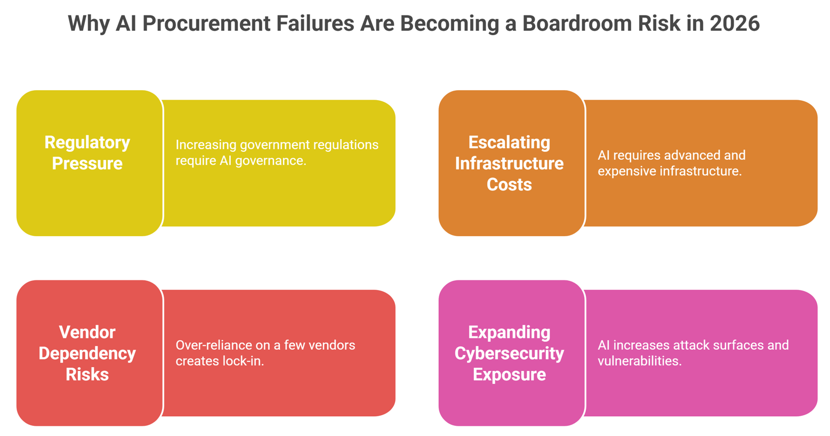
Several emerging governance concerns are driving this shift:
- Regulatory Pressure Is Increasing
Governments and regulatory bodies worldwide are introducing stricter AI governance frameworks focused on transparency, accountability, ethical deployment, cybersecurity, and data sovereignty. Enterprises that procure AI solutions without adequate governance structures may face legal exposure, audit complications, and compliance penalties.
- Infrastructure Costs Are Escalating
AI workloads require advanced infrastructure capabilities involving high-performance computing, energy-intensive GPU clusters, cloud optimization, and specialized networking environments. Procurement teams that fail to accurately evaluate infrastructure requirements can create long-term operational inefficiencies and unsustainable cost structures.
- Vendor Dependency Risks Are Rising
Many organizations are becoming heavily dependent on a small number of AI vendors and cloud providers. Without procurement strategies focused on interoperability and flexibility, enterprises may face severe vendor lock-in challenges that limit scalability and negotiation leverage.
- Cybersecurity Exposure Is Expanding
AI ecosystems significantly increase attack surfaces through APIs, training data pipelines, third-party integrations, and autonomous decision systems. Weak procurement standards around cybersecurity validation can expose organizations to substantial risks.
Procurement Is Becoming a Strategic Governance Function
In 2026, procurement leaders are expected to work closely with CIOs, CISOs, legal teams, compliance officers, and executive boards to ensure AI investments align with enterprise governance objectives.
Modern AI procurement now requires evaluation frameworks that include:
- AI ethics and governance assessments
- Infrastructure readiness analysis
- Data governance validation
- Cybersecurity compliance reviews
- Vendor resilience evaluation
- Scalability and interoperability planning
- Long-term operational cost forecasting
- Risk mitigation benchmarking
Organizations that fail to modernize procurement governance structures may struggle to achieve sustainable AI adoption despite significant investments.
Why Enterprises Are Seeking Market Intelligence Before AI Procurement Decisions
As AI ecosystems become increasingly complex, enterprises are relying more heavily on external market intelligence and procurement research to reduce uncertainty during vendor selection and infrastructure planning.
Decision-makers now require deeper visibility into:
- Emerging AI infrastructure trends
- Vendor capability benchmarking
- Competitive procurement strategies
- GPU supply chain developments
- Enterprise AI adoption patterns
- Regulatory risk forecasts
- AI operations cost modeling
- Cloud and hybrid deployment trends
This shift is increasing demand for research-driven procurement support that helps organizations make defensible, scalable, and future-ready AI investment decisions.
Supporting Strategic AI Procurement Planning
Orion Market Research provides enterprises with comprehensive market intelligence, competitive analysis, technology forecasting, and strategic research insights that support informed AI procurement and governance decisions.
Organizations navigating complex AI transformation initiatives increasingly require research-backed intelligence to evaluate vendor ecosystems, infrastructure investments, regulatory developments, and long-term technology trends before committing significant procurement budgets.
Through detailed industry analysis and enterprise-focused market research, Orion Market Research helps business leaders strengthen procurement planning, reduce technology adoption risks, and improve decision-making confidence in rapidly evolving AI markets.
The Future of AI Procurement Governance
AI procurement is evolving from a back-office sourcing activity into a strategic governance discipline directly tied to enterprise resilience, operational scalability, and executive accountability.
Boards are no longer asking whether organizations should adopt AI. They are asking whether procurement strategies are sophisticated enough to support responsible, scalable, and secure AI deployment.
In 2026, enterprises that integrate procurement intelligence, governance frameworks, and market research into AI decision-making processes will be better positioned to reduce operational risk, strengthen compliance readiness, and achieve sustainable competitive advantage in the AI economy.