Why EV Charging Expansion Depends More on Procurement Than Technology
The EV Infrastructure Race Is No Longer a Technology Problem
The global electric vehicle (EV) transition is accelerating, but the real bottleneck in charging infrastructure expansion is shifting away from hardware innovation and toward procurement strategy. While public discussions continue to focus on charger speed, battery range, and software integration, industry leaders are increasingly recognizing that procurement inefficiencies are delaying deployment timelines, inflating infrastructure costs, and limiting scalability across regions.
Governments, utility providers, automotive OEMs, fleet operators, and private infrastructure developers are investing heavily in EV charging ecosystems. However, many projects still face long approval cycles, supply shortages, inconsistent vendor quality, compliance risks, and fragmented sourcing models. These challenges are turning procurement into one of the most decisive operational functions in EV infrastructure development.
According to insights published by Orion Market Research, procurement-driven decision-making is rapidly becoming a competitive differentiator in the EV infrastructure market as organizations attempt to scale charging networks efficiently while controlling long-term operational risks.
Procurement Complexity Is Reshaping EV Charging Deployment
The EV charging ecosystem depends on a multilayered supplier network involving:
- Power electronics manufacturers
- Semiconductor suppliers
- Charging station assemblers
- Grid equipment vendors
- Installation contractors
- Cloud software providers
- Energy storage solution providers
- Cable and connector manufacturers
A disruption in any one of these procurement layers can delay infrastructure rollout for months. As demand for fast-charging corridors and urban charging hubs rises globally, infrastructure developers are finding that procurement visibility matters as much as charging technology performance.
In many cases, organizations deploying EV infrastructure are dealing with:
- Long lead times for critical electrical components
- Rising transformer procurement costs
- Geopolitical sourcing risks
- Vendor compliance issues
- Localization requirements
- Sustainability reporting obligations
- Grid interoperability concerns
This growing complexity is pushing procurement teams into strategic leadership roles within EV infrastructure planning.
Why Technology Alone Cannot Solve Charging Expansion Challenges
The EV industry has made significant progress in charger efficiency and interoperability. Ultra-fast DC chargers, AI-enabled load balancing systems, and smart energy management platforms are already commercially available. Yet deployment gaps continue to widen because infrastructure expansion depends on operational execution.
Several charging projects fail to scale because procurement strategies are reactive rather than predictive.
For example:
- Hardware vendors may lack sufficient manufacturing capacity
- Software platforms may not integrate with regional utility systems
- Procurement contracts may ignore future maintenance scalability
- Supplier diversification may be inadequate during shortages
- Cross-border sourcing may trigger regulatory complications
As a result, organizations are increasingly adopting procurement intelligence frameworks that evaluate supplier resilience, sourcing diversification, ESG compliance, lifecycle cost optimization, and long-term infrastructure support.
AI Is Transforming Procurement Decisions in EV Infrastructure
Artificial intelligence is now playing a growing role in procurement optimization for EV charging expansion. Infrastructure developers are using AI-driven procurement analytics to forecast supply shortages, evaluate vendor risk, optimize sourcing timelines, and improve infrastructure planning.
AI-powered procurement systems can help organizations:
- Predict component shortages before deployment delays occur
- Analyze supplier performance in real time
- Forecast regional infrastructure demand patterns
- Optimize procurement budgets for charging rollouts
- Reduce downtime risks caused by vendor failures
- Improve inventory planning for charging components
This shift is helping mobility infrastructure providers reduce deployment uncertainty while improving capital efficiency.
Industry analysis from Orion Market Research EV Infrastructure Studies indicates that procurement intelligence platforms are expected to become core operational tools across large-scale EV charging projects over the next several years.
Supplier Ecosystems Are Becoming Strategic Assets
One of the biggest changes in EV infrastructure development is the growing importance of supplier ecosystems. Organizations are no longer evaluating suppliers only on pricing. They are increasingly prioritizing:
- Manufacturing reliability
- Cybersecurity standards
- ESG compliance
- Regional service support
- Software compatibility
- Long-term maintenance capability
- Energy management integration
This transition is encouraging strategic partnerships instead of transactional vendor relationships.
Automotive OEMs and charging network operators are also building multi-vendor procurement strategies to reduce dependency risks and improve infrastructure resilience.
Public Infrastructure Goals Depend on Procurement Readiness
Many national EV adoption goals now depend on whether infrastructure procurement can scale effectively. Governments worldwide are introducing funding programs and public-private partnerships to accelerate charger deployment, but procurement bottlenecks continue to slow execution.
Key infrastructure concerns include:
- Delayed utility approvals
- Grid equipment shortages
- Contractor availability constraints
- Inconsistent charger standardization
- Vendor qualification delays
Without procurement modernization, EV infrastructure expansion may struggle to match vehicle adoption growth.
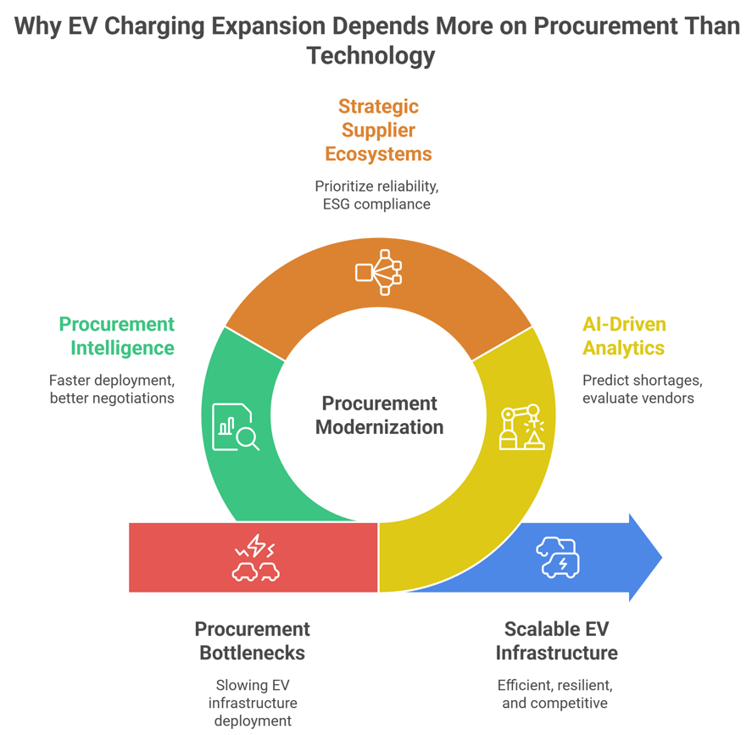
Why Procurement Intelligence Is Becoming Critical for Market Competitiveness
Infrastructure developers who invest in procurement intelligence are gaining advantages in:
- Faster charging deployment
- Better vendor negotiations
- Lower infrastructure downtime
- Reduced supply chain disruption
- Improved capital allocation
- Higher project scalability
As EV infrastructure markets become increasingly competitive, procurement maturity is emerging as a decisive factor in long-term growth.
Organizations that rely solely on technology innovation without strengthening procurement capabilities may face slower expansion, operational inefficiencies, and higher infrastructure risks.
The Future of EV Charging Expansion Will Be Procurement-Led
The next phase of EV infrastructure growth will likely be defined less by breakthrough charging technologies and more by the ability to secure resilient supplier ecosystems, optimize sourcing strategies, and scale infrastructure deployment efficiently.
For automotive companies, utilities, infrastructure investors, and mobility service providers, procurement is no longer a back-office function. It is becoming a central driver of infrastructure scalability and market competitiveness. Comprehensive market intelligence, supplier benchmarking, procurement forecasting, and infrastructure trend analysis are therefore becoming essential for organizations navigating the rapidly evolving EV charging ecosystem.
Explore more EV infrastructure procurement insights, supplier intelligence trends, and mobility market forecasts through the Orion Market Research Official Website.