Aerospace Parts Manufacturing Market


Aerospace Parts Manufacturing Market Size, Share & Trends Analysis Report by Product Type (Engines, Cabin Interiors, Aerostructure, Equipment, System, Support, Avionics, and Insulation Components) and By End User (Commercial Aircraft, Business Aircraft, Military Aircraft and Other) Forecast Period (2026-2035)
Industry Overview
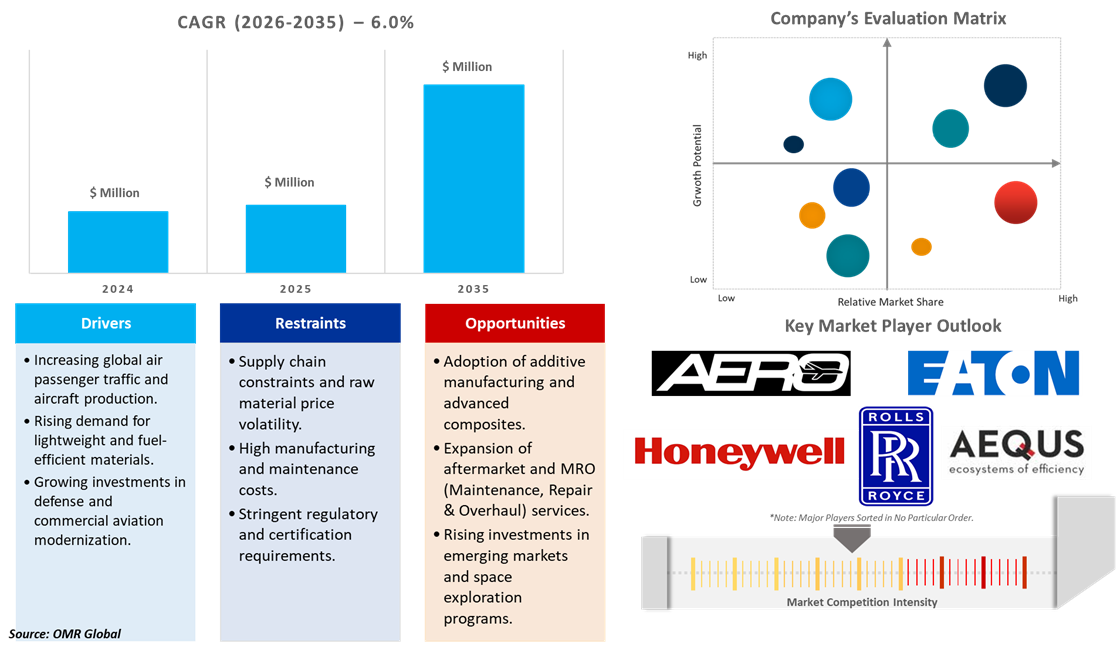
Aerospace parts manufacturing market was valued at $191 billion in 2025 and is projected to reach $374 billion by 2035, growing at a CAGR of 6.0% during the forecast period (2026–2035). Global aerospace parts manufacturing refers to the production of components and systems essential for the design, assembly, and maintenance of aircraft and spacecraft. These include engines, aerostructures, cabin interiors, avionics, insulation materials, and various equipment and support systems. The market plays a vital role in supporting commercial aviation, defense, and space exploration, providing precision-engineered, lightweight, and high-performance parts that meet stringent safety and regulatory standards.
The global aerospace parts manufacturing market is witnessing strong growth, driven by rising air travel demand, fleet modernization, and the expansion of defense and space programs. The surge in commercial aircraft deliveries from leading OEMs such as Boeing and Airbus, coupled with increasing maintenance, repair, and overhaul (MRO) activities, is accelerating production volumes across the supply chain. According to the International Air Transport Association (IATA), in December 2023, global air travel demand continued to rise 2023, moving closer to pre-pandemic 2019 levels. After a sharp 64.9% rebound in 2022, passenger traffic measured in revenue passenger-kilometers (RPKs) grew by 40.1% in the first nine months of 2023 compared to the same period in 2022. All regions saw growth, with North America leading due to early reopening and strong domestic travel, while China’s market reopening in January 2023 significantly boosted traffic recovery in the Asia-Pacific region.
Market Dynamics
Digital Integration & Advanced Manufacturing Technologies
The global aerospace parts manufacturing market is being driven by increasing adoption of advanced digital technologies aimed at enhancing design precision, production efficiency, and supply chain integration. Manufacturers are increasingly leveraging 3D modeling, simulation, and low-code development platforms to create unified digital ecosystems that connect mechanical, electrical, and operational processes. This digital transformation enables faster development cycles, improved collaboration across engineering teams, and higher product quality while reducing costs and time-to-market. The shift from traditional systems to agile, data-driven frameworks reflects a broader industry trend toward smart manufacturing and end-to-end digital integration. For instance, in April 2025, Bombardier is expanding its use of Siemens Digital Industries Software to advance digital transformation across its aircraft development programs. The company will adopt Siemens’ NX software for 3D modeling, simulation, and manufacturing, along with Capital software for electrical system design, integrating them under the Siemens Xcelerator portfolio to create a connected digital thread across mechanical and electrical processes. This move is aimed at improving efficiency, collaboration, and speed in aircraft development while maintaining quality. Bombardier is also using Siemens’ Mendix low-code platform to enhance data integration and streamline internal operations, marking a shift from legacy systems toward more agile, digitally connected workflows.
Material Innovation & Advanced Composites
Breakthroughs in high-performance materials are redefining manufacturing efficiency and durability in the global aerospace parts manufacturing market. The growing demand for hypersonic, space, and next-generation aircraft platforms is driving the development of advanced composite materials that can withstand extreme temperatures while reducing fabrication time and costs. In April 2025, Cambium introduced its new ApexShield 1000 high-temperature resin system, designed to significantly speed up the fabrication of carbon-carbon parts used in hypersonic vehicles and rocket components. Developed through AI-driven material discovery in collaboration with U.S. Department of Defense labs and BioMADE, the resin system cuts production time by reducing polymer infiltration and pyrolysis (PIP) cycles from up to nine to just one or two — a 70–80% improvement over traditional methods. The material’s low melt viscosity makes it suitable for vacuum and resin transfer molding, and its room-temperature stability removes the need for freezer storage. Produced at a large scale, ApexShield 1000 enables faster, more cost-effective manufacturing of high-temperature aerospace parts using existing infrastructure within the domestic supply chain.
Market Segmentation
- Based on the product type, the market is segmented into engines, cabin interiors, aerostructure, equipment, system, support, avionics, and insulation components.
- Based on the end user, the market is segmented into commercial aircraft, business aircraft, military aircraft, and others.
Aerostructure Segment Leads with Rising Demand for Lightweight and Advanced Composite Materials
The aerostructure segment is expected to dominate the global aerospace parts manufacturing market, driven by the increasing use of lightweight materials and precision-engineered structures to improve aircraft efficiency and fuel performance. Manufacturers are focusing on integrating advanced composite materials, titanium alloys, and additive manufacturing techniques to enhance structural strength while minimizing weight. For instance, Spirit AeroSystems identifies itself as one of the world’s largest users of automated fiber placement (AFP) technology and describes recent investments in high-rate AFP systems, including a thermoplastic AFP head and high-speed AFP capabilities that enable faster, more reliable layup of large fuselage and wing components.
Regional Outlook
The global aerospace parts manufacturing market is further divided by region, including North America (the US and Canada), Europe (the UK, Germany, France, Italy, Spain, Russia, and the Rest of Europe), Asia-Pacific (India, China, Japan, South Korea, Australia and New Zealand, ASEAN Countries, and the Rest of Asia-Pacific), and the Rest of the World (the Middle East & Africa, and Latin America).
North America Leading the Global Aerospace Parts Manufacturing Market Growth
North America remains a key contributor to the aerospace parts manufacturing market, driven by strong government and private sector investments in advanced production capabilities and defense programs. The region’s focus on digital manufacturing, automation, and localized supply chains is reinforcing its leadership in high-value aerospace components. Major OEMs are proactively expanding and upgrading facilities to align with next-generation aircraft initiatives, particularly in the defense segment. These developments highlight a strategic push toward securing long-term manufacturing readiness and technological superiority in anticipation of future military and commercial aircraft demands. For instance, in June 2024, Boeing started building a $1.8 billion classified facility near its St. Louis headquarters to support future combat aircraft programs. The project, launched without a confirmed contract, reflects the company’s effort to position itself for upcoming U.S. fighter aircraft opportunities such as the Next Generation Air Dominance (NGAD) program.
Market Players Outlook
The major companies operating in the global aerospace parts manufacturing market include Aequs, Eaton Corporation plc, Honeywell International Inc., Rolls-Royce plc, among others. Market players are leveraging partnerships, collaborations, mergers, and acquisition strategies for business expansion and innovative product development to maintain their market positioning.
Recent Developments
- In September 2025, Jamco Corporation, a Bain Capital portfolio company, announced the acquisition of Aerospace Technologies Group (ATG) by Bain Capital to expand its global cabin interiors business. ATG, based in Florida with additional facilities in Dubai and Toulouse, is a major supplier of electric window shade systems for commercial and private aircraft. Both Jamco and ATG will continue operating independently under Bain Capital’s ownership, led by Executive Chair Kate Schaefer.
- In September 2025, Woodward announced plans to build a new 300,000-square-foot manufacturing facility in Greer, South Carolina, to produce servo-hydraulic actuation systems used in aircraft flight control. The $200 million investment will primarily support spoiler actuation production for the Airbus A350, with operations expected to begin in 2027. The site is projected to create about 275 jobs in manufacturing, engineering, and operations, with potential for future expansion.
- In July 2025, Woodward completed its acquisition of Safran’s North American electromechanical actuation business, which operates in the U.S., Mexico, and Canada. The deal includes intellectual property, assets, and long-term customer agreements for key systems such as the Horizontal Stabilizer Trim Actuation (HSTA) used on the Airbus A350. The acquisition broadens Woodward’s electromechanical actuation portfolio and strengthens its role in primary flight control systems for commercial and business aircraft.
The Report Covers
- Market value data analysis of 2025 and forecast to 2035.
- Annualized market revenues ($ million) for each market segment.
- Country-wise analysis of major geographical regions.
- Key companies operating in the global aerospace parts manufacturing market. Based on the availability of data, information related to new products and relevant news is also available in the report.
- Analysis of business strategies by identifying the key market segments positioned for strong growth in the future.
- Analysis of market-entry and market expansion strategies.
- Competitive strategies by identifying ‘who-stands-where’ in the market.
- Report Summary
- Current Industry Analysis and Growth Potential Outlook
- Global Aerospace Parts Manufacturing Market Sales Analysis – Product Type | End User ($ Million)
- Aerospace Parts Manufacturing Market Sales Market Sales Performance of Top Countries
- Research Methodology
- Primary Research Approach
- Secondary Research Approach
- Market Snapshot
- Market Overview and Insights
- Scope of the Study
- Analyst Insight & Current Market Trends
- Key Aerospace Parts Manufacturing Market Trends
- Market Recommendations
- Market Determinants
- Market Drivers
- Drivers for Global Aerospace Parts Manufacturing Market: Impact Analysis
- Market Pain Points and Challenges
- Restraints for Global Aerospace Parts Manufacturing Market: Impact Analysis
- Market Opportunities
- Opportunities for Global Aerospace Parts Manufacturing Market: Impact Analysis
- Market Drivers
- Competitive Landscape
- Competitive Dashboard – Aerospace Parts Manufacturing Market Revenue and Share by Manufacturers
- Aerospace Parts Manufacturing Comparison Analysis
- Top Market Player Ranking Matrix
- Key Company Analysis
- Safran
- Overview
- Product Portfolio
- Financial Analysis
- SWOT Analysis
- Business Strategy
- GE Aerospace
- Overview
- Product Portfolio
- Financial Analysis
- SWOT Analysis
- Business Strategy
- Honeywell International Inc.
- Overview
- Product Portfolio
- Financial Analysis
- SWOT Analysis
- Business Strategy
- TransDigm
- Overview
- Product Portfolio
- Financial Analysis
- SWOT Analysis
- Business Strategy
- Safran
- Key Company Analysis
- Top Winning Strategies by Market Players
- Merger and Acquisition
- Product Launch
- Partnership and Collaboration
- Global Aerospace Parts Manufacturing Market Sales Analysis by Product Type ($ Million)
- Engines
- Cabin Interiors
- Aerostructure
- Equipment, System, and Support
- Avionics
- Insulation Components
- Global Aerospace Parts Manufacturing Market Sales Analysis by End User ($ Million)
- Commercial Aircraft
- Business Aircraft
- Military Aircraft
- Others
- Regional Analysis
- North American Aerospace Parts Manufacturing Market Sales Analysis – Product Type | End User | Country ($ Million)
- Macroeconomic Factors for North America
- United States
- Canada
- European Aerospace Parts Manufacturing Market Sales Analysis – Product Type | End User | Country ($ Million)
- Macroeconomic Factors for Europe
- UK
- Germany
- Italy
- Spain
- France
- Russia
- Rest of Europe
- Asia-Pacific Aerospace Parts Manufacturing Market Sales Analysis – Product Type | End User | Country ($ Million)
- Macroeconomic Factors for Asia-Pacific
- China
- Japan
- South Korea
- India
- Australia & New Zealand
- ASEAN Countries (Thailand, Indonesia, Vietnam, Singapore, And Other)
- Rest of Asia-Pacific
- Rest of the World Aerospace Parts Manufacturing Market Sales Analysis – Product Type | End User | Country ($ Million)
- Macroeconomic Factors for the Rest of the World
- Latin America
- Middle East and Africa
- Company Profiles
- Collins Aerospace
- Quick Facts
- Company Overview
- Product Portfolio
- Business Strategies
- Ducommun Incorporated
- Quick Facts
- Company Overview
- Product Portfolio
- Business Strategies
- Eaton Corporation plc
- Quick Facts
- Company Overview
- Product Portfolio
- Business Strategies
- FACC AG
- Quick Facts
- Company Overview
- Product Portfolio
- Business Strategies
- GKN Aerospace (Melrose Industries)
- Quick Facts
- Company Overview
- Product Portfolio
- Business Strategies
- GE Aerospace
- Quick Facts
- Company Overview
- Product Portfolio
- Business Strategies
- Héroux-Devtek Inc.
- Quick Facts
- Company Overview
- Product Portfolio
- Business Strategies
- Honeywell International Inc.
- Quick Facts
- Company Overview
- Product Portfolio
- Business Strategies
- Howmet Aerospace
- Quick Facts
- Company Overview
- Product Portfolio
- Business Strategies
- Kaman Corporation
- Quick Facts
- Company Overview
- Product Portfolio
- Business Strategies
- Latecoère S.A
- Quick Facts
- Company Overview
- Product Portfolio
- Business Strategies
- Leonardo S.p.A
- Quick Facts
- Company Overview
- Product Portfolio
- Business Strategies
- Liebherr Aerospace & Transportation Systems
- Quick Facts
- Company Overview
- Product Portfolio
- Business Strategies
- Moog Inc.
- Quick Facts
- Company Overview
- Product Portfolio
- Business Strategies
- Parker-Hannifin Corporation
- Quick Facts
- Company Overview
- Product Portfolio
- Business Strategies
- RECARO Aircraft Seating
- Quick Facts
- Company Overview
- Product Portfolio
- Business Strategies
- Rolls-Royce plc
- Quick Facts
- Company Overview
- Product Portfolio
- Business Strategies
- Safran Group
- Quick Facts
- Company Overview
- Product Portfolio
- Business Strategies
- Business Strategies
- Spirit AeroSystems, Inc.
- Quick Facts
- Company Overview
- Product Portfolio
- Business Strategies
- Business Strategies
- Senior plc
- Quick Facts
- Company Overview
- Product Portfolio
- Business Strategies
- Business Strategies
- ST Engineering
- Quick Facts
- Company Overview
- Product Portfolio
- Business Strategies
- Business Strategies
- Thales Group
- Quick Facts
- Company Overview
- Product Portfolio
- Business Strategies
- Business Strategies
- TransDigm Group Inc
- Quick Facts
- Company Overview
- Product Portfolio
- Business Strategies
- Business Strategies
- Triumph Group Inc
- Quick Facts
- Company Overview
- Product Portfolio
- Business Strategies
- Business Strategies
- Woodward Inc.
- Quick Facts
- Company Overview
- Product Portfolio
- Business Strategies
- Business Strategies
- Collins Aerospace
1. Global Aerospace Parts Manufacturing Market Research and Analysis By Product Type, 2025-2035 ($ Million)
2. Global Aerospace Engines Parts Manufacturing Market Research and Analysis By Region, 2025-2035 ($ Million)
3. Global Aerospace Cabin Interiors Parts Manufacturing Market Research and Analysis By Region, 2025-2035 ($ Million)
4. Global Aerostructure Parts Manufacturing Market Research and Analysis By Region, 2025-2035 ($ Million)
5. Global Aerospace Equipment, System, and Support Parts Manufacturing Market Research and Analysis By Region, 2025-2035 ($ Million)
6. Global Avionics Parts Manufacturing Market Research and Analysis By Region, 2025-2035 ($ Million)
7. Global Aerospace Insulation Components Manufacturing Market Research and Analysis By Region, 2025-2035 ($ Million)
8. Global Aerospace Parts Manufacturing Market Research and Analysis By End User, 2025-2035 ($ Million)
9. Global Aerospace Parts Manufacturing for Commercial Aircraft Market Research and Analysis By Region, 2025-2035 ($ Million)
10. Global Aerospace Parts Manufacturing for Business Aircraft Market Research and Analysis By Region, 2025-2035 ($ Million)
11. Global Aerospace Parts Manufacturing for Military Aircraft Market Research and Analysis By Region, 2025-2035 ($ Million)
12. Global Aerospace Parts Manufacturing for Others Market Research and Analysis By Region, 2025-2035 ($ Million)
13. Global Aerospace Parts Manufacturing Market Research and Analysis By Region, 2025-2035 ($ Million)
14. North American Aerospace Parts Manufacturing Market Research and Analysis By Country, 2025-2035 ($ Million)
15. North American Aerospace Parts Manufacturing Market Research and Analysis By Product Type, 2025-2035 ($ Million)
16. North American Aerospace Parts Manufacturing Market Research and Analysis By End User, 2025-2035 ($ Million)
17. European Aerospace Parts Manufacturing Market Research and Analysis By Country, 2025-2035 ($ Million)
18. European Aerospace Parts Manufacturing Market Research and Analysis By Product Type, 2025-2035 ($ Million)
19. European Aerospace Parts Manufacturing Market Research and Analysis By End User, 2025-2035 ($ Million)
20. Asia-Pacific Aerospace Parts Manufacturing Market Research and Analysis By Country, 2025-2035 ($ Million)
21. Asia-Pacific Aerospace Parts Manufacturing Market Research and Analysis By Product Type, 2025-2035 ($ Million)
22. Asia-Pacific Aerospace Parts Manufacturing Market Research and Analysis By End User, 2025-2035 ($ Million)
23. Rest of The World Aerospace Parts Manufacturing Market Research and Analysis By Country, 2025-2035 ($ Million)
24. Rest of The World Aerospace Parts Manufacturing Market Research and Analysis By Product Type, 2025-2035 ($ Million)
25. Rest of The World Aerospace Parts Manufacturing Market Research and Analysis By End User, 2025-2035 ($ Million)
1. Global Aerospace Parts Manufacturing Market Share By Product Type, 2025 Vs 2035 (%)
2. Global Aerospace Engines Parts Manufacturing Market Share By Region, 2025 Vs 2035 (%)
3. Global Aerospace Cabin Interiors Parts Manufacturing Market Share By Region, 2025 Vs 2035 (%)
4. Global Aerostructure Parts Manufacturing Market Share By Region, 2025 Vs 2035 (%)
5. Global Aerospace Equipment, System, and Support Manufacturing Market Share By Region, 2025 Vs 2035 (%)
6. Global Avionics Parts Manufacturing Market Share By Region, 2025 Vs 2035 (%)
7. Global Aerospace Insulation Components Manufacturing Market Share By Region, 2025 Vs 2035 (%)
8. Global Aerospace Parts Manufacturing Market Share By End User, 2025 Vs 2035 (%)
9. Global Aerospace Parts Manufacturing for Commercial Aircraft Market Share By Region, 2025 Vs 2035 (%)
10. Global Aerospace Parts Manufacturing for Business Aircraft Market Share By Region, 2025 Vs 2035 (%)
11. Global Aerospace Parts Manufacturing for Military Aircraft Market Share By Region, 2025 Vs 2035 (%)
12. Global Aerospace Parts Manufacturing for Others Market Share By Region, 2025 Vs 2035 (%)
13. US Aerospace Parts Manufacturing Market Size, 2025-2035 ($ Million)
14. Canada Aerospace Parts Manufacturing Market Size, 2025-2035 ($ Million)
15. UK Aerospace Parts Manufacturing Market Size, 2025-2035 ($ Million)
16. France Aerospace Parts Manufacturing Market Size, 2025-2035 ($ Million)
17. Germany Aerospace Parts Manufacturing Market Size, 2025-2035 ($ Million)
18. Italy Aerospace Parts Manufacturing Market Size, 2025-2035 ($ Million)
19. Spain Aerospace Parts Manufacturing Market Size, 2025-2035 ($ Million)
20. Russia Aerospace Parts Manufacturing Market Size, 2025-2035 ($ Million)
21. Rest of Europe Aerospace Parts Manufacturing Market Size, 2025-2035 ($ Million)
22. India Aerospace Parts Manufacturing Market Size, 2025-2035 ($ Million)
23. China Aerospace Parts Manufacturing Market Size, 2025-2035 ($ Million)
24. Japan Aerospace Parts Manufacturing Market Size, 2025-2035 ($ Million)
25. South Korea Aerospace Parts Manufacturing Market Size, 2025-2035 ($ Million)
26. Australia and New Zealand Aerospace Parts Manufacturing Market Size, 2025-2035 ($ Million)
27. ASEAN Economies Aerospace Parts Manufacturing Market Size, 2025-2035 ($ Million)
28. Rest of Asia-Pacific Aerospace Parts Manufacturing Market Size, 2025-2035 ($ Million)
29. Latin America Aerospace Parts Manufacturing Market Size, 2025-2035 ($ Million)
30. Middle East and Africa Aerospace Parts Manufacturing Market Size, 2025-2035 ($ Million)
- Printable version
- No restriction to number of users within the company