Asia-Pacific Bioceramics Market


Asia Pacific Bioceramics Market Size, Share & Trends Analysis Report by Product Type (Bio-Inert, Bio-Active, and Bio-Resorbable) and by Application (Dental, Orthopedics and Others), Forecast Period (2026-2035)
Industry Overview
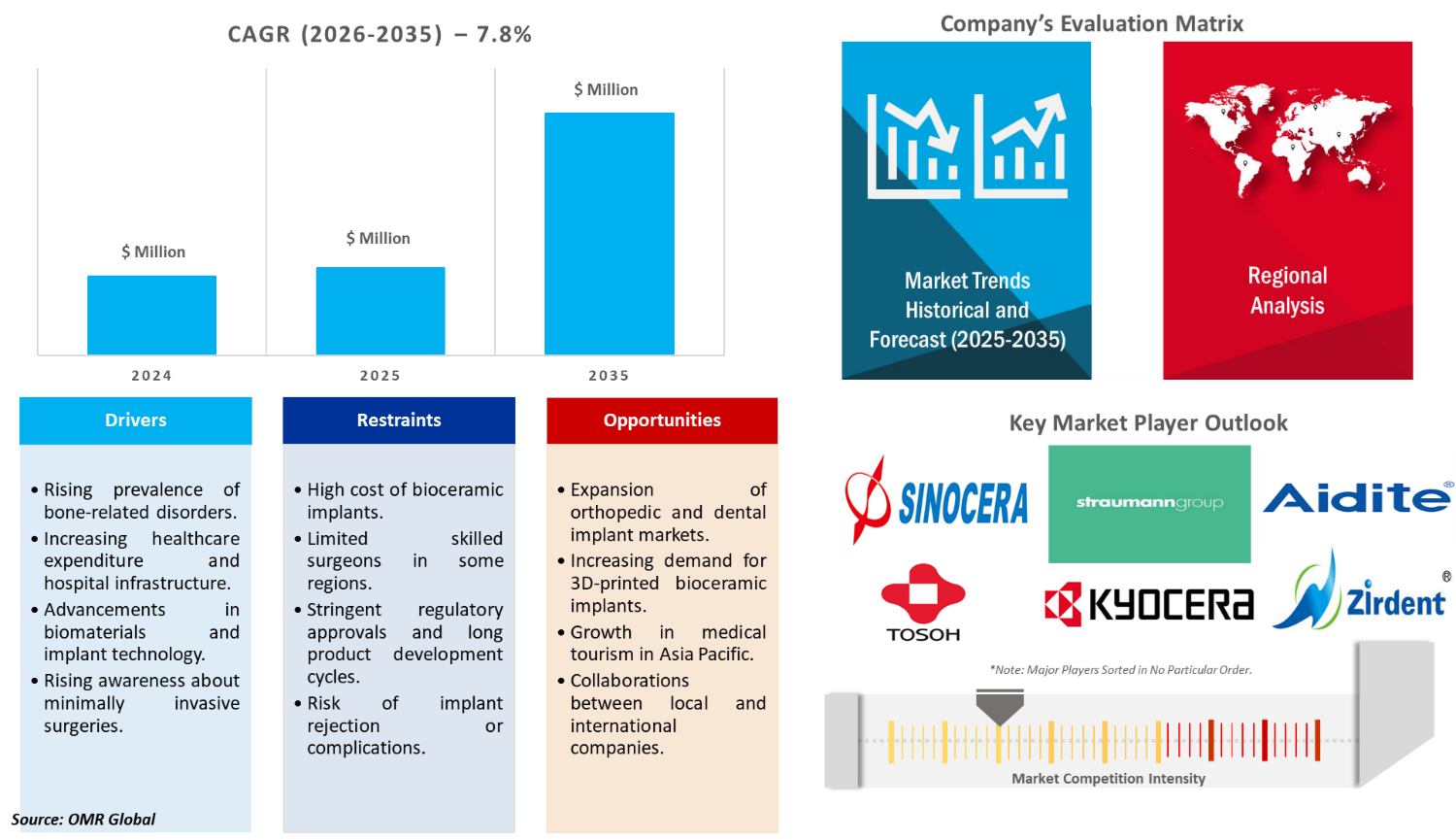
Asia Pacific bioceramics market was valued at $2.2 billion in 2025 and is projected to reach $4.7 billion in 2035, growing at a CAGR of 7.8% during the forecast period (2026-2035). Asia Pacific bioceramics market is gaining strong momentum owing to the aging population & rising orthopedic/ dental disorders, improving healthcare infrastructure & higher healthcare spend, technological advancements and increasing medical tourism in countries such as India, Thailand, Malaysia, South Korea, and Singapore. Bioceramics are ceramics specifically engineered for use in medical and biological environments. Such materials play major role in drug delivery and regenerative medicine, as well as for treatment via implantation into living organisms.
Market Dynamics
Healthcare Tourism’s Contribution to Bioceramic Market Development
The increasing number of international patients travelling for advanced medical and dental treatments in countries such as India, Thailand, Malaysia, South Korea, and Singapore is driving the growth of the bioceramics market across the Asia-Pacific region. These countries are recognized for offering advanced medical treatments such as orthopedic surgeries, dental implants, and cosmetic procedures at comparatively lower costs while maintaining high standards of care. For instance, Apollo Hospitals in India, which serves patients from over 100 countries. The hospital reports conducting more than 5,000 dental implant surgeries annually and over 30,000 total dental surgeries each year, including procedures involving zirconia crowns and implants, which are favored for their biocompatibility and aesthetic properties. The use of bioceramics such as zirconia in dental and orthopedic applications is particularly relevant in the context of medical tourism, as international patients often seek long-lasting, minimally reactive, and high-performance materials. The growing influx of such patients drives demand for advanced implant technologies and high-quality bioceramic materials, thereby contributing to the expansion of the regional market.
Technological Advancements & Innovation
The Asia-Pacific bioceramics market is witnessing a surge in innovation driven by rapid advancements in nanotechnology and biomedical engineering. Major advances include magnetic nanobots (“calbots”) for tooth sensitivity, 3d printing & additive manufacturing, advanced surface engineering, injectable & minimally invasive bioceramics among others. For instance, in August 2025, Indian Institute of Science (IISc), in collaboration with Bengaluru-based deep-tech startup Theranautilus, have engineered "CalBots" – magnetic nanobots that can seal the problem at its source. As per IISc, CalBots are 400-nanometre particles loaded with a calcium silicate-based bioceramic formula, designed to travel 500 micrometres deep inside dentinal tubules, the tiny tunnels in the tooth that lead to nerve endings. Such nanobot-based applications position bioceramics as a key frontier in both medical innovation and the expanding ceramics industry.
Market Segmentation
- Based on the product type, the market is segmented into bio-inert, bio-active, and bio-resorbable.
- Based on the application, the market is segmented into by dental, orthopedics and others.
Orthopedics Leads the Asia-Pacific Bioceramics Market Driven by Rising Bone Disorder Cases and Medical Advancements
Orthopedics accounts for the largest share of the bioceramics market in the Asia-Pacific region, driven by a combination of demographic trends, increased incidence of bone-related disorders, and the region's emergence as a hub for high-quality, cost-effective medical care. Bioceramics particularly materials like alumina, zirconia, and hydroxyapatite are widely used in orthopedic applications, including hip and knee replacements, spinal implants, and bone grafts, due to their excellent biocompatibility, wear resistance, and structural integrity.
Countries like China and India play a particularly important role in this growth. India has emerged as a global destination for specialized medical services, including orthopedic surgeries. The country attracts millions of international patients annually, owing to its combination of highly trained medical professionals, state-of-the-art healthcare facilities, advanced surgical technologies, and significantly lower treatment costs compared to Western nations. In 2022 alone, India performed over 5.6 million orthopedic procedures nationwide, indicating both high domestic demand and a robust medical tourism sector.
Bio-Inert: A Key Segment in Market Growth
The Bio-Inert segment currently holds the largest share of the Asia pacific bioceramics market. Bio-inert ceramics such as alumina (Al?O?) and zirconia (ZrO?) have high compressive strength, wear resistance, and hardness, making them suitable for load-bearing implants (hip, knee, and dental prosthetics). Alumina and zirconia have been in clinical use from long time, especially in orthopedic joint replacements and dental restorations. Furthermore, manufacturing of alumina and zirconia is well-optimized and scalable, reducing costs compared to some newer, specialized bio-active material. CeramTec GmbH, Kyocera Corporation, and Weiert Ceramics Technology Co., Ltd. are among the leading Bio-Inert bioceramics manufacturers. These companies are known for their innovative material developments, strong presence in orthopaedic, dental and other applications, and a proven track record of producing high-performance alumina and zirconia ceramics for medical usage.
Global players such as CeramTec GmbH have been continuously expanding their footprint across the Asia-Pacific region, establishing operations in countries including China, India, South Korea, Malaysia, and Taiwan. The company operates through several subsidiaries and regional offices, with its CeramTec Suzhou Ltd. facility in China serving as a key production and sales hub to meet local demand for advanced alumina and zirconia ceramics used in orthopaedic, dental, and other biomedical applications.
China Maintains a Dominant Position in the Asia Pacific Bioceramics Market
China holds the largest market share in the Asia-Pacific bioceramics market, owing to a combination of factors including its vast economic scale, robust domestic manufacturing infrastructure, and rapid expansion of healthcare services. The country has developed a comprehensive medical device manufacturing ecosystem, which includes the large-scale production of key bioceramic materials such as zirconia, alumina, and hydroxyapatite. The widespread availability of raw materials, coupled with advanced manufacturing capabilities, allows China to produce high-quality bioceramic implants and components at a comparatively lower cost. Companies such as Shandong Sinocera Functional Material Co., Ltd. and Weiert Ceramics Technology Co., Ltd. represent the advancement of China’s bioceramics manufacturing sector. These firms specialize in producing advanced bioceramic components used in dental restorations and orthopedic implants, aligning with global standards for biocompatibility and performance.
Market Players Outlook
The major companies operating in the Asia Pacific bioceramics market include Aidite (Qinhuangdao) Technology Co., Ltd, Institut Strauman, KYOCERA Medical Technologies, Inc., Shandong Sinocera Functional Materials Co., Ltd., Tosoh Ceramics Co., Ltd., among others. Market players are leveraging partnerships, collaborations, mergers, and acquisition strategies for business expansion and innovative product development to maintain their market positioning.
Recent Development
- In 2023, Bioconcept expanded its capabilities by opening a state-of-the-art 25,000-square-metre production facility. The company follows international quality standards (FDA, CE, MDSAP, NMPA) and uses advanced CNC processes with certified titanium materials to ensure consistent manufacturing and safety compliance.
The Report Covers
- Market value data analysis of 2025 and forecast to 2035.
- Annualized market revenues ($ million) for each market segment.
- Country-wise analysis of major geographical regions.
- Key companies operating in the Asia Pacific bioceramics market. Based on the availability of data, information related to new products and relevant news is also available in the report.
- Analysis of business strategies by identifying the key market segments positioned for strong growth in the future.
- Analysis of market-entry and market expansion strategies.
- Competitive strategies by identifying ‘who-stands-where’ in the market.
- Report Summary
- Current Industry Analysis and Growth Potential Outlook
- Asia-Pacific Bioceramic Market Sales Analysis – Product Type| Application ($ Million)
- Asia-Pacific Bioceramic Market Sales Performance of Top Countries
- Research Methodology
- Primary Research Approach
- Secondary Research Approach
- Market Snapshot
- Market Overview and Insights
- Scope of the Study
- Analyst Insight & Current Market Trends
- Key Asia-Pacific Bioceramic Industry Trends
- Market Recommendations
- Market Determinants
- Market Drivers
- Drivers For Asia-Pacific Bioceramic Market: Impact Analysis
- Market Pain Points and Challenges
- Restraints For Asia-Pacific Bioceramic Market: Impact Analysis
- Market Opportunities
- Opportunities For Asia-Pacific Bioceramic Market: Impact Analysis
- Market Drivers
- Competitive Landscape
- Competitive Dashboard – Bioceramics Market Revenue and Share by Manufacturers
- Bioceramics Product Comparison Analysis
- Top Market Player Ranking Matrix
- Key Company Analysis
- Aidite (Qinhuangdao) Technology Co., Ltd
- Overview
- Product Portfolio
- Financial Analysis
- SWOT Analysis
- Business Strategy
- Institut Strauman
- Overview
- Product Portfolio
- Financial Analysis
- SWOT Analysis
- Business Strategy
- KYOCERA Medical Technologies, Inc.
- Overview
- Product Portfolio
- Financial Analysis
- SWOT Analysis
- Business Strategy
- Shandong Sinocera Functional Materials Co., Ltd.
- Overview
- Product Portfolio
- Financial Analysis
- SWOT Analysis
- Business Strategy
- Tosoh Ceramics Co., Ltd.
- Overview
- Product Portfolio
- Financial Analysis
- SWOT Analysis
- Business Strategy
- Top Winning Strategies by Market Players
- Merger and Acquisition
- Product Launch
- Partnership And Collaboration
- Aidite (Qinhuangdao) Technology Co., Ltd
- Key Company Analysis
- Asia-Pacific Bioceramics Market Sales Analysis by Product Type ($ Million)
- Bio-Inert
- Alumina
- Zirconia
- Others (Silicon nitride, Titania)
- Bio-Active
- Bioglass
- Glass Ceramics
- Others (Hydroxyapatite, Calcium silicates)
- Bio-Resorbable
- ?-Tricalcium phosphate
- Calcium phosphate
- Bio-Inert
- Asia-Pacific Bioceramics Market Sales Analysis by Application($ Million)
- Dental
- Orthopedics
- Others
- Company Profiles
- Aidite (Qinhuangdao) Technology Co., Ltd
- Quick Facts
- Company Overview
- Product Portfolio
- Business Strategies
- Baikowski
- Quick Facts
- Company Overview
- Product Portfolio
- Business Strategies
- BAOT Biological Technology Co., Ltd.
- Quick Facts
- Company Overview
- Product Portfolio
- Business Strategies
- BONESUPPORT AB
- Quick Facts
- Company Overview
- Product Portfolio
- Business Strategies
- CeramTec India Innovative Ceramic Engineering Pvt. Ltd.
- Quick Facts
- Company Overview
- Product Portfolio
- Business Strategies
- CGbio
- Quick Facts
- Company Overview
- Product Portfolio
- Business Strategies
- CoorsTek Inc.
- Quick Facts
- Company Overview
- Product Portfolio
- Business Strategies
- Cowellmedi Co., Ltd.
- Quick Facts
- Company Overview
- Product Portfolio
- Business Strategies
- Dentsply Sirona Inc
- Quick Facts
- Company Overview
- Product Portfolio
- Business Strategies Dentsply Sirona Inc
- DSM-Firmenich AG
- Quick Facts
- Company Overview
- Product Portfolio
- Business Strategies
- Institut Straumann AG
- Quick Facts
- Company Overview
- Product Portfolio
- Business Strategies
- KYOCERA Medical Technologies, Inc.
- Quick Facts
- Company Overview
- Product Portfolio
- Business Strategies
- Maxigen Biotech Inc.
- Quick Facts
- Company Overview
- Product Portfolio
- Business Strategies Maxigen Biotech Inc.
- Nobel Biocare Services AG
- Quick Facts
- Company Overview
- Product Portfolio
- Business Strategies
- Orbray Co., Ltd
- Quick Facts
- Company Overview
- Product Portfolio
- Business Strategies
- Tosoh Ceramics Co., Ltd.
- Quick Facts
- Company Overview
- Product Portfolio
- Business Strategies
- Shandong Sinocera Functional Materials Co., Ltd.
- Quick Facts
- Company Overview
- Product Portfolio
- Business Strategies
- Weiert Ceramics Technology Co., Ltd
- Quick Facts
- Company Overview
- Product Portfolio
- Business Strategies
- XTCERA
- Quick Facts
- Company Overview
- Product Portfolio
- Business Strategies
- Zimmer Biomet Holdings, Inc.
- Quick Facts
- Company Overview
- Product Portfolio
- Business Strategies
- Zirdent Biotechnology Co., Ltd
- Quick Facts
- Company Overview
- Product Portfolio
- Business Strategies
- Aidite (Qinhuangdao) Technology Co., Ltd
1. Asia-Pacific Bioceramics Market Research And Analysis By Product Type, 2025-2035 ($ Million)
2. Asia-Pacific Bio-Inert Bioceramics Market Research And Analysis By Region, 2025-2035 ($ Million)
3. Asia-Pacific Alumina Bio-Inert Market Research And Analysis By Region, 2025-2035 ($ Million)
4. Asia-Pacific Zirconia Bio-Inert Market Research And Analysis By Region, 2025-2035 ($ Million)
5. Asia-Pacific Other Bio-Inert Market Research And Analysis By Region, 2025-2035 ($ Million)
6. Asia-Pacific Bio-Active Bioceramics Market Research And Analysis By Region, 2025-2035 ($ Million)
7. Asia-Pacific Bioglass Market Research And Analysis By Region, 2025-2035 ($ Million)
8. Asia-Pacific Bio-Active Glass Ceramics Market Research And Analysis By Region, 2025-2035 ($ Million)
9. Asia-Pacific Other Bio-Active Market Research And Analysis By Region, 2025-2035 ($ Million)
10. Asia-Pacific Bio-Resorbable Bioceramics Market Research And Analysis By Region, 2025-2035 ($ Million)
11. Asia-Pacific ?-Tricalcium Phosphate Bioceramics Market Research And Analysis By Region, 2025-2035 ($ Million)
12. Asia-Pacific Calcium Phosphate Bioceramics Market Research And Analysis By Region, 2025-2035 ($ Million)
13. Asia-Pacific Bioceramics Market Research And Analysis By Application, 2025-2035 ($ Million)
14. Asia-Pacific Bioceramics For Dental Market Research And Analysis By Region, 2025-2035 ($ Million)
15. Asia-Pacific Bioceramics For Orthopedics Market Research And Analysis By Region, 2025-2035 ($ Million)
16. Asia-Pacific Bioceramics For Other Application Market Research And Analysis By Region, 2025-2035 ($ Million)
17. Asia-Pacific Bioceramics Market Research And Analysis By Region, 2025-2035 ($ Million)
18. Asia-Pacific Bioceramic Market Sales Analysis by Country, 2025–2035 ($ Million)
19. China Bioceramic Market Research and Analysis by Product Type, 2025–2035 ($ Million)
20. China Bioceramic Market Research and Analysis by Application, 2025–2035 ($ Million)
21. India Bioceramic Market Research and Analysis by Product Type, 2025–2035 ($ Million)
22. India Bioceramic Market Research and Analysis by Application, 2025–2035 ($ Million)
23. Japan Bioceramic Market Research and Analysis by Product Type, 2025–2035 ($ Million)
24. Japan Bioceramic Market Research and Analysis by Application, 2025–2035 ($ Million)
25. South Korea Bioceramic Market Research and Analysis by Product Type, 2025–2035 ($ Million)
26. South Korea Bioceramic Market Research and Analysis by Application, 2025–2035 ($ Million)
27. Australia & New Zealand Bioceramic Market Research and Analysis by Product Type, 2025–2035 ($ Million)
28. Australia & New Zealand Bioceramic Market Research and Analysis by Application, 2025–2035 ($ Million)
29. ASEAN Bioceramic Market Research and Analysis by Product Type, 2025–2035 ($ Million)
30. ASEAN Bioceramic Market Research and Analysis by Application, 2025–2035 ($ Million)
31. Rest of Asia-Pacific Bioceramic Market Research and Analysis by Product Type, 2025–2035 ($ Million)
32. Rest of Asia-Pacific Bioceramic Market Research and Analysis by Application, 2025–2035 ($ Million)
1. Asia-Pacific Bioceramics Market Share By Product Type, 2025 Vs 2035 (%)
2. Asia-Pacific Bio-Inert Bioceramics Market Share By Region, 2025 Vs 2035 (%)
3. Asia-Pacific Alumina Bio-Inert Market Share By Region, 2025 Vs 2035 (%)
4. Asia-Pacific Zirconia Bio-Inert Market Share By Region, 2025 Vs 2035 (%)
5. Asia-Pacific Other Bio-Inert Market Share By Region, 2025 Vs 2035 (%)
6. Asia-Pacific Bio-Active Bioceramics Market Share By Region, 2025 Vs 2035 (%)
7. Asia-Pacific Bioglass Market Share By Region, 2025 Vs 2035 (%)
8. Asia-Pacific Bio-Active Glass Ceramics Market Share By Region, 2025 Vs 2035 (%)
9. Asia-Pacific Other Bio-Active Market Share By Region, 2025 Vs 2035 (%)
10. Asia-Pacific Bio-Resorbable Bioceramics Market Share By Region, 2025 Vs 2035 (%)
11. Asia-Pacific ?-Tricalcium phosphate Bioceramics Market Share By Region, 2025 Vs 2035 (%)
12. Asia-Pacific Calcium phosphate Bioceramics Market Share By Region, 2025 Vs 2035 (%)
13. Asia-Pacific Bioceramics Market Share By Application, 2025 Vs 2035 (%)
14. Asia-Pacific Bioceramics For Dental Market Share By Region, 2025 Vs 2035 (%)
15. Asia-Pacific Bioceramics For Orthopedics Market Share By Region, 2025 Vs 2035 (%)
16. Asia-Pacific Bioceramics For Other Application Market Share By Region, 2025 Vs 2035 (%)
17. Asia-Pacific Bioceramic Market Share by Country, 2025 Vs 2035 (%)
18. China Bioceramic Market Size, 2025–2035 ($ Million)
19. India Bioceramic Market Size, 2025–2035 ($ Million)
20. Japan Bioceramic Market Size, 2025–2035 ($ Million)
21. South Korea Bioceramic Market Size, 2025–2035 ($ Million)
22. Australia & New Zealand Bioceramic Market Size, 2025–2035 ($ Million)
23. ASEAN Bioceramic Market Size, 2025–2035 ($ Million)
24. Rest of Asia-Pacific Bioceramic Market Size, 2025–2035 ($ Million)
- Printable version
- No restriction to number of users within the company