Asia-Pacific Online Entertainment Market


Asia-Pacific Online entertainment Market Size, Share & Trends Analysis Report By Device (Laptops/ Desktops/Tablets, Smart TVs/Monitors/Projectors, Smartphones, Virtual Reality, and Others), By Form (Audio, Video, Games, And Others), and By Platform (Audio Streaming, Video Streaming, And Internet Radio), Forecast Period (2026-2035)
Industry Overview
Asia-Pacific online entertainment market was valued at $230.5 billion in 2025 and is projected to reach $859.2 billion by 2035, growing at a CAGR of 14.1% during the forecast period (2026–2035). Online entertainment refers to digital content & activities accessed through the internet, including video streaming, music platforms, online games and esports, podcasts, and e-books. The online entertainment market is booming in the Asia-Pacific, mainly due to rising internet penetration along with the availability of affordable data plans.
- In August 2025, Vi introduced the REDX Family Plan. The company’s plan includes unlimited 5G data, global roaming, and OTT access to all members. The package redefines postpaid family plans with unmatched entertainment and travel perks.
- In June 2025, Vodafone launched Vi Max Family with a Netflix basic subscription. The customers will now be able to stream the online content from any device, from anywhere.
- In May 2025, Bharti Airtel announced entertainment?packs for prepaid customers. The prepaid customers will have access to a portfolio of 25+ top OTT platforms, including Netflix, JioHotstar, Zee5, and SonyLiv. The company’s move to consolidate all these various OTT services into one affordable package, the company seeks to meet the changing entertainment preferences of its prepaid users.
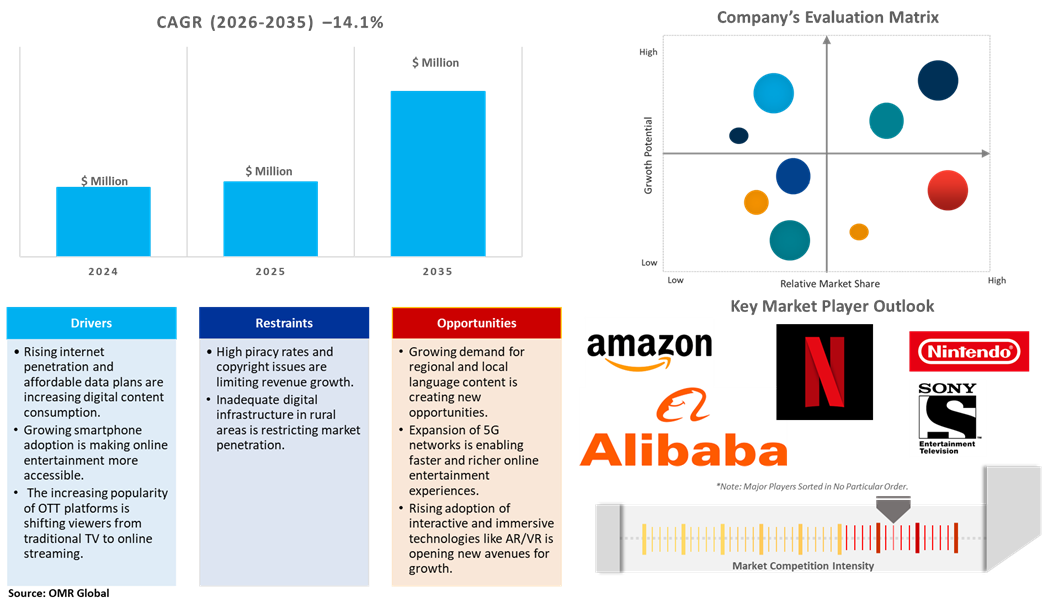
Market Dynamics
Growing Smartphone Adoption is Increasing Access to Digital Entertainment Platforms
The growing adoption of smartphones across the region is a key driver to propel the Asia-Pacific online entertainment market during the forecast period. The benefits associated with smartphones, such as affordable prices, easy accessibility to all platforms, such as online games, music, and more, will further boost smartphone adoption in the region. For instance, according to the 2023 Global System for Mobile Communications Association (GSMA) report, the Asia-Pacific region has 1.8 billion people subscribed to a mobile service. The GSMA demonstrated that the mobile subscribers from 1.8 billion in 2023 are expected to grow to 2.1 billion by 2030.
The Increasing Popularity of OTT Platforms is Shifting Viewers from Traditional TV to Online Streaming
The rising popularity of OTT platforms in the region is reshaping the online entertainment market during the forecast period. The OTT platforms are providing on-demand, ad-free, and personalized content to their customers that fits into their lifestyles. The market players are taking strategic initiatives, such as expansion, partnerships, and collaborations will further drive the market growth. For instance, in 2024, Cignal TV, owned by PLDT, planned to invest in OTT app aggregation platforms. Additionally, in November 2024, the government of Goa launched Waves, Waves is an OTT platform launched at the International Film Festival of India (IFFI). The platform will be available in 12+ Languages - Hindi, English, Bengali, Marathi, Kannada, Malayalam, Telugu, Tamil, Gujarati, Punjabi, and Assamese. It will be spread across 10+ Genres of Infotainment. It will provide Video on demand, free-to-play gaming, Radio streaming, Live TV streaming, 65 live Channels, several app-in-app integrations for video and gaming content, and online shopping through an Open Network for Digital Commerce (ONDC) supported e-commerce platform.
Market Segmentation
- Based on the device, the market is segmented into laptops/ desktops/tablets, smart TVs/monitors/projectors, smartphones, virtual reality, and others.
- Based on the form, the market is segmented into audio, video, games, and others.
- Based on the platform, the market is segmented into audio streaming, video streaming, gaming, and internet radio.
Smartphone Segment to Lead the Market with the Largest Share
The supportive government policies and initiatives, along with a rise in consumer spending, are propelling the growth of the Asia-Pacific online entertainment market during the forecast period. For instance, the Make in India initiative by the government of India is pushing the manufacturing and electronics sector to manufacture smartphones in India. For instance, according to the India Brand Equity Foundation (IBEF), India is rising as the second-largest smartphone manufacturer across the globe. Additionally, the Union Budget 2024-25 outlined significant steps by lowering basic customs duty on mobile phones, PCBs, and chargers from 20% to 15%, while also exempting critical minerals and inputs required for smartphone manufacturing.
Video Streaming: A Key Segment in Market Growth
Among the platforms, video streaming is expected to be a key segment to drive the Asia-Pacific online entertainment market during the forecast period. The rise in demand for OTT platforms, short-video apps, and on-demand content is driving massive consumer engagement in the region. Further, the growing adoption of interactive live streaming and shoppable video solutions will accelerate the online entertainment market in the region. For instance, in December 2024, BeLive Technology announced its collaboration with DigiLive to connect both the retail and content worlds, to help increase sales and engagement for some of the biggest brands across the globe. BeLive Technology is a well-known provider of interactive live streaming solutions in Southeast Asia.
Regional Outlook
The Asia-Pacific online entertainment market is further divided by countries, including India, China, Japan, South Korea, ASEAN economies, Australia and New Zealand, and the Rest of Asia-Pacific.
China Dominates the Market with a Major Share
China is expected to dominate the Asia-Pacific online entertainment market during the forecast period, owing to the rising adoption of smartphones and internet penetration, the presence of domestic OTT and gaming platforms, and increasing consumer spending on digital content. Additionally, the rising smartphone shipments along with their adoption will further boost the market during the forecast period. For instance, the stats revealed by The China Internet Information Center showed that the country’s mobile phone shipments surged 22.1% year on year in 2024. Moreover, in 2024, total cellphone shipments grew by 8.7% year on year to 314 million units, of which 272 million units were 5G mobile phones.
Market Players Outlook
The major companies operating in the Asia-Pacific online entertainment market include Alibaba Group, ByteDance, Sony Interactive Entertainment, Nintendo, Netflix, Amazon, Activision Blizzard, and others. The companies are pursuing partnerships, collaborations, mergers, and acquisitions to drive innovation, expand product portfolios, enhance sustainability, and strengthen market presence. These strategies enable players to respond to growing demand for energy-efficient, high-performance insulation solutions across residential, commercial, and industrial applications while maintaining a competitive edge.
Recent Developments
- In June 2024, Rock Entertainment, a Singapore-based company, announced the launch of its new free ad-supported streaming television (FAST) Channels. A sooka, a Malaysian streaming app for global and local LIVE sports, Asian entertainment, children’s entertainment, and curated local Originals.
The Report Covers
- Market value data analysis of 2025 and forecast to 2035.
- Annualized market revenues ($ million) for each market segment.
- Country-wise analysis of major geographical regions.
- Key companies operating in the Asia-Pacific online entertainment market. Based on the availability of data, information related to new products and relevant news is also available in the report.
- Analysis of business strategies by identifying the key market segments positioned for strong growth in the future.
- Analysis of market-entry and market expansion strategies.
- Competitive strategies by identifying ‘who-stands-where’ in the market.
- Report Summary
- Current Industry Analysis and Growth Potential Outlook
- Asia-Pacific Online Entertainment Market Sales Analysis – Device | Form | Platform ($ Million)
- Asia-Pacific Online Entertainment Market Sales Performance of Top Countries
- Research Methodology
- Primary Research Approach
- Secondary Research Approach
- Market Snapshot
- Market Overview and Insights
- Scope of the Study
- Analyst Insight & Current Market Trends
- Key Asia-Pacific Online Entertainment Industry Trends
- Market Recommendations
- Market Determinants
- Market Drivers
- Drivers For the Asia-Pacific Online Entertainment Market: Impact Analysis
- Market Pain Points and Challenges
- Restraints For the Asia-Pacific Online Entertainment Market: Impact Analysis
- Market Opportunities
- Opportunities For the Asia-Pacific Online Entertainment Market: Impact Analysis
- Market Drivers
- Competitive Landscape
- Competitive Dashboard – Asia-Pacific Online Entertainment Market Revenue and Share by Manufacturers
- Online Entertainment Product Comparison Analysis
- Top Market Player Ranking Matrix
- Key Company Analysis
- Amazon Web Series, Inc.
- Overview
- Product Portfolio
- Financial Analysis (Subject to Data Availability)
- SWOT Analysis
- Business Strategy
- Alibaba Group
- Overview
- Product Portfolio
- Financial Analysis (Subject to Data Availability)
- SWOT Analysis
- Business Strategy
- Netflix, Inc.
- Overview
- Product Portfolio
- Financial Analysis (Subject to Data Availability)
- SWOT Analysis
- Business Strategy
- Nintendo Co., Ltd.
- Overview
- Product Portfolio
- Financial Analysis (Subject to Data Availability)
- SWOT Analysis
- Business Strategy
- Sony Interactive Entertainments
- Overview
- Product Portfolio
- Financial Analysis (Subject to Data Availability)
- SWOT Analysis
- Business Strategy
- Top Winning Strategies by Market Players
- Merger and Acquisition
- Product Launch
- Partnership And Collaboration
- Amazon Web Series, Inc.
- Key Company Analysis
- Asia-Pacific Online Entertainment Market Sales Analysis by Device ($ Million)
- Laptops/ Desktops/Tablets
- Smart TVs/Monitors/Projectors
- Smartphones
- Virtual Reality
- Others
- Asia-Pacific Online Entertainment Market Sales Analysis by Form ($ Million)
- Video
- Audio
- Games
- Others
- Asia-Pacific Online Entertainment Market Sales Analysis by Platform ($ Million)
- Audio Streaming
- Video Streaming
- Gaming
- Internet Radio
- Regional Analysis
- Asia-Pacific Online Entertainment Market Sales Analysis – Device | Form | Platform | Country ($ Million)
- Macroeconomic Factors for Asia-Pacific
- China
- India
- Japan
- South Korea
- Australia and New Zealand
- ASEAN Economies
- Rest of Asia-Pacific
- Company Profiles
- Activision Blizzard, Inc.
- Quick Facts
- Company Overview
- Product Portfolio
- Business Strategies
- Alibaba Group
- Quick Facts
- Company Overview
- Product Portfolio
- Business Strategies
- Amazon Web Series, Inc.
- Quick Facts
- Company Overview
- Product Portfolio
- Business Strategies
- Alphabet, Inc.
- Quick Facts
- Company Overview
- Product Portfolio
- Business Strategies
- Apple, Inc.
- Quick Facts
- Company Overview
- Product Portfolio
- Business Strategies
- Baidu, Inc.
- Quick Facts
- Company Overview
- Product Portfolio
- Business Strategies
- ByteDance Ltd.
- Quick Facts
- Company Overview
- Product Portfolio
- Business Strategies
- Electronic Arts, Inc.
- Quick Facts
- Company Overview
- Product Portfolio
- Business Strategies
- Epic Games, Inc.
- Quick Facts
- Company Overview
- Product Portfolio
- Business Strategies
- Gamania Digital Entertainment Co., Ltd.
- Quick Facts
- Company Overview
- Product Portfolio
- Business Strategies
- iQIYI, Inc.
- Quick Facts
- Company Overview
- Product Portfolio
- Business Strategies
- Jiostar India Private Ltd.
- Quick Facts
- Company Overview
- Product Portfolio
- Business Strategies
- Meta
- Quick Facts
- Company Overview
- Product Portfolio
- Business Strategies
- Microsoft Corp.
- Quick Facts
- Company Overview
- Product Portfolio
- Business Strategies
- Netflix, Inc.
- Quick Facts
- Company Overview
- Product Portfolio
- Business Strategies
- NetEase, Inc.
- Quick Facts
- Company Overview
- Product Portfolio
- Business Strategies
- Nintendo Co., Ltd.
- Quick Facts
- Company Overview
- Product Portfolio
- Business Strategies
- Rakuten Group
- Quick Facts
- Company Overview
- Product Portfolio
- Business Strategies
- Roblox Corp.
- Quick Facts
- Company Overview
- Product Portfolio
- Business Strategies
- Sea Ltd.
- Quick Facts
- Company Overview
- Product Portfolio
- Business Strategies
- Sony Interactive Entertainments
- Quick Facts
- Company Overview
- Product Portfolio
- Business Strategies
- Square Enix Holdings Co., Ltd.
- Quick Facts
- Company Overview
- Product Portfolio
- Business Strategies
- Spotify AB
- Quick Facts
- Company Overview
- Product Portfolio
- Business Strategies
- The Walt Disney Co.
- Quick Facts
- Company Overview
- Product Portfolio
- Business Strategies
- Ubisoft Entertainment SA
- Quick Facts
- Company Overview
- Product Portfolio
- Business Strategies
- Universal Music Group N.V.
- Quick Facts
- Company Overview
- Product Portfolio
- Business Strategies
- Warner Bros. Discovery, Inc.
- Quick Facts
- Company Overview
- Product Portfolio
- Business Strategies
- WeMade Co., Ltd.
- Quick Facts
- Company Overview
- Product Portfolio
- Business Strategies
- Zee Entertainment Enterprises Ltd.
- Quick Facts
- Company Overview
- Product Portfolio
- Business Strategies
- Activision Blizzard, Inc.
1. Asia-Pacific Online Entertainment Market Research and Analysis by Device, 2025–2035 ($ Million)
2. Asia-Pacific Online Entertainment For Laptops/ Desktops/Tablets Market Research and Analysis by Region, 2025–2035 ($ Million)
3. Asia-Pacific Online Entertainment For Smart TVs/Monitors/Projectors Market Research and Analysis by Region, 2025–2035 ($ Million)
4. Asia-Pacific Online Entertainment For Smartphones Market Research and Analysis by Region, 2025–2035 ($ Million)
5. Asia-Pacific Online Entertainment For Virtual Reality Market Research and Analysis by Region, 2025–2035 ($ Million)
6. Asia-Pacific Online Entertainment For Others Market Research and Analysis by Region, 2025–2035 ($ Million)
7. Asia-Pacific Online Entertainment Market Research and Analysis by Form, 2025–2035 ($ Million)
8. Asia-Pacific Video Online Entertainment Market Research and Analysis by Region, 2025–2035 ($ Million)
9. Asia-Pacific Audio Online Entertainment Market Research and Analysis by Region, 2025–2035 ($ Million)
10. Asia-Pacific Virtual Reality Online Entertainment Market Research and Analysis by Region, 2025–2035 ($ Million)
11. Asia-Pacific Others Online Entertainment Market Research and Analysis by Region, 2025–2035 ($ Million)
12. Asia-Pacific Online Entertainment Market Research and Analysis by Platform, 2025–2035 ($ Million)
13. Asia-Pacific Audio Streaming Online Entertainment Market Research and Analysis by Region, 2025–2035 ($ Million)
14. Asia-Pacific Video Streaming Online Entertainment Market Research and Analysis by Region, 2025–2035 ($ Million)
15. Asia-Pacific Gaming Online Entertainment Market Research and Analysis by Region, 2025–2035 ($ Million)
16. Asia-Pacific Internet Radio Online Entertainment Market Research and Analysis by Region, 2025–2035 ($ Million)
17. Asia-Pacific Online Entertainment Market Research and Analysis by Region, 2025–2035 ($ Million)
18. Asia-Pacific Online Entertainment Market Research and Analysis by Country, 2025–2035 ($ Million)
19. Asia-Pacific Online Entertainment Market Research and Analysis by Device, 2025–2035 ($ Million)
20. Asia-Pacific Online Entertainment Market Research and Analysis by Form, 2025–2035 ($ Million)
21. Asia-Pacific Online Entertainment Market Research and Analysis by Platform, 2025–2035 ($ Million)
1. Asia-Pacific Online Entertainment Market Share by Device, 2025 Vs 2035 (%)
2. Asia-Pacific Online Entertainment For Laptops/ Desktops/Tablets Market Share by Region, 2025 Vs 2035 (%)
3. Asia-Pacific Online Entertainment For Smart TVs/Monitors/Projectors Market Share by Region, 2025 Vs 2035 (%)
4. Asia-Pacific Online Entertainment For Smartphones Market Share by Region, 2025 Vs 2035 (%)
5. Asia-Pacific Online Entertainment For Virtual Reality Market Share by Region, 2025 Vs 2035 (%)
6. Asia-Pacific Online Entertainment For Others Market Share by Region, 2025 Vs 2035 (%)
7. Asia-Pacific Online Entertainment Market Share by Form, 2025 Vs 2035 (%)
8. Asia-Pacific Video Online Entertainment Market Share by Region, 2025 Vs 2035 (%)
9. Asia-Pacific Audio Online Entertainment Market Share by Region, 2025 Vs 2035 (%)
10. Asia-Pacific Games Online Entertainment Market Share by Region, 2025 Vs 2035 (%)
11. Asia-Pacific Others Online Entertainment Market Share by Region, 2025 Vs 2035 (%)
12. Asia-Pacific Online Entertainment Market Share by Platform, 2025 Vs 2035 (%)
13. Asia-Pacific Audio Streaming Online Entertainment Market Share by Region, 2025 Vs 2035 (%)
14. Asia-Pacific Video Streaming Online Entertainment Market Share by Region, 2025 Vs 2035 (%)
15. Asia-Pacific Gaming Online Entertainment Market Share by Region, 2025 Vs 2035 (%)
16. Asia-Pacific Internet Radio Online Entertainment Market Share by Region, 2025 Vs 2035 (%)
17. Asia-Pacific Online Entertainment Market Share by Region, 2025 Vs 2035 (%)
18. India Online Entertainment Market Size, 2025–2035 ($ Million)
19. China Online Entertainment Market Size, 2025–2035 ($ Million)
20. Japan Online Entertainment Market Size, 2025–2035 ($ Million)
21. South Korea Online Entertainment Market Size, 2025–2035 ($ Million)
22. Australia and New Zealand Online Entertainment Market Size, 2025–2035 ($ Million)
23. ASEAN Economies Online Entertainment Market Size, 2025–2035 ($ Million)
24. Rest of Asia-Pacific Online Entertainment Market Size, 2025–2035 ($ Million)
- Printable version
- No restriction to number of users within the company