Automotive Filters Market


Automotive Filters Market Size, Share & Trends Analysis Report by Filter Type (Air Filters, Oil Filters, Fuel Filters, Cabin Air Filters, and Other Automotive Filters), by Vehicle Type (Passenger Cars, Light Commercial Vehicles, and Heavy Duty Vehicles), by Material Type (Cellulose, Synthetic, Activated Carbon, Metal Mesh / Stainless Steel, and Others), and by Sales Channel (OEM and Aftermarket), Forecast Period (2026–2035)
Industry Overview
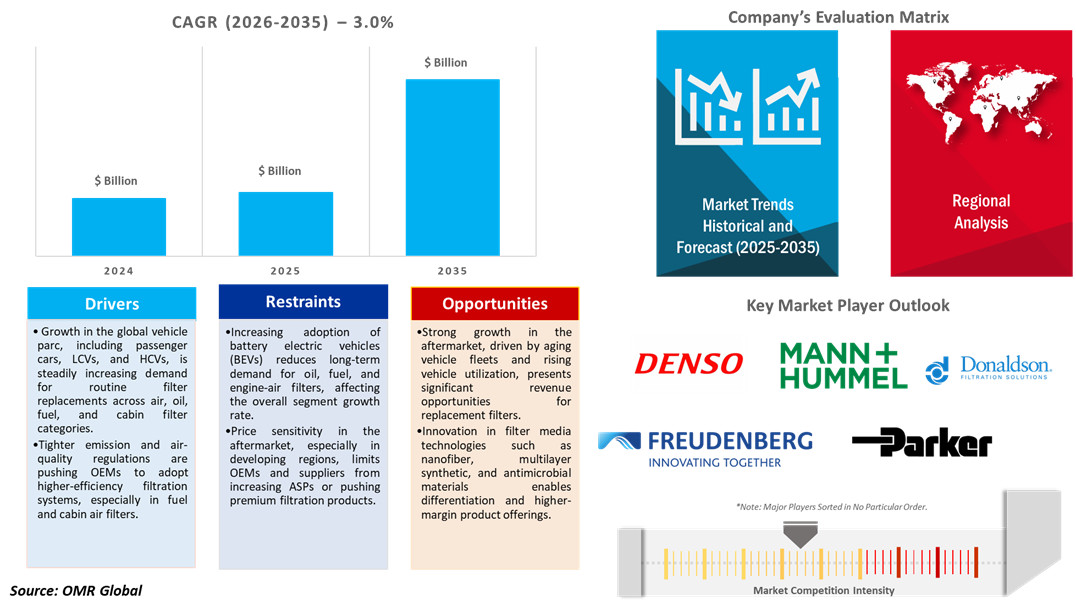
Automotive filters market was valued at $12.30 billion in 2025 and is projected to reach $16.53 billion by 2035, growing at a CAGR of 3.0% during the forecast period (2026-2035). The automotive filters market is expanding steadily as global emission norms tighten, vehicle production remains strong in major economies, and public-health concerns elevate the importance of clean in-cabin air. Growth is further supported by the rising complexity of modern powertrains, the widespread use of turbocharged engines, and the proliferation of electrified and hybrid vehicles. According to the European Environment Agency and the US Environmental Protection Agency (EPA), modern internal combustion engines require increasingly precise air, oil, and fuel filtration systems to meet stringent particulate and NOx emission standards, directly driving demand for advanced filter technologies. In addition, the World Health Organization (WHO) reports that exposure to PM2.5 and airborne pollutants continues to exceed recommended thresholds for over 90% of the global population, pushing automakers to integrate higher-efficiency cabin air filters capable of reducing particulate and allergen exposure inside vehicles.
Market Dynamics
Increasing Global Vehicle Lifespan and Aftermarket Replacement Demand
Vehicles in major automotive markets are remaining in operation for longer periods. According to the European Automobile Manufacturers Association, the European Union, cars average 12.3 years, vans 12.5 years, trucks 13.9 years, and buses 12.5 years. Vehicles accumulate more mileage, their engines and related systems face higher particulate buildup, oil degradation, and fuel contamination, increasing the demands placed on filtration systems to maintain proper function.
- The average age of light commercial vehicles in the EU is 12.5 years. Of the EU’s four major markets, Italy has the oldest van fleet (14.7 years), followed closely by Spain (14 years).
- Trucks are on average 13.9 years old in the European Union. With an average age of 23 years, Greece has the oldest truck fleet, while the newest ones can be found in Austria (6.7 years) and Luxembourg (7.6 years).
- Buses on EU roads are on average 12.5 years old. Aged around 18 years, the Greek and Romanian buses are the oldest in the region. Only seven countries in the European Union have a bus fleet that is less than 10 years old.
Growing vehicle longevity has also prompted innovations in filter design. Manufacturers are developing extended life synthetic media, multi-layer filtration structures, and higher capacity oil filters engineered to withstand the stress of prolonged engine operation. These technologies are increasingly used in high-mileage vehicles, where filtration performance plays a central role in reducing engine wear and sustaining fuel efficiency.
Rising Cost Pressures and Material Challenges in the Automotive Filters Market
Despite strong demand, the automotive filters market faces rising cost pressures and structural challenges linked to global transportation shifts. High-efficiency filters often use synthetic fibers, activated carbon layers, multilayer composites, or stainless-steel mesh, all costlier than traditional cellulose media. The European Commission’s Circular Economy Action Plan emphasizes reducing single-use materials and increasing recyclability in automotive components, placing additional cost and compliance pressure on filter manufacturers. This regulatory environment forces companies to redesign filter materials to meet sustainability requirements, affecting margins and production timelines. Global supply chain disruptions and increased input material prices have added further strain. The OECD’s transportation materials outlook indicates significant cost escalations for polymers, resins, and metals used in filter housings and media. These inflationary pressures have raised manufacturing costs, especially in regions where automotive suppliers operate on tight margins. Higher logistics expenses and energy prices also contribute to rising operational costs for filtration plants globally.
Market Segmentation
- Based on the filter type, the market is segmented into air filters, oil filters, fuel filters, cabin air filters, and other automotive filters.
- Based on the vehicle type, the market is segmented into passenger cars, light commercial vehicles (LCVs), and heavy-duty vehicles (HCVs)
- Based on the material type, the market is segmented into cellulose, synthetic, activated carbon, metal mesh/stainless steel, and others.
- Based on the sales channel, the market is segmented into OEM (original equipment manufacturer) and aftermarket (replacement market)
Cabin Air Filters Emerging as a Critical Growth Segment in the Automotive Filters Market
In the market, the cabin air filters segment is gaining strong momentum as global transportation agencies and environmental regulators indicate the growing presence of traffic-related pollutants inside vehicle cabins. The European Commission reports that road transport remains one of the largest contributors to urban air pollution across the EU, releasing significant levels of nitrogen oxides, particulate matter, and airborne chemical compounds that easily infiltrate vehicle interiors during daily commuting. Similarly, the US Environmental Protection Agency (EPA) notes that in-cabin pollutant levels can be 2–5 times higher than outdoor concentrations when vehicles operate in congested traffic, tunnels, or high-emission zones, increasing passenger exposure to harmful particles and gases.
These findings promote automakers to adopt more advanced cabin filtration technologies, including multi-layer synthetic filters, activated carbon systems capable of trapping gaseous pollutants, and high-efficiency microfiltration media designed to improve in-vehicle air quality.
Regional Outlook
The global automotive filters market is further divided by region, including North America (the US and Canada), Europe (the UK, Germany, France, Italy, Spain, Russia, and the Rest of Europe), Asia-Pacific (India, China, Japan, South Korea, Australia and New Zealand, ASEAN Countries, and the Rest of Asia-Pacific), and the Rest of the World (the Middle East & Africa, and Latin America).
Asia Pacific Leads the Global Automotive Filters Market Growth
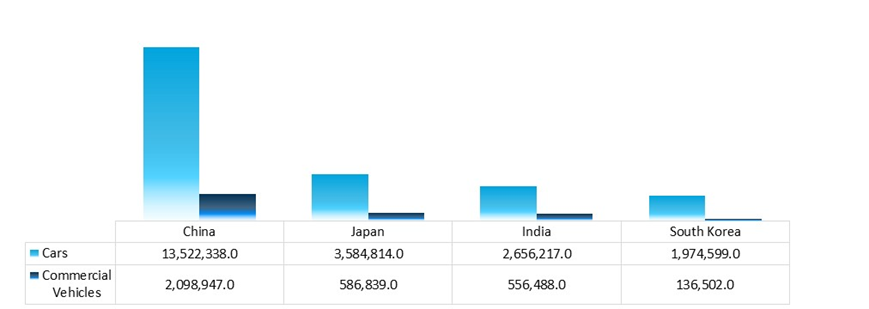
The Asia Pacific region holds a dominant position in the automotive filters market, supported by its large-scale vehicle manufacturing capacity, expanding automotive fleets, and persistent air-quality challenges. According to the International Organization of Motor Vehicle Manufacturers (OICA), Asia Pacific, led by China, Japan, India, and South Korea, accounts for over half of global vehicle production, ensuring continuous demand for OEM-installed air, oil, fuel, and cabin filtration systems. The region’s strong dependence on internal combustion engine (ICE) vehicles, combined with rapid economic growth and increasing vehicle ownership, reinforces its leadership in filter consumption across both the OEM and aftermarket segments.
Motor Vehicle Production 2025
Source: International Organization of Motor Vehicle Manufacturers
Market Players Outlook
The major companies operating in the global automotive filters market, DENSO Products and Services Americas, Inc., MANN+HUMMEL International GmbH & Co. KG, Freudenberg SE, Parker-Hannifin Corporation, Donaldson Company, Inc., among others. Market players are leveraging partnerships, collaborations, mergers, and acquisition strategies for business expansion and innovative product development to maintain their market positioning.
Recent Developments
- In March 2025, MANN-FILTER launched new CO2-reduced filters impregnated with plant-based raw materials, manufactured using renewable energy, and packaged in sustainable, recycled material.
- In November 2024, MANN+HUMMEL announced its strategic partnership with PT. B-Quik Otomotif Indonesia (B-Quik) to offer automotive filtration solutions through its aftermarket brands, WIX Filters and MANN-FILTER, in Indonesia. This collaboration is part of MANN+HUMMEL’s ongoing expansion efforts in the Asian market, reinforcing its commitment to enhancing safety, sustainability, and engine performance for drivers.
- In April 2023, Ahlstrom launched Ahlstrom ECO, a renewable lignin-based automotive filter media. Ahlstrom ECO is a technology supporting the increasing sustainability demands of the global transportation market and offering a new choice for filter manufacturers.
The Report Covers
- Market value data analysis of 2025 and forecast to 2035.
- Annualized market revenues ($ million) for each market segment.
- Country-wise analysis of major geographical regions.
- Key companies operating in the global automotive filters market. Based on the availability of data, information related to new products and relevant news is also available in the report.
- Analysis of business strategies by identifying the key market segments positioned for strong growth in the future.
- Analysis of market-entry and market expansion strategies.
- Competitive strategies by identifying ‘who-stands-where’ in the market.
- Report Summary
- Current Industry Analysis and Growth Potential Outlook
- Global Automotive Filters Market Sales Analysis – Filter Type | Vehicle Type | Material Type | Sales Channel ($ Million)
- Automotive Filters Market Sales Performance of Top Countries
- Research Methodology
- Primary Research Approach
- Secondary Research Approach
- Market Snapshot
- Market Overview and Insights
- Scope of the Study
- Analyst Insight & Current Market Trends
- Key Automotive Filters Industry Trends
- Market Recommendations
- Porter's Five Forces Analysis for the Automotive Filters Market
- Competitive Rivalry
- Threat of New Entrants
- Bargaining Power of Suppliers
- Bargaining Power of Buyers
- Threat of Substitutes
- Market Determinants
- Market Drivers
- Drivers For the Global Automotive Filters Market: Impact Analysis
- Market Pain Points and Challenges
- Restraints For Global Automotive Filters Market: Impact Analysis
- Market Opportunities
- Opportunities For Global Automotive Filters Market: Impact Analysis
- Market Drivers
- Competitive Landscape
- Competitive Dashboard – Automotive Filters Market Revenue and Share by Manufacturers
- Automotive Filters Product Comparison Analysis
- Top Market Player Ranking Matrix
- Key Company Analysis
- DENSO Products and Services Americas, Inc.
- Overview
- Product Portfolio
- Financial Analysis
- SWOT Analysis
- Business Strategy
- MANN+HUMMEL International GmbH & Co. KG
- Overview
- Product Portfolio
- Financial Analysis
- SWOT Analysis
- Business Strategy
- Freudenberg SE
- Overview
- Product Portfolio
- Financial Analysis
- SWOT Analysis
- Business Strategy
- Parker-Hannifin Corporation
- Overview
- Product Portfolio
- Financial Analysis
- SWOT Analysis
- Business Strategy
- Donaldson Company, Inc.
- Overview
- Product Portfolio
- Financial Analysis
- SWOT Analysis
- Business Strategy
- DENSO Products and Services Americas, Inc.
- Key Company Analysis
- Top Winning Strategies by Market Players
- Merger and Acquisition
- Product Launch
- Partnership And Collaboration
- Global Automotive Filters Market Sales Analysis by Filter Type ($ Million)
- Air Filters
- Oil Filters
- Fuel Filters
- Cabin Air Filters
- Other Automotive Filter
- Global Automotive Filters Market Sales Analysis by Vehicle Type ($ Million)
- Passenger Cars
- Light Commercial Vehicles (LCVs)
- Heavy Duty Vehicles (HCVs)
- Global Automotive Filters Market Sales Analysis by Material Type ($ Million)
- Cellulose
- Synthetic
- Activated Carbon
- Metal Mesh / Stainless Steel
- Other
- Global Automotive Filters Market Sales Analysis by Sales Channel ($ Million)
- OEM (Original Equipment Manufacturer)
- Aftermarket (Replacement Market)
- Regional Analysis
- North American Automotive Filters Market Sales Analysis – Filter Type | Vehicle Type | Material Type | Sales Channel | Country ($ Million)
- Macroeconomic Factors for North America
- United States
- Canada
- European Automotive Filters Market Sales Analysis – Filter Type | Vehicle Type | Material Type | Sales Channel | Country ($ Million)
- Macroeconomic Factors for Europe
- UK
- Germany
- Italy
- Spain
- France
- Russia
- Rest of Europe
- Asia-Pacific Automotive Filters Market Sales Analysis – Filter Type | Vehicle Type | Material Type | Sales Channel | Country ($ Million)
- Macroeconomic Factors for Asia-Pacific
- China
- Japan
- South Korea
- India
- Australia & New Zealand
- ASEAN Countries (Thailand, Indonesia, Vietnam, Singapore, And Other)
- Rest of Asia-Pacific
- Rest of the World Automotive Filters Market Sales Analysis – Filter Type | Vehicle Type | Material Type | Sales Channel | Country ($ Million)
- Macroeconomic Factors for the Rest of the World
- Latin America
- Middle East and Africa
- Company Profiles
- Freudenberg SE
- Quick Facts
- Company Overview
- Product Portfolio
- Business Strategies
- ACDelco (GM Genuine Parts Brand)
- Quick Facts
- Company Overview
- Product Portfolio
- Business Strategies
- Ahlstrom Oyj
- Quick Facts
- Company Overview
- Product Portfolio
- Business Strategies
- Bosch Ltd.
- Quick Facts
- Company Overview
- Product Portfolio
- Business Strategies
- Cummins Inc.
- Quick Facts
- Company Overview
- Product Portfolio
- Business Strategies
- DENSO Products and Services Americas, Inc.
- Quick Facts
- Company Overview
- Product Portfolio
- Business Strategies
- Donaldson Company, Inc.
- Quick Facts
- Company Overview
- Product Portfolio
- Business Strategies
- Elofic
- Quick Facts
- Company Overview
- Product Portfolio
- Business Strategies
- Filter Group
- Quick Facts
- Company Overview
- Product Portfolio
- Business Strategies
- First Brands Group LLC.
- Quick Facts
- Company Overview
- Product Portfolio
- Business Strategies
- Hengst SE
- Quick Facts
- Company Overview
- Product Portfolio
- Business Strategies
- K&N Engineering, Inc.
- Quick Facts
- Company Overview
- Product Portfolio
- Business Strategies
- MAHLE Aftermarket GmbH
- Quick Facts
- Company Overview
- Product Portfolio
- Business Strategies
- MANN+HUMMEL International GmbH & Co. KG
- Quick Facts
- Company Overview
- Product Portfolio
- Business Strategies
- Parker-Hannifin Corporation
- Quick Facts
- Company Overview
- Product Portfolio
- Business Strategies
- Pennzoil (Shell Plc.)
- Quick Facts
- Company Overview
- Product Portfolio
- Business Strategies
- Sogefi Group
- Quick Facts
- Company Overview
- Product Portfolio
- Business Strategies
- Totachi Industrial Co. Ltd.
- Quick Facts
- Company Overview
- Product Portfolio
- Business Strategies
- Toyota Boshoku Corporation
- Quick Facts
- Company Overview
- Product Portfolio
- Business Strategies
- UFI Filters S.p.A.
- Quick Facts
- Company Overview
- Product Portfolio
- Business Strategies
- Union Sangyo (M) Sdn Bhd
- Quick Facts
- Company Overview
- Product Portfolio
- Business Strategies
- Valeo Service
- Quick Facts
- Company Overview
- Product Portfolio
- Business Strategies
- Wuxi Weifu High-Tech Group Co., Ltd.
- Quick Facts
- Company Overview
- Product Portfolio
- Business Strategies
- Zenith Filters
- Quick Facts
- Company Overview
- Product Portfolio
- Business Strategies
- Zhejiang Universe Filter Co., Ltd
- Quick Facts
- Company Overview
- Product Portfolio
- Business Strategies
- Freudenberg SE
1. Global Automotive Filters Market Research and Analysis by Filter Type, 2025–2035 ($ Million)
2. Global Automotive Air Filters Market Research and Analysis by Region, 2025–2035 ($ Million)
3. Global Automotive Oil Filters Market Research and Analysis by Region, 2025–2035 ($ Million)
4. Global Automotive Fuel Filters Market Research and Analysis by Region, 2025–2035 ($ Million)
5. Global Automotive Cabin Air Filters Market Research and Analysis by Region, 2025–2035 ($ Million)
6. Global Automotive Other Filters Market Research and Analysis by Region, 2025–2035 ($ Million)
7. Global Automotive Filters Market Research and Analysis by Vehicle Type, 2025–2035 ($ Million)
8. Global Passenger Cars Automotive Filters Market Research and Analysis by Region, 2025–2035 ($ Million)
9. Global Light Commercial Vehicles (LCVs) Automotive Filters Market Research and Analysis by Region, 2025–2035 ($ Million)
10. Global Heavy Duty Vehicles (HCVs) Automotive Filters Market Research and Analysis by Region, 2025–2035 ($ Million)
11. Global Automotive Filters Market Research and Analysis by Material Type, 2025–2035 ($ Million)
12. Global Cellulose Automotive Filters Market Research and Analysis by Region, 2025–2035 ($ Million)
13. Global Synthetic Automotive Filters Market Research and Analysis by Region, 2025–2035 ($ Million)
14. Global Activated Carbon Automotive Filters Market Research and Analysis by Region, 2025–2035 ($ Million)
15. Global Metal Mesh & Stainless Steel Automotive Filters Market Research and Analysis by Region, 2025–2035 ($ Million)
16. Global Other Material Automotive Filters Market Research and Analysis by Region, 2025–2035 ($ Million)
17. Global Automotive Filters Market Research and Analysis by Sales Channel, 2025–2035 ($ Million)
18. Global Automotive Filters via OEM (Original Equipment Manufacturer) Market Research and Analysis by Region, 2025–2035 ($ Million)
19. Global Automotive Filters via Aftermarket (Replacement Market) Research and Analysis by Region, 2025–2035 ($ Million)
20. Global Automotive Filters Market Research and Analysis by Region, 2025–2035 ($ Million)
21. North American Automotive Filters Market Research and Analysis by Country, 2025–2035 ($ Million)
22. North American Automotive Filters Market Research and Analysis by Type, 2025–2035 ($ Million)
23. North American Automotive Filters Market Research and Analysis by Vehicle Type, 2025–2035 ($ Million)
24. North American Automotive Filters Market Research and Analysis by Material, 2025–2035 ($ Million)
25. North American Automotive Filters Market Research and Analysis by Sales Distribution, 2025–2035 ($ Million)
26. European Automotive Filters Market Research and Analysis by Country, 2025–2035 ($ Million)
27. European Automotive Filters Market Research and Analysis by Type, 2025–2035 ($ Million)
28. European Automotive Filters Market Research and Analysis by Vehicle Type, 2025–2035 ($ Million)
29. European Automotive Filters Market Research and Analysis by Material Type, 2025–2035 ($ Million)
30. European Automotive Filters Market Research and Analysis by Sales Channel, 2025–2035 ($ Million)
31. Asia-Pacific Automotive Filters Market Research and Analysis by Country, 2025–2035 ($ Million)
32. Asia-Pacific Automotive Filters Market Research and Analysis by Type, 2025–2035 ($ Million)
33. Asia-Pacific Automotive Filters Market Research and Analysis by Vehicle Type, 2025–2035 ($ Million)
34. Asia-Pacific Automotive Filters Market Research and Analysis by Material Type, 2025–2035 ($ Million)
35. Asia-Pacific Automotive Filters Market Research and Analysis by Sales Channel, 2025–2035 ($ Million)
36. Rest of the World Automotive Filters Market Research and Analysis by Region, 2025–2035 ($ Million)
37. Rest of the World Automotive Filters Market Research and Analysis by Type, 2025–2035 ($ Million)
38. Rest of the World Automotive Filters Market Research and Analysis by Vehicle Type, 2025–2035 ($ Million)
39. Rest of the World Automotive Filters Market Research and Analysis by Material Type, 2025–2035 ($ Million)
40. Rest of the World Automotive Filters Market Research and Analysis by Sales Channel, 2025–2035 ($ Million)
1. Global Automotive Filters Market Research and Analysis by Filter Type, 2025 Vs 2035 (%)
2. Global Automotive Air Filters Market Research and Analysis by Region, 2025 Vs 2035 (%)
3. Global Automotive Oil Filters Market Research and Analysis by Region, 2025 Vs 2035 (%)
4. Global Automotive Fuel Filters Market Research and Analysis by Region, 2025 Vs 2035 (%)
5. Global Automotive Cabin Air Filters Market Research and Analysis by Region, 2025 Vs 2035 (%)
6. Global Automotive Other Filters Market Research and Analysis by Region, 2025 Vs 2035 (%)
7. Global Automotive Filters Market Research and Analysis by Vehicle Type, 2025 Vs 2035 (%)
8. Global Passenger Cars Automotive Filters Market Research and Analysis by Region, 2025 Vs 2035 (%)
9. Global Light Commercial Vehicles (LCVs) Automotive Filters Market Research and Analysis by Region, 2025 Vs 2035 (%)
10. Global Heavy Duty Vehicles (HCVs) Automotive Filters Market Research and Analysis by Region, 2025 Vs 2035 (%)
11. Global Automotive Filters Market Research and Analysis by Material Type, 2025 Vs 2035 (%)
12. Global Cellulose Automotive Filters Market Research and Analysis by Region, 2025 Vs 2035 (%)
13. Global Synthetic Automotive Filters Market Research and Analysis by Region, 2025 Vs 2035 (%)
14. Global Activated Carbon Automotive Filters Market Research and Analysis by Region, 2025 Vs 2035 (%)
15. Global Metal Mesh & Stainless Steel Automotive Filters Market Research and Analysis by Region, 2025 Vs 2035 (%)
16. Global Other Material Automotive Filters Market Research and Analysis by Region, 2025 Vs 2035 (%)
17. Global Automotive Filters Market Research and Analysis by Sales Channel, 2025 Vs 2035 (%)
18. Global Automotive Filters via OEM (Original Equipment Manufacturer) Market Research and Analysis by Region, 2025 Vs 2035 (%)
19. Global Automotive Filters via Aftermarket (Replacement Market) Research and Analysis by Region, 2025 Vs 2035 (%)
20. Global Automotive Filters Market Share by Region, 2025 Vs 2035 (%)
21. US Automotive Filters Market Size, 2025–2035 ($ Million)
22. Canada Automotive Filters Market Size, 2025–2035 ($ Million)
23. UK Automotive Filters Market Size, 2025–2035 ($ Million)
24. France Automotive Filters Market Size, 2025–2035 ($ Million)
25. Germany Automotive Filters Market Size, 2025–2035 ($ Million)
26. Italy Automotive Filters Market Size, 2025–2035 ($ Million)
27. Spain Automotive Filters Market Size, 2025–2035 ($ Million)
28. Russia Automotive Filters Market Size, 2025–2035 ($ Million)
29. Rest of Europe Automotive Filters Market Size, 2025–2035 ($ Million)
30. India Automotive Filters Market Size, 2025–2035 ($ Million)
31. China Automotive Filters Market Size, 2025–2035 ($ Million)
32. Japan Automotive Filters Market Size, 2025–2035 ($ Million)
33. South Korea Automotive Filters Market Size, 2025–2035 ($ Million)
34. Australia and New Zealand Automotive Filters Market Size, 2025–2035 ($ Million)
35. ASEAN Economies Automotive Filters Market Size, 2025–2035 ($ Million)
36. Rest of Asia-Pacific Automotive Filters Market Size, 2025–2035 ($ Million)
37. Latin America Automotive Filters Market Size, 2025–2035 ($ Million)
38. Middle East and Africa Automotive Filters Market Size, 2025–2035 ($ Million)
- Printable version
- No restriction to number of users within the company