Automotive Night Vision System Market


Automotive Night Vision System Market Size, Share & Trends Analysis Report by Technology (Far Infrared, and Near Infrared) By Component (Night-vision camera, Controlling Unit, Display Unit, Sensor, and Others) By Display Type (Instrument Cluster, Navigation System, and HUD) and By Vehicle Type (Passenger Vehicle, and Commercial Vehicle) Forecast Period (2026-2035)
Industry Overview
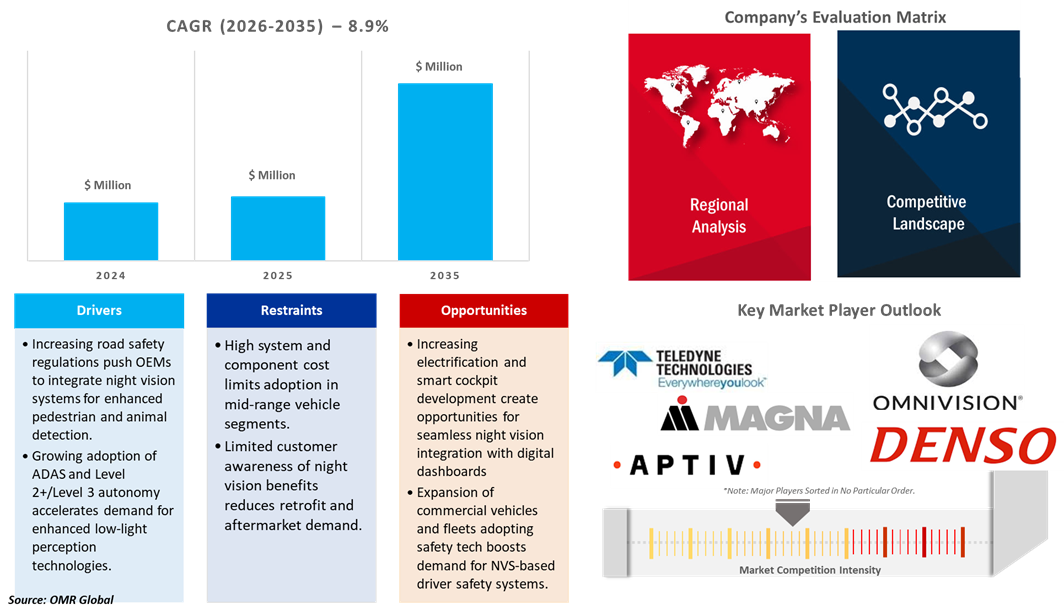
Automotive night vision system market was valued at $3.5 billion in 2025 and is projected to reach $8.2 billion by 2035, growing at a CAGR of 8.9% during the forecast period (2026–2035). Automotive night vision system market is expanding as automakers integrate more intelligent low-light perception technologies to enhance safety during nighttime and poor-visibility driving. Night vision systems act as a critical extension of the driver’s visual range by detecting pedestrians, animals, road debris, and unlit obstacles beyond the reach of headlights. Using thermal imaging, near-infrared sensors, long-range cameras, and AI-based object classification, these systems provide real-time alerts and visual overlays that help drivers respond faster to potential hazards. As vehicles evolve into software-defined platforms, night vision technologies are increasingly adopting advanced sensor fusion, onboard deep-learning processing, and high-dynamic-range imaging to deliver more reliable detection across fog, rain, and low-light conditions.
Connectivity and cloud-enhanced perception are also emerging trends, allowing vehicles to share hazard information and contextual visibility data to enrich detection accuracy further. For instance, In October 2023, KOITO and DENSO have started working together to improve night-time driving safety by coordinating vehicle lighting and image sensors. The idea is that better-controlled headlights can provide illumination that helps cameras detect pedestrians and objects more accurately in low-light conditions. By combining KOITO’s expertise in adaptive lighting with DENSO’s image-recognition technology, the companies aim to develop systems that reduce night-time accidents, especially pedestrian fatalities, which are significantly higher after dark.
Market Dynamics
Heightened Need for Road-Safety and Night Driving Hazard Mitigation
The global automotive night vision system market is experiencing accelerated growth driven by the increasing need to reduce road traffic accidents and enhance driver safety during nighttime and low-visibility conditions. Night vision systems, utilizing far-infrared and near-infrared cameras, enable early detection of pedestrians, cyclists, animals, and obstacles beyond the range of standard vehicle headlights. When integrated with ADAS and augmented display technologies such as HUDs, these systems provide timely alerts that significantly reduce reaction times and improve overall driving safety. According to the World Health Organization, in December 2023, road traffic crashes killed about 1.19 million people worldwide and injured tens of millions more. Vulnerable road users including pedestrians, cyclists, and motorcyclists bear a disproportionate share of these casualties. Children and young adults aged 5–29 face the highest risk. Contributing factors include speeding, impaired driving, distracted driving, unsafe vehicles and roads, lack of protective gear, weak law enforcement, and delays in emergency care. Automotive night vision systems address these risks by improving nighttime visibility, alerting drivers to potential hazards, and supporting safer driving practices.
Advanced Night Vision Integration & Enhancements in Driver Perception
The global automotive night vision system market is experiencing rapid technological evolution as manufacturers move from basic infrared imaging toward fully integrated perception architectures. Modern systems combine far-infrared and near-infrared cameras with AI-powered image processing and sensor fusion technologies to enhance real-time situational awareness in low-light conditions. These solutions are designed to improve detection of pedestrians, cyclists, and road obstacles while compensating for reduced visibility, impaired depth perception, and driver fatigue. According to the European Commission, in March 2023, night driving is a major risk factor, contributing to 55% of motor fatalities in Europe, despite only 28% of travel occurring at night. Reduced visibility, impaired depth perception, fatigue, and difficulty detecting dark-clothed pedestrians all increase accident risk. To address this, the EDEL project under the IST program developed advanced onboard night vision systems. These systems use near-infrared CMOS cameras integrated with vehicle headlamps and a user-focused human-machine interface to enhance driver perception of road signs, obstacles, and unexpected events. The system processes images in real time and can display information via a dashboard screen or head-up display. Prototype testing is ongoing to evaluate technological performance and user acceptance, with the goal of improving nighttime road safety for drivers, cyclists, and pedestrians.
Market Segmentation
- Based on the technology, the market is segmented into far infrared and near infrared.
- Based on the component, the market is segmented into night-vision camera, controlling unit, display unit, sensor, and others.
- Based on the display type, the market is segmented into instrument cluster, navigation system, and HUD.
- Based on the vehicle type, the market is segmented into passenger vehicle, and commercial vehicle.
Display Units Lead Night Vision Adoption as Integrated HUDs Become Standard
The display segment is emerging as a key growth driver in the global automotive night vision system market, fuelled by increasing consumer demand for safer driving experiences and the evolution of software-defined, connected vehicles. Automakers are moving beyond standalone infrared cameras and simple dashboard indicators, adopting wide-format, multi-functional HUDs that project night vision imagery, hazard alerts, and driver information onto a single, integrated interface. These systems provide enhanced visibility in low-light conditions, early detection of pedestrians and animals, and intuitive warnings, helping drivers respond faster to potential hazards. For instance, in January 2025, Continental showcased a 1.3-meter curved HUD combining driver, passenger, and night vision displays into a single panoramic unit. The system uses AI-powered detection to highlight pedestrians, cyclists, and roadside obstacles and features localized dimming to improve visibility without distracting the driver. Its interactive interface allows drivers to control distant screen areas via reachable, haptic-touch panels, making night vision information easily accessible while maintaining focus on the road.
Regional Outlook
The global automotive night vision system market is further divided by region, including North America (the US and Canada), Europe (the UK, Germany, France, Italy, Spain, Russia, and the Rest of Europe), Asia-Pacific (India, China, Japan, South Korea, Australia and New Zealand, ASEAN Countries, and the Rest of Asia-Pacific), and the Rest of the World (the Middle East & Africa, and Latin America).
Asia-Pacific Driving the Global Automotive Night Vision System Market Growth
Asia-Pacific is emerging as a key growth engine in the global automotive night vision system market, fueled by rising vehicle electrification, increasing premium vehicle sales, and stringent road safety regulations across major automotive economies. The region’s rapid adoption of EVs and ADAS is directly boosting demand for night vision technologies, as automakers integrate far-infrared (FIR) and near-infrared (NIR) sensors into next-generation vehicle platforms. According to the International Energy Agency (IEA), China accounted for over 8.1 million new EV registrations in 2023 a 35% increase over 2022 and adoption continued strongly in 2025, driving OEMs to implement advanced in-cabin and roadway visibility solutions. This momentum is encouraging manufacturers to prioritize night vision systems that improve detection of pedestrians, cyclists, and unexpected obstacles in low-light conditions while complying with increasingly strict safety mandates.
Market Players Outlook
The major companies operating in the global automotive night vision system market include Aptiv, Denso Corp, Magna International Inc, OMNIVISION, Teledyne Technologies Incorporated, among others. Market players are leveraging partnerships, collaborations, mergers, and acquisition strategies for business expansion and innovative product development to maintain their market positioning.
Recent Developments
- In July 2025, AUMOVIO, the newly independent automotive division spun off from Continental, will make its first appearance at IAA Mobility 2025. The company plans to present several in-development technologies, including an electric brake caliper for EVs, a compact corner module integrating multiple chassis functions, a scalable system for assisted and automated driving, and an AI-supported night-vision camera aimed at improving low-light detection. It will also show early concepts for in-vehicle displays and cloud-connected software functions.
- In October 2024, Thermal Master Technology Co., Ltd. introduced the NV300 Max, a dual-spectrum automotive night vision system capable of detecting pedestrians, cyclists, and animals up to 300 meters away. It combines thermal imaging with visual cameras, features AI-powered collision warnings with a 0.1-second response time, and displays information on a 6.4-inch HD screen compatible with various vehicles. The system is designed to enhance driver visibility and safety during night and low-visibility conditions.
- In October 2022, Kyocera developed an automotive night vision system that uses a single GaN laser device capable of emitting both white (RGB) and near-infrared (NIR) light along the same optical axis, improving object recognition in darkness and adverse weather. The system pairs RGB-NIR sensors with Kyocera’s fusion-based AI recognition technology, which analyzes and combines visible and infrared imagery to detect pedestrians, vehicles, and other hazards with higher accuracy.
- In January 2022, Opel introduced the Grandland SUV as its first model equipped with a Night Vision system. Using an infrared camera integrated behind the Opel Vizor and paired with IntelliLux LED Pixel headlights, the system detects pedestrians and animals in dark or low-visibility conditions. The launch signals Opel’s entry into factory-installed night vision technology and reflects a wider shift toward making advanced nighttime safety features available in mainstream vehicles, potentially encouraging broader adoption across the industry.
The Report Covers
- Market value data analysis of 2024 and forecast to 2035.
- Annualized market revenues ($ million) for each market segment.
- Country-wise analysis of major geographical regions.
- Key companies operating in the global automotive night vision system market. Based on the availability of data, information related to new products and relevant news is also available in the report.
- Analysis of business strategies by identifying the key market segments positioned for strong growth in the future.
- Analysis of market-entry and market expansion strategies.
- Competitive strategies by identifying ‘who-stands-where’ in the market.
- Report Summary
- Current Industry Analysis and Growth Potential Outlook
- Global Automotive Night Vision Market Sales Analysis – Technology | Component | Display Type | Vehicle Type ($ Million)
- Automotive Night Vision Market Sales Performance of Top Countries
- Research Methodology
- Primary Research Approach
- Secondary Research Approach
- Market Snapshot
- Market Overview and Insights
- Scope of the Study
- Analyst Insight & Current Market Trends
- Key Automotive Night Vision Market Trends
- Market Recommendations
- Market Determinants
- Market Drivers
- Drivers for Global Automotive Night Vision Market: Impact Analysis
- Market Pain Points and Challenges
- Restraints for Global Automotive Night Vision Market: Impact Analysis
- Market Opportunities
- Opportunities for Global Automotive Night Vision Market: Impact Analysis
- Market Drivers
- Competitive Landscape
- Competitive Dashboard – Automotive Night Vision Market Revenue and Share by Manufacturers
- Automotive Night Vision Comparison Analysis
- Top Market Player Ranking Matrix
- Key Company Analysis
- Aptiv
- Overview
- Product Portfolio
- Financial Analysis
- SWOT Analysis
- Business Strategy
- Denso Corp
- Overview
- Product Portfolio
- Financial Analysis
- SWOT Analysis
- Business Strategy
- Magna International Inc
- Overview
- Product Portfolio
- Financial Analysis
- SWOT Analysis
- Business Strategy
- OMNIVISION
- Overview
- Product Portfolio
- Financial Analysis
- SWOT Analysis
- Business Strategy
- Teledyne Technologies Incorporated
- Overview
- Product Portfolio
- Financial Analysis
- SWOT Analysis
- Business Strategy
- Aptiv
- Key Company Analysis
- Top Winning Strategies by Market Players
- Merger and Acquisition
- Product Launch
- Partnership and Collaboration
- Global Automotive Night Vision Market Sales Analysis by Technology ($ Million)
- Far Infrared
- Near Infrared
- Global Automotive Night Vision Market Sales Analysis by Component ($ Million)
- Night-vision camera
- Controlling Unit
- Display Unit
- Sensor
- Others
- Global Automotive Night Vision Market Sales Analysis by Display Type ($ Million)
- Instrument Cluster
- Navigation System
- HUD
- Global Automotive Night Vision Market Sales Analysis by Vehicle Type ($ Million)
- Passenger Vehicle
- Commercial Vehicle
- Regional Analysis
- North American Automotive Night Vision Market Sales Analysis – Technology | System Type | Sales Channel | Vehicle Type | Country ($ Million)
- Macroeconomic Factors for North America
- United States
- Canada
- European Automotive Night Vision Market Sales Analysis – Technology | Component | Display Type | Vehicle Type | Country ($ Million)
- Macroeconomic Factors for Europe
- UK
- Germany
- Italy
- Spain
- France
- Russia
- Rest of Europe
- Asia-Pacific Automotive Night Vision Market Sales Analysis – Technology | Component | Display Type | Vehicle Type | Country ($ Million)
- Macroeconomic Factors for Asia-Pacific
- China
- Japan
- South Korea
- India
- Australia & New Zealand
- ASEAN Countries (Thailand, Indonesia, Vietnam, Singapore, And Other)
- Rest of Asia-Pacific
- Rest of the World Automotive Night Vision Market Sales Analysis – Technology | Component | Display Type | Vehicle Type | Country ($ Million)
- Macroeconomic Factors for the Rest of the World
- Latin America
- Middle East and Africa
- Company Profiles
- Aptiv
- Quick Facts
- Company Overview
- Product Portfolio
- Business Strategies
- AUMOVIO Aftermarket GmbH
- Quick Facts
- Company Overview
- Product Portfolio
- Business Strategies
- Delphi (PHINIA Inc.)
- Quick Facts
- Company Overview
- Product Portfolio
- Business Strategies
- Denso Corp
- Quick Facts
- Company Overview
- Product Portfolio
- Business Strategies
- Gentex Corp
- Quick Facts
- Company Overview
- Product Portfolio
- Business Strategies
- HUDWAY LLC
- Quick Facts
- Company Overview
- Product Portfolio
- Business Strategies
- IRay Technology Co., Ltd.
- Quick Facts
- Company Overview
- Product Portfolio
- Business Strategies
- Lanmodo
- Quick Facts
- Company Overview
- Product Portfolio
- Business Strategies
- Magna International Inc
- Quick Facts
- Company Overview
- Product Portfolio
- Business Strategies
- Nippon Seiki Co., Ltd.
- Quick Facts
- Company Overview
- Product Portfolio
- Business Strategies
- OMNIVISION
- Quick Facts
- Company Overview
- Product Portfolio
- Business Strategies
- Panasonic Automotive Systems Co., Ltd.
- Quick Facts
- Company Overview
- Product Portfolio
- Business Strategies
- Robert Bosch GmbH
- Quick Facts
- Company Overview
- Product Portfolio
- Business Strategies
- Satir
- Quick Facts
- Company Overview
- Product Portfolio
- Business Strategies
- Seek Thermal, Inc.
- Quick Facts
- Company Overview
- Product Portfolio
- Business Strategies
- Semiconductor Components Industries, LLC
- Quick Facts
- Company Overview
- Product Portfolio
- Business Strategies
- Sony Semiconductor Solutions Corp
- Quick Facts
- Company Overview
- Product Portfolio
- Business Strategies
- Stellantis NV
- Quick Facts
- Company Overview
- Product Portfolio
- Business Strategies
- Teledyne Technologies Incorporated
- Quick Facts
- Company Overview
- Product Portfolio
- Business Strategies
- Texas Instruments Incorporated
- Quick Facts
- Company Overview
- Product Portfolio
- Business Strategies
- Valeo
- Quick Facts
- Company Overview
- Product Portfolio
- Business Strategies
- Veoneer US Safety Systems, LLC
- Quick Facts
- Company Overview
- Product Portfolio
- Business Strategies
- Xinfrared
- Quick Facts
- Company Overview
- Product Portfolio
- Business Strategies
- ZF Friedrichshafen AG
- Quick Facts
- Company Overview
- Product Portfolio
- Business Strategies
- Aptiv
1. Global Automotive Night Vision Market Research and Analysis By Technology, 2025-2035 ($ Million)
2. Global Far Infrared Automotive Night Vision Market Research and Analysis By Region, 2025-2035 ($ Million)
3. Global Near Infrared Automotive Night Vision Market Research and Analysis By Region, 2025-2035 ($ Million)
4. Global Automotive Night Vision Market Research and Analysis By Component, 2025-2035 ($ Million)
5. Global Night-vision camera Automotive Night Vision Market Research and Analysis By Region, 2025-2035 ($ Million)
6. Global Controlling Unit Automotive Night Vision Market Research and Analysis By Region, 2025-2035 ($ Million)
7. Global Display Unit Automotive Night Vision Market Research and Analysis By Region, 2025-2035 ($ Million)
8. Global Sensor Automotive Night Vision Market Research and Analysis By Region, 2025-2035 ($ Million)
9. Global Others Automotive Night Vision Market Research and Analysis By Region, 2025-2035 ($ Million)
10. Global Automotive Night Vision Market Research and Analysis By Display Type, 2025-2035 ($ Million)
11. Global Instrument Cluster Automotive Night Vision Market Research and Analysis By Region, 2025-2035 ($ Million)
12. Global Navigation System Automotive Night Vision Market Research and Analysis By Region, 2025-2035 ($ Million)
13. Global HUD Automotive Night Vision Market Research and Analysis By Region, 2025-2035 ($ Million)
14. Global Automotive Night Vision Market Research and Analysis By Vehicle Type, 2025-2035 ($ Million)
15. Global Automotive Night Vision for Passenger Vehicle Market Research and Analysis By Region, 2025-2035 ($ Million)
16. Global Automotive Night Vision for Commercial Vehicle Market Research and Analysis By Region, 2025-2035 ($ Million)
17. Global Automotive Night Vision Market Research and Analysis By Region, 2025-2035 ($ Million)
18. North American Automotive Night Vision Market Research and Analysis By Country, 2025-2035 ($ Million)
19. North American Automotive Night Vision Market Research and Analysis By Technology, 2025-2035 ($ Million)
20. North American Automotive Night Vision Market Research and Analysis By Component, 2025-2035 ($ Million)
21. North American Automotive Night Vision Market Research and Analysis By Display Type, 2025-2035 ($ Million)
22. North American Automotive Night Vision Market Research and Analysis By Vehicle Type, 2025-2035 ($ Million)
23. European Automotive Night Vision Market Research and Analysis By Country, 2025-2035 ($ Million)
24. European Automotive Night Vision Market Research and Analysis By Technology, 2025-2035 ($ Million)
25. European Automotive Night Vision Market Research and Analysis By Component, 2025-2035 ($ Million)
26. European Automotive Night Vision Market Research and Analysis By Display Type, 2025-2035 ($ Million)
27. European Automotive Night Vision Market Research and Analysis By Vehicle Type, 2025-2035 ($ Million)
28. Asia-Pacific Automotive Night Vision Market Research and Analysis By Country, 2025-2035 ($ Million)
29. Asia-Pacific Automotive Night Vision Market Research and Analysis By Technology, 2025-2035 ($ Million)
30. Asia-Pacific Automotive Night Vision Market Research and Analysis By Component, 2025-2035 ($ Million)
31. Asia-Pacific Automotive Night Vision Market Research and Analysis By Display Type, 2025-2035 ($ Million)
32. Asia-Pacific Automotive Night Vision Market Research and Analysis By Vehicle Type, 2025-2035 ($ Million)
33. Rest of The World Automotive Night Vision Market Research and Analysis By Country, 2025-2035 ($ Million)
34. Rest of The World Automotive Night Vision Market Research and Analysis By Technology, 2025-2035 ($ Million)
35. Rest of The World Automotive Night Vision Market Research and Analysis By Component, 2025-2035 ($ Million)
36. Rest of The World Automotive Night Vision Market Research and Analysis By Display Type, 2025-2035 ($ Million)
37. Rest of The World Automotive Night Vision Market Research and Analysis By Vehicle Type, 2025-2035 ($ Million)
1. Global Automotive Night Vision Market Share By Technology, 2025 Vs 2035 (%)
2. Global Far Infrared Automotive Night Vision Market Share By Region, 2025 Vs 2035 (%)
3. Global Near Infrared Automotive Night Vision Market Share By Region, 2025 Vs 2035 (%)
4. Global Automotive Night Vision Market Share By Component, 2025 Vs 2035 (%)
5. Global Night-vision camera Automotive Night Vision Market Share By Region, 2025 Vs 2035 (%)
6. Global Controlling Unit Automotive Night Vision Market Share By Region, 2025 Vs 2035 (%)
7. Global Display Unit Automotive Night Vision Market Share By Region, 2025 Vs 2035 (%)
8. Global Sensor Automotive Night Vision Market Share By Region, 2025 Vs 2035 (%)
9. Global Others Automotive Night Vision Market Share By Region, 2025 Vs 2035 (%)
10. Global Automotive Night Vision Market Share By Display Type, 2025 Vs 2035 (%)
11. Global Instrument Cluster Automotive Night Vision Market Share By Region, 2025 Vs 2035 (%)
12. Global Navigation System Automotive Night Vision Market Share By Region, 2025 Vs 2035 (%)
13. Global HUD Automotive Night Vision Market Share By Region, 2025 Vs 2035 (%)
14. Global Automotive Night Vision Market Share By Vehicle Type, 2025 Vs 2035 (%)
15. Global Automotive Night Vision for Passenger Vehicle Market Share By Region, 2025 Vs 2035 (%)
16. Global Automotive Night Vision for Commercial Vehicle Market Share By Region, 2025 Vs 2035 (%)
17. Global Automotive Night Vision Market Share By Region, 2025 Vs 2035 (%)
18. US Automotive Night Vision Market Size, 2025-2035 ($ Million)
19. Canada Automotive Night Vision Market Size, 2025-2035 ($ Million)
20. UK Automotive Night Vision Market Size, 2025-2035 ($ Million)
21. France Automotive Night Vision Market Size, 2025-2035 ($ Million)
22. Germany Automotive Night Vision Market Size, 2025-2035 ($ Million)
23. Italy Automotive Night Vision Market Size, 2025-2035 ($ Million)
24. Spain Automotive Night Vision Market Size, 2025-2035 ($ Million)
25. Russia Automotive Night Vision Market Size, 2025-2035 ($ Million)
26. Rest of Europe Automotive Night Vision Market Size, 2025-2035 ($ Million)
27. India Automotive Night Vision Market Size, 2025-2035 ($ Million)
28. China Automotive Night Vision Market Size, 2025-2035 ($ Million)
29. Japan Automotive Night Vision Market Size, 2025-2035 ($ Million)
30. South Korea Automotive Night Vision Market Size, 2025-2035 ($ Million)
31. Australia and New Zealand Automotive Night Vision Market Size, 2025-2035 ($ Million)
32. ASEAN Economies Automotive Night Vision Market Size, 2025-2035 ($ Million)
33. Rest of Asia-Pacific Automotive Night Vision Market Size, 2025-2035 ($ Million)
34. Latin America Automotive Night Vision Market Size, 2025-2035 ($ Million)
35. Middle East and Africa Automotive Night Vision Market Size, 2025-2035 ($ Million)
- Printable version
- No restriction to number of users within the company

