Beta-Blocker Market


Beta-Blocker Market Size, Share & Trends Analysis Report By Category (Non-Selective Beta Blockers, Selective Beta Blockers And Combined Alpha And Beta Blockers), By Drug Type (Metoprolol, Carvedilol, Atenolol, Propranolol, Timolol And Others), By Application (Cardiac Diseases, Hypertension, Glaucoma, And Migraine And Other), By Route Of Administration (Oral, Intravenous And Ophthalmic), And By Distribution Channel (Hospital Pharmacy, Retail Pharmacy And Online / E-Pharmacies) Forecast Period (2026-2035)
Industry Overview
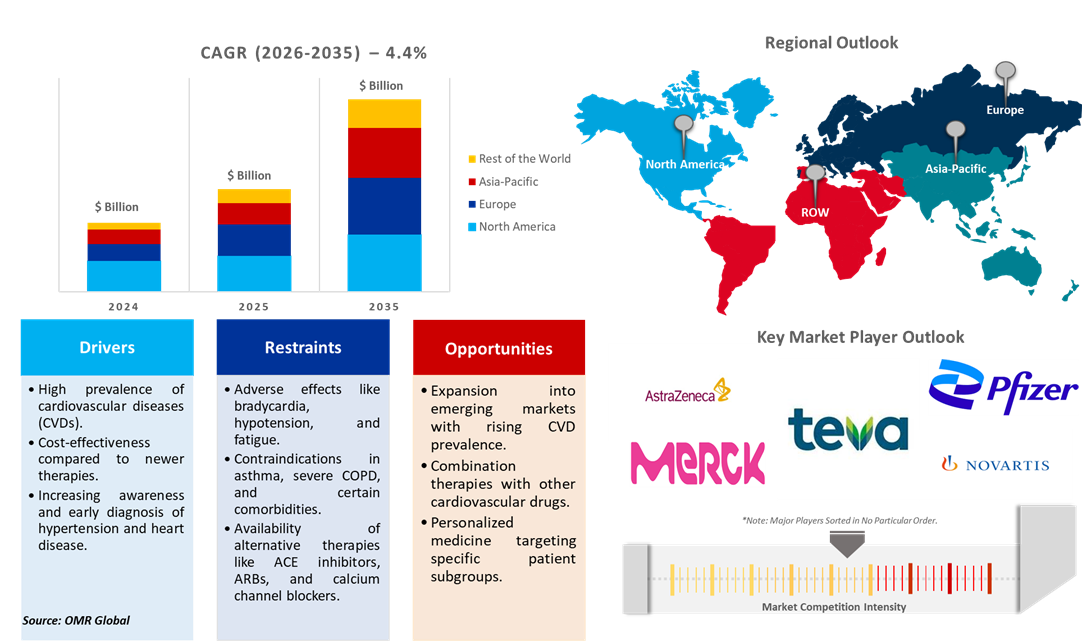
Beta-blocker market was valued at $10.2 billion in 2025 and is projected to reach $15.6 billion by 2035, growing at a CAGR of 4.4% during the forecast period (2026–2035). The global beta-blocker market is expanding at a steady pace owing to the rising prevalence of cardiovascular diseases, increasing geriatric population, growing awareness about hypertension and heart failure management, advancements in drug formulations, and favorable regulatory approvals. A beta-blocker is a type of medication that blocks beta-adrenergic receptors in the body. These receptors normally respond to hormones like adrenaline (epinephrine) and noradrenaline (norepinephrine), which regulate heart rate, blood pressure, and other functions.
Market Dynamics
Shift toward Highly Selective Beta Blockers Supported by EMA Regulatory Advancements
The beta-blocker market is experiencing a notable shift toward highly selective, cardio-focused agents, driven by their superior tolerability, safer profiles, and stronger clinical outcomes in both hypertension and heart-failure management. Selective molecules such as bisoprolol and nebivolol are increasingly preferred owing to reduced off-target effects and consistent evidence supporting improved patient adherence and long-term outcomes. This shift is further reinforced by regulatory developments in major markets. The European Medicines Agency (EMA) has granted product-specific pediatric waivers for nebivolol–ramipril capsule formulations, along with a separate waiver issued in 2023 for ramipril/nebivolol hydrochloride. Additionally, EMA’s continued listing of nationally authorized nebivolol products across EU member states underscores sustained regulatory confidence and therapeutic relevance. These approvals collectively support the broader market movement toward selective, evidence-backed beta-blockers and indicate ongoing expansion opportunities for advanced formulations within the cardiovascular therapy landscape.
Safety Concerns, Contraindications, and Competitive Therapies Limiting Beta Blocker Adoption
Despite their extensive therapeutic benefits, beta blockers are associated with several adverse effects, including bradycardia, hypotension, fatigue, dizziness, and nausea, which can limit patient compliance. These side effects may lead to dose reductions or discontinuation, ultimately affecting treatment outcomes. For instance, metoprolol, a commonly prescribed cardio-selective beta blocker, which is known to cause tiredness, dizziness, diarrhea or constipation, breathing problems and clinically significant bradycardia in some patients. Certain beta blockers are also contraindicated in individuals with specific medical conditions, such as asthma or severe respiratory disorders, and although cardio-selective agents like metoprolol pose a lower risk, caution is still advised. Furthermore, potential drug interactions with other cardiovascular or non-cardiovascular medications restrict their broader use. The availability of alternative therapies such as ACE inhibitors, ARBs, and calcium channel blockers provides clinicians with additional options, which may further limit beta blocker market adoption.
Market Segmentation
- Based on the category, the market is segmented into non-selective beta blockers, selective beta blockers and combined alpha and beta blockers.
- Based on the drug type, the market is segmented into metoprolol, carvedilol, atenolol, propranolol, timolol and others.
- Based on the application, the market is segmented into cardiac diseases, hypertension, glaucoma, and migraine and other.
- Based on the Route of Administration, the market is segmented into oral, intravenous and ophthalmic.
- Based on the distribution channel, the market is segmented into hospital pharmacy, retail pharmacy and online / E-Pharmacies.
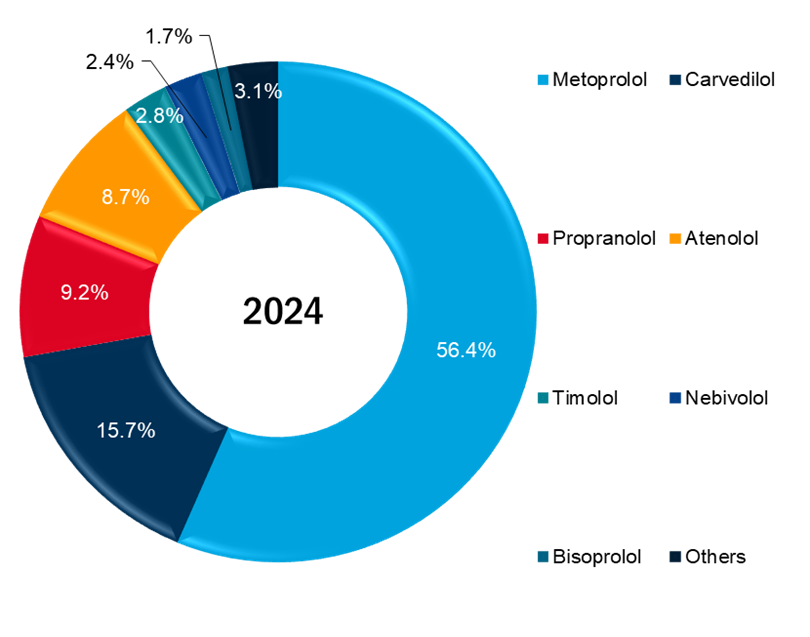
Metoprolol Remains Dominant Drug Types In the Beta-Blocker Market
Metoprolol remains one of the most dominant drug types in the beta-blocker market, supported by its widespread clinical use, well-established efficacy, and broad prescribing base across hypertension, angina, and heart-failure management. Its long-standing inclusion in major cardiovascular treatment guidelines and the availability of multiple formulations including immediate-release and extended-release variants have contributed to consistently high prescription volumes.
Leading pharmaceutical companies are actively expanding their portfolios to address this demand, with regulatory approvals enabling broader patient access to proven treatments. For instance, in August 2023, Lupin Ltd. received US FDA approval for its generic Metoprolol Succinate Extended-Release Tablets (25–200 mg), a bioequivalent to Toprol-XL. The product was manufactured at Lupin’s Pithampur facility in India. This approval allowed Lupin to market the drug in the US, strengthening its cardiovascular portfolio.
Established Pharmacologic Class (EPC) Comparison, US, 2023
Source: Medical Expenditure Panel Survey (MEPS) 2014-2023. Agency for Healthcare Research and Quality (AHRQ)
Regional Outlook
The global beta-blocker market is further divided by region, including North America (the US and Canada), Europe (the UK, Germany, France, Italy, Spain, Russia, and the Rest of Europe), Asia-Pacific (India, China, Japan, South Korea, Australia and New Zealand, ASEAN Countries, and the Rest of Asia-Pacific), and the Rest of the World (the Middle East & Africa, and Latin America).
North America Holds a Leading Position in the Global Beta-blocker Market
North America holds a significant share in the global beta blockers market, supported by a strong healthcare system, high treatment accessibility, and the substantial burden of cardiovascular diseases conditions for which beta blockers remain an essential component of clinical management. The region has well-established prescribing guidelines for hypertension, arrhythmias, heart failure, and post-myocardial infarction care, along with high awareness and early diagnosis rates. Additionally, the presence of leading pharmaceutical manufacturers, continuous introduction of improved formulations, and the large geriatric population further reinforce market growth.
The high prevalence of hypertension and heart-related mortality in the United States significantly contributes to regional market demand. Hypertension, a major risk factor for heart disease and stroke two leading causes of fatal outcomes in the country remains widespread. One out of every five fatal outcomes in the US are linked to heart disease, and 49.1% of adults aged 20 and older had hypertension from August 2021 to August 2023. In 2023, high blood pressure was identified as a primary or contributing factor in 664,470 fatal cases and nearly half of all the US adults (48.1%, or 119.9 million) have high blood pressure, yet only about one in four individuals with the condition (22.5%, 27 million) have it under control. This substantial untreated or undertreated patient population drives sustained demand for beta blockers across preventive and ongoing cardiovascular care.
Asia Pacific Beta-Blocker Market: Accelerated Growth and Strategic Industry Expansion
The Asia Pacific region is emerging as one of the fastest-growing markets for beta blockers, driven by rising cardiovascular disease burdens, expanding healthcare access, and increasing diagnosis rates. China remains a major growth engine, where hypertension prevalence though at 29% in 2024, slightly below global averages translates into a massive 271.5 million affected adults, or one in four. This large patient pool continues to fuel strong demand for antihypertensive therapies, including beta blockers. The region’s momentum is further reinforced by a surge in hypertension-related hospital admissions. In 2023, China recorded 1.854 million hospitalized hypertension patients, marking a 42.3% rise from 2022, reflecting heightened disease awareness and improved screening. As treatment needs intensify, beta blockers are increasingly adopted across Asia Pacific, strengthening the market’s overall growth trajectory.
Major pharmaceutical companies in the region are entering the beta-blocker segment, supported by strong global clinical evidence. The availability of internationally validated data is enabling the introduction of advanced and clinically proven cardiac therapies. For instance, in June 2025, Cadila Pharmaceuticals has entered the beta-blocker segment with the launch of Biscado (Bisoprolol) for cardiac care. The drug targets India-specific risks like high sympathetic activity and elevated resting heart rate. Backed by global trials, Bisoprolol shows superior survival benefits over Metoprolol and Carvedilol in heart-failure treatment. This trend is reinforcing the region’s position as an important market for evidence-driven innovations in cardiac care.
Market Players Outlook
The major companies operating in the global beta-blocker market include AstraZeneca plc, Merck KGaA, Novartis AG, Pfizer Inc. and Teva Pharmaceutical Industries Ltd., among others. Market players are leveraging partnerships, collaborations, mergers, and acquisition strategies for business expansion and innovative product development to maintain their market positioning.
Recent Developments
- In November 2024, FDA approved Rapiblyk (landiolol), an ultra-short-acting, beta-1 selective blocker by AOP Health for rapid heart rate control in hospitalized patients with supraventricular tachycardia. Clinical trials showed 40–90% of patients achieved significant heart rate reduction within 10 minutes. The most common side effect was hypotension (9.9%), and the drug is given as a titrated IV infusion in monitored settings.
The Report Covers
- Market value data analysis of 2026 and forecast to 2035.
- Annualized market revenues ($ million) for each market segment.
- Country-wise analysis of major geographical regions.
- Key companies operating in the global beta-blocker market. Based on the availability of data, information related to new products and relevant news is also available in the report.
- Analysis of business strategies by identifying the key market segments positioned for strong growth in the future.
- Analysis of market-entry and market expansion strategies.
- Competitive strategies by identifying ‘who-stands-where’ in the market.
- Report Summary
- Current Industry Analysis and Growth Potential Outlook
- Global Beta Blockers Market Sales Analysis – Category | Drug Type | Application | Route of Administration | Distribution Channel ($ Million)
- Beta Blockers Market Sales Market Sales Performance of Top Countries
- Research Methodology
- Primary Research Approach
- Secondary Research Approach
- Market Snapshot
- Market Overview and Insights
- Scope of the Study
- Analyst Insight & Current Market Trends
- Key Beta Blockers Market Trends
- Market Recommendations
- Market Determinants
- Market Drivers
- Drivers For Global Beta Blockers Market: Impact Analysis
- Market Pain Points and Challenges
- Restraints For Global Beta Blockers Market: Impact Analysis
- Market Opportunities
- Opportunities For Global Beta Blockers Market: Impact Analysis
- Market Drivers
- Competitive Landscape
- Competitive Dashboard – Beta Blockers Market Revenue and Share by Manufacturers
- Beta Blockers Type Comparison Analysis
- Top Market Player Ranking Matrix
- Key Company Analysis
- AstraZeneca Plc
- Overview
- Product Type Portfolio
- Financial Analysis
- SWOT Analysis
- Business Strategy
- Merck KGaA
- Overview
- Product Type Portfolio
- Financial Analysis
- SWOT Analysis
- Business Strategy
- Novartis AG
- Overview
- Product Type Portfolio
- Financial Analysis
- SWOT Analysis
- Business Strategy
- Pfizer Inc.
- Overview
- Product Type Portfolio
- Financial Analysis
- SWOT Analysis
- Business Strategy
- Teva Pharmaceutical Industries Ltd.
- Overview
- Product Type Portfolio
- Financial Analysis
- SWOT Analysis
- Business Strategy
- AstraZeneca Plc
- Key Company Analysis
- Top Winning Strategies by Market Players
- Merger and Acquisition
- Product Type Launch
- Partnership And Collaboration
- Global Beta Blockers Market Sales Analysis By Category ($ Million)
- Non-selective Beta Blockers
- Selective Beta Blockers
- Combined Alpha and Beta Blockers
- Global Beta Blockers Market Sales Analysis By Drug Type ($ Million)
- Metoprolol
- Carvedilol
- Atenolol
- Propranolol
- Timolol
- Others (Bisoprololm, Timolol, Nadolol)
- Global Beta Blockers Market Sales Analysis By Application ($ Million)
- Cardiac diseases
- Hypertension
- Glaucoma
- Migraine
- Other
- Global Beta Blockers Market Sales Analysis By Route of Administration ($ Million)
- Oral
- Intravenous
- Ophthalmic
- Global Beta Blockers Market Sales Analysis By Distribution Channel ($ Million)
- Hospital Pharmacy
- Retail Pharmacy
- Online / E-Pharmacies
- Regional Analysis
- North American Beta Blockers Market Sales Analysis – Category | Drug Type | Application| Route of Administration | Distribution Channel | Country ($ Million)
- Macroeconomic Factors for North America
- United States
- Canada
- European Beta Blockers Market Sales Analysis – Category | Drug Type | Application| Route of Administration | Distribution Channel | Country ($ Million)
- Macroeconomic Factors for Europe
- UK
- Germany
- Italy
- Spain
- France
- Russia
- Rest of Europe
- Asia-Pacific Beta Blockers Market Sales Analysis – Category | Drug Type | Application| Route of Administration | Distribution Channel | Country ($ Million)
- Macroeconomic Factors for Asia-Pacific
- China
- Japan
- South Korea
- India
- Australia & New Zealand
- ASEAN Countries (Thailand, Indonesia, Vietnam, Singapore, And Other)
- Rest of Asia-Pacific
- Rest of the World Beta Blockers Market Sales Analysis – Category | Drug Type | Application| Route of Administration | Distribution Channel | Country ($ Million)
- Macroeconomic Factors for the Rest of the World
- Latin America
- Middle East and Africa
- Company Profiles
- Abbott Laboratories, Inc.
- Quick Facts
- Company Overview
- Product Portfolio
- Business Strategies
- ANI Pharmaceuticals, Inc.
- Quick Facts
- Company Overview
- Product Portfolio
- Business Strategies
- AstraZeneca PLC
- Quick Facts
- Company Overview
- Product Portfolio
- Business Strategies
- AOP Orphan Pharmaceuticals GmbH
- Quick Facts
- Company Overview
- Product Portfolio
- Business Strategies
- Cipla Ltd
- Quick Facts
- Company Overview
- Product Portfolio
- Business Strategies
- CTX Lifesciences Pvt. Ltd.
- Quick Facts
- Company Overview
- Product Portfolio
- Business Strategies
- Cubic Lifesciences Pvt. Ltd.
- Quick Facts
- Company Overview
- Product Portfolio
- Business Strategies
- Reddy’s Laboratories Ltd
- Quick Facts
- Company Overview
- Product Portfolio
- Business Strategies
- Lupin Ltd.
- Quick Facts
- Company Overview
- Product Portfolio
- Business Strategies
- Merck KGaA
- Quick Facts
- Company Overview
- Product Portfolio
- Business Strategies
- Micro Labs Ltd.
- Quick Facts
- Company Overview
- Product Portfolio
- Business Strategies
- Mylan N.V.
- Quick Facts
- Company Overview
- Product Portfolio
- Business Strategies
- Novartis AG
- Quick Facts
- Company Overview
- Product Portfolio
- Business Strategies
- Pfizer Inc.
- Quick Facts
- Company Overview
- Product Portfolio
- Business Strategies
- Sandoz International GmbH
- Quick Facts
- Company Overview
- Product Portfolio
- Business Strategies
- Sanofi S.A.
- Quick Facts
- Company Overview
- Product Portfolio
- Business Strategies
- SimSon Pharma Ltd.
- Quick Facts
- Company Overview
- Product Portfolio
- Business Strategies
- Sun Pharmaceutical Industries Ltd
- Quick Facts
- Company Overview
- Product Portfolio
- Business Strategies
- Teva Pharmaceuticals Industries Ltd.
- Quick Facts
- Company Overview
- Product Portfolio
- Business Strategies
- Torrent Pharmaceuticals Ltd.
- Quick Facts
- Company Overview
- Product Portfolio
- Business Strategies
- Waylis Therapeutics LLC.
- Quick Facts
- Company Overview
- Product Portfolio
- Business Strategies
- Zydus Lifesciences Ltd.
- Quick Facts
- Company Overview
- Product Portfolio
- Business Strategies
- Abbott Laboratories, Inc.
1. Global Beta Blockers Market Research and Analysis By Category, 2025-2035 ($ Million)
2. Global Non-selective Beta Blockers Market Research and Analysis By Region, 2025-2035 ($ Million)
3. Global Selective Beta Blockers Market Research and Analysis By Region, 2025-2035 ($ Million)
4. Global Combined Alpha and Beta Blockers Market Research and Analysis By Region, 2025-2035 ($ Million)
5. Global Beta Blockers Market Research and Analysis By Drug Type, 2025-2035 ($ Million)
6. Global Metoprolol Beta Blockers Market Research and Analysis By Region, 2025-2035 ($ Million)
7. Global Carvedilol Beta Blockers Market Research and Analysis By Region, 2025-2035 ($ Million)
8. Global Atenolol Beta Blockers Market Research and Analysis By Region, 2025-2035 ($ Million)
9. Global Propranolol Beta Blockers Market Research and Analysis By Region, 2025-2035 ($ Million)
10. Global Timolol Beta Blockers Market Research and Analysis By Region, 2025-2035 ($ Million)
11. Global Other Drug Type Beta Blockers Market Research and Analysis By Region, 2025-2035 ($ Million)
12. Global Beta Blockers Market Research and Analysis By Application, 2025-2035 ($ Million)
13. Global Beta Blockers For Cardiac Diseases Market Research and Analysis By Region, 2025-2035 ($ Million)
14. Global Beta Blockers For Hypertension Market Research and Analysis By Region, 2025-2035 ($ Million)
15. Global Beta Blockers For Glaucoma Market Research and Analysis By Region, 2025-2035 ($ Million)
16. Global Beta Blockers For Migraine Market Research and Analysis By Region, 2025-2035 ($ Million)
17. Global Beta Blockers For Other Application Market Research and Analysis By Region, 2025-2035 ($ Million)
18. Global Beta Blockers Market Research and Analysis By Route of Administration, 2025-2035 ($ Million)
19. Global Oral Beta Blockers Market Research and Analysis By Region, 2025-2035 ($ Million)
20. Global Intravenous Beta Blockers Market Research and Analysis By Region, 2025-2035 ($ Million)
21. Global Ophthalmic Beta Blockers Market Research and Analysis By Region, 2025-2035 ($ Million)
22. Global Beta Blockers Market Research and Analysis By Distribution Channel, 2025-2035 ($ Million)
23. Global Beta Blockers Sales Via Hospital Pharmacy Market Research and Analysis By Region, 2025-2035 ($ Million)
24. Global Beta Blockers Sales Via Retail Pharmacy Market Research and Analysis By Region, 2025-2035 ($ Million)
25. Global Beta Blockers Sales Via Online/E-Pharmacies Market Research and Analysis By Region, 2025-2035 ($ Million)
26. Global Beta Blockers Market Research and Analysis By Region, 2025-2035 ($ Million)
27. North American Beta Blockers Market Research and Analysis By Country, 2025-2035 ($ Million)
28. North American Beta Blockers Market Research and Analysis By Category, 2025-2035 ($ Million)
29. North American Beta Blockers Market Research and Analysis By Drug Type, 2025-2035 ($ Million)
30. North American Beta Blockers Market Research and Analysis By Application, 2025-2035 ($ Million)
31. North American Beta Blockers Market Research and Analysis By Route of Administration, 2025-2035 ($ Million)
32. North American Beta Blockers Market Research and Analysis By Distribution Channel, 2025-2035 ($ Million)
33. European Beta Blockers Market Research and Analysis By Country, 2025-2035 ($ Million)
34. European Beta Blockers Market Research and Analysis By Category, 2025-2035 ($ Million)
35. European Beta Blockers Market Research and Analysis By Drug Type, 2025-2035 ($ Million)
36. European Beta Blockers Market Research and Analysis By Application, 2025-2035 ($ Million)
37. European Beta Blockers Market Research and Analysis By Route of Administration, 2025-2035 ($ Million)
38. European Beta Blockers Market Research and Analysis By Distribution Channel, 2025-2035 ($ Million)
39. Asia-Pacific Beta Blockers Market Research and Analysis By Country, 2025-2035 ($ Million)
40. Asia-Pacific Beta Blockers Market Research and Analysis By Category, 2025-2035 ($ Million)
41. Asia-Pacific Beta Blockers Market Research and Analysis By Drug Type, 2025-2035 ($ Million)
42. Asia-Pacific Beta Blockers Market Research and Analysis By Application, 2025-2035 ($ Million)
43. Asia-Pacific Beta Blockers Market Research and Analysis By Route of Administration, 2025-2035 ($ Million)
44. Asia-Pacific Beta Blockers Market Research and Analysis By Distribution Channel, 2025-2035 ($ Million)
45. Rest of The World Beta Blockers Market Research and Analysis By Country, 2025-2035 ($ Million)
46. Rest of The World Beta Blockers Market Research and Analysis By Category, 2025-2035 ($ Million)
47. Rest Of The World Beta Blockers Market Research and Analysis By Drug Type, 2025-2035 ($ Million)
48. Rest of The World Beta Blockers Market Research and Analysis By Application, 2025-2035 ($ Million)
49. Rest of The World Beta Blockers Market Research and Analysis By Route of Administration, 2025-2035 ($ Million)
50. Rest of The World Beta Blockers Market Research and Analysis By Distribution Channel, 2025-2035 ($ Million)
1. Global Beta Blockers Market Share By Category, 2025 Vs 2035 (%)
2. Global Non-selective Beta Blockers Market Share By Region, 2025 Vs 2035 (%)
3. Global Selective Beta Blockers Market Share By Region, 2025 Vs 2035 (%)
4. Global Combined Alpha and Beta Blockers Market Share By Region, 2025 Vs 2035 (%)
5. Global Beta Blockers Market Share By Drug Type, 2025 Vs 2035 (%)
6. Global Metoprolol Beta Blockers Market Share By Region, 2025 Vs 2035 (%)
7. Global Carvedilol Beta Blockers Market Share By Region, 2025 Vs 2035 (%)
8. Global Atenolol Beta Blockers Market Share By Region, 2025 Vs 2035 (%)
9. Global Propranolol Beta Blockers Market Share By Region, 2025 Vs 2035 (%)
10. Global Timolol Beta Blockers Market Share By Region, 2025 Vs 2035 (%)
11. Global Other Drug Type Beta Blockers Market Share By Region, 2025 Vs 2035 (%)
12. Global Beta Blockers Market Share By Application, 2025 Vs 2035 (%)
13. Global Beta Blockers For Cardiac Diseases Market Share By Region, 2025 Vs 2035 (%)
14. Global Beta Blockers For Hypertension Market Share By Region, 2025 Vs 2035 (%)
15. Global Beta Blockers For Glaucoma Market Share By Region, 2025 Vs 2035 (%)
16. Global Beta Blockers For Migraine Market Share By Region, 2025 Vs 2035 (%)
17. Global Beta Blockers For Other Market Share By Region, 2025 Vs 2035 (%)
18. Global Beta Blockers Market Share By Route of Administration, 2025 Vs 2035 (%)
19. Global Oral Beta Blockers Market Share By Region, 2025 Vs 2035 (%)
20. Global Intravenous Beta Blockers Market Share By Region, 2025 Vs 2035 (%)
21. Global Ophthalmic Beta Blockers Transportation Market Share By Region, 2025 Vs 2035 (%)
22. Global Beta Blockers Market Share By Distribution Channel, 2025 Vs 2035 (%)
23. Global Beta Blockers Sale Via Hospital Pharmacy Market Share By Region, 2025 Vs 2035 (%)
24. Global Beta Blockers Sale Via Retail Pharmacy Market Share By Region, 2025 Vs 2035 (%)
25. Global Beta Blockers Sale Via Online / E-Pharmacies Market Share By Region, 2025 Vs 2035 (%)
26. US Beta Blockers Market Size, 2025-2035 ($ Million)
27. Canada Beta Blockers Market Size, 2025-2035 ($ Million)
28. UK Beta Blockers Market Size, 2025-2035 ($ Million)
29. France Beta Blockers Market Size, 2025-2035 ($ Million)
30. Germany Beta Blockers Market Size, 2025-2035 ($ Million)
31. Italy Beta Blockers Market Size, 2025-2035 ($ Million)
32. Spain Beta Blockers Market Size, 2025-2035 ($ Million)
33. Russia Beta Blockers Market Size, 2025-2035 ($ Million)
34. Rest of Europe Beta Blockers Market Size, 2025-2035 ($ Million)
35. India Beta Blockers Market Size, 2025-2035 ($ Million)
36. China Beta Blockers Market Size, 2025-2035 ($ Million)
37. Japan Beta Blockers Market Size, 2025-2035 ($ Million)
38. South Korea Beta Blockers Market Size, 2025-2035 ($ Million)
39. Australia and New Zealand Beta Blockers Market Size, 2025-2035 ($ Million)
40. ASEAN Economies Beta Blockers Market Size, 2025-2035 ($ Million)
41. Rest of Asia-Pacific Beta Blockers Market Size, 2025-2035 ($ Million)
42. Latin America Beta Blockers Market Size, 2025-2035 ($ Million)
43. Middle East and Africa Beta Blockers Market Size, 2025-2035 ($ Million)
- Printable version
- No restriction to number of users within the company