Botanical Ingredients Market


Botanical Ingredients Market Size, Share & Trends Analysis Report by Ingredient Type (Extracts, Essential Oils, Oleoresins, Plant Powders, Phytochemicals, and Others), by Source (Herbs, Spices, Fruits, Roots and Seeds, and Others), by Form (Powder, Liquid, and Oil), and by Application (Food and Beverages, Dietary Supplements, Cosmetics and Personal Care, Pharmaceuticals, and Other), Forecast Period (2026-2035)
Industry Overview
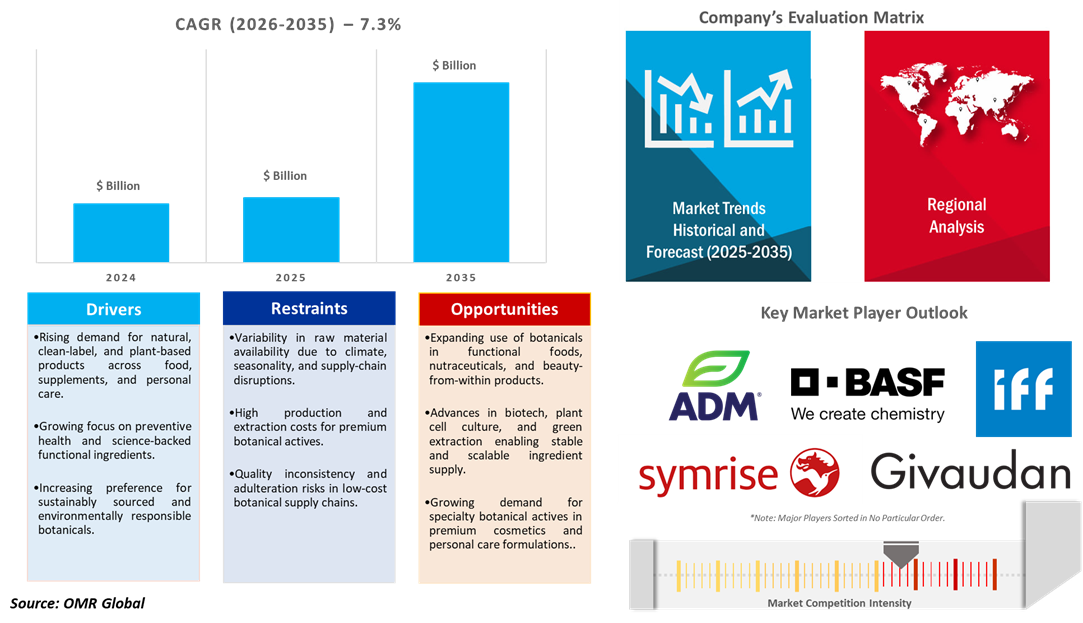
Botanical ingredients market was valued at $5.7 billion in 2025 and is projected to reach $11.4 billion by 2035, growing at a CAGR of 7.3% during the forecast period (2026–2035). Botanical ingredients are plant-derived compounds, including extracts, essential oils, oleoresins, powders, and phytochemicals, widely used across food and beverages, dietary supplements, cosmetics, and pharmaceuticals. The market is driven by increasing consumer demand for natural, clean-label, and functional products. Health-conscious lifestyles and interest in preventive healthcare continue to push botanical adoption, supported by emerging research linking botanicals with benefits for immunity, digestive health, mental wellbeing, and heart health. Buyers increasingly look for natural ingredients backed by verified science, while also expecting ethical sourcing and environmentally responsible production, further strengthening demand across global markets.
Market Dynamics
Rising Demand for Botanical Ingredients in Food and Beverage Applications
The growing consumer preference for natural, plant-based ingredients in food and beverages is a key driver of the global botanical ingredients market. Consumers are increasingly seeking products that combine flavor, functionality, and wellness benefits, encouraging manufacturers to integrate botanical extracts, syrups, and herbal formulations into their offerings. Companies are responding by launching innovative botanical-based products that meet this demand. For instance:
- Torani announced Forest Pine as its 2026 “Flavor of the Year,” adding a unique botanical syrup to its 400+ product lineup. Torani’s new Forest Pine syrup blends pine, ginger, and sage to evoke the outdoors, enhancing various beverages. Part of their Puremade line, it uses pure cane sugar and natural ingredients without artificial flavors or colors.
- In September 2025, Israeli food-tech start-up Solveat partnered with The Central Bottling Company to develop functional soft drinks infused with Solveat’s patented natural herbal formulations, targeting metabolic support, blood sugar control, and other wellness benefits.
Rising Preference for Clean-Label Personal Care Formulations
Clean-label expectations are reshaping ingredient selection in the cosmetics and personal care industry, with consumers placing greater emphasis on natural, transparent, and organic formulations. This shift is strengthening demand for botanical ingredients, as brands move away from synthetic additives and toward plant-derived actives that align with safety and transparency standards. Recent consumer findings reinforce this transition. The National Science Foundation (NSF) reported in its 2024 survey that 74% of consumers consider organic ingredients important in personal care products, while 65% want clear ingredient lists to identify potentially harmful ingredients. These preferences are increasingly steering formulators toward botanicals, supporting steady growth for botanical ingredients in clean-label beauty products.
Market Segmentation
- Based on the ingredient type, the market is segmented into extracts, essential oils, oleoresins, plant powders, phytochemicals, and others.
- Based on the source, the market is segmented into herbs, spices, fruits, roots and seeds, and others.
- Based on the form, the market is segmented into powder, liquid, and oil.
- Based on the application, the market is segmented into food and beverages, dietary supplements, cosmetics and personal care, pharmaceuticals, and other.
Cosmetics and Personal Care Account for the Largest Share of the Global Botanical Ingredients Market
The cosmetics and personal care segment holds the largest share of the global botanical ingredients market, driven by rising consumer demand for natural-origin, high-performing ingredients. Botanical extracts are widely used in skin care, hair care, and personal care formulations, with established suppliers such as Givaudan, Symrise, and Evonik providing a broad range of actives and extracts to meet this demand. For Instance, in September 2024, Evonik introduced two sustainable, natural active ingredients for beauty and personal care: CapilAcid, a Maqui fruit-derived antioxidant protecting hair, and Oleobiota, a sebum-normalizing ingredient sourced from the Misiones rainforest. Both products come from Novachem, acquired by Evonik a year ago and now part of its Care Solutions business.
Dietary Supplements Represent the Fastest-Growing Segment in the Global Botanical Ingredients Market.
The increasing focus on health, wellness, and preventive care is driving demand for botanical ingredients in dietary supplements. Consumers are seeking natural solutions to support specific health needs, such as hormonal balance, immunity, and cognitive function, prompting companies to develop innovative supplements that combine botanicals with other functional ingredients. This trend is encouraging manufacturers to invest in botanical formulations and advanced extraction technologies to deliver high-quality, effective products. For instance:
- In October 2025, Resbiotic Nutrition, Inc. launched resW Perimenopause Postbiotic, a heat-treated probiotic supplement designed to support women during perimenopause. The formula combines postbiotic L. plantarum RSB11 with botanicals like Chasteberry, Black Cohosh, Magnesium Glycinate, L-Theanine, and vitamins D3, B6, and B12.
- In May 2024, Indena and DSM-Firmenich showcased new dietary supplement solutions at Vitafoods Europe 2024, combining botanicals with biotics in enjoyable formats that enhance flavor and taste.
Regional Outlook
The global botanical ingredients market is further divided by region, including North America (the US and Canada), Europe (the UK, Germany, France, Italy, Spain, Russia, and the Rest of Europe), Asia-Pacific (India, China, Japan, South Korea, Australia and New Zealand, ASEAN Countries, and the Rest of Asia-Pacific), and the Rest of the World (the Middle East & Africa, and Latin America).
Europe Emerges as a Key Growth Region in the Botanical Ingredients Market
Europe is becoming a critical region for botanical ingredients, fueled by its robust cosmetics and personal care sector and rising demand for natural, plant-based actives. According to CBI (Centre for the Promotion of Imports from developing countries), the European cosmetics market was valued at €96?billion in 2023, making up roughly 24% of the global beauty and personal care market. Given the high consumption of natural cosmetic formulations in Europe, the demand for botanical extracts, essential oils, and other natural ingredients is expected to grow significantly in this region.
Market Players Outlook
The major companies operating in the global botanical ingredients market include Archer Daniels Midland Company (ADM), BASF SE, Givaudan International SA, International Flavors & Fragrances Inc., Symrise Group, among others. Market players are leveraging partnerships, collaborations, mergers, and acquisition strategies for business expansion and innovative product development to maintain their market positioning.
Recent Developments
- In October 2025, Symrise, with 70+ years in botanical extraction, launched two new Actipone products: Actipone Pure Balance CC and Neo Actipone AHA Renew, to meet growing consumer demand for high-performance, natural cosmetic ingredients. These ingredients are standardized to key plant molecules, backed by enhanced scientific efficacy data (in vitro and ex vivo), and offer 100% natural origin content per ISO 16128.
- In May 2024, Evonik created a new Botanicals & Natural Actives segment within its Nutrition & Care division to consolidate expertise from legacy products and recent acquisitions. This segment enhances Evonik’s ability to meet rising demand for botanical extracts and scientifically supported natural actives, supported by its Skin Institute. Through strategic partnerships and a B2B approach, Evonik offers both standardized biotech natural actives and customized plant-based solutions for beauty and personal care markets.
- In 2024, Givaudan showcased consumer-inspired concepts at Vitafoods Europe 2024, featuring instant drinks and gummies with branded botanical ingredients. These address immune support, urinary tract health, cognition, relaxation, energy, and gut health.
- In September 2024, Ayana Bio and TruHealthMatters launched NeuroNovum and ImmunoNovum, the first commercial products using Ayana Bio’s Plant Cell Advantage (PCA) technology. This innovation ensures a stable, contaminant-free, and sustainable supply of botanical supplements.
- In July 2024, PLT Health Solutions announced the addition of Vanizem, a botanical ingredient from Aframomum melegueta (Grains of Paradise), to its cognitive health portfolio in North America. Clinically shown to reduce stress, improve mood, enhance happiness, and boost sleep quality, Vanizem demonstrated significant benefits in tension reduction, sleep quality, mood, vigor, and ease of falling asleep.
- Natural Field, a top Chinese botanical ingredient supplier, will unveil its Ashwagandha White Paper at the Food Technology and Application Forum in Hangzhou. The event gathers experts in nutrition and health innovation.
The Report Covers
- Market value data analysis of 2025 and forecast to 2035.
- Annualized market revenues ($ million) for each market segment.
- Country-wise analysis of major geographical regions.
- Key companies operating in the global botanical ingredients market. Based on the availability of data, information related to new products and relevant news is also available in the report.
- Analysis of business strategies by identifying the key market segments positioned for strong growth in the future.
- Analysis of market-entry and market expansion strategies.
- Competitive strategies by identifying ‘who-stands-where’ in the market.
- Report Summary
- Current Industry Analysis and Growth Potential Outlook
- Global Botanical Ingredients Market Sales Analysis – Ingredient Type| Source| Form| Application ($ Million)
- Botanical Ingredients Market Sales Performance of Top Countries
- Research Methodology
- Primary Research Approach
- Secondary Research Approach
- Market Snapshot
- Market Overview and Insights
- Scope of the Study
- Analyst Insight & Current Market Trends
- Key Botanical Ingredients Industry Trends
- Market Recommendations
- Porter's Five Forces Analysis for the Botanical Ingredients Market
- Competitive Rivalry
- Threat of New Entrants
- Bargaining Power of Suppliers
- Bargaining Power of Buyers
- Threat of Substitutes
- Market Determinants
- Market Drivers
- Drivers For Global Botanical Ingredients Market: Impact Analysis
- Market Pain Points and Challenges
- Restraints For Global Botanical Ingredients Market: Impact Analysis
- Market Opportunities
- Opportunities For Global Botanical Ingredients Market: Impact Analysis
- Market Drivers
- Competitive Landscape
- Competitive Dashboard – Botanical Ingredients Market Revenue and Share by Manufacturers
- Botanical Ingredients Product Comparison Analysis
- Top Market Player Ranking Matrix
- Key Company Analysis
- Archer Daniels Midland Company (ADM)
- Overview
- Product Portfolio
- Financial Analysis
- SWOT Analysis
- Business Strategy
- BASF SE
- Overview
- Product Portfolio
- Financial Analysis
- SWOT Analysis
- Business Strategy
- Givaudan International SA
- Overview
- Product Portfolio
- Financial Analysis
- SWOT Analysis
- Business Strategy
- International Flavors & Fragrances Inc.
- Overview
- Product Portfolio
- Financial Analysis
- SWOT Analysis
- Business Strategy
- Symrise Group
- Overview
- Product Portfolio
- Financial Analysis
- SWOT Analysis
- Business Strategy
- Top Winning Strategies by Market Players
- Merger and Acquisition
- Product Launch
- Partnership And Collaboration
- Archer Daniels Midland Company (ADM)
- Key Company Analysis
- Global Botanical Ingredients Market Sales Analysis by Ingredient Type ($ Million)
- Extracts
- Essential Oils
- Oleoresins
- Plant Powders
- Phytochemicals
- Others
- Global Botanical Ingredients Market Sales Analysis by Source ($ Million)
- Herbs
- Spices
- Fruits
- Roots and Seeds
- Others
- Global Botanical Ingredients Market Sales Analysis by Form ($ Million)
- Powder
- Liquid
- Oil
- Global Botanical Ingredients Market Sales Analysis by Application ($ Million)
- Food and Beverages
- Dietary Supplements
- Cosmetics and Personal Care
- Pharmaceuticals
- Other
- Regional Analysis
- North American Botanical Ingredients Market Sales Analysis – Ingredient Type| Source| Form| Application| Country ($ Million)
- Macroeconomic Factors for North America
- United States
- Canada
- European Botanical Ingredients Market Sales Analysis – Ingredient Type| Source| Form| Application| Country ($ Million)
- Macroeconomic Factors for Europe
- UK
- Germany
- Italy
- Spain
- France
- Russia
- Rest of Europe
- Asia-Pacific Botanical Ingredients Market Sales Analysis – Ingredient Type| Source| Form| Application| Country ($ Million)
- Macroeconomic Factors for Asia-Pacific
- China
- Japan
- South Korea
- India
- Australia & New Zealand
- ASEAN Countries (Thailand, Indonesia, Vietnam, Singapore, And Other)
- Rest of Asia-Pacific
- Rest of the World Botanical Ingredients Market Sales Analysis – Ingredient Type| Source| Form| Application| Country ($ Million)
- Macroeconomic Factors for Rest of the World
- Latin America
- Middle East and Africa
- Company Profiles
- Ambe Phytoextracts Pvt. Ltd.
- Quick Facts
- Company Overview
- Product Portfolio
- Business Strategies
- Archer Daniels Midland Company (ADM)
- Quick Facts
- Company Overview
- Product Portfolio
- Business Strategies
- Arjuna Natural Pvt Ltd.
- Quick Facts
- Company Overview
- Product Portfolio
- Business Strategies
- BASF SE
- Quick Facts
- Company Overview
- Product Portfolio
- Business Strategies
- Bell Flavors & Fragrances, Inc.
- Quick Facts
- Company Overview
- Product Portfolio
- Business Strategies
- Berjé Inc.
- Quick Facts
- Company Overview
- Product Portfolio
- Business Strategies
- Blue Sky Botanics
- Quick Facts
- Company Overview
- Product Portfolio
- Business Strategies
- Döhler GmbH
- Quick Facts
- Company Overview
- Product Portfolio
- Business Strategies
- DSM-Firmenich AG
- Quick Facts
- Company Overview
- Product Portfolio
- Business Strategies
- Evonik Industries AG
- Quick Facts
- Company Overview
- Product Portfolio
- Business Strategies
- Gencor
- Quick Facts
- Company Overview
- Product Portfolio
- Business Strategies
- Givaudan International SA
- Quick Facts
- Company Overview
- Product Portfolio
- Business Strategies
- Indena S.p.A.
- Quick Facts
- Company Overview
- Product Portfolio
- Business Strategies
- Indesso
- Quick Facts
- Company Overview
- Product Portfolio
- Business Strategies
- International Flavors & Fragrances Inc.
- Quick Facts
- Company Overview
- Product Portfolio
- Business Strategies
- Kalsec, Inc.
- Quick Facts
- Company Overview
- Product Portfolio
- Business Strategies
- Kerry Group plc
- Quick Facts
- Company Overview
- Product Portfolio
- Business Strategies
- Layn USA, Inc
- Quick Facts
- Company Overview
- Product Portfolio
- Business Strategies
- Lipoid Kosmetik AG
- Quick Facts
- Company Overview
- Product Portfolio
- Business Strategies
- Mane Kancor Ingredients Private Ltd.
- Quick Facts
- Company Overview
- Product Portfolio
- Business Strategies
- Merck Group
- Quick Facts
- Company Overview
- Product Portfolio
- Business Strategies
- Nexira
- Quick Facts
- Company Overview
- Product Portfolio
- Business Strategies
- OBG Pharmaceuticals Ltd. (Ransom Naturals Ltd)
- Quick Facts
- Company Overview
- Product Portfolio
- Business Strategies
- PLT Health Solutions
- Quick Facts
- Company Overview
- Product Portfolio
- Business Strategies
- Rutland Biodynamics Ltd.
- Quick Facts
- Company Overview
- Product Portfolio
- Business Strategies
- Sabinsa Corp.
- Quick Facts
- Company Overview
- Product Portfolio
- Business Strategies
- Symrise Group
- Quick Facts
- Company Overview
- Product Portfolio
- Business Strategies
- Synthite Group
- Quick Facts
- Company Overview
- Product Portfolio
- Business Strategies
- Ambe Phytoextracts Pvt. Ltd.
1. Global Botanical Ingredients Market Research and Analysis by Ingredient Type, 2025–2035 ($ Million)
2. Global Botanical Extracts Market Research and Analysis by Region, 2025–2035 ($ Million)
3. Global Botanical Essential Oils Market Research and Analysis by Region, 2025–2035 ($ Million)
4. Global Botanical Oleoresins Market Research and Analysis by Region, 2025–2035 ($ Million)
5. Global Botanical Plant Powders Market Research and Analysis by Region, 2025–2035 ($ Million)
6. Global Botanical Phytochemicals Market Research and Analysis by Region, 2025–2035 ($ Million)
7. Global Other Botanical Ingredients Market Research and Analysis by Region, 2025–2035 ($ Million)
8. Global Botanical Ingredients Market Research and Analysis by Source, 2025–2035 ($ Million)
9. Global Botanical Ingredients from Herbs Market Research and Analysis by Region, 2025–2035 ($ Million)
10. Global Botanical Ingredients from Spices Market Research and Analysis by Region, 2025–2035 ($ Million)
11. Global Botanical Ingredients from Fruits Market Research and Analysis by Region, 2025–2035 ($ Million)
12. Global Botanical Ingredients from Roots and Seeds Market Research and Analysis by Region, 2025–2035 ($ Million)
13. Global Botanical Ingredients from Others Source Market Research and Analysis by Region, 2025–2035 ($ Million)
14. Global Botanical Ingredients Market Research and Analysis by Form, 2025–2035 ($ Million)
15. Global Botanical Ingredients in Powder Form Market Research and Analysis by Region, 2025–2035 ($ Million)
16. Global Botanical Ingredients in Liquid Form Market Research and Analysis by Region, 2025–2035 ($ Million)
17. Global Botanical Ingredients in Oil Form Market Research and Analysis by Region, 2025–2035 ($ Million)
18. Global Botanical Ingredients Market Research and Analysis by Application, 2025–2035 ($ Million)
19. Global Botanical Ingredients for Food and Beverages Market Research and Analysis by Region, 2025–2035 ($ Million)
20. Global Botanical Ingredients for Dietary Supplements Market Research and Analysis by Region, 2025–2035 ($ Million)
21. Global Botanical Ingredients for Cosmetics and Personal Care Market Research and Analysis by Region, 2025–2035 ($ Million)
22. Global Botanical Ingredients for Pharmaceuticals Market Research and Analysis by Region, 2025–2035 ($ Million)
23. Global Botanical Ingredients for Other Applications Market Research and Analysis by Region, 2025–2035 ($ Million)
24. Global Botanical Ingredients Market Research and Analysis by Region, 2025–2035 ($ Million)
25. North American Botanical Ingredients Market Research and Analysis by Country, 2025–2035 ($ Million)
26. North American Botanical Ingredients Market Research and Analysis by Ingredient Type, 2025–2035 ($ Million)
27. North American Botanical Ingredients Market Research and Analysis by Source, 2025–2035 ($ Million)
28. North American Botanical Ingredients Market Research and Analysis by Form, 2025–2035 ($ Million)
29. North American Botanical Ingredients Market Research and Analysis by Application, 2025–2035 ($ Million)
30. European Botanical Ingredients Market Research and Analysis by Country, 2025–2035 ($ Million)
31. European Botanical Ingredients Market Research and Analysis by Ingredient Type, 2025–2035 ($ Million)
32. European Botanical Ingredients Market Research and Analysis by Source, 2025–2035 ($ Million)
33. European Botanical Ingredients Market Research and Analysis by Form, 2025–2035 ($ Million)
34. European Botanical Ingredients Market Research and Analysis by Application, 2025–2035 ($ Million)
35. Asia-Pacific Botanical Ingredients Market Research and Analysis by Country, 2025–2035 ($ Million)
36. Asia-Pacific Botanical Ingredients Market Research and Analysis by Ingredient Type, 2025–2035 ($ Million)
37. Asia-Pacific Botanical Ingredients Market Research and Analysis by Source, 2025–2035 ($ Million)
38. Asia-Pacific Botanical Ingredients Market Research and Analysis by Form, 2025–2035 ($ Million)
39. Asia-Pacific Botanical Ingredients Market Research and Analysis by Application, 2025–2035 ($ Million)
40. Rest of the World Botanical Ingredients Market Research and Analysis by Region, 2025–2035 ($ Million)
41. Rest of the World Botanical Ingredients Market Research and Analysis by Ingredient Type, 2025–2035 ($ Million)
42. Rest of the World Botanical Ingredients Market Research and Analysis by Source, 2025–2035 ($ Million)
43. Rest of the World Botanical Ingredients Market Research and Analysis by Form, 2025–2035 ($ Million)
44. Rest of the World Botanical Ingredients Market Research and Analysis by Application, 2025–2035 ($ Million)
1. Global Botanical Ingredients Market Share by Ingredient Type, 2025 Vs 2035 (%)
2. Global Botanical Extracts Market Share by Region, 2025 Vs 2035 (%)
3. Global Botanical Essential Oils Market Share by Region, 2025 Vs 2035 (%)
4. Global Botanical Oleoresins Market Share by Region, 2025 Vs 2035 (%)
5. Global Botanical Plant Powders Market Share by Region, 2025 Vs 2035 (%)
6. Global Botanical Phytochemicals Market Share by Region, 2025 Vs 2035 (%)
7. Global Other Botanical Ingredients Market Share by Region, 2025 Vs 2035 (%)
8. Global Botanical Ingredients Market Share by Source, 2025 Vs 2035 (%)
9. Global Botanical Ingredients from Herbs Market Share by Region, 2025 Vs 2035 (%)
10. Global Botanical Ingredients from Spices Market Share by Region, 2025 Vs 2035 (%)
11. Global Botanical Ingredients from Fruits Market Share by Region, 2025 Vs 2035 (%)
12. Global Botanical Ingredients from Roots and Seeds Market Share by Region, 2025 Vs 2035 (%)
13. Global Botanical Ingredients from Others Source Market Share by Region, 2025 Vs 2035 (%)
14. Global Botanical Ingredients Market Share by Form, 2025 Vs 2035 (%)
15. Global Botanical Ingredients in Powder Form Market Share by Region, 2025 Vs 2035 (%)
16. Global Botanical Ingredients in Liquid Form Market Share by Region, 2025 Vs 2035 (%)
17. Global Botanical Ingredients in Oil Form Market Share by Region, 2025 Vs 2035 (%)
18. Global Botanical Ingredients Market Share by Application, 2025 Vs 2035 (%)
19. Global Botanical Ingredients for Food and Beverages Market Share by Region, 2025 vs 2035 (%)
20. Global Botanical Ingredients for Dietary Supplements Market Share by Region, 2025 vs 2035 (%)
21. Global Botanical Ingredients for Cosmetics and Personal Care Market Share by Region, 2025 vs 2035 (%)
22. Global Botanical Ingredients for Pharmaceuticals Market Share by Region, 2025 vs 2035 (%)
23. Global Botanical Ingredients for Other Applications Market Share by Region, 2025 vs 2035 (%)
24. Global Botanical Ingredients Market Share by Region, 2025 Vs 2035 (%)
25. US Botanical Ingredients Market Size, 2025–2035 ($ Million)
26. Canada Botanical Ingredients Market Size, 2025–2035 ($ Million)
27. UK Botanical Ingredients Market Size, 2025–2035 ($ Million)
28. France Botanical Ingredients Market Size, 2025–2035 ($ Million)
29. Germany Botanical Ingredients Market Size, 2025–2035 ($ Million)
30. Italy Botanical Ingredients Market Size, 2025–2035 ($ Million)
31. Spain Botanical Ingredients Market Size, 2025–2035 ($ Million)
32. Russia Botanical Ingredients Market Size, 2025–2035 ($ Million)
33. Rest of Europe Botanical Ingredients Market Size, 2025–2035 ($ Million)
34. India Botanical Ingredients Market Size, 2025–2035 ($ Million)
35. China Botanical Ingredients Market Size, 2025–2035 ($ Million)
36. Japan Botanical Ingredients Market Size, 2025–2035 ($ Million)
37. South Korea Botanical Ingredients Market Size, 2025–2035 ($ Million)
38. Australia and New Zealand Botanical Ingredients Market Size, 2025–2035 ($ Million)
39. ASEAN Economies Botanical Ingredients Market Size, 2025–2035 ($ Million)
40. Rest of Asia-Pacific Botanical Ingredients Market Size, 2025–2035 ($ Million)
41. Latin America Botanical Ingredients Market Size, 2025–2035 ($ Million)
42. Middle East and Africa Botanical Ingredients Market Size, 2025–2035 ($ Million)
- Printable version
- No restriction to number of users within the company