E-Commerce Platform Market


E-Commerce Platform Market Size, Share & Trends Analysis Report by Deployment Method (On-Premise, Cloud-Based, and Open-Source), by Business Size (Small and Medium-Sized Businesses (SMBs), and Enterprise Businesses), by Industry (Beauty & Personal Care, Consumer Electronics, Food & Beverage, Health & Wellness, and Others (Home Decor, Household Consumables, Fashion & Apparel)), and by Functionality (Product Management, Order Management, Payment Processing, Inventory Management, and Marketing and Analytics), Forecast Period (2025-2035)
Industry Overview
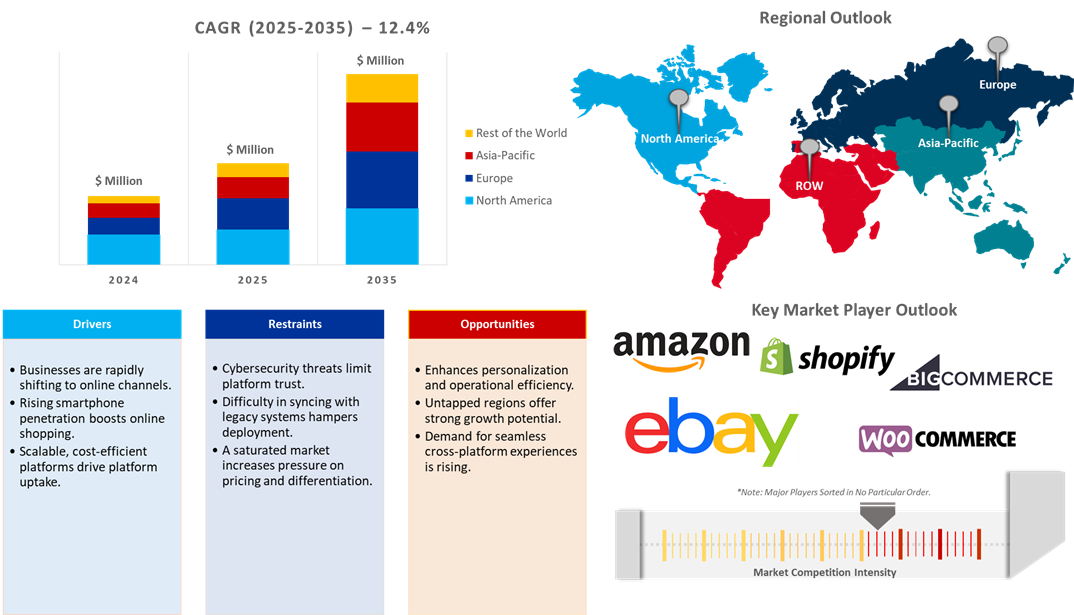
E-commerce platform market was valued at $8.9 billion in 2024 and is projected to reach $31.9 billion by 2035, growing at a CAGR of 12.4% during the forecast period (2025-2035). The e-commerce platform market continues to grow with a rapid transition occurring to a digital retailing environment across the marketplace. Companies are focusing on online environments that help them reach and serve customers and improve operational efficiency. As demand for ideal user evolving experiences necessitates substantiated shopping experiences, more platforms are being developed. All these factors work together to shape the market trend across developed and emerging markets. According to the International Trade Administration (ITA), 2024, e-commerce sales for B2B businesses have been steadily rising year over year for the last decade, with the global B2B e-commerce market valued at $36 trillion by 2026. Similar to advanced manufacturing, energy, and healthcare, the professional business services industry and heavy industry also account for the majority of this B2B trade value.
Market Dynamics
AI-Powered Personalization Driving Market Expansion
The market for e-commerce platforms is growing rapidly, as companies take advantage of AI-powered personalization to improve their engagement with customers. The personalization tools allow e-commerce platforms to monitor user behavior, preferences, and purchasing, to be able to make better product recommendations while providing more relevant content to customers. By personalizing their digital storefronts, e-commerce platforms can improve a customer’s experience, drive actions more quickly, and grow customer loyalty. In an increasingly competitive landscape for market share, companies are leaning on intelligent automation (robotizing) to develop differentiated digital storefronts that respond dynamically to customers' wants.
Growth in E-Commerce Platforms Supported by Voice Commerce Integration
Voice commerce is a growing trend that impacts the technology frameworks of e-commerce platforms. Consumers increasingly continue to use voice assistants and smart speakers for shopping and digital retailing, owing to the convenience and ease of voice-activated shopping. Many e-commerce platforms have developed or added voice-enabled shopping that integrates better ways for consumers to search, order, and engage with customer service, growing accessibility, and putting reach on new audiences. Raising voice technology as a strategic priority to provide consumers with uninterrupted hands-free experiences of digital retail is necessary.
Market Segmentation
- Based on the deployment method, the market is segmented into on-premise, cloud-based, and open-source.
- Based on the business size, the market is segmented into small and medium-sized businesses (SMBs), and enterprise businesses.
- Based on the industry, the market is segmented into beauty & personal care, consumer electronics, food & beverage, health & wellness, and others.
- Based on the functionality, the market is segmented into product management, order management, payment processing, inventory management, and marketing and analytics.
Cloud-Based Segment to Lead the Market with the Largest Share
The e-commerce platform sector is thriving, and much of the growth is being driven by a movement in consumer preferences towards cloud deployment models. Many e-commerce platforms allow organizations to operate efficiently and cost-effectively since those platforms can scale effortlessly, with the lowest expense structure possible. For e-commerce platforms with a cloud-deployment model, actual total updates are simplified, data security is continuous (and often happens at a block level), and integration with other digital tools is constant and adaptable. The cloud's deployment capability is ideal for adapting a new digital e-commerce strategy into the potential agile retail environment. For instance, Salesforce, Inc., offers Commerce Cloud, a cloud-native solution designed to support individualized and scalable online shopping experiences.
Consumer Electronics: A Key Segment in Market Growth
The expansion of the e-commerce platform market is particularly driven by the consumer electronics sector's transition to cloud-based systems. The increasing demand for perfect digital experiences, companies in this industry are using cloud platforms to manage high product volumes, complex supplies, and real-time customer relations. These results enable rapid deployment, enhanced system dependability, and better integration with payment and logistics services. The power to handle vast operations while holding facility and responsiveness has created cloud-based platforms as an integral part of digital strategies in the consumer electronics area.
Regional Outlook
The global e-commerce platform market is further divided by geography, including North America (the US and Canada), Europe (the UK, Germany, France, Italy, Spain, Russia, and the Rest of Europe), Asia-Pacific (India, China, Japan, South Korea, Australia and New Zealand, ASEAN Countries, and the Rest of Asia-Pacific), and the Rest of the World (the Middle East & Africa, and Latin America).
Growing Demand for Digital Commerce in Asia-Pacific
The e-commerce platforms in the Asia-Pacific region are achieving acceleration owing to growing internet availability and the widespread approval of smartphones across regional and rural areas. Businesses are turning to localized digital commerce strategies to respond to different consumer preferences. A rising adolescent population with accelerating disposable income is propelling online retail demand. Government action supporting digital conversion and cross-border trade is strengthening industry structure. The region is reshaping the benefits of rising mobile payment adoption and advancements in logistics. For instance, BigCommerce Holding, Inc. is among the companies providing tailored e-commerce experiences suited to the ever-changing needs of the region.
North America Region Dominates the Market with a Major Share
North America has a well-established digital structure and a considerable number of users connected to that internet that drives the e-commerce platforms market, in addition to the growth of mobile commerce and artificial intelligence integration to better connect shopping experiences and provide platforms. Cloud-supported deployments are preferred for their scalability and cost-effectiveness. Regulatory support for secure digital trades assists the expansion of the market. For instance, Shopify Inc. offers a unique platform that allows merchants to purchase products, accept payments, and fulfill logistics on a variety of platforms.
Market Players Outlook
The major companies operating in the global e-commerce platform market include Amazon Web Services, Inc., BigCommerce Holdings, Inc., eBay Inc., Shopify Inc., and WooCommerce (Automattic Inc.), among others. Market players are leveraging partnerships, collaborations, mergers, and acquisition strategies for business expansion and innovative product development to maintain their market positioning.
Recent Developments
- In May 2025, Albertsons Companies, Inc. announced a larger expansion of its business e-commerce platform to cover more than 2,000 stores, including Albertsons, Safeway, ACME, Jewel-Osco, Shaw's, Star Market, Vons, Pavilions, Tom Thumb, and Randalls. Available, the business platform enables businesses of all sizes a perfect way to order important food and breakroom products, along with cleaning and paper products from their favorite local grocer.
- In October 2024, GoodRx, the prescription savings platform in the US, announced the rollout of its new e-commerce result, with Opill as its launch partner. This new absolute direct-to-consumer shopping experience allows consumers to order eligible health products and shop specifically on the GoodRx platform and have them dispatched directly to their door. Not only does this mark GoodRx’s entry into the over-the-counter (OTC) industry, expanding opportunities for consumer health and pharmaceutical brands looking to influence GoodRx’s extended reach and scale.
- In September 2023, Footwear giant launched an AI-first e-commerce platform with Salesforce. Integrating all data and analytics from across the company enables greater personalization, suggesting the best products and best experiences to users. New media functionality enhances Vibram's campaigns and storytelling capabilities, showcasing its sustainability efforts and latest collaborations with partner brands.
The Report Covers
- Market value data analysis of 2024 and forecast to 2035.
- Annualized market revenues ($ million) for each market segment.
- Country-wise analysis of major geographical regions.
- Key companies operating in the global e-commerce platform market. Based on the availability of data, information related to new products and relevant news is also available in the report.
- Analysis of business strategies by identifying the key market segments positioned for strong growth in the future.
- Analysis of market-entry and market expansion strategies.
- Competitive strategies by identifying ‘who-stands-where’ in the market.
- Report Summary
- Current Industry Analysis and Growth Potential Outlook
- Global E-Commerce Platform Market Sales Analysis – Deployment Method | Business Size | Industry | Functionality ($ Million)
- E-Commerce Platform Market Sales Performance of Top Countries
- Research Methodology
- Primary Research Approach
- Secondary Research Approach
- Market Snapshot
- Market Overview and Insights
- Scope of the Study
- Analyst Insight & Current Market Trends
- Key E-Commerce Platform Market Trends
- Market Recommendations
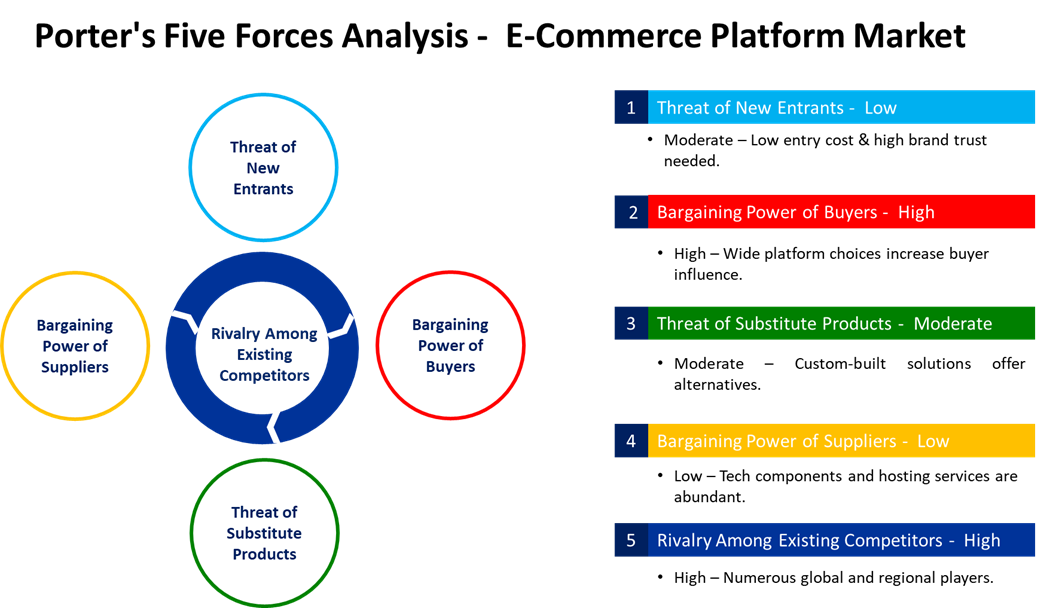
- Porter's Five Forces Analysis for the E-Commerce Platform Market
- Competitive Rivalry
- Threat of New Entrants
- Bargaining Power of Suppliers
- Bargaining Power of Buyers
- Threat of Substitutes
- Market Determinants
- Market Drivers
- Drivers For the Global E-Commerce Platform Market: Impact Analysis
- Market Pain Points and Challenges
- Restraints For the Global E-Commerce Platform Market: Impact Analysis
- Market Opportunities
- Opportunities For the Global E-Commerce Platform Market: Impact Analysis
- Market Drivers
- Competitive Landscape
- Competitive Dashboard – E-Commerce Platform Market Revenue and Share by Manufacturers
- E-Commerce Platform Product Comparison Analysis
- Top Market Player Ranking Matrix
- Key Company Analysis
- Amazon Web Services, Inc.
- Overview
- Product Portfolio
- Financial Analysis (Subject to Data Availability)
- SWOT Analysis
- Business Strategy
- BigCommerce Holding, Inc.
- Overview
- Product Portfolio
- Financial Analysis (Subject to Data Availability)
- SWOT Analysis
- Business Strategy
- eBay Inc.
- Overview
- Product Portfolio
- Financial Analysis (Subject to Data Availability)
- SWOT Analysis
- Business Strategy
- Shopify Inc.
- Overview
- Product Portfolio
- Financial Analysis (Subject to Data Availability)
- SWOT Analysis
- Business Strategy
- WooCommerce (Automattic Inc.)
- Overview
- Product Portfolio
- Financial Analysis (Subject to Data Availability)
- SWOT Analysis
- Business Strategy
- Top Winning Strategies by Market Players
- Merger and Acquisition
- Product Launch
- Partnership And Collaboration
- Amazon Web Services, Inc.
- Key Company Analysis
- Global E-Commerce Platform Market Sales Analysis by Deployment Method ($ Million)
- On-Premise
- Cloud-Based
- Open-Source
- Global E-Commerce Platform Market Sales Analysis by Business Size ($ Million)
- Small and Medium-Sized Businesses (SMBs)
- Enterprise Businesses
- Global E-Commerce Platform Market Sales Analysis by Industry ($ Million)
- Beauty & Personal Care
- Consumer Electronics
- Food & Beverage
- Health & Wellness
- Others (Home Décor, Household Consumables, Fashion & Apparel)
- Global E-Commerce Platform Market Sales Analysis by Functionality ($ Million)
- Product Management
- Order Management
- Payment Processing
- Inventory Management
- Marketing and Analytics
- Regional Analysis
- North American E-Commerce Platform Market Sales Analysis – Deployment Method | Business Size | Industry | Functionality | Country ($ Million)
- Macroeconomic Factors for North America
- United States
- Canada
- European E-Commerce Platform Market Sales Analysis – Deployment Method | Business Size | Industry | Functionality | Country ($ Million)
- Macroeconomic Factors for Europe
- UK
- Germany
- Italy
- Spain
- France
- Russia
- Rest of Europe
- Asia-Pacific E-Commerce Platform Market Sales Analysis – Deployment Method | Business Size | Industry | Functionality | Country ($ Million)
- Macroeconomic Factors for Asia-Pacific
- China
- Japan
- South Korea
- India
- Australia & New Zealand
- ASEAN Countries (Thailand, Indonesia, Vietnam, Singapore, And Other)
- Rest of Asia-Pacific
- Rest of the World E-Commerce Platform Market Sales Analysis – Deployment Method | Business Size | Industry | Functionality | Country ($ Million)
- Macroeconomic Factors for the Rest of the World
- Latin America
- Middle East and Africa
- Company Profiles
- Adobe Inc.
- Quick Facts
- Company Overview
- Product Portfolio
- Business Strategies
- Amazon Web Services, Inc.
- Quick Facts
- Company Overview
- Product Portfolio
- Business Strategies
- BigCommerce Holding, Inc.
- Quick Facts
- Company Overview
- Product Portfolio
- Business Strategies
- commercetools GmbH
- Quick Facts
- Company Overview
- Product Portfolio
- Business Strategies
- CS-Cart (Bolide Network LLC)
- Quick Facts
- Company Overview
- Product Portfolio
- Business Strategies
- eBay Inc.
- Quick Facts
- Company Overview
- Product Portfolio
- Business Strategies
- Ecwid (Lightspeed Commerce Inc.)
- Quick Facts
- Company Overview
- Product Portfolio
- Business Strategies
- Elastic Path Software Inc.
- Quick Facts
- Company Overview
- Product Portfolio
- Business Strategies
- GoDaddy Operating Company, LLC (GoDaddy E-Store)
- Quick Facts
- Company Overview
- Product Portfolio
- Business Strategies
- Kibo Software, Inc.
- Quick Facts
- Company Overview
- Product Portfolio
- Business Strategies
- Miva Parent, LLC
- Quick Facts
- Company Overview
- Product Portfolio
- Business Strategies
- OpenCart Ltd.
- Quick Facts
- Company Overview
- Product Portfolio
- Business Strategies
- Oracle Corp.
- Quick Facts
- Company Overview
- Product Portfolio
- Business Strategies
- OroCommerce (Oro Inc.)
- Quick Facts
- Company Overview
- Product Portfolio
- Business Strategies
- PrestaShop
- Quick Facts
- Company Overview
- Product Portfolio
- Business Strategies
- Salesforce, Inc.
- Quick Facts
- Company Overview
- Product Portfolio
- Business Strategies
- SAP SE
- Quick Facts
- Company Overview
- Product Portfolio
- Business Strategies
- Shift4 Payments, LLC
- Quick Facts
- Company Overview
- Product Portfolio
- Business Strategies
- Shopify Inc.
- Quick Facts
- Company Overview
- Product Portfolio
- Business Strategies
- Shopwired Ltd.
- Quick Facts
- Company Overview
- Product Portfolio
- Business Strategies
- Sitecore Holding II A/S
- Quick Facts
- Company Overview
- Product Portfolio
- Business Strategies
- Spryker Systems GmbH
- Quick Facts
- Company Overview
- Product Portfolio
- Business Strategies
- Squarespace, Inc.
- Quick Facts
- Company Overview
- Product Portfolio
- Business Strategies
- Volusion, LLC
- Quick Facts
- Company Overview
- Product Portfolio
- Business Strategies
- VTEX Platform
- Quick Facts
- Company Overview
- Product Portfolio
- Business Strategies
- Weebly (Square, Inc.)
- Quick Facts
- Company Overview
- Product Portfolio
- Business Strategies
- com Ltd.
- Quick Facts
- Company Overview
- Product Portfolio
- Business Strategies
- WooCommerce (Automattic Inc.)
- Quick Facts
- Company Overview
- Product Portfolio
- Business Strategies
- Yo!Kart (FATbit Technologies)
- Quick Facts
- Company Overview
- Product Portfolio
- Business Strategies
- Zoho Corp. Pvt. Ltd
- Quick Facts
- Company Overview
- Product Portfolio
- Business Strategies
- Adobe Inc.
1. Global E-Commerce Platform Market Research and Analysis By Deployment Method, 2024–2035 ($ Million)
2. Global On-Premise E-Commerce Platform Market Research And Analysis by Region, 2024–2035 ($ Million)
3. Global Cloud-Based E-Commerce Platform Market Research And Analysis by Region, 2024–2035 ($ Million)
4. Global Open-Source E-Commerce Platform Market Research And Analysis by Region, 2024–2035 ($ Million)
5. Global E-Commerce Platform Market Research And Analysis by Business Size, 2024–2035 ($ Million)
6. Global E-Commerce Platform For Small And Medium-Sized Businesses (SMBs) Market Research And Analysis by Region, 2024–2035 ($ Million)
7. Global E-Commerce Platform For Enterprise Businesses Market Research And Analysis by Region, 2024–2035 ($ Million)
8. Global E-Commerce Platform Market Research And Analysis by Industry, 2024–2035 ($ Million)
9. Global E-Commerce Platform For Beauty And Personal Care Market Research And Analysis by Region, 2024–2035 ($ Million)
10. Global E-Commerce Platform For Consumer Electronics Market Research And Analysis by Region, 2024–2035 ($ Million)
11. Global E-Commerce Platform For Food & Beverage Market Research And Analysis by Region, 2024–2035 ($ Million)
12. Global E-Commerce Platform For Health & Wellness Market Research And Analysis by Region, 2024–2035 ($ Million)
13. Global E-Commerce Platform For Other Industry Market Research And Analysis by Region, 2024–2035 ($ Million)
14. Global E-Commerce Platform Market Research And Analysis By Functionality, 2024–2035 ($ Million)
15. Global E-Commerce Platform For Product Management Market Research And Analysis By Region, 2024–2035 ($ Million)
16. Global E-Commerce Platform For Order Management Market Research And Analysis By Region, 2024–2035 ($ Million)
17. Global E-Commerce Platform For Payment Processing Market Research And Analysis By Region, 2024–2035 ($ Million)
18. Global E-Commerce Platform For Inventory Management Market Research And Analysis By Region, 2024–2035 ($ Million)
19. Global E-Commerce Platform For Marketing And Analytics Market Research And Analysis By Region, 2024–2035 ($ Million)
20. Global E-Commerce Platform Market Research And Analysis By Region, 2024–2035 ($ Million)
21. North American E-Commerce Platform Market Research And Analysis By Country, 2024–2035 ($ Million)
22. North American E-Commerce Platform Market Research And Analysis By Deployment Method, 2024–2035 ($ Million)
23. North American E-Commerce Platform Market Research And Analysis By Business Size, 2024–2035 ($ Million)
24. North American E-Commerce Platform Market Research And Analysis By Industry, 2024–2035 ($ Million)
25. North American E-Commerce Platform Market Research And Analysis By Functionality, 2024–2035 ($ Million)
26. European E-Commerce Platform Market Research And Analysis By Country, 2024–2035 ($ Million)
27. European E-Commerce Platform Market Research And Analysis By Deployment Method, 2024–2035 ($ Million)
28. European E-Commerce Platform Market Research And Analysis By Business Size, 2024–2035 ($ Million)
29. European E-Commerce Platform Market Research And Analysis By Industry, 2024–2035 ($ Million)
30. European E-Commerce Platform Market Research And Analysis By Functionality, 2024–2035 ($ Million)
31. Asia-Pacific E-Commerce Platform Market Research And Analysis By Country, 2024–2035 ($ Million)
32. Asia-Pacific E-Commerce Platform Market Research And Analysis By Deployment Method, 2024–2035 ($ Million)
33. Asia-Pacific E-Commerce Platform Market Research And Analysis By Business Size, 2024–2035 ($ Million)
34. Asia-Pacific E-Commerce Platform Market Research And Analysis By Industry, 2024–2035 ($ Million)
35. Asia-Pacific E-Commerce Platform Market Research And Analysis By Functionality, 2024–2035 ($ Million)
36. Rest of the World E-Commerce Platform Market Research And Analysis By Region, 2024–2035 ($ Million)
37. Rest of the World E-Commerce Platform Market Research And Analysis By Deployment Method, 2024–2035 ($ Million)
38. Rest of the World E-Commerce Platform Market Research And Analysis By Business Size, 2024–2035 ($ Million)
39. Rest of the World E-Commerce Platform Market Research And Analysis By Industry, 2024–2035 ($ Million)
40. Rest of the World E-Commerce Platform Market Research And Analysis By Functionality, 2024–2035 ($ Million)
1. Global E-Commerce Platform Market Share By Deployment Method, 2024 Vs 2035 (%)
2. Global On-Premise E-Commerce Platform Market Share By Region, 2024 Vs 2035 (%)
3. Global Cloud-Based E-Commerce Platform Market Share By Region, 2024 Vs 2035 (%)
4. Global Open-Source E-Commerce Platform Market Share By Region, 2024 Vs 2035 (%)
5. Global E-Commerce Platform Market Share By Business Size, 2024 Vs 2035 (%)
6. Global E-Commerce Platform For Small And Medium-Sized Businesses (SMBs) Market Share By Region, 2024 Vs 2035 (%)
7. Global E-Commerce Platform For Enterprise Businesses Market Share By Region, 2024 Vs 2035 (%)
8. Global E-Commerce Platform Market Share By Industry, 2024 Vs 2035 (%)
9. Global E-Commerce Platform For Beauty And Personal Care Market Share By Region, 2024 Vs 2035 (%)
10. Global E-Commerce Platform For Consumer Electronics Market Share By Region, 2024 Vs 2035 (%)
11. Global E-Commerce Platform For Food & Beverage Market Share By Region, 2024 Vs 2035 (%)
12. Global E-Commerce Platform For Health & Wellness Market Share By Region, 2024 Vs 2035 (%)
13. Global E-Commerce Platform For Other Industry Market Share By Region, 2024 Vs 2035 (%)
14. Global E-Commerce Platform Market Share By Functionality, 2024 Vs 2035 (%)
15. Global E-Commerce Platform For Product Management Market Share By Region, 2024 Vs 2035 (%)
16. Global E-Commerce Platform For Order Management Market Share By Region, 2024 Vs 2035 (%)
17. Global E-Commerce Platform For Payment Processing Market Share By Region, 2024 Vs 2035 (%)
18. Global E-Commerce Platform For Inventory Management Market Share By Region, 2024 Vs 2035 (%)
19. Global E-Commerce Platform For Marketing And Analytics Market Share By Region, 2024 Vs 2035 (%)
20. Global E-Commerce Platform Market Share By Region, 2024 Vs 2035 (%)
21. US E-Commerce Platform Market Size, 2024–2035 ($ Million)
22. Canada E-Commerce Platform Market Size, 2024–2035 ($ Million)
23. UK E-Commerce Platform Market Size, 2024–2035 ($ Million)
24. France E-Commerce Platform Market Size, 2024–2035 ($ Million)
25. Germany E-Commerce Platform Market Size, 2024–2035 ($ Million)
26. Italy E-Commerce Platform Market Size, 2024–2035 ($ Million)
27. Spain E-Commerce Platform Market Size, 2024–2035 ($ Million)
28. Russia E-Commerce Platform Market Size, 2024–2035 ($ Million)
29. Rest of Europe E-Commerce Platform Market Size, 2024–2035 ($ Million)
30. India E-Commerce Platform Market Size, 2024–2035 ($ Million)
31. China E-Commerce Platform Market Size, 2024–2035 ($ Million)
32. Japan E-Commerce Platform Market Size, 2024–2035 ($ Million)
33. South Korea E-Commerce Platform Market Size, 2024–2035 ($ Million)
34. Australia and New Zealand E-Commerce Platform Market Size, 2024–2035 ($ Million)
35. ASEAN Economies E-Commerce Platform Market Size, 2024–2035 ($ Million)
36. Rest of Asia-Pacific E-Commerce Platform Market Size, 2024–2035 ($ Million)
37. Latin America E-Commerce Platform Market Size, 2024–2035 ($ Million)
38. Middle East And Africa E-Commerce Platform Market Size, 2024–2035 ($ Million)
- Printable version
- No restriction to number of users within the company

