ENT Devices Market


ENT Devices Market Size, Share & Trends Analysis Report by Product (Endoscopes & Visualization Systems, Microscopes & Optical Systems, Hearing Assessment & Audiology Equipment, Surgical Instruments & Powered Systems, Implantable & Prosthetic Devices, Laser & Energy-Based Surgical Systems, Imaging & Navigation Systems, Airway & Sleep Disorder Devices, Therapeutic & Rehabilitation Devices, Consumables & Accessories) by Distribution Channel (Direct, Indirect) by End-User (Hospitals, ENT Centers, Ambulatory Surgery Centers) Forecast Period (2025-2035)
Industry Overview
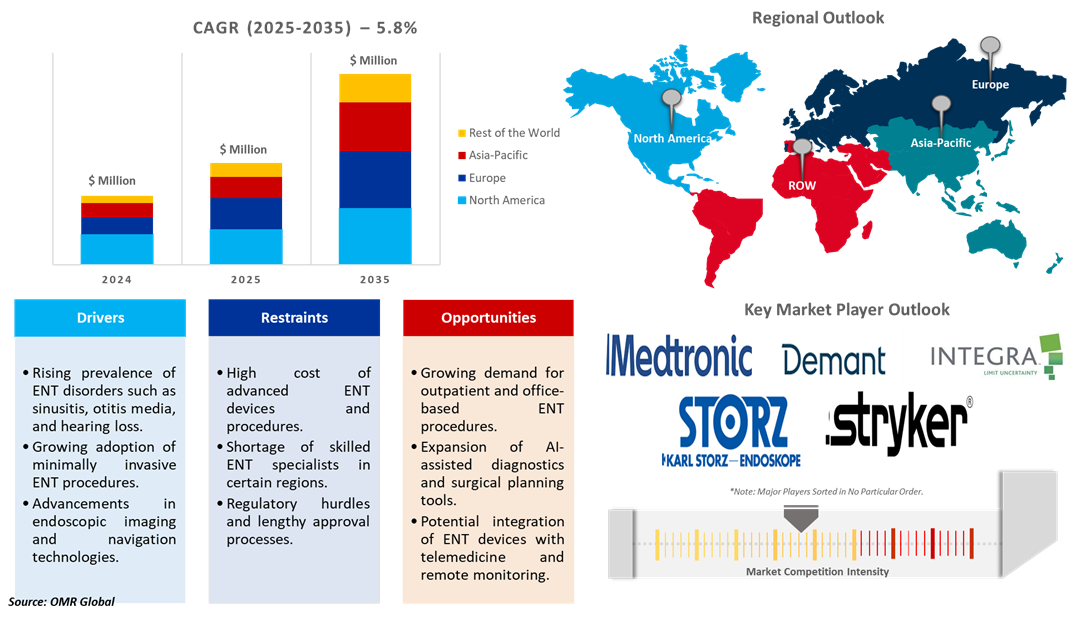
ENT devices market was valued at $27 billion in 2024 and is projected to reach $49 billion by 2035, growing at a CAGR of 5.8% during the forecast period (2025–2035). ENT devices have gained increased popularity due to the rising number of cases, including chronic ear infections, Eustachian tube dysfunction, and related hearing impairment in patients, especially in children. The endoscopic tympanostomy device allows for a minimally invasive procedure with reduced recovery, lower risk, and greater accuracy compared to traditional tympanostomy devices. Outpatient procedures, which take relatively little time, serve to maximize patient comfort, safety, and accessibility. Chronic inflammation, genetic predisposition, and natural aging of the ear lead to additional factors leading to hearing loss, further increasing the growth of the market.
- According to the WHO, over 5% of the world's population, or 430 million people, require rehabilitation to address their disabling hearing loss (including 34 million children). By 2050, it is estimated that over 700 million people, or 1 in 10 people, will have disabling hearing loss; and over 1 billion young adults are at risk of permanent avoidable hearing loss due to unsafe listening practices.
Market Dynamics
Increasing Prevalence of ENT Disorders
The increasing incidence of ENT disorders, including hearing loss, sinusitis, sleep apnea, and eustachian tube dysfunction, is developing into a considerable global health challenge, largely related to aging populations, environmental pollutants, lifestyle alterations, and more of these conditions being recognized as detection rates are increasing due to new diagnostics. The conditions not only create negative impacts on quality of life, but also a societal and economic burden. Obstructive Sleep Apnea (OSA) is also a significant contributor to ENT-associated diagnostic/therapeutic needs. According to the CDC, about 40% of young adults with hearing loss identified during childhood reported experiencing at least one limitation in daily functioning, and about 71% of young adults with hearing loss didn’t have other related conditions.
Growing Cases of Loss of Hearing in Elderly People
Hearing loss in the elderly is an increasingly common condition, affecting millions worldwide. Hearing loss in the elderly is complex and multifactorial. Aging is complicated since syndromes of age interplay among various organ systems, and basic homeostasis and physiology become altered with advancing age. According to NIDCD, about 5% of adults ages 45-54 have disabling hearing loss. The rate increases to 10% for adults ages 55-64. 22% of those ages 65-74 and 55% of those who are 75 and older have disabling hearing loss. The increasing prevalence of hearing loss within the elderly population highlights an important need for early intervention, improved access to hearing care solutions, and the increased adoption of assistive ENT technologies to maintain quality of life and communication in an aging population.
Market Segmentation
- Based on the product, the market is segmented into endoscopes & visualization systems, microscopes & optical systems, hearing assessment & audiology equipment, surgical instruments & powered systems, implantable & prosthetic devices, laser & energy-based surgical systems, imaging & navigation systems, airway & sleep disorder devices, therapeutic & rehabilitation devices, and consumables & accessories.
- Based on the distribution channel, the market is segmented into direct and indirect.
- Based on the end-user, the market is segmented into hospitals, ENT centers, and ambulatory surgery centers.
Endoscopes and Visualization Systems: A Key Segment in Market Growth
Endoscopes and visualization systems are critical to ENT procedures. They effectively allow the therapist to make very precise diagnoses and perform minimally invasive surgical treatments through superior visualization of the very delicate and complex structures of the ear, nose, and throat. There have been tremendous advances in recent years in areas such as miniaturization, wireless data transmission, AI-assisted image analysis, and augmented imaging technologies, all leading directly to improvements in portability for the clinician, comfort for the patient, and advancements in diagnostic accuracy. Furthermore, the inclusion of AI tissue-recognition and fluorescence-guided imaging systems from manufacturers such as Stryker and KARL STORZ has improved rates of earlier detection, assisted surgeons with real-time guidance, and decreased overall operative times to facilitate wider acceptance across modern medical practices in the field of ENT surgery.
- For instance, in March 2025, Fujifilm introduced the EN-840T Double Balloon Enteroscopy in the U.S., featuring HD CMOS imaging, enhanced lighting, and integrated water-jet capability—providing superior navigation and visualization even in complex anatomical regions.
Regional Outlook
The global ENT Devices is further divided by region, including North America (the US and Canada), Europe (the UK, Germany, France, Italy, Spain, Russia, and the Rest of Europe), Asia-Pacific (India, China, Japan, South Korea, Australia and New Zealand, ASEAN Countries, and the Rest of Asia-Pacific), and the Rest of the World (the Middle East & Africa, and Latin America).
Rising Adoption of ENT Devices in North America
The North American ENT devices market, particularly the US, is the largest globally, driven by strong reimbursement frameworks, high adoption of advanced diagnostics and treatment devices, and a substantial geriatric population. Factors such as increasing demand for hearing aids and a substantial target demographic further accelerated growth. The region benefits from local industry players and supportive government policies favoring portable medical devices.
- According to NIDC, about 2 to 3 out of every 1,000 children in the United States are born with a detectable level of hearing loss in one or both ears. Also, about 5% of adults ages 45-54 have disabling hearing loss. The rate increases to 10% for adults ages 55-64. 22% of those ages 65-74 and 55% of those who are 75 and older have disabling hearing loss.
The high and continuously increasing occurrence of hearing loss in North America affirms the pressing and constant need for ENT devices. This demographic trend, along with sophisticated healthcare systems and early screening programs, will continue to facilitate the acceptance of diagnostic, surgical, and rehabilitation ENT technologies in the U.S. and Canada shortly.
Asia-Pacific Maintains Strong Market Position
The growth of the ENT devices market in Asia-Pacific is one of the fastest-growing in the world due to rising investments in healthcare and greater access to medical technology, as well as a large aging population. The largest demand for ENT devices is in Japan, China, and India as a result of the significant changes in urban lifestyle, increased detection rates, and an improved infrastructure for ENT care. The World Health Organization has reported that the highest prevalence of hearing loss is in the Western Pacific Region worldwide, reporting approximately 7% of people suffering from hearing loss. Furthermore, by the year 2050, the Western Pacific Region should anticipate the largest number of individuals living with hearing loss – approximately 760 million people. WHO has cautioned that a substantial segment of this population in the Western Pacific Region consists of young people who run the risk of preventable hearing loss due to unsafe listening practices. Unsafe listening practices, such as exposure to loud sounds through personal audio devices and/or noisy entertainment venues.
Market Players Outlook
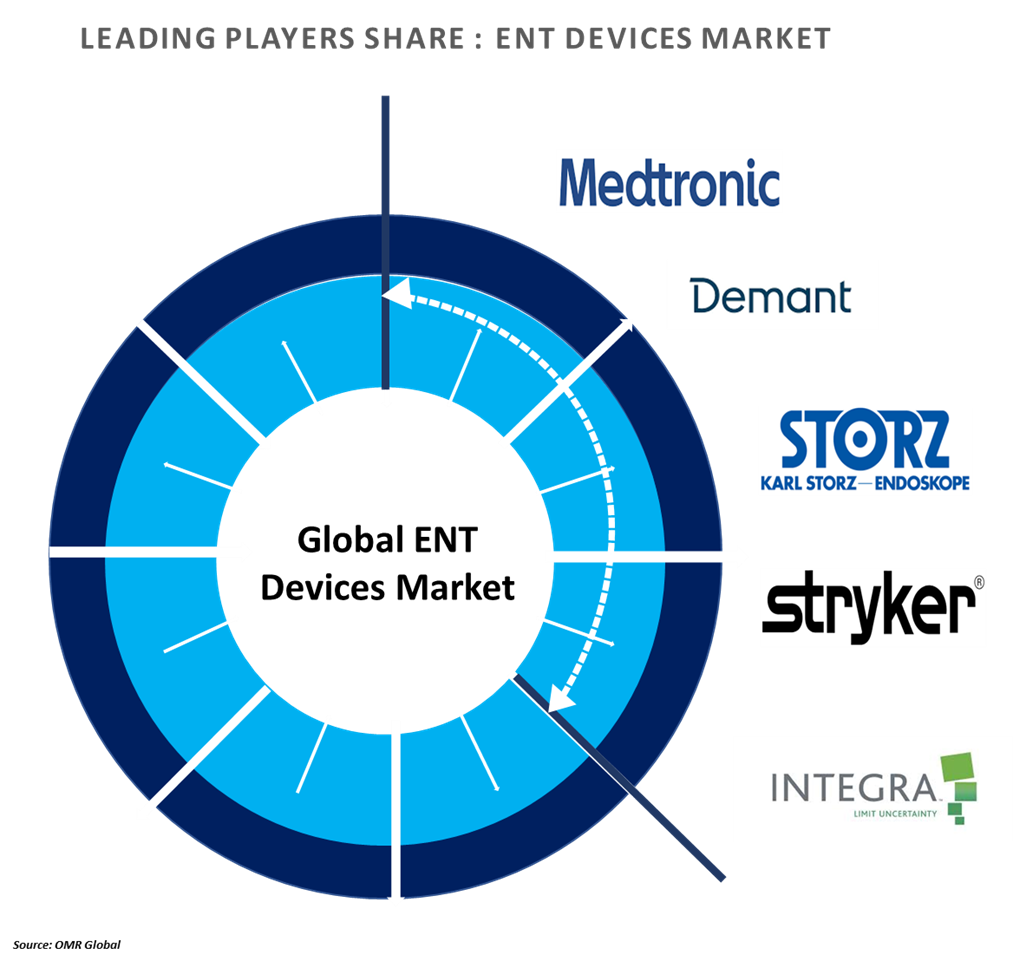
The major companies operating in the global ENT devices market include Integra Lifesciences, Demant A/S., KARL STORZ SE & Co. KG, Medtronic, Stryker Corporation, and Sonova AG, among others. Market players are leveraging partnerships, collaborations, mergers, and acquisition strategies for business expansion and innovative product development to maintain their market positioning.
Recent Developments
- In October 2024, Olympus Europa SE & Co. KG (Olympus) announced that its group company, Odin Medical Ltd. (Odin Vision), has received approval for its innovative cloud-AI (artificial intelligence) endoscopy medical devices – CADDIE, CADU, and SMARTIBD as CE-marked medical devices in Europe under the Medical Device Regulation (MDR). This approval marks a significant milestone in Olympus' efforts to enhance clinical outcomes and operational efficiency in endoscopy.
- In August 2024, Inspire Medical Systems received expanded FDA approval for its hypoglossal nerve stimulation therapy for obstructive sleep apnea, extending its indication to patients aged 18 and older with moderate-to-severe OSA who are intolerant to CPAP therapy.
- In February 2023, Starkey introduced the Genesis AI Hearing Aid series, featuring real-time language translation, health tracking, and adaptive sound processing powered by on-device AI, aiming to improve accessibility and personalization in hearing care.
The Report Covers
- Market value data analysis of 2024 and forecast to 2035.
- Annualized market revenues ($ million) for each market segment.
- Country-wise analysis of major geographical regions.
- Key companies operating in the global ENT devices market. Based on the availability of data, information related to new products and relevant news is also available in the report.
- Analysis of business strategies by identifying the key market segments positioned for strong growth in the future.
- Analysis of market-entry and market expansion strategies.
- Competitive strategies by identifying ‘who-stands-where’ in the market.
1. Report Summary
• Current Industry Analysis and Growth Potential Outlook
• Global ENT Devices Market Sales Analysis – Product| Distribution Channel | End-User ($ Million)
• ENT Devices Market Sales Performance of Top Countries
1.1. Research Methodology
• Primary Research Approach
• Secondary Research Approach
1.2. Market Snapshot
2. Market Overview and Insights
2.1. Scope of the Study
2.2. Analyst Insight & Current Market Trends
2.2.1. Key ENT Devices Industry Trends
2.2.2. Market Recommendations
2.3. Porter's Five Forces Analysis for the ENT Devices Market
2.3.1. Competitive Rivalry
2.3.2. Threat of New Entrants
2.3.3. Bargaining Power of Suppliers
2.3.4. Bargaining Power of Buyers
2.3.5. Threat of Substitutes
3. Market Determinants
3.1. Market Drivers
3.1.1. Drivers For the Global ENT Devices Market: Impact Analysis
3.2. Market Pain Points and Challenges
3.2.1. Restraints For the Global ENT Devices Market: Impact Analysis
3.3. Market Opportunities
3.3.1. Opportunities For the Global ENT Devices Market: Impact Analysis
4. Competitive Landscape
4.1. Competitive Dashboard – ENT Devices Market Revenue and Share by Manufacturers
• ENT Devices Product Comparison Analysis
• Top Market Player Ranking Matrix
4.2. Key Company Analysis
4.2.1. Integra LifeSciences Corporation
4.2.1.1. Overview
4.2.1.2. Product Portfolio
4.2.1.3. Financial Analysis (Subject to Data Availability)
4.2.1.4. SWOT Analysis
4.2.1.5. Business Strategy
4.2.2. Demant A/S.
4.2.2.1. Overview
4.2.2.2. Product Portfolio
4.2.2.3. Financial Analysis (Subject to Data Availability)
4.2.2.4. SWOT Analysis
4.2.2.5. Business Strategy
4.2.3. KARL STORZ SE & Co. KG
4.2.3.1. Overview
4.2.3.2. Product Portfolio
4.2.3.3. Financial Analysis (Subject to Data Availability)
4.2.3.4. SWOT Analysis
4.2.3.5. Business Strategy
4.2.4. Medtronic
4.2.4.1. Overview
4.2.4.2. Product Portfolio
4.2.4.3. Financial Analysis (Subject to Data Availability)
4.2.4.4. SWOT Analysis
4.2.4.5. Business Strategy
4.2.5. Stryker Corporation
4.2.5.1. Overview
4.2.5.2. Product Portfolio
4.2.5.3. Financial Analysis (Subject to Data Availability)
4.2.5.4. SWOT Analysis
4.2.5.5. Business Strategy
4.2.6. Sonova AG
4.2.6.1. Overview
4.2.6.2. Product Portfolio
4.2.6.3. Financial Analysis (Subject to Data Availability)
4.2.6.4. SWOT Analysis
4.2.6.5. Business Strategy
4.3. Top Winning Strategies by Market Players
4.3.1. Merger and Acquisition
4.3.2. Product Launch
4.3.3. Partnership And Collaboration
5. Global ENT Devices Market Sales Analysis by Product ($ Million)
5.1. Endoscopes & Visualization Systems
• Rigid endoscopes
• Flexible endoscopes
• Video endoscopes
• Endoscopic camera systems
• Stroboscopes
• Sinus transilluminators
5.2. Microscopes & Optical Systems
• ENT examination microscopes
• Operating microscopes
• Video microscopes
• Binocular loupes for ENT surgeries
5.3. Hearing Assessment & Audiology Equipment
• Audiometers
• Tympanometers
• Otoacoustic emission (OAE) analyzers
• Auditory Brainstem Response (ABR) systems
• Acoustic reflex meters
• Real Ear Measurement (REM) systems
5.4. Surgical Instruments & Powered Systems
• FESS (Functional Endoscopic Sinus Surgery) instruments
• Microdebriders (powered shavers)
• Surgical drills & burrs (otologic, skull base)
• Myringotomy knives & grommet insertion tools
• Microlaryngeal instruments (forceps, scissors)
• Septoplasty & turbinoplasty sets
• Tracheostomy and cricothyrotomy kits
5.5. Implantable & Prosthetic Devices
• Cochlear implants
• Middle ear implants
• Bone-anchored hearing aids (BAHA)
• Middle ear prostheses (stapes, ossicular chain)
• Voice prostheses
5.6. Laser & Energy-Based Surgical Systems
• CO? lasers
• KTP lasers
• Diode lasers
• Radiofrequency (RF) ablation systems
5.7. Imaging & Navigation Systems
• Cone Beam CT (CBCT) for ENT
• ENT-dedicated CT/MRI systems
• Ultrasound for neck/thyroid
5.8. Airway & Sleep Disorder Devices
• CPAP / BiPAP devices for sleep apnea
• Nasal dilators
• Airway stents
5.9. Therapeutic & Rehabilitation Devices
• Speech therapy devices
• Vestibular rehabilitation systems
• Drug delivery nebulizers for ENT
5.10. Consumables & Accessories
• Speculum tips
• Endoscope sheaths
• Suction tips
• Sterile drapes
• Surgical blades
• Nasal packing & splints
• Biopsy needles
• Ear syringes
6. Global ENT Devices Market Sales Analysis by Distribution Channel ($ Million)
6.1. Direct
6.2. Indirect
7. Global ENT Devices Market Sales Analysis by End-User ($ Million)
7.1. Hospitals
7.2. ENT Centers
7.3. Ambulatory Surgery Centers
8. Regional Analysis
8.1. North American ENT Devices Market Sales Analysis – Product| Distribution Channel | End-User| Country ($ Million)
• Macroeconomic Factors for North America
8.1.1. United States
8.1.2. Canada
8.2. European ENT Devices Market Sales Analysis – Product| Distribution Channel | End-User| Country ($ Million)
• Macroeconomic Factors for Europe
8.2.1. UK
8.2.2. Germany
8.2.3. Italy
8.2.4. Spain
8.2.5. France
8.2.6. Russia
8.2.7. Rest of Europe
8.3. Asia-Pacific ENT Devices Market Sales Analysis – Product| Distribution Channel | End-User| Country ($ Million)
• Macroeconomic Factors for Asia-Pacific
8.3.1. China
8.3.2. Japan
8.3.3. South Korea
8.3.4. India
8.3.5. Australia & New Zealand
8.3.6. ASEAN Countries (Thailand, Indonesia, Vietnam, Singapore, And Other)
8.3.7. Rest of Asia-Pacific
8.4. Rest of the World ENT Devices Market Sales Analysis – Product| Distribution Channel | End-User| Country ($ Million)
• Macroeconomic Factors for the Rest of the World
8.4.1. Latin America
8.4.2. Middle East and Africa
9. Company Profiles
9.1. Ambu A/S
9.1.1. Quick Facts
9.1.2. Company Overview
9.1.3. Product Portfolio
9.1.4. Business Strategies
9.2. Atos Medical AB
9.2.1. Quick Facts
9.2.2. Company Overview
9.2.3. Product Portfolio
9.2.4. Business Strategies
9.3. Audina Hearing Instruments, Inc.
9.3.1. Quick Facts
9.3.2. Company Overview
9.3.3. Product Portfolio
9.3.4. Business Strategies
9.4. Boston Scientific Corporation
9.4.1. Quick Facts
9.4.2. Company Overview
9.4.3. Product Portfolio
9.4.4. Business Strategies
9.5. Carl Zeiss AG
9.5.1. Quick Facts
9.5.2. Company Overview
9.5.3. Product Portfolio
9.5.4. Business Strategies
9.6. Cochlear Ltd.
9.6.1. Quick Facts
9.6.2. Company Overview
9.6.3. Product Portfolio
9.6.4. Business Strategies
9.7. Cook Group Incorporated
9.7.1. Quick Facts
9.7.2. Company Overview
9.7.3. Product Portfolio
9.7.4. Business Strategies
9.8. DAIICHI MEDICAL CO., LTD.
9.8.1. Quick Facts
9.8.2. Company Overview
9.8.3. Product Portfolio
9.8.4. Business Strategies
9.9. Demant A/S.
9.9.1. Quick Facts
9.9.2. Company Overview
9.9.3. Product Portfolio
9.9.4. Business Strategies
9.10. DP Medical Systems Ltd
9.10.1. Quick Facts
9.10.2. Company Overview
9.10.3. Product Portfolio
9.10.4. Business Strategies
9.11. FUJIFILM Corporation
9.11.1. Quick Facts
9.11.2. Company Overview
9.11.3. Product Portfolio
9.11.4. Business Strategies
9.12. GN Hearing A/S
9.12.1. Quick Facts
9.12.2. Company Overview
9.12.3. Product Portfolio
9.12.4. Business Strategies
9.13. InHealth Technologies.
9.13.1. Quick Facts
9.13.2. Company Overview
9.13.3. Product Portfolio
9.13.4. Business Strategies
9.14. Integra LifeSciences Corporation
9.14.1. Quick Facts
9.14.2. Company Overview
9.14.3. Product Portfolio
9.14.4. Business Strategies
9.15. KARL STORZ SE & Co. KG
9.15.1. Quick Facts
9.15.2. Company Overview
9.15.3. Product Portfolio
9.15.4. Business Strategies
9.16. MED-EL Medical Electronics
9.16.1. Quick Facts
9.16.2. Company Overview
9.16.3. Product Portfolio
9.16.4. Business Strategies
9.17. Medtronic
9.17.1. Quick Facts
9.17.2. Company Overview
9.17.3. Product Portfolio
9.17.4. Business Strategies
9.18. Meril Life Science
9.18.1. Quick Facts
9.18.2. Company Overview
9.18.3. Product Portfolio
9.18.4. Business Strategies
9.19. Nanos Medical (Shanghai) Limited
9.19.1. Quick Facts
9.19.2. Company Overview
9.19.3. Product Portfolio
9.19.4. Business Strategies
9.20. Narang Medical Ltd.
9.20.1. Quick Facts
9.20.2. Company Overview
9.20.3. Product Portfolio
9.20.4. Business Strategies
9.21. Olympus Corporation
9.21.1. Quick Facts
9.21.2. Company Overview
9.21.3. Product Portfolio
9.21.4. Business Strategies
9.22. Optim LLC
9.22.1. Quick Facts
9.22.2. Company Overview
9.22.3. Product Portfolio
9.22.4. Business Strategies
9.23. PENTAX Medical
9.23.1. Quick Facts
9.23.2. Company Overview
9.23.3. Product Portfolio
9.23.4. Business Strategies
9.24. Smith & Nephew plc
9.24.1. Quick Facts
9.24.2. Company Overview
9.24.3. Product Portfolio
9.24.4. Business Strategies
9.25. Soluvos Medical
9.25.1. Quick Facts
9.25.2. Company Overview
9.25.3. Product Portfolio
9.25.4. Business Strategies
9.26. Sonova AG
9.26.1. Quick Facts
9.26.2. Company Overview
9.26.3. Product Portfolio
9.26.4. Business Strategies
9.27. Starkey Laboratories, Inc.
9.27.1. Quick Facts
9.27.2. Company Overview
9.27.3. Product Portfolio
9.27.4. Business Strategies
9.28. Stryker Corporation
9.28.1. Quick Facts
9.28.2. Company Overview
9.28.3. Product Portfolio
9.28.4. Business Strategies
9.29. Zephyr Surgical Implants
9.29.1. Quick Facts
9.29.2. Company Overview
9.29.3. Product Portfolio
9.29.4. Business Strategies
9.30. ZHEJIANG NUROTRON BIOTECHNOLOGY CO., LTD
9.30.1. Quick Facts
9.30.2. Company Overview
9.30.3. Product Portfolio
9.30.4. Business Strategies
1. Global ENT Devices Market Research and Analysis by Product, 2024–2035 ($ Million)
2. Global ENT Endoscopes & Visualization Systems Market Research and Analysis by Region, 2024–2035 ($ Million)
3. Global ENT Microscopes & Optical Systems Market Research and Analysis by Region, 2024–2035 ($ Million)
4. Global ENT Hearing Assessment & Audiology Equipment Market Research and Analysis by Region, 2024–2035 ($ Million)
5. Global ENT Surgical Instruments & Powered Systems Market Research and Analysis by Region, 2024–2035 ($ Million)
6. Global ENT Implantable & Prosthetic Devices Market Research and Analysis by Region, 2024–2035 ($ Million)
7. Global ENT Laser & Energy-Based Surgical Systems Market Research and Analysis by Region, 2024–2035 ($ Million)
8. Global ENT Imaging & Navigation Systems Market Research and Analysis by Region, 2024–2035 ($ Million)
9. Global ENT Airway & Sleep Disorder Devices Market Research and Analysis by Region, 2024–2035 ($ Million)
10. Global ENT Therapeutic & Rehabilitation Devices Market Research and Analysis by Region, 2024–2035 ($ Million)
11. Global ENT Consumables & Accessories Market Research and Analysis by Region, 2024–2035 ($ Million)
12. Global ENT Devices Market Research and Analysis by Distribution Channel, 2024–2035 ($ Million)
13. Global Direct ENT Devices Market Research and Analysis by Region, 2024–2035 ($ Million)
14. Global Indirect ENT Devices Market Research and Analysis by Region, 2024–2035 ($ Million)
15. Global ENT Devices Market Research and Analysis by End-User, 2024–2035 ($ Million)
16. Global ENT Devices For Hospitals Market Research and Analysis by Region, 2024–2035 ($ Million)
17. Global ENT Devices For ENT Centers Market Research and Analysis by Region, 2024–2035 ($ Million)
18. Global ENT Devices For Ambulatory Surgery Centers Market Research and Analysis by Region, 2024–2035 ($ Million)
19. Global ENT Devices Market Research and Analysis by Region, 2024–2035 ($ Million)
20. North American ENT Devices Market Research and Analysis by Country, 2024–2035 ($ Million)
21. North American ENT Devices Market Research and Analysis by Product, 2024–2035 ($ Million)
22. North American ENT Devices Market Research and Analysis by Distribution Channel, 2024–2035 ($ Million)
23. North American ENT Devices Market Research and Analysis by End-User, 2024–2035 ($ Million)
24. European ENT Devices Market Research and Analysis by Country, 2024–2035 ($ Million)
25. European ENT Devices Market Research and Analysis by Product, 2024–2035 ($ Million)
26. European ENT Devices Market Research and Analysis by Distribution Channel, 2024–2035 ($ Million)
27. European ENT Devices Market Research and Analysis by End-User, 2024–2035 ($ Million)
28. Asia-Pacific ENT Devices Market Research and Analysis by Country, 2024–2035 ($ Million)
29. Asia-Pacific ENT Devices Market Research and Analysis by Product, 2024–2035 ($ Million)
30. Asia-Pacific ENT Devices Market Research and Analysis by Distribution Channel, 2024–2035 ($ Million)
31. Asia-Pacific ENT Devices Market Research and Analysis by End-User, 2024–2035 ($ Million)
32. Rest of the World ENT Devices Market Research and Analysis by Region, 2024–2035 ($ Million)
33. Rest of the World ENT Devices Market Research and Analysis by Product, 2024–2035 ($ Million)
34. Rest of the World ENT Devices Market Research and Analysis by Distribution Channel, 2024–2035 ($ Million)
35. Rest of the World ENT Devices Market Research and Analysis by End-User, 2024–2035 ($ Million)
1. Global ENT Devices Market Share by Product, 2024 Vs 2035 (%)
2. Global ENT Endoscopes & Visualization Systems Market Share by Region, 2024 Vs 2035 (%)
3. Global ENT Microscopes & Optical Systems Market Share by Region, 2024 Vs 2035 (%)
4. Global ENT Hearing Assessment & Audiology Equipment Market Share by Region, 2024 Vs 2035 (%)
5. Global ENT Surgical Instruments & Powered Systems Market Share by Region, 2024 Vs 2035 (%)
6. Global ENT Implantable & Prosthetic Devices Market Share by Region, 2024 Vs 2035 (%)
7. Global ENT Laser & Energy-Based Surgical Systems Market Share by Region, 2024 Vs 2035 (%)
8. Global ENT Imaging & Navigation Systems Market Share by Region, 2024 Vs 2035 (%)
9. Global ENT Airway & Sleep Disorder Devices Market Share by Region, 2024 Vs 2035 (%)
10. Global ENT Therapeutic & Rehabilitation Devices Market Share by Region, 2024 Vs 2035 (%)
11. Global ENT Consumables & Accessories Market Share by Region, 2024 Vs 2035 (%)
12. Global ENT Devices Market Share by Distribution Channel, 2024 Vs 2035 (%)
13. Global Direct ENT Devices Market Share by Region, 2024 Vs 2035 (%)
14. Global Indirect ENT Devices Market Share by Region, 2024 Vs 2035 (%)
15. Global ENT Devices Market Share by End-User, 2024 Vs 2035 (%)
16. Global ENT Devices For Hospitals Market Share by Region, 2024 Vs 2035 (%)
17. Global ENT Devices For ENT Centers Market Share by Region, 2024 Vs 2035 (%)
18. Global ENT Devices For Ambulatory Surgery Centers Market Share by Region, 2024 Vs 2035 (%)
19. Global ENT Devices Market Share by Region, 2024 Vs 2035 (%)
20. US ENT Devices Market Size, 2024–2035 ($ Million)
21. Canada ENT Devices Market Size, 2024–2035 ($ Million)
22. UK ENT Devices Market Size, 2024–2035 ($ Million)
23. France ENT Devices Market Size, 2024–2035 ($ Million)
24. Germany ENT Devices Market Size, 2024–2035 ($ Million)
25. Italy ENT Devices Market Size, 2024–2035 ($ Million)
26. Spain ENT Devices Market Size, 2024–2035 ($ Million)
27. Russia ENT Devices Market Size, 2024–2035 ($ Million)
28. Rest of Europe ENT Devices Market Size, 2024–2035 ($ Million)
29. India ENT Devices Market Size, 2024–2035 ($ Million)
30. China ENT Devices Market Size, 2024–2035 ($ Million)
31. Japan ENT Devices Market Size, 2024–2035 ($ Million)
32. South Korea ENT Devices Market Size, 2024–2035 ($ Million)
33. Australia and New Zealand ENT Devices Market Size, 2024–2035 ($ Million)
34. ASEAN Economies ENT Devices Market Size, 2024–2035 ($ Million)
35. Rest of Asia-Pacific ENT Devices Market Size, 2024–2035 ($ Million)
36. Latin America ENT Devices Market Size, 2024–2035 ($ Million)
37. Middle East and Africa ENT Devices Market Size, 2024–2035 ($ Million)
- Printable version
- No restriction to number of users within the company

