Hydrogen Pipeline Market


Hydrogen Pipeline Market Size, Share & Trends Analysis Report by Pipeline Type (Pure Hydrogen Pipelines and Blended Pipelines), by Hydrogen Type (Blue Hydrogen, Green Hydrogen, Grey Hydrogen, and Turquoise Hydrogen), by Application (Carbon Steel, Stainless Steel, Nickel Alloys and Polymer/Composites), and by End-User (Power Generation, Industrial Sector and Transportation) Forecast Period (2026-2035)
Industry Overview
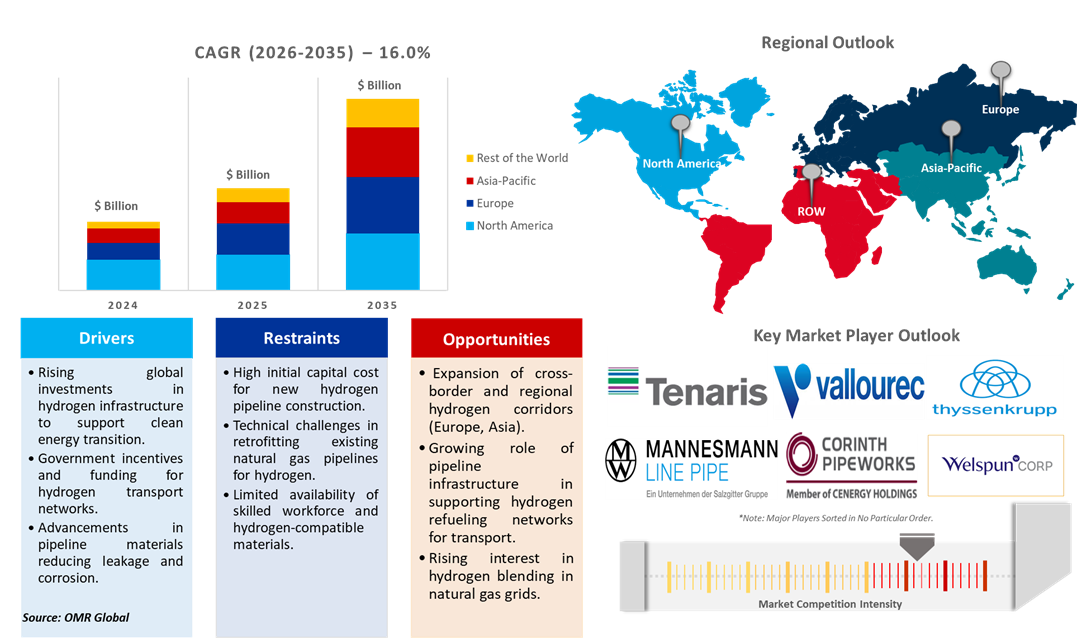
Hydrogen pipeline market was valued at $1.8 billion in 2025 and is projected to reach $11.5 billion by 2035, growing at a CAGR of 16.0% during the forecast period (2026–2035). The global hydrogen pipeline market is expanding at a fast pace owing to the global push to reduce greenhouse gas emissions and shift toward cleaner energy systems, government policies, incentives & regulation, growth in hydrogen production & industrial demand, technology advancement & cost reduction. Europe is among the most active regions in developing large-scale hydrogen pipeline infrastructure, driven by strong decarbonization goals and energy transition policies. As part of Europe’s broader clean-energy transition, nation such as Germany is taking major steps to build a nationwide hydrogen transport system to support industrial decarbonization. For instance, in October 2024, the government approved the plan in October 2024 for a “core hydrogen grid” spanning approximately 9,040 km, with about 60% repurposed from existing natural gas pipelines.
Market Dynamics
Technological Innovation Strengthens the Global Hydrogen Infrastructure Market
Innovative pipeline technologies are driving progress in the global hydrogen infrastructure market by enhancing safety and reducing costs. New designs are tackling issues such as leakage, corrosion, and installation inefficiencies. Such advancements are crucial for enabling large-scale, cost-effective hydrogen transport systems. For instance, in September 2024, NOV’s Fiber Glass Systems business unit and H2C Safety Pipe Inc., a subsidiary of H2 Clipper, Inc. (H2C), have been named one of the 13 Phase 1 winners of the US Department of Energy’s (DOE) Facilities Track of the Manufacture of Advanced Key Energy Infrastructure Technologies (MAKE IT) Prize. H2C’s Safety Pipe uses a double-walled design with inert gas to capture hydrogen leaks and enable real-time monitoring. In partnership with NOV, it delivers safer, corrosion-free, and lower-cost hydrogen transport with faster installation.
Market Uncertainty Slows Large-Scale Hydrogen Pipeline Investments
Uncertainty in demand and regulation continues to challenge large-scale hydrogen pipeline investments. Even technically viable projects are being delayed as market clarity and customer commitments lag behind expectations. For instance, in September 2024, Equinor paused plans for a €4–6 billion hydrogen pipeline development from Norway to Germany, citing unclear regulations, no confirmed customers, and insufficient supply. Although technically feasible, the project lacks a viable business case due to uncertain hydrogen demand and shifting German energy plans.
As of 2024–2025, green hydrogen remains more expensive than grey hydrogen, with India’s levelised cost of green hydrogen (LCOH) estimated at $3.5–5/kg, compared to $2.3–2.5/kg for grey hydrogen. However, costs are expected to decline due to falling renewable power prices, economies of scale in electrolyser production, and technological improvements enhancing efficiency and durability. Expanding hydrogen infrastructure, including pipelines and storage, will further cut logistics costs. While government incentives, carbon pricing, and low-cost green financing are also improving project viability.
Market Segmentation
- Based on the pipeline type, the market is segmented into pure hydrogen pipelines and blended pipelines.
- Based on the type of hydrogen, the market is segmented into blue hydrogen, green hydrogen, grey hydrogen, and turquoise hydrogen.
- Based on the material, the market is segmented into carbon steel, stainless steel, nickel alloys and polymer/composites.
- Based on the end-user, the market is segmented into power generation, industrial sector and transportation.
Industrial Sector Dominates Global Hydrogen Demand and Pipeline Development
According to Organisation for Economic Co?operation and Development (OECD) demand for hydrogen remains concentrated in traditional sectors including, oil refining (41 Mt), ammonia production (33 Mt) and methanol production (16 Mt), which account for most of hydrogen demand as of now, while steel accounts for 5 Mt (IEA, 2024). Nearly all hydrogen consumed in the US is used by industry for refining petroleum, treating metals, producing fertilizer and other chemicals, and processing foods.
The industrial sector continues to be the primary driver of hydrogen pipeline demand, as industries such as steel, refining, and chemicals work to cut carbon emissions. Europe, in particular, is advancing several key projects to integrate hydrogen into its energy and industrial networks. For instance, in March 2024, Nowega, OGE, and Thyssengas have signed a realisation agreement with thyssenkrupp Steel to connect its Duisburg steelworks to Germany’s future hydrogen core network and the Dutch import route. The project, part of the GET H2 initiative, includes new and converted pipelines set to be operational by 2027, with thyssenkrupp’s connection ready by 2028. The move supports thyssenkrupp’s plan to shift to green hydrogen-based steel production, cutting CO? emissions by up to 3.5 million tonnes annually.
Regional Outlook
The global hydrogen pipeline is further divided by region, including North America (the US and Canada), Europe (the UK, Germany, France, Italy, Spain, Russia, and the Rest of Europe), Asia-Pacific (India, China, Japan, South Korea, Australia and New Zealand, ASEAN Countries, and the Rest of Asia-Pacific), and the Rest of the World (the Middle East & Africa, and Latin America).
North America Is Leading the Global Hydrogen Pipeline Market
The North America hydrogen pipeline market is leading the global expansion owing to the established hydrogen infrastructure and industrial base, government support and funding programs, rising industrial and power sector demand, decarbonization and energy security goals, and new project development and large-scale investments. The US and Canada are developing large-scale hydrogen infrastructure to cut carbon emissions and support industrial decarbonization. Over the next five years, 76 green hydrogen projects are planned in the US, backed by $36 billion in investment. States such as Texas, Louisiana, Alabama and California are leading the charge in hydrogen development. In 2026, several major facilities are set to begin operations, marking a significant step forward in the country’s clean energy transition.
The US currently has one of the most developed hydrogen transport infrastructures across the globe, supporting its strong industrial base and growing clean energy initiatives. Approximately 1,600 miles of hydrogen pipelines are currently operating in the US. Owned by merchant hydrogen producers, these pipelines are located where large hydrogen users, such as petroleum refineries and chemical plants, are concentrated such as the Gulf Coast region.
Europe Continues To Be a Stronghold for the Hydrogen Pipeline Market Globally
Europe holds a significant share hydrogen pipeline market owing growing demand for clean energy & decarbonization goals, government policies and hydrogen strategies, cross-border hydrogen trade & dedicated hydrogen infrastructure. Europe is taking major steps to develop a large-scale hydrogen infrastructure to support its clean energy transition and strengthen energy security. A key part of this effort is the European Hydrogen Backbone (EHB) initiative, a project aims to construct a network of 58,000 km of hydrogen pipelines by 2024, of which about 60% will be made from repurposed natural gas pipelines. Together with port terminals and subterranean storage facilities, this network will stabilize energy supply and demand throughout Europe, lowering the cost of the energy transition and lowering reliance on outside sources. Countries such as Germany, the Netherlands, and Spain are leading the rollout of repurposed natural gas pipelines for hydrogen transport.
Market Players Outlook
The major companies operating in the global hydrogen pipeline market include Corinth Pipeworks S.A., Mannesmann Line Pipe GmbH, thyssenkrupp AG, Tenaris S.A., Vallourec among others. Market players are leveraging partnerships, collaborations, mergers, and acquisition strategies for business expansion and innovative product development to maintain their market positioning.
Recent Developments
- In July 2025, China approved its first cross-provincial green hydrogen pipeline, a 400 km project by Sinopec linking Inner Mongolia and Beijing. The pipeline will transport 100,000 tons of wind-powered hydrogen annually to the Yanshan refinery, cutting costs and advancing national hydrogen infrastructure goals. The project marks a major step toward building a northern green hydrogen supply hub in Inner Mongolia.
- In August 2023, State-owned Gasgrid Finland, through its subsidiary Gasgrid Vetyverkot Oy, awarded ILF the basic design contract for a 23 km hydrogen transmission pipeline from Kemira’s Joutseno plant to Ovako’s Imatra steel mill. The €9.5 million EU-supported project marks Finland’s first hydrogen pipeline beyond an industrial site and a key step toward developing national and cross-border hydrogen infrastructure.
The Report Covers
- Market value data analysis of 2025 and forecast to 2035.
- Annualized market revenues ($ million) for each market segment.
- Country-wise analysis of major geographical regions.
- Key companies operating in the global hydrogen pipeline market. Based on the availability of data, information related to new products and relevant news is also available in the report.
- Analysis of business strategies by identifying the key market segments positioned for strong growth in the future.
- Analysis of market-entry and market expansion strategies.
- Competitive strategies by identifying ‘who-stands-where’ in the market.
- Report Summary
- Current Industry Analysis and Growth Potential Outlook
- Global Hydrogen Pipeline Market Sales Analysis – Feedstock | Derivative Chemicals | Fuel | End-User Industry ($ Million)
- Hydrogen Pipeline Market Sales Market Sales Performance of Top Countries
- Research Methodology
- Primary Research Approach
- Secondary Research Approach
- Market Snapshot
- Market Overview and Insights
- Scope of the Study
- Analyst Insight & Current Market Trends
- Key Hydrogen Pipeline Market Trends
- Market Recommendations
- Market Determinants
- Market Drivers
- Drivers For Global Hydrogen Pipeline Market: Impact Analysis
- Market Pain Points and Challenges
- Restraints For Global Hydrogen Pipeline Market: Impact Analysis
- Market Opportunities
- Opportunities For Global Hydrogen Pipeline Market: Impact Analysis
- Market Drivers
- Competitive Landscape
- Competitive Dashboard – Hydrogen Pipeline Market Revenue and Share by Manufacturers
- Hydrogen Pipeline Comparison Analysis
- Top Market Player Ranking Matrix
- Key Company Analysis
- Corinth Pipeworks S.A.
- Overview
- Product Portfolio
- Financial Analysis
- SWOT Analysis
- Business Strategy
- Mannesmann Line Pipe GmbH
- Overview
- Product Portfolio
- Financial Analysis
- SWOT Analysis
- Business Strategy
- Tenaris S.A.
- Overview
- Product Portfolio
- Financial Analysis
- SWOT Analysis
- Business Strategy
- Vallourec
- Overview
- Product Portfolio
- Financial Analysis
- SWOT Analysis
- Business Strategy
- Corinth Pipeworks S.A.
- Key Company Analysis
- Top Winning Strategies by Market Players
- Merger and Acquisition
- Product Launch
- Partnership And Collaboration
- Global Hydrogen Pipeline Market Sales Analysis By Pipeline Type ($ Million)
- Pure Hydrogen Pipelines
- Blended Hydrogen Pipelines
- Global Hydrogen Pipeline Market Sales Analysis By Hydrogen Type ($ Million)
- Blue Hydrogen
- Green Hydrogen
- Grey Hydrogen
- Turquoise Hydrogen
- Global Hydrogen Pipeline Market Sales Analysis By Material ($ Million)
- Carbon Steel
- Stainless Steel
- Nickel Alloys
- Polymer/Composites
- Global Hydrogen Pipeline Market Sales Analysis By End-User ($ Million)
- Power Generation
- Industrial Sector
- Transportation
- Regional Analysis
- North American Hydrogen Pipeline Market Sales Analysis – Pipeline Type | Hydrogen Type | Material | End-User | Country ($ Million)
- Macroeconomic Factors for North America
- United States
- Canada
- European Hydrogen Pipeline Market Sales Analysis – Pipeline Type | Hydrogen Type | Material | End-User | Country ($ Million)
- Macroeconomic Factors for Europe
- UK
- Germany
- Italy
- Spain
- France
- Russia
- Rest of Europe
- Asia-Pacific Hydrogen Pipeline Market Sales Analysis – Pipeline Type | Hydrogen Type | Material | End-User | Country ($ Million)
- Macroeconomic Factors for Asia-Pacific
- China
- Japan
- South Korea
- India
- Australia & New Zealand
- ASEAN Countries (Thailand, Indonesia, Vietnam, Singapore, And Other)
- Rest of Asia-Pacific
- Rest of the World Hydrogen Pipeline Market Sales Analysis – Pipeline Type | Hydrogen Type | Material | End-User | Country ($ Million)
- Macroeconomic Factors for the Rest of the World
- Latin America
- Middle East and Africa
- Company Profiles
- Baker Hughes Company
- Quick Facts
- Company Overview
- Product Portfolio
- Business Strategies
- Corinth Pipeworks S.A.
- Quick Facts
- Company Overview
- Product Portfolio
- Business Strategies
- Business Strategies
- Fluxys S.A.
- Quick Facts
- Company Overview
- Product Portfolio
- Business Strategies
- Business Strategies
- Georg Fischer Ltd.
- Quick Facts
- Company Overview
- Product Portfolio
- Business Strategies
- Jindal SAW Limited
- Quick Facts
- Company Overview
- Product Portfolio
- Business Strategies
- PIPELIFE INTERNATIONAL GmbH
- Quick Facts
- Company Overview
- Product Portfolio
- Business Strategies
- Radius Systems Ltd
- Quick Facts
- Company Overview
- Product Portfolio
- Business Strategies
- Royal IHC
- Quick Facts
- Company Overview
- Product Portfolio
- Business Strategies
- Mannesmann Line Pipe GmbH
- Quick Facts
- Company Overview
- Product Portfolio
- Business Strategies
- SoluForce B.V
- Quick Facts
- Company Overview
- Product Portfolio
- Business Strategies
- Tenaris S.A.
- Quick Facts
- Company Overview
- Product Portfolio
- Business Strategies
- thyssenkrupp AG
- Quick Facts
- Company Overview
- Product Portfolio
- Business Strategies
- Vallourec
- Quick Facts
- Company Overview
- Product Portfolio
- Business Strategies
- Welspun Corp
- Quick Facts
- Company Overview
- Product Portfolio
- Business Strategies
- Baker Hughes Company
1. Global Hydrogen Pipeline Market Research and Analysis By Pipeline Type, 2025-2035 ($ Million)
2. Global Pure Hydrogen Pipeline Market Research and Analysis By Region, 2025-2035 ($ Million)
3. Global Blended Hydrogen Pipeline Market Research and Analysis By Region, 2025-2035 ($ Million)
4. Global Hydrogen Pipeline Market Research and Analysis By Hydrogen Type, 2025-2035 ($ Million)
5. Global Blue Hydrogen Pipeline Market Research and Analysis By Region, 2025-2035 ($ Million)
6. Global Green Hydrogen Pipeline Market Research and Analysis By Region, 2025-2035 ($ Million)
7. Global Grey Hydrogen Pipeline Market Research and Analysis By Region, 2025-2035 ($ Million)
8. Global Turquoise Hydrogen Pipeline Market Research and Analysis By Region, 2025-2035 ($ Million)
9. Global Hydrogen Pipeline Market Research and Analysis By Material, 2025-2035 ($ Million)
10. Global Carbon Steel Hydrogen Pipeline Market Research and Analysis By Region, 2025-2035 ($ Million)
11. Global Stainless Steel Hydrogen Pipeline Market Research and Analysis By Region, 2025-2035 ($ Million)
12. Global Nickel Alloys Hydrogen Pipeline Market Research and Analysis By Region, 2025-2035 ($ Million)
13. Global Polymer/Composites Hydrogen Pipeline Market Research and Analysis By Region, 2025-2035 ($ Million)
14. Global Hydrogen Pipeline Market Research and Analysis By End-User, 2025-2035 ($ Million)
15. Global Hydrogen Pipeline For Power Generation Market Research and Analysis By Region, 2025-2035 ($ Million)
16. Global Hydrogen Pipeline For Industrial Sector Market Research and Analysis By Region, 2025-2035 ($ Million)
17. Global Hydrogen Pipeline For Transportation Market Research and Analysis By Region, 2025-2035 ($ Million)
18. Global Hydrogen Pipeline Market Research and Analysis By Region, 2025-2035 ($ Million)
19. North American Hydrogen Pipeline Market Research and Analysis By Country, 2025-2035 ($ Million)
20. North American Hydrogen Pipeline Market Research and Analysis By Pipeline Type, 2025-2035 ($ Million)
21. North American Hydrogen Pipeline Market Research and Analysis By Hydrogen Type, 2025-2035 ($ Million)
22. North American Hydrogen Pipeline Market Research and Analysis By Material, 2025-2035 ($ Million)
23. North American Hydrogen Pipeline Market Research and Analysis By End-User, 2025-2035 ($ Million)
24. European Hydrogen Pipeline Market Research and Analysis By Country, 2025-2035 ($ Million)
25. European Hydrogen Pipeline Market Research and Analysis By Pipeline Type, 2025-2035 ($ Million)
26. European Hydrogen Pipeline Market Research and Analysis By Hydrogen Type, 2025-2035 ($ Million)
27. European Hydrogen Pipeline Market Research and Analysis By Material, 2025-2035 ($ Million)
28. European Hydrogen Pipeline Market Research and Analysis By End-User, 2025-2035 ($ Million)
29. Asia-Pacific Hydrogen Pipeline Market Research and Analysis By Country, 2025-2035 ($ Million)
30. Asia-Pacific Hydrogen Pipeline Market Research and Analysis By Pipeline Type, 2025-2035 ($ Million)
31. Asia-Pacific Hydrogen Pipeline Market Research and Analysis By Hydrogen Type, 2025-2035 ($ Million)
32. Asia-Pacific Hydrogen Pipeline Market Research and Analysis By Material, 2025-2035 ($ Million)
33. Asia-Pacific Hydrogen Pipeline Market Research and Analysis By End-User, 2025-2035 ($ Million)
34. Rest of The World Hydrogen Pipeline Market Research and Analysis By Country, 2025-2035 ($ Million)
35. Rest of The World Hydrogen Pipeline Market Research and Analysis By Pipeline Type, 2025-2035 ($ Million)
36. Rest Of The World Hydrogen Pipeline Market Research and Analysis By Hydrogen Type, 2025-2035 ($ Million)
37. Rest of The World Hydrogen Pipeline Market Research and Analysis By Material, 2025-2035 ($ Million)
38. Rest of The World Hydrogen Pipeline Market Research and Analysis By End-User, 2025-2035 ($ Million)
1. Global Hydrogen Pipeline Market Share By Pipeline Type, 2025 Vs 2035 (%)
2. Global Pure Hydrogen Pipeline Market Share By Region, 2025 Vs 2035 (%)
3. Global Blended Pipelines Market Share By Region, 2025 Vs 2035 (%)
4. Global Hydrogen Pipeline Market Share By Hydrogen Type, 2025 Vs 2035 (%)
5. Global Blue Hydrogen Pipeline Market Share By Region, 2025 Vs 2035 (%)
6. Global Green Hydrogen Pipeline Market Share By Region, 2025 Vs 2035 (%)
7. Global Grey Hydrogen Pipeline Market Share By Region, 2025 Vs 2035 (%)
8. Global Turquoise Hydrogen Pipeline Market Share By Region, 2025 Vs 2035 (%)
9. Global Hydrogen Pipeline Market Share By Material, 2025 Vs 2035 (%)
10. Global Carbon Steel Hydrogen Pipeline Market Share By Region, 2025 Vs 2035 (%)
11. Global Stainless Steel Hydrogen Pipeline Market Share By Region, 2025 Vs 2035 (%)
12. Global Nickel Alloys Hydrogen Pipeline Market Share By Region, 2025 Vs 2035 (%)
13. Global Polymer/Composites Hydrogen Pipeline Market Share By Region, 2025 Vs 2035 (%)
14. Global Hydrogen Pipeline Market Share By End-User, 2025 Vs 2035 (%)
15. Global Hydrogen Pipeline For Power Generation Market Share By Region, 2025 Vs 2035 (%)
16. Global Hydrogen Pipeline For Industrial Sector Market Share By Region, 2025 Vs 2035 (%)
17. Global Hydrogen Pipeline Transportation Market Share By Region, 2025 Vs 2035 (%)
18. US Hydrogen Pipeline Market Size, 2025-2035 ($ Million)
19. Canada Hydrogen Pipeline Market Size, 2025-2035 ($ Million)
20. UK Hydrogen Pipeline Market Size, 2025-2035 ($ Million)
21. France Hydrogen Pipeline Market Size, 2025-2035 ($ Million)
22. Germany Hydrogen Pipeline Market Size, 2025-2035 ($ Million)
23. Italy Hydrogen Pipeline Market Size, 2025-2035 ($ Million)
24. Spain Hydrogen Pipeline Market Size, 2025-2035 ($ Million)
25. Russia Hydrogen Pipeline Market Size, 2025-2035 ($ Million)
26. Rest of Europe Hydrogen Pipeline Market Size, 2025-2035 ($ Million)
27. India Hydrogen Pipeline Market Size, 2025-2035 ($ Million)
28. China Hydrogen Pipeline Market Size, 2025-2035 ($ Million)
29. Japan Hydrogen Pipeline Market Size, 2025-2035 ($ Million)
30. South Korea Hydrogen Pipeline Market Size, 2025-2035 ($ Million)
31. Australia and New Zealand Hydrogen Pipeline Market Size, 2025-2035 ($ Million)
32. ASEAN Economies Hydrogen Pipeline Market Size, 2025-2035 ($ Million)
33. Rest of Asia-Pacific Hydrogen Pipeline Market Size, 2025-2035 ($ Million)
34. Latin America Hydrogen Pipeline Market Size, 2025-2035 ($ Million)
35. Middle East and Africa Hydrogen Pipeline Market Size, 2025-2035 ($ Million)
- Printable version
- No restriction to number of users within the company