Japan Air Conditioning Market


Japan Air Conditioning Market Size, Share & Trends Analysis Report by Application (Residential, Commercial, Industrial, Healthcare, Institution, Automotive), by Type (Splits, Rooftop, Indoor Packaged, Chillers, VRF, AHU/FCU), by Duct Type (Ducted, Ductless) by Refrigerant Type (HCFC, HFC, HFO, Natural Refrigerant) and Forecast Period (2025-2035)
Industry Overview
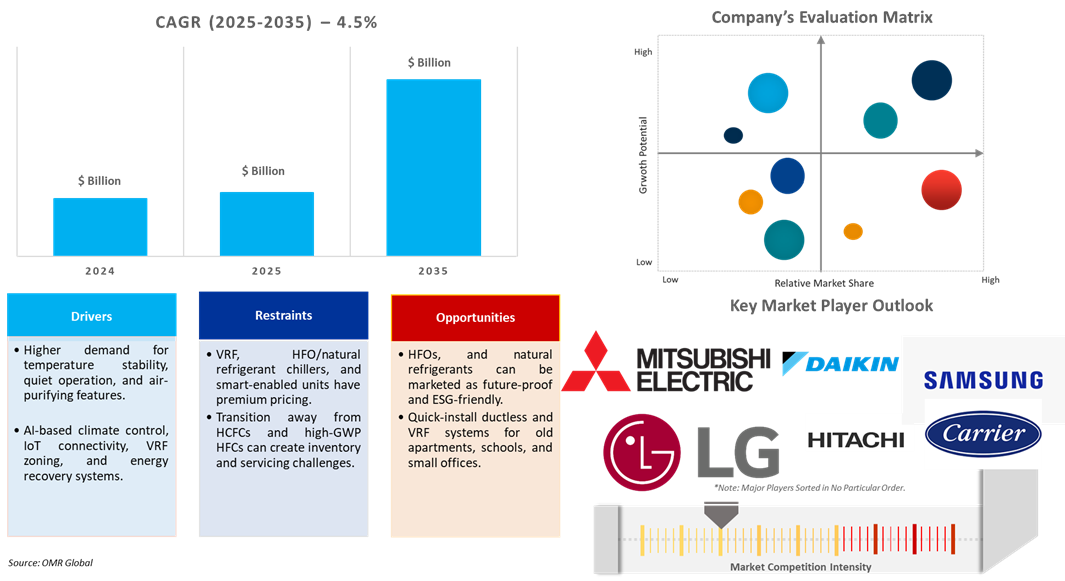
Japan air conditioning market was valued at $18,276 million in 2024 and is projected to reach $29,472 million in 2035, growing at a CAGR of 4.5% during the forecast period (2025-2035). Air Conditioning is experiencing massive growth in the market owing to the rise of smart and AI-enabled AC, energy efficiency regulations, launches of advanced air conditioners, and robust government subsidies. In July 2025, Osaka Prefecture launched a subsidy scheme to enable small and medium-sized companies to exchange old air conditioners for energy-efficient versions, paying up to half of the equipment and installation fees.
Market Dynamics
Advancements in AI-Enabled Air Conditioning
Air conditioning technology advancements offer users the advantage of automatic adjustment of cooling levels. These air conditioners operate through continuous learning processes to achieve energy efficiency, personalised cooling features, and improved performance while requiring minimal input from users. Companies like Daikin, Panasonic, Samsung, and others are providing AI-enabled AC to deliver comfort, convenience, and innovation.
- In January 2025, Samsung launched BESPOKE AI WindFree Air conditioners. This range binds AI-driven innovations to adapt to varying climate conditions, ensuring consistent comfort and maximum efficiency.
- In September 2024, Daikin introduced an AI control service for AC systems in commercial buildings.
- In January 2024, Panasonic launched Eolia inverter air conditioners with advanced AI functions for optimized temperature control and air quality management, leveraging real-time data for personalized comfort.
Rising Demand for Energy-Efficient Air Conditioning
Consumer preference is shifting towards energy-efficient air conditioners due to various advantages, including improved indoor air quality, lower energy consumption, environmental sustainability, government support and incentives, and others. The Japanese government offers various incentives and subsidy programs to encourage energy conservation and renewable energy adoption. Local governments offer rebates to replace older, less efficient appliances with newer, more efficient ones. Tokyo, Mie, Toyama, and Fukui are among the municipalities that have introduced programmes specifically for replacing old units with energy-efficient appliances. In September 2023, Daikin displayed a high-efficiency inverter air conditioner at the COP28 Japan Pavilion, emphasising its ability to achieve up to 50% energy savings.
Market Segmentation
- Based on the application, the market is segmented into residential, commercial, industrial, healthcare, institutional, and automotive.
- Based on the type, the market is segmented into splits, rooftop, indoor packaged, chillers, VRF, and AHU/FCU.
- Based on the duct type, the market is segmented into ducted and ductless.
- Based on the type of refrigerant, the market is segmented into HCFC, HFC, HFO, and Natural refrigerants.
Split Air Conditioning Segment to Dominate the Market
Split air conditioning offers various advantages, including quiet operation, easy installation, enhanced visual appearance, and no ductwork required. Split AC is are suitable choice for households, corporate offices. Split AC consumes less power while offering optimum cooling. Modern split AC comes with smartphone app integration. LG offers a light commercial single split AC for various retail shops. Minimal noise and energy efficiency lead to the adoption of split AC across healthcare facilities such as clinics and diagnostic centres.
Automotive: A Key Segment in Market Growth
As per the International Trade Administration (ITA), Japan is the fourth-largest automotive market globally, and has leading automakers such as Toyota, Honda, Nissan, Mazda, Suzuki, Subaru, Daihatsu, and Mitsubishi. The strong automotive production base increases the demand for automotive air conditioning systems, including compressors, condensers, and eco-friendly refrigerants, for climate control solutions. Increasing adoption of passenger electric and hybrid vehicles promotes demand for advanced, energy-efficient, and lightweight AC systems that minimize battery consumption.
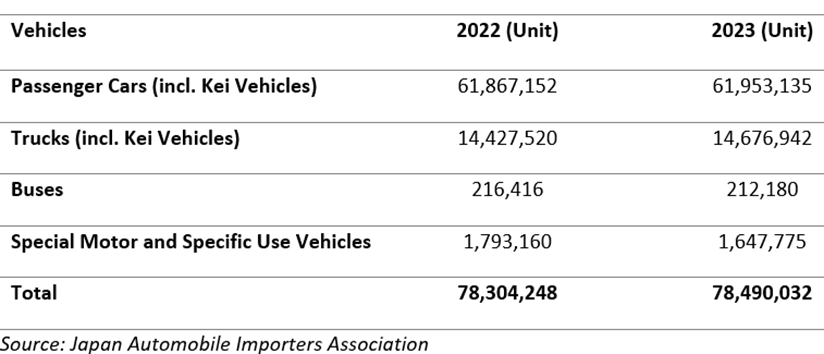
Japan’s vehicle population creates a demand for automotive air conditioning systems. According Japan Automobile Importers Association in March 2023, there were over 78.49 million vehicles in use in the country, including 61.95 million passenger cars, 14.68 million trucks, over 212,000 buses, and 1.64 million special-purpose vehicles.
Number of Vehicles in Use in Japan as of the end of March 2023
Market Players Outlook
The major companies operating in the Japanese air conditioning market include Mitsubishi Electric Corporation, LG Electronics, Daikin Industries, Ltd., Hitachi Air Conditioning Company, Carrier Corp., Samsung, among others. Market players are leveraging partnerships, collaborations, mergers, and acquisition strategies for business expansion and innovative product development to maintain their market positioning.
Recent Developments
- In March 2025, Mitsubishi Heavy Industries Thermal Systems, Ltd., a part of Mitsubishi Heavy Industries (MHI) Group, launched 31 new models of residential-use air-conditioners for the Japanese market for 2025.
The Report Covers
- Market value data analysis of 2024 and forecast to 2035.
- Annualized market revenues ($ million) for each market segment.
- Country-wise analysis of major geographical regions.
- Key companies operating in the Japan air conditioning market. Based on the availability of data, information related to new products and relevant news is also available in the report.
- Analysis of business strategies by identifying the key market segments positioned for strong growth in the future.
- Analysis of market-entry and market expansion strategies.
- Competitive strategies by identifying ‘who-stands-where’ in the market.
1. Report Summary
• Current Industry Analysis and Growth Potential Outlook
• Japan Air Conditioning Market Sales Analysis – Material Application | Type | Duct Type | Refrigerant Type ($ Million)
1.1. Research Methodology
• Primary Research Approach
• Secondary Research Approach
1.2. Market Snapshot
2. Market Overview and Insights
2.1. Scope of the Study
2.2. Analyst Insight & Current Market Trends
2.2.1. Key Air Conditioning Industry Trends
2.2.2. Market Recommendations
3. Market Determinants
3.1. Market Drivers
3.1.1. Drivers For Japan Air Conditioning Market: Impact Analysis
3.2. Market Pain Points and Challenges
3.2.1. Restraints For Japan Air Conditioning Market: Impact Analysis
3.3. Market Opportunities
3.3.1. Opportunities For Japan Air Conditioning Market: Impact Analysis
4. Competitive Landscape
4.1. Competitive Dashboard – Japan Air Conditioning Market Revenue and Share by Manufacturers
• Air Conditioning Product Comparison Analysis
• Top Market Player Ranking Matrix
4.2. Key Company Analysis
4.3. Mitsubishi Electric Corporation
4.3.1.1. Overview
4.3.1.2. Product Portfolio
4.3.1.3. Financial Analysis (Subject to Data Availability)
4.3.1.4. SWOT Analysis
4.3.1.5. Business Strategy
4.3.2. LG Electronics
4.3.2.1. Overview
4.3.2.2. Product Portfolio
4.3.2.3. Financial Analysis (Subject to Data Availability)
4.3.2.4. SWOT Analysis
4.3.2.5. Business Strategy
4.3.3. Daikin Industries, Ltd.
4.3.3.1. Overview
4.3.3.2. Product Portfolio
4.3.3.3. Financial Analysis (Subject to Data Availability)
4.3.3.4. SWOT Analysis
4.3.3.5. Business Strategy
4.3.4. Carrier Corp.
4.3.4.1. Overview
4.3.4.2. Product Portfolio
4.3.4.3. Financial Analysis (Subject to Data Availability)
4.3.4.4. SWOT Analysis
4.3.4.5. Business Strategy
4.3.5. Hitachi Air Conditioning Company
4.3.5.1. Overview
4.3.5.2. Product Portfolio
4.3.5.3. Financial Analysis (Subject to Data Availability)
4.3.5.4. SWOT Analysis
4.3.5.5. Business Strategy
4.3.6. Hitachi Air Conditioning Company
4.3.6.1. Overview
4.3.6.2. Product Portfolio
4.3.6.3. Financial Analysis (Subject to Data Availability)
4.3.6.4. SWOT Analysis
4.3.6.5. Business Strategy
4.3.7. Samsung Electronics Co. Ltd.
4.3.7.1. Overview
4.3.7.2. Product Portfolio
4.3.7.3. Financial Analysis (Subject to Data Availability)
4.3.7.4. SWOT Analysis
4.3.7.5. Business Strategy
4.4. Top Winning Strategies by Market Players
4.4.1. Merger and Acquisition
4.4.2. Product Launch
4.4.3. Partnership And Collaboration
5. Japan Air Conditioning Market Sales Analysis by Application ($ Million)
5.1. Residential
5.2. Commercial
5.3. Industrial
5.4. Healthcare
5.5. Institution
5.6. Automotive
6. Japan Air Conditioning Market Sales Analysis by Type ($ Million)
6.1. Splits
6.2. Rooftop
6.3. Indoor Packaged
6.4. Chillers
6.5. VRF (Variable Refrigerant Flow)
6.6. AHU/FCU (Air Handling Unit / Fan Coil Unit)
7. Japan Air Conditioning Market Sales Analysis by Duct Type ($ Million)
7.1. Ducted
7.2. Ductless
8. Japan Air Conditioning Market Sales Analysis by Refrigerant Type ($ Million)
8.1. HCFC
8.2. HFC
8.3. HFO
8.4. Natural Refrigerant
9. Company Profiles
9.1. AGI Greenpac
9.1.1. Quick Facts
9.1.2. Company Overview
9.1.3. Product Portfolio
9.1.4. Business Strategies
9.2. AUX Group (NINGBOAUXELECTRICCO.,LTD.)
9.2.1. Overview
9.2.2. Product Portfolio
9.2.3. Financial Analysis (Subject to Data Availability)
9.2.4. SWOT Analysis
9.2.5. Business Strategy
9.3. Blue Star Ltd.
9.3.1. Overview
9.3.2. Product Portfolio
9.3.3. Financial Analysis (Subject to Data Availability)
9.3.4. SWOT Analysis
9.3.5. Business Strategy
9.4. Bosch Termotecnologia S.A.
9.4.1. Overview
9.4.2. Product Portfolio
9.4.3. Financial Analysis (Subject to Data Availability)
9.4.4. SWOT Analysis
9.4.5. Business Strategy
9.5. Carrier Corp.
9.5.1. Overview
9.5.2. Product Portfolio
9.5.3. Financial Analysis (Subject to Data Availability)
9.5.4. SWOT Analysis
9.5.5. Business Strategy
9.6. Chofu Seisakusho Co.,Ltd.
9.6.1. Overview
9.6.2. Product Portfolio
9.6.3. Financial Analysis (Subject to Data Availability)
9.6.4. SWOT Analysis
9.6.5. Business Strategy
9.7. Delta Electronics, Inc.
9.7.1. Overview
9.7.2. Product Portfolio
9.7.3. Financial Analysis (Subject to Data Availability)
9.7.4. SWOT Analysis
9.7.5. Business Strategy
9.8. Denso Aircool Corp.
Overview
9.8.1. Product Portfolio
9.8.2. Financial Analysis (Subject to Data Availability)
9.8.3. SWOT Analysis
9.8.4. Business Strategy
9.9. Eberspächer
9.9.1. Overview
9.9.2. Product Portfolio
9.9.3. Financial Analysis (Subject to Data Availability)
9.9.4. SWOT Analysis
9.9.5. Business Strategy
9.10. Fujitsu General
9.10.1. Overview
9.10.2. Product Portfolio
9.10.3. Financial Analysis (Subject to Data Availability)
9.10.4. SWOT Analysis
9.10.5. Business Strategy
9.11. Haier Inc.
9.11.1. Overview
9.11.2. Product Portfolio
9.11.3. Financial Analysis (Subject to Data Availability)
9.11.4. SWOT Analysis
9.11.5. Business Strategy
9.12. Hella GmbH & Co. KGaA
9.12.1. Overview
9.12.2. Product Portfolio
9.12.3. Financial Analysis (Subject to Data Availability)
9.12.4. SWOT Analysis
9.12.5. Business Strategy
9.13. Johnson Controls Inc.
9.13.1. Overview
9.13.2. Product Portfolio
9.13.3. Financial Analysis (Subject to Data Availability)
9.13.4. SWOT Analysis
9.13.5. Business Strategy
9.14. Mahle GmbH
9.14.1. Overview
9.14.2. Product Portfolio
9.14.3. Financial Analysis (Subject to Data Availability)
9.14.4. SWOT Analysis
9.14.5. Business Strategy
9.15. Panasonic Corp.
9.15.1. Overview
9.15.2. Product Portfolio
9.15.3. Financial Analysis (Subject to Data Availability)
9.15.4. SWOT Analysis
9.15.5. Business Strategy
9.16. Rinnai Corp.
9.16.1. Overview
9.16.2. Product Portfolio
9.16.3. Financial Analysis (Subject to Data Availability)
9.16.4. SWOT Analysis
9.16.5. Business Strategy
9.17. Sharp Corporation
9.17.1. Overview
9.17.2. Product Portfolio
9.17.3. Financial Analysis (Subject to Data Availability)
9.17.4. SWOT Analysis
9.17.5. Business Strategy
9.18. TEYU
9.18.1. Overview
9.18.2. Product Portfolio
9.18.3. Financial Analysis (Subject to Data Availability)
9.18.4. SWOT Analysis
9.18.5. Business Strategy
9.19. Toyotomi CO., LTD.
9.19.1. Overview
9.19.2. Product Portfolio
9.19.3. Financial Analysis (Subject to Data Availability)
9.19.4. SWOT Analysis
9.19.5. Business Strategy
9.20. Trane Technologies Company, LLC
9.20.1. Overview
9.20.2. Product Portfolio
9.20.3. Financial Analysis (Subject to Data Availability)
9.20.4. SWOT Analysis
9.20.5. Business Strategy
9.21. Valeo Service
9.21.1. Overview
9.21.2. Product Portfolio
9.21.3. Financial Analysis (Subject to Data Availability)
9.21.4. SWOT Analysis
9.21.5. Business Strategy
9.22. Yanmar Holdings CO., LTD.
9.22.1. Overview
9.22.2. Product Portfolio
9.22.3. Financial Analysis (Subject to Data Availability)
9.22.4. SWOT Analysis
9.22.5. Business Strategy
1. Japan Air Conditioning Market Research and Analysis by Application, 2024–2035 ($ Million)
2. Japan Air Conditioning for Residential Market Research and Analysis by Application, 2024–2035 ($ Million)
3. Japan Air Conditioning for Commercial Market Research and Analysis, 2024–2035 ($ Million)
4. Japan Air Conditioning for Industrial Market Research and Analysis, 2024–2035 ($ Million)
5. Japan Air Conditioning for Healthcare Market Research and Analysis, 2024–2035 ($ Million)
6. Japan Air Conditioning for Institution Market Research and Analysis, 2024–2035 ($ Million)
7. Japan Air Conditioning for Automative Market Research and Analysis, 2024–2035 ($ Million)
8. Japan Air Conditioning Market Research and Analysis by Type, 2024–2035 ($ Million)
9. Japan Split Air Conditioning Market Research and Analysis, 2024–2035 ($ Million)
10. Japan Rooftop Air Conditioning Market Research and Analysis, 2024–2035 ($ Million)
11. Japan Indoor Packaged Air Conditioning Market Research and Analysis, 2024–2035 ($ Million)
12. Japan Chillers Air Conditioning Market Research and Analysis, 2024–2035 ($ Million)
13. Japan VRF Air Conditioning Market Research and Analysis, 2024–2035 ($ Million)
14. Japan AHU/FCU Air Conditioning Market Research and Analysis, 2024–2035 ($ Million)
15. Japan Air Conditioning Market Research and Analysis by Duct Type, 2024–2035 ($ Million)
16. Japan Ducted Air Conditioning Market Research and Analysis, 2024–2035 ($ Million)
17. Japan Ductless Air Conditioning Market Research and Analysis, 2024–2035 ($ Million)
18. Japan Air Conditioning Market Research and Analysis by Refrigerant Type, 2024–2035 ($ Million)
19. Japan HCFC Air Conditioning Market Research and Analysis, 2024–2035 ($ Million)
20. Japan HFC Air Conditioning Market Research and Analysis, 2024–2035 ($ Million)
21. Japan HFO Air Conditioning Market Research and Analysis, 2024–2035 ($ Million)
22. Japan Natural Refrigerant Air Conditioning Market Research and Analysis, 2024–2035 ($ Million)
1. Japan Air Conditioning Market Share by Application, 2024 Vs 2035 (%)
2. Japan Air Conditioning for Residential Market Share, 2024 Vs 2035 (%)
3. Japan Air Conditioning for Commercial Market Share, 2024 Vs 2035 (%)
4. Japan Air Conditioning for Industrial Market Share, 2024 Vs 2035 (%)
5. Japan Air Conditioning for Healthcare Market Share, 2024 Vs 2035 (%)
6. Japan Air Conditioning for Institution Market Share, 2024 Vs 2035 (%)
7. Japan Air Conditioning for Automative Market Share, 2024 Vs 2035 (%)
8. Japan Air Conditioning Market Share by Type, 2024 Vs 2035 (%)
9. Japan Split Air Conditioning Market Share, 2024 Vs 2035 (%)
10. Japan Rooftop Air Conditioning Market Share, 2024 Vs 2035 (%)
11. Japan Indoor Packaged Air Conditioning Market Share, 2024 Vs 2035 (%)
12. Japan Chillers Air Conditioning Market Share, 2024 Vs 2035 (%)
13. Japan VRF Air Conditioning Market Share, 2024 Vs 2035 (%)
14. Japan AHU/FCU Air Conditioning Market Share, 2024 Vs 2035 (%)
15. Japan Air Conditioning Market Share by Duct Type, 2024 Vs 2035 (%)
16. Japan Ducted Air Conditioning Market Share, 2024 Vs 2035 (%)
17. Japan Ductless Air Conditioning Market Share, 2024 Vs 2035 (%)
18. Japan Air Conditioning Market Share by Refrigerant Type, 2024 Vs 2035 (%)
19. Japan HCFC Air Conditioning Market Share, 2024 Vs 2035 (%)
20. Japan HFC Air Conditioning Market Share, 2024 Vs 2035 (%)
21. Japan HFO Air Conditioning Market Share, 2024 Vs 2035 (%)
22. Japan Natural Refrigerant Air Conditioning Market Share, 2024 Vs 2035 (%)
- Printable version
- No restriction to number of users within the company