Massive MIMO Market


Massive MIMO Market Size, Share & Trends Analysis Report by Type (LTE Advance, LTE Advance Pro, and 5G), by Spectrum (Time Division Duplexing (TDD), and Frequency Division Duplexing (FDD)), and by Type of Antenna (8T8R, 16T16R, 32T32R, 64T64R, 128T128R and Above) Forecast Period (2025-2035)
Industry Overview
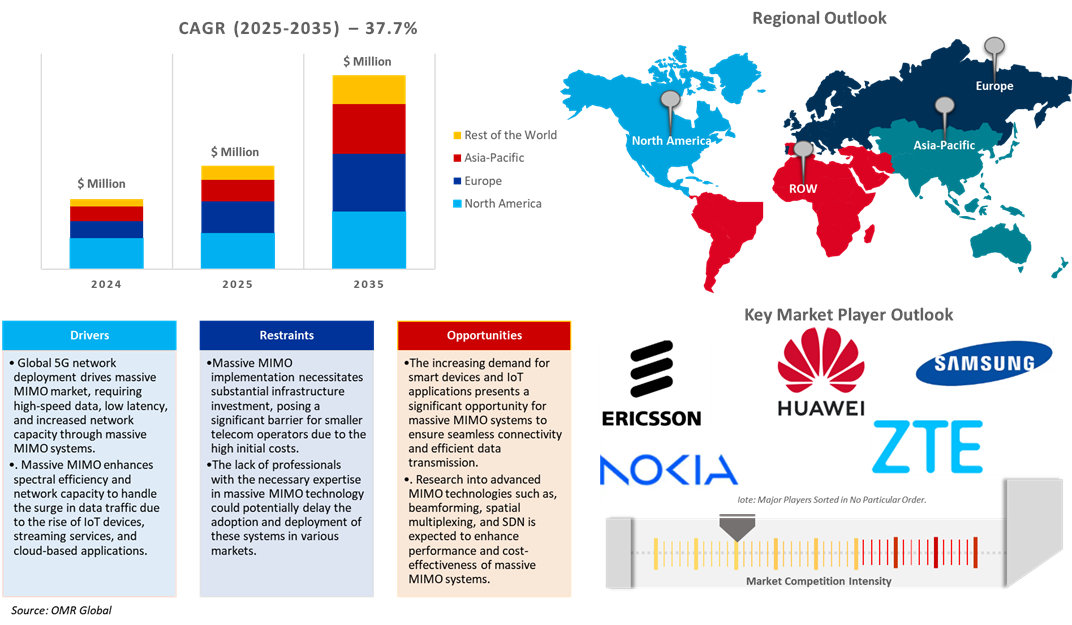
Massive MIMO market was valued at $4,800 million in 2024 and is projected to reach $160,435 million by 2035, growing at a CAGR of 37.7% from 2025 to 2035. Pivotal factors such as expanding the 5G telecommunication footprint, rapidly growing internet traffic and wireless connectivity, and augmenting adoption of AI and cloud-based solutions for optimizing massive MIMO solutions are expected to spur market growth. Additionally, the industry-level focus on creating energy-efficient and high-utility MIMO solutions, including AI-based MIMO software, and ongoing regulatory pressure to create smart and advanced telecom infrastructure are expected to contribute to long-term market growth. For instance, in October 2024, the EU Commission invests $899.6 million under CEF Digital (2024-2027) to drive 5G deployment, including gigabit and standalone 5G infrastructure. Support for large-scale initiatives, edge cloud integration, and sector-specific applications in health, manufacturing, transport, and logistics promotes Europe's digital connectivity and 5G uptake.
Market Dynamics
Adoption of 5G and Transition to 6G
Global operators are investing in 5 G-Advanced and 6 G-ready infrastructure, with high-frequency bands like 6 GHz and terahertz heavily relying on Massive MIMO for market growth. For instance, in February 2025, VIAVI Solutions confirmed the over-the-air (OTA) capability of the Nokia Massive MIMO radio in the higher 6 GHz frequency band, a band that provided capacity to the existing cell sites for 5 G-Advanced and 6G networks. Operators are required to increase their TDD mid-band spectrum holdings due to the increased capacity of 5G applications. The test setup for Nokia consisted of a 128TRX Massive MIMO radio on the Nokia AirScale Habrok platform. VIAVI provided the NITRO Wireless test solution featuring the TM500 Network Tester and OneAdvisor 800 spectrum and signal analyzer.
Increasing Adoption for Open RAN and Cloud RAN
Open and cloud-based radio access networks are gaining considerable popularity in the global massive MIMO market as they can offer a cost-effective, interoperable, and flexible solution to telecom operators. The utilization of these architectures offers centralized processing, reduction of CAPEX, and multi-vendor operability, which is being received well across the telecom sector and is set to contribute considerably to the evolution of the next-generation MIMO solutions. For instance, in February 2024, Viettel showcased its Massive MIMO 32T32R, the first that is powered by Qualcomm's QRU/QDU chipset, promoting 5G and Open Fronthaul. The end-to-end configuration combines Viettel CU/DU software on Intel X86 COTS servers with high-performance testing for 5G NSA with downlink and uplink stability.
Market Segmentation
- Based on the technology, the market is segmented into LTE advance, LTE advance pro, and 5G.
- Based on the spectrum, the market is segmented into time division duplexing (TDD), and frequency division duplexing (FDD).
- Based on the type of antenna, the market is segmented into 8T8R, 16T16R, 32T32R, 64T64R, 128T128R and above.
5G: A Key Segment in Market Growth
The rollout of the 5G network is powered by the adoption of Massive MIMO technology that enhances spectral efficiency and coverage, and boosts market growth. For instance, in February 2024, Türk Telekom collaborated with Open RAN supplier Parallel Wireless to add its energy-efficient xApps solution and AMD-based 5G massive MIMO solution to its trial cluster. GreenRAN xApps are included in the expansion, which offers power consumption optimization and adjusts traffic demand variability on an O-RAN-compliant platform.
Regional Outlook
The global massive MIMO market is further divided by geography, including North America (the US and Canada), Asia-Pacific (India, China, Japan, South Korea, Australia and New Zealand, ASEAN Countries, and the Rest of Asia-Pacific), Europe (the UK, Germany, France, Italy, Spain, Russia, and the Rest of Europe), and the Rest of the World (the Middle East & Africa, and Latin America).
Government Incentives & Funding in North America
Government funding programs and incentives, including the US public wireless fund initiative, offer financing for 5G and Massive MIMO technology-related innovations that fuel market growth. For instance, in January 2025, the Biden-Harris Administration provided $117 million in grants from the public wireless supply chain innovation fund to promote open and interoperable wireless networks, promote competition, enhance global supply chain resilience, and reduce costs for consumers and network operators.
Asia-Pacific Region Dominates the Market with Major Share
Asia-Pacific holds a significant share, owing to the evolution to 5G and 6G is the largest impact driver for developing and implementing massive MIMO solutions. This is owing to the evolution of requirements needed in deploying 5G or 6G, such as component disaggregation, increased efficiency, network diversification, among numerous others. These needs are more appropriately fulfilled through the integration of massive MIMOs in comparison to traditional deployment that is expected to enhance demand for massive MIMOs across the 5G and 6G rollout path. According to the Press Information Bureau of India (PIB), India is at the forefront of adopting 5G technology, with more than 90% coverage and cheap services fueling accessibility. In India, Nepal, and Bhutan, 5G subscriptions are projected to grow to 97 crores by 2030, accounting for 74% of all mobile subscriptions in the region. 5G is projected to contribute around $$455 billion to India's economy by 2040.
Market Players Outlook
The major companies operating in the global Massive MIMO market include Huawei Technologies Co., Ltd., Nokia Corp., Samsung Electronics Co., Ltd., Telefonaktiebolaget LM Ericsson, and ZTE Corp., among others. Market players are leveraging partnerships, collaborations, mergers, and acquisition strategies for business expansion and innovative product development to maintain their market positioning.
Recent Developments
- In June 2024, Nokia and Telia conducted a successful outdoor trial in the upper 6 GHz band spectrum, illustrating macro-grid-ready uplink performance and establishing readiness for large area capacity expansion for 5G and 6G networks. The trial employed a Massive MIMO antenna from Nokia's AirScale Habrok radio, illustrating Nokia's technology leadership in providing mobile operators with a seamless evolution path for their network when 5 G-Advanced and 6G networks become commercially available. The assignment of the upper 6 GHz band for mobile services, including 200 MHz of mid-band TDD spectrum per operator, is important in those markets that lack the 7.2-8.4 GHz band.
- In February 2025, Mavenir introduced a low-power next-generation 32TRX mMIMO variant and a high-power 32TRX AAU with energy efficiency and significant OpEx savings. The products are designed to support Uplink Performance Improvement (ULPI) to enable network operators to enhance uplink performance, reduce latency, and lower fronthaul bandwidth in cities. The portfolio includes two standalone models, such as the 32TRX AAU low power model that is optimized for high-density environments and the 32TRX AAU high power model that suited for RAN sharing deployments.
- In February 2024, Keysight Technologies is enabling Intel to design and test massive MIMO beamforming structures with Open RAN Studio to speed up the adoption of Open RAN. Deployed on Intel Agilex 7 SoC FPGA, the solution delivers improved signal quality, flexibility, and cost effectiveness while solving the conformance and interoperability problems in Open RAN networks.
- In February 2023, Nokia unveiled Habrok 32 and Habrok 64 AirScale massive MIMO radios at MWC 2023 with the help of the new SoC ReefShark. At a light weight of 24 kg, Habrok 64 offers higher output power, 30% lower power consumption, and faster 5G deployment with 400 MHz IBW for improved network performance.
The Report Covers
- Market value data analysis for 2024 and forecast to 2035.
- Annualized market revenues ($ million) for each market segment.
- Country-wise analysis of major geographical regions.
- Key companies operating in the global massive MIMO market. Based on the availability of data, information related to new products and relevant news is also available in the report.
- Analysis of business strategies by identifying the key market segments positioned for strong growth in the future.
- Analysis of market-entry and market expansion strategies.
- Competitive strategies by identifying ‘who-stands-where’ in the market.
1. Report Summary
• Current Industry Analysis and Growth Potential Outlook
• Global Massive MIMO Market Sales Analysis – Technology | Spectrum | Type of Antenna |($ Million)
• Massive MIMO Market Sales Performance of Top Countries
1.1. Research Methodology
• Primary Research Approach
• Secondary Research Approach
1.2. Market Snapshot
2. Market Overview and Insights
2.1. Scope of the Study
2.2. Analyst Insight & Current Market Trends
2.2.1. Key Massive MIMO Industry Trends
2.2.2. Market Recommendations
2.3. Porter's Five Forces Analysis for the Massive MIMO Market
2.3.1. Competitive Rivalry
2.3.2. Threat of New Entrants
2.3.3. Bargaining Power of Suppliers
2.3.4. Bargaining Power of Buyers
2.3.5. Threat of Substitutes
3. Market Determinants
3.1. Market Drivers
3.1.1. Drivers For the Global Massive MIMO Market: Impact Analysis
3.2. Market Pain Points and Challenges
3.2.1. Restraints For the Global Massive MIMO Market: Impact Analysis
3.3. Market Opportunities
4. Competitive Landscape
4.1. Competitive Dashboard – Massive MIMO Market Revenue and Share by Manufacturers
• Massive MIMO Product Comparison Analysis
• Top Market Player Ranking Matrix
4.2. Key Company Analysis
4.2.1. Huawei Technologies Co., Ltd.
4.2.1.1. Overview
4.2.1.2. Product Portfolio
4.2.1.3. Financial Analysis (Subject to Data Availability)
4.2.1.4. SWOT Analysis
4.2.1.5. Business Strategy
4.2.2. Nokia Corp.
4.2.2.1. Overview
4.2.2.2. Product Portfolio
4.2.2.3. Financial Analysis (Subject to Data Availability)
4.2.2.4. SWOT Analysis
4.2.2.5. Business Strategy
4.2.3. Samsung Electronics Co., Ltd.
4.2.3.1. Overview
4.2.3.2. Product Portfolio
4.2.3.3. Financial Analysis (Subject to Data Availability)
4.2.3.4. SWOT Analysis
4.2.3.5. Business Strategy
4.2.4. Telefonaktiebolaget LM Ericsson
4.2.4.1. Overview
4.2.4.2. Product Portfolio
4.2.4.3. Financial Analysis (Subject to Data Availability)
4.2.4.4. SWOT Analysis
4.2.4.5. Business Strategy
4.2.5. ZTE Corp.
4.2.5.1. Overview
4.2.5.2. Product Portfolio
4.2.5.3. Financial Analysis (Subject to Data Availability)
4.2.5.4. SWOT Analysis
4.2.5.5. Business Strategy
4.3. Top Winning Strategies by Market Players
4.3.1. Merger and Acquisition
4.3.2. Product Launch
4.3.3. Partnership And Collaboration
5. Global Massive MIMO Market Sales Analysis by Technology ($ Million)
5.1. LTE Advance
5.2. LTE Advance Pro
5.3. 5G
6. Global Massive MIMO Market Sales Analysis by Spectrum ($ Million)
6.1. Time Division Duplexing (TDD)
6.2. Frequency Division Duplexing (FDD)
7. Global Massive MIMO Market Sales Analysis by Type of Antenna ($ Million)
7.1. 8T8R
7.2. 16T16R
7.3. 32T32R
7.4. 64T64R
7.5. 128T128R and Above
8. Regional Analysis
8.1. North American Massive MIMO Market Sales Analysis – Technology | Spectrum | Type of Antenna | Country ($ Million)
• Macroeconomic Factors for North America
8.1.1. United States
8.1.2. Canada
8.2. European Massive MIMO Market Sales Analysis – Technology | Spectrum | Type of Antenna | Country ($ Million)
• Macroeconomic Factors for Europe
8.2.1. UK
8.2.2. Germany
8.2.3. Italy
8.2.4. Spain
8.2.5. France
8.2.6. Russia
8.2.7. Rest of Europe
8.3. Asia-Pacific Massive MIMO Market Sales Analysis – Technology | Spectrum | Type of Antenna | Country ($ Million)
• Macroeconomic Factors for Asia-Pacific
8.3.1. China
8.3.2. Japan
8.3.3. South Korea
8.3.4. India
8.3.5. Australia & New Zealand
8.3.6. ASEAN Countries (Thailand, Indonesia, Vietnam, Singapore, And Others)
8.3.7. Rest of Asia-Pacific
8.4. Rest of the World Massive MIMO Market Sales Analysis – Technology | Spectrum | Type of Antenna | Country ($ Million)
• Macroeconomic Factors for the Rest of the World
8.4.1. Latin America
8.4.2. Middle East and Africa
9. Company Profiles
9.1. Airspan Networks Inc.
9.1.1. Quick Facts
9.1.2. Company Overview
9.1.3. Product Portfolio
9.1.4. Business Strategies
9.2. Analog Devices, Inc.
9.2.1. Quick Facts
9.2.2. Company Overview
9.2.3. Product Portfolio
9.2.4. Business Strategies
9.3. Cambium Networks, Ltd.
9.3.1. Quick Facts
9.3.2. Company Overview
9.3.3. Product Portfolio
9.3.4. Business Strategies
9.4. Cisco Systems, Inc.
9.4.1. Quick Facts
9.4.2. Company Overview
9.4.3. Product Portfolio
9.4.4. Business Strategies
9.5. Comba Telecom Systems Holdings Ltd.
9.5.1. Quick Facts
9.5.2. Company Overview
9.5.3. Product Portfolio
9.5.4. Business Strategies
9.6. CommScope, Inc.
9.6.1. Quick Facts
9.6.2. Company Overview
9.6.3. Product Portfolio
9.6.4. Business Strategies
9.7. Deutsche Telekom AG
9.7.1. Quick Facts
9.7.2. Company Overview
9.7.3. Product Portfolio
9.7.4. Business Strategies
9.8. Fibocom Wireless Inc.
9.8.1. Quick Facts
9.8.2. Company Overview
9.8.3. Product Portfolio
9.8.4. Business Strategies
9.9. Fujitsu Ltd.
9.9.1. Quick Facts
9.9.2. Company Overview
9.9.3. Product Portfolio
9.9.4. Business Strategies
9.10. Huawei Technologies Co., Ltd.
9.10.1. Quick Facts
9.10.2. Company Overview
9.10.3. Product Portfolio
9.10.4. Business Strategies
9.11. Intel Corp.
9.11.1. Quick Facts
9.11.2. Company Overview
9.11.3. Product Portfolio
9.11.4. Business Strategies
9.12. Juniper Networks, Inc.
9.12.1. Quick Facts
9.12.2. Company Overview
9.12.3. Product Portfolio
9.12.4. Business Strategies
9.13. Keysight Technologies, Inc.
9.13.1. Quick Facts
9.13.2. Company Overview
9.13.3. Product Portfolio
9.13.4. Business Strategies
9.14. Mavenir Systems, Inc.
9.14.1. Quick Facts
9.14.2. Company Overview
9.14.3. Product Portfolio
9.14.4. Business Strategies
9.15. MediaTek
9.15.1. Quick Facts
9.15.2. Company Overview
9.15.3. Product Portfolio
9.15.4. Business Strategies
9.16. Mimosa Networks, Inc.
9.16.1. Quick Facts
9.16.2. Company Overview
9.16.3. Product Portfolio
9.16.4. Business Strategies
9.17. NEC Corp.
9.17.1. Quick Facts
9.17.2. Company Overview
9.17.3. Product Portfolio
9.17.4. Business Strategies
9.18. Nokia Corp.
9.18.1. Quick Facts
9.18.2. Company Overview
9.18.3. Product Portfolio
9.18.4. Business Strategies
9.19. NXP Semiconductors N.V.
9.19.1. Quick Facts
9.19.2. Company Overview
9.19.3. Product Portfolio
9.19.4. Business Strategies
9.20. Prose Technologies Co., Ltd.
9.20.1. Quick Facts
9.20.2. Company Overview
9.20.3. Product Portfolio
9.20.4. Business Strategies
9.21. Qualcomm Technologies, Inc.
9.21.1. Quick Facts
9.21.2. Company Overview
9.21.3. Product Portfolio
9.21.4. Business Strategies
9.22. Samsung Electronics Co., Ltd.
9.22.1. Quick Facts
9.22.2. Company Overview
9.22.3. Product Portfolio
9.22.4. Business Strategies
9.23. Skyworks Solutions, Inc.
9.23.1. Quick Facts
9.23.2. Company Overview
9.23.3. Product Portfolio
9.23.4. Business Strategies
9.24. Telefonaktiebolaget LM Ericsson
9.24.1. Quick Facts
9.24.2. Company Overview
9.24.3. Product Portfolio
9.24.4. Business Strategies
9.25. Verizon Communications Inc.
9.25.1. Quick Facts
9.25.2. Company Overview
9.25.3. Product Portfolio
9.25.4. Business Strategies
9.26. ZTE Corp.
9.26.1. Quick Facts
9.26.2. Company Overview
9.26.3. Product Portfolio
9.26.4. Business Strategies
1. Global Massive MIMO Market Research And Analysis By Technology, 2024-2035 ($ Million)
2. Global LTE Advance Massive MIMO Market Research And Analysis By Region, 2024-2035 ($ Million)
3. Global LTE Advance Pro Massive MIMO Market Research And Analysis By Region, 2024-2035 ($ Million)
4. Global 5G Massive MIMO Market Research And Analysis By Region, 2024-2035 ($ Million)
5. Global Massive MIMO Market Research And Analysis By Spectrum, 2024-2035 ($ Million)
6. Global Massive MIMO Time Division Duplexing (TDD) Market Research And Analysis By Region, 2024-2035 ($ Million)
7. Global Massive MIMO Frequency Division Duplexing (FDD) Market Research And Analysis By Region, 2024-2035 ($ Million)
8. Global Massive MIMO Market Research And Analysis By Type of Antenna, 2024-2035 ($ Million)
9. Global 8T8R Antenna-Based Massive MIMO Market Research And Analysis By Region, 2024-2035 ($ Million)
10. Global 16T16R Antenna-Based Massive MIMO Market Research And Analysis By Region, 2024-2035 ($ Million)
11. Global 32T32R Antenna-Based Massive MIMO Market Research And Analysis By Region, 2024-2035 ($ Million)
12. Global 64T64R Antenna-Based Massive MIMO Market Research And Analysis By Region, 2024-2035 ($ Million)
13. Global 128T128R and Above Antenna-Based Massive MIMO Market Research And Analysis By Region, 2024-2035 ($ Million)
14. Global Massive MIMO Market Research And Analysis By Region, 2024-2035 ($ Million)
15. North American Massive MIMO Market Research And Analysis By Country, 2024-2035 ($ Million)
16. North American Massive MIMO Market Research And Analysis By Technology, 2024-2035 ($ Million)
17. North American Massive MIMO Market Research And Analysis By Spectrum, 2024-2035 ($ Million)
18. North American Massive MIMO Market Research And Analysis By Type of Antenna, 2024-2035 ($ Million)
19. European Massive MIMO Market Research And Analysis By Country, 2024-2035 ($ Million)
20. European Massive MIMO Market Research And Analysis By Technology, 2024-2035 ($ Million)
21. European Massive MIMO Market Research And Analysis By Spectrum, 2024-2035 ($ Million)
22. European Massive MIMO Market Research And Analysis By Type of Antenna, 2024-2035 ($ Million)
23. Asia-Pacific Massive MIMO Market Research And Analysis By Country, 2024-2035 ($ Million)
24. Asia-Pacific Massive MIMO Market Research And Analysis By Technology, 2024-2035 ($ Million)
25. Asia-Pacific Massive MIMO Market Research And Analysis By Spectrum, 2024-2035 ($ Million)
26. Asia-Pacific Massive MIMO Market Research And Analysis By Type of Antenna, 2024-2035 ($ Million)
27. Rest Of The World Massive MIMO Market Research And Analysis By Region, 2024-2035 ($ Million)
28. Rest Of The World Massive MIMO Market Research And Analysis By Country, 2024-2035 ($ Million)
29. Rest Of The World Massive MIMO Market Research And Analysis By Technology, 2024-2035 ($ Million)
30. Rest Of The World Massive MIMO Market Research And Analysis By Spectrum, 2024-2035 ($ Million)
31. Rest Of The World Massive MIMO Market Research And Analysis By Type of Antenna, 2024-2035 ($ Million)
- Printable version
- No restriction to number of users within the company