Mobile Sensing Fitness Market


Mobile Sensing Fitness Market Size, Share & Trends Analysis Report by Product Type (Activity Trackers Band, Smartwatches, Heart Rate Monitors Band, Smart Rings, and Smart Clothing), and by End-User (Individual Consumers, Fitness Centers/Gyms, Healthcare Providers, and Corporate Wellness Programs) Forecast Period (2025-2035)
Industry Overview
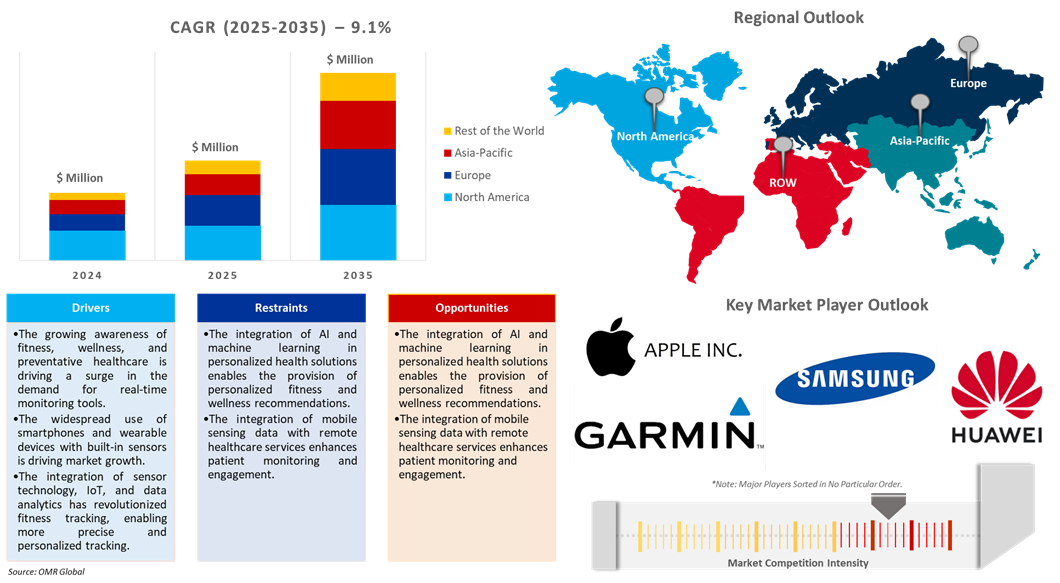
The global Mobile Sensing Fitness Market was valued at approximately USD 5.69 billion in 2025 and is projected to reach USD 14.2 billion by 2035, growing at a CAGR of 9.57% during the forecast period. The growing emphasis on health and fitness has increased the demand for real-time physical activity tracking. Technological innovation, smartphone penetration, wearables, IoT adoption, remote monitoring, telehealth, government support, and R&D expenditure are propelling the growth of advanced fitness solutions.
Market Dynamics
Rising Health Awareness
Global health awareness drives aging populations and high-risk regions to monitor fitness levels, leading to increased adoption of mobile sensing fitness devices to reduce healthcare costs. According to the Global Wellness Institute (GWI) Org, the global wellness economy experienced significant growth following the pandemic, reaching $6.3 trillion in 2023 which accounts for 6.03% of global GDP. It surpasses sectors such as the green economy, IT, and sports in size. Through an anticipated annual growth rate of 7.3% from 2023 to 2028, the wellness economy is expected to expand to approximately $6.8 trillion in 2024 and approach $9.0 trillion by 2028, outpacing the IMF's projected global GDP growth rate of 4.8%.
Growing Fitness Awareness and Participation Trends
The growing fitness awareness and participation trends, coupled with the rise of hybrid fitness models and at-home workouts, are driving the demand for mobile fitness tracking. According to the Sports and Fitness Industry Association (SFIA), in 2023, sports and fitness activities in the US experienced notable growth. Winter sports saw a 22% increase from 2022, while team sports grew by 10.8%, with 20 out of 24 tracked sports showing growth. Fitness activities in health clubs, including treadmills, stair-climbing, and class-based exercises such as Barre, Pilates, and Yoga, additionally saw increased participation. Pickleball emerged as the fastest-growing sport for the third consecutive year, with a 51.8% increase from 2022 and a 223.5% increase over three years, contributing to the growth in racquet sports. Overall, 242 million Americans, or 78.8%, participated in an activity at least once, marking a 2.2% rise from the previous year and a decade-long trend of increasing participation. Inactivity decreased to 21.2%, although there is a notable link between higher inactivity rates and lower family incomes.
Market Segmentation
- Based on the product type, the market is segmented into activity tracker bands, smartwatches, heart rate monitor bands, smart rings, and smart clothing.
- Based on the end-user industry, the market is segmented into individual consumers, fitness centers/gyms, healthcare providers, and corporate wellness programs.
Smartwatches Segment to Lead the Market with the Largest Share
Mobile sensing in fitness uses sensors in smartwatches, fitness trackers, and devices to monitor physical activity, vital signs, and health parameters in real-time. Technologies such as accelerometers, gyroscopes, heart rate monitors, GPS, and bioimpedance sensors track movement, heart rate, stress levels, and overall fitness performance. Furthermore, smartwatches, dominated by Apple, Samsung, Garmin, Fitbit, and Huawei, offer applications such as sports analytics, remote health monitoring, chronic disease management, and workplace monitoring. It drives digital health and personalized medicine.
Individual Consumers: A Key Segment in Market Growth
Mobile sensing fitness employs sensors integrated into devices such as smartphones and smartwatches to gather information regarding physical activity and health. It assists people in monitoring their health, establishing fitness goals, and tailoring workouts. The information is employed for activity tracking, health management, remote guidance, telemedicine, gamification, and social interaction. It additionally enables the integration of fitness devices with other devices, giving a comprehensive perspective of health. The technology is more commonly applied to monitor health, coach remotely, and practice telemedicine, which means it is an important asset to individuals.
Regional Outlook
The global mobile sensing fitness market is further divided by geography, including North America (the US and Canada), Asia-Pacific (India, China, Japan, South Korea, Australia and New Zealand, ASEAN Countries, and the Rest of Asia-Pacific), Europe (the UK, Germany, France, Italy, Spain, Russia, and the Rest of Europe), and the Rest of the World (the Middle East & Africa, and Latin America).
Technological Advancements in Sensor Technology in Asia-Pacific
Technological advancements in sensor technology and data analytics enable high-accuracy monitoring of various health metrics, attracting tech-savvy users and driving market growth. For instance, in October 2024, Garmin launched its Fenix 8 series of multisport GPS smartwatches in India, aimed at athletes and adventure enthusiasts. The series features advanced tracking capabilities, new fitness modules, and superior battery performance. The Fenix 8 series offers two display options, such as an ultra-bright AMOLED and a solar-charging model. Both models offer daily training readiness scores and body battery metrics, providing insights into fitness levels. The series additionally features rugged design elements, leak-proof metal buttons, and a built-in speaker and microphone for voice commands and phone call functionality.
North America Region Dominates the Market with Major Share
North America holds a significant share owing to the increasing demand for wearable fitness trackers, embedded with sensors such as accelerometers, gyroscopes, heart rate sensors, and GPS, which are transforming fitness through real-time capture of data. It monitors activity and health and offers immediate feedback. It is additionally used in conjunction with mobile apps to enable personalized guidance and data review. Goal setting, gamification, and sharing enable users to remain motivated and active in fitness programs. Furthermore, wearable devices, including smartwatches and fitness trackers, are rapidly gaining popularity, with brands such as Apple, Fitbit, Garmin, and Xiaomi implementing the lead in monitoring several indicators. For instance, in September 2024, Apple unveiled the Apple Watch Series 10, which is the thinnest yet and offers the largest display of any Apple Watch. It additionally features sleep apnea notifications, faster charging, water depth and temperature sensing, and health and fitness insights in watchOS 11. The S10 SiP and built-in 4-core Neural Engine enable intelligent features such as double-tap gestures, Siri, dictation, workout detection, crash and fall detection, and the updated Smart Stack and Photos face.
Market Players Outlook
The major companies operating in the global mobile sensing fitness market include Apple Inc., Garmin Ltd., Huawei Device Co., Ltd., and Samsung Electronics Co., Ltd., among others. Market players are leveraging partnerships, collaborations, mergers, and acquisition strategies for business expansion and innovative product development to maintain their market positioning.
Recent Development
- In June 2024, Nike and Hyperice partnered to create wearable technology for athletes, enhancing warm-up and recovery. The Nike x Hyperice boot and vest offer heat and dynamic air-compression massage for feet and ankles, while the Nike x Hyperice vest provides instant heating and cooling without ice or liquid, allowing athletes to adjust their body temperatures during warm-ups and cool-downs. These innovative wearables aim to improve performance in athletic journeys.
The Report Covers
- Market value data analysis for 2024 and forecast to 2035.
- Annualized market revenues ($ million) for each market segment.
- Country-wise analysis of major geographical regions.
- Key companies operating in the global mobile sensing fitness market. Based on the availability of data, information related to new products, and relevant news is also available in the report.
- Analysis of business strategies by identifying the key market segments positioned for strong growth in the future.
- Analysis of market-entry and market expansion strategies.
- Competitive strategies by identifying ‘who-stands-where’ in the market.
1. Report Summary
• Current Industry Analysis and Growth Potential Outlook
• Global Mobile Sensing Fitness Market Sales Analysis – Product Type | End-User ($ Million)
• Mobile Sensing Fitness Market Sales Performance of Top Countries
1.1. Research Methodology
• Primary Research Approach
• Secondary Research Approach
1.2. Market Snapshot
2. Market Overview and Insights
2.1. Scope of the Study
2.2. Analyst Insight & Current Market Trends
2.2.1. Key Mobile Sensing Fitness Industry Trends
2.2.2. Market Recommendations
2.3. Porter's Five Forces Analysis for the Mobile Sensing Fitness Market
2.3.1. Competitive Rivalry
2.3.2. Threat of New Entrants
2.3.3. Bargaining Power of Suppliers
2.3.4. Bargaining Power of Buyers
2.3.5. Threat of Substitutes
3. Market Determinants
3.1. Market Drivers
3.1.1. Drivers For Global Mobile Sensing Fitness Market: Impact Analysis
3.2. Market Pain Points and Challenges
3.2.1. Restraints For Global Mobile Sensing Fitness Market: Impact Analysis
3.3. Market Opportunities
4. Competitive Landscape
4.1. Competitive Dashboard – Mobile Sensing Fitness Market Revenue and Share by Manufacturers
• Mobile Sensing Fitness Product Comparison Analysis
• Top Market Player Ranking Matrix
4.2. Key Company Analysis
4.2.1. Apple Inc.
4.2.1.1. Overview
4.2.1.2. Product Portfolio
4.2.1.3. Financial Analysis (Subject to Data Availability)
4.2.1.4. SWOT Analysis
4.2.1.5. Business Strategy
4.2.2. Garmin Ltd.
4.2.2.1. Overview
4.2.2.2. Product Portfolio
4.2.2.3. Financial Analysis (Subject to Data Availability)
4.2.2.4. SWOT Analysis
4.2.3. Huawei Technologies Co., Ltd.
4.2.3.1. Overview
4.2.3.2. Product Portfolio
4.2.3.3. Financial Analysis (Subject to Data Availability)
4.2.3.4. SWOT Analysis
4.2.3.5. Business Strategy
4.2.4. Samsung Electronics Co., Ltd.
4.2.4.1. Overview
4.2.4.2. Product Portfolio
4.2.4.3. Financial Analysis (Subject to Data Availability)
4.2.4.4. SWOT Analysis
4.2.4.5. Business Strategy
4.3. Top Winning Strategies by Market Players
4.3.1. Merger and Acquisition
4.3.2. Product Launch
4.3.3. Partnership And Collaboration
5. Global Mobile Sensing Fitness Market Sales Analysis by Product Type ($ Million)
5.1. Activity Trackers Band
5.2. Smartwatches
5.3. Heart Rate Monitors Band
5.4. Smart Rings
5.5. Smart Clothing
6. Global Mobile Sensing Fitness Market Sales Analysis by End-User($ Million)
6.1. Individual Consumers
6.2. Fitness Centers/Gyms
6.3. Healthcare Providers
6.4. Corporate Wellness Programs
7. Regional Analysis
7.1. North American Mobile Sensing Fitness Market Sales Analysis | Product Type| End-User |Country ($ Million)
• Macroeconomic Factors for North America
7.1.1. United States
7.1.2. Canada
7.2. European Mobile Sensing Fitness Market Sales Analysis – Product Type| End-User| Country ($ Million)
• Macroeconomic Factors for Europe
7.2.1. UK
7.2.2. Germany
7.2.3. Italy
7.2.4. Spain
7.2.5. France
7.2.6. Russia
7.2.7. Rest of Europe
7.3. Asia-Pacific Mobile Sensing Fitness Market Sales Analysis – Product Type| End-User |Country ($ Million)
• Macroeconomic Factors for Asia-Pacific
7.3.1. China
7.3.2. Japan
7.3.3. South Korea
7.3.4. India
7.3.5. Australia & New Zealand
7.3.6. ASEAN Countries (Thailand, Indonesia, Vietnam, Singapore, And Others)
7.3.7. Rest of Asia-Pacific
7.4. Rest of the World Mobile Sensing Fitness Market Sales Analysis – Product Type| End-User| Country ($ Million)
• Macroeconomic Factors for the Rest of the World
7.4.1. Latin America
7.4.2. Middle East and Africa
8. Company Profiles
8.1. Adidas AG
8.1.1. Quick Facts
8.1.2. Company Overview
8.1.3. Product Portfolio
8.1.4. Business Strategies
8.2. Apple Inc.
8.2.1. Quick Facts
8.2.2. Company Overview
8.2.3. Product Portfolio
8.2.4. Business Strategies
8.3. Fitbit
8.3.1. Quick Facts
8.3.2. Company Overview
8.3.3. Product Portfolio
8.3.4. Business Strategies
8.4. Fossil Group, Inc.
8.4.1. Quick Facts
8.4.2. Company Overview
8.4.3. Product Portfolio
8.4.4. Business Strategies
8.5. Garmin Ltd.
8.5.1. Quick Facts
8.5.2. Company Overview
8.5.3. Product Portfolio
8.5.4. Business Strategies
8.6. Huawei Device Co., Ltd.
8.6.1. Quick Facts
8.6.2. Company Overview
8.6.3. Product Portfolio
8.6.4. Business Strategies
8.7. Jawbone
8.7.1. Quick Facts
8.7.2. Company Overview
8.7.3. Product Portfolio
8.7.4. Business Strategies
8.8. Lenovo
8.8.1. Quick Facts
8.8.2. Company Overview
8.8.3. Product Portfolio
8.8.4. Business Strategies
8.9. LG Electronics Inc.
8.9.1. Quick Facts
8.9.2. Company Overview
8.9.3. Product Portfolio
8.9.4. Business Strategies
8.10. Motorola Mobility LLC
8.10.1. Quick Facts
8.10.2. Company Overview
8.10.3. Product Portfolio
8.10.4. Business Strategies
8.11. Moov Inc.
8.11.1. Quick Facts
8.11.2. Company Overview
8.11.3. Product Portfolio
8.11.4. Business Strategies
8.12. Nike, Inc.
8.12.1. Quick Facts
8.12.2. Company Overview
8.12.3. Product Portfolio
8.12.4. Business Strategies
8.13. Oura Health Oy
8.13.1. Quick Facts
8.13.2. Company Overview
8.13.3. Product Portfolio
8.13.4. Business Strategies
8.14. Polar Electro Oy
8.14.1. Quick Facts
8.14.2. Company Overview
8.14.3. Product Portfolio
8.14.4. Business Strategies
8.15. Samsung Electronics Co., Ltd.
8.15.1. Quick Facts
8.15.2. Company Overview
8.15.3. Product Portfolio
8.15.4. Business Strategies
8.16. Sony Corp.
8.16.1. Quick Facts
8.16.2. Company Overview
8.16.3. Product Portfolio
8.16.4. Business Strategies
8.17. Suunto Oy
8.17.1. Quick Facts
8.17.2. Company Overview
8.17.3. Product Portfolio
8.17.4. Business Strategies
8.18. Under Armour Inc.
8.18.1. Quick Facts
8.18.2. Company Overview
8.18.3. Product Portfolio
8.18.4. Business Strategies
8.19. Whoop, Inc.
8.19.1. Quick Facts
8.19.2. Company Overview
8.19.3. Product Portfolio
8.19.4. Business Strategies
8.20. Withings
8.20.1. Quick Facts
8.20.2. Company Overview
8.20.3. Product Portfolio
8.20.4. Business Strategies
8.21. Xiaomi
8.21.1. Quick Facts
8.21.2. Company Overview
8.21.3. Product Portfolio
8.21.4. Business Strategies
1. Global Mobile Sensing Fitness Market Research And Analysis By Product Type, 2024-2035 ($ Million)
2. Global Activity Trackers Band Market Research And Analysis By Region, 2024-2035 ($ Million)
3. Global Smartwatches Market Research And Analysis By Region, 2024-2035 ($ Million)
4. Global Heart Rate Monitors Band Market Research And Analysis By Region, 2024-2035 ($ Million)
5. Global Smart Rings Market Research And Analysis By Region, 2024-2035 ($ Million)
6. Global Smart Clothing Market Research And Analysis By Region, 2024-2035 ($ Million)
7. Global Mobile Sensing Fitness Market Research And Analysis By End-User, 2024-2035 ($ Million)
8. Global Mobile Sensing Fitness For Individual Consumers Market Research And Analysis By Region, 2024-2035 ($ Million)
9. Global Mobile Sensing Fitness For Fitness Centers/Gyms Market Research And Analysis By Region, 2024-2035 ($ Million)
10. Global Mobile Sensing Fitness For Healthcare Providers Market Research And Analysis By Region, 2024-2035 ($ Million)
11. Global Mobile Sensing Fitness For Corporate Wellness Programs Market Research And Analysis By Region, 2024-2035 ($ Million)
12. Global Mobile Sensing Fitness Market Research And Analysis By Region, 2024-2035 ($ Million)
13. North American Mobile Sensing Fitness Market Research And Analysis By Country, 2024-2035 ($ Million)
14. North American Mobile Sensing Fitness Market Research And Analysis By Product Type, 2024-2035 ($ Million)
15. North American Mobile Sensing Fitness Market Research And Analysis By End-User, 2024-2035 ($ Million)
16. European Mobile Sensing Fitness Market Research And Analysis By Country, 2024-2035 ($ Million)
17. European Mobile Sensing Fitness Market Research And Analysis By Product Type, 2024-2035 ($ Million)
18. European Mobile Sensing Fitness Market Research And Analysis By End-User, 2024-2035 ($ Million)
19. Asia-Pacific Mobile Sensing Fitness Market Research And Analysis By Country, 2024-2035 ($ Million)
20. Asia-Pacific Mobile Sensing Fitness Market Research And Analysis By Product Type, 2024-2035 ($ Million)
21. Asia-Pacific Mobile Sensing Fitness Market Research And Analysis By End-User, 2024-2035 ($ Million)
22. Rest Of The World Mobile Sensing Fitness Market Research And Analysis By Region, 2024-2035 ($ Million)
23. Rest Of The World Mobile Sensing Fitness Market Research And Analysis By Product Type, 2024-2035 ($ Million)
24. Rest Of The World Mobile Sensing Fitness Market Research And Analysis By End-User, 2024-2035 ($ Million)
1. Global Mobile Sensing Fitness Market Research And Analysis By Product Type, 2024 Vs 2035 (%)
2. Global Activity Trackers Band Market Share By Region, 2024 Vs 2035 (%)
3. Global Smartwatches Market Share By Region, 2024 Vs 2035 (%)
4. Global Heart Rate Monitors Band Market Share By Region, 2024 Vs 2035 (%)
5. Global Smart Rings Market Share By Region, 2024 Vs 2035 (%)
6. Global Smart Clothing Market Share By Region, 2024 Vs 2035 (%)
7. Global Mobile Sensing Fitness Market Research And Analysis By End-User, 2024 Vs 2035 (%)
8. Global Mobile Sensing Fitness For Individual Consumers Market Share By Region, 2024 Vs 2035 (%)
9. Global Mobile Sensing Fitness For Fitness Centers/Gyms Market Share By Region, 2024 Vs 2035 (%)
10. Global Mobile Sensing Fitness For Healthcare Providers Market Share By Region, 2024 Vs 2035 (%)
11. Global Mobile Sensing Fitness For Corporate Wellness Programs Market Share By Region, 2024 Vs 2035 (%)
12. Global Mobile Sensing Fitness Market Share By Region, 2024 Vs 2035 (%)
13. US Mobile Sensing Fitness Market Size, 2024-2035 ($ Million)
14. Canada Mobile Sensing Fitness Market Size, 2024-2035 ($ Million)
15. UK Mobile Sensing Fitness Market Size, 2024-2035 ($ Million)
16. France Mobile Sensing Fitness Market Size, 2024-2035 ($ Million)
17. Germany Mobile Sensing Fitness Market Size, 2024-2035 ($ Million)
18. Italy Mobile Sensing Fitness Market Size, 2024-2035 ($ Million)
19. Spain Mobile Sensing Fitness Market Size, 2024-2035 ($ Million)
20. Russia Mobile Sensing Fitness Market Size, 2024-2035 ($ Million)
21. Rest Of Europe Mobile Sensing Fitness Market Size, 2024-2035 ($ Million)
22. India Mobile Sensing Fitness Market Size, 2024-2035 ($ Million)
23. China Mobile Sensing Fitness Market Size, 2024-2035 ($ Million)
24. Japan Mobile Sensing Fitness Market Size, 2024-2035 ($ Million)
25. South Korea Mobile Sensing Fitness Market Size, 2024-2035 ($ Million)
26. ASEAN Mobile Sensing Fitness Market Size, 2024-2035 ($ Million)
27. Australia and New Zealand Mobile Sensing Fitness Market Size, 2024-2035 ($ Million)
28. Rest Of Asia-Pacific Mobile Sensing Fitness Market Size, 2024-2035 ($ Million)
29. Latin America Mobile Sensing Fitness Market Size, 2024-2035 ($ Million)
30. Middle East And Africa Mobile Sensing Fitness Market Size, 2024-2035 ($ Million)
- Printable version
- No restriction to number of users within the company

