North America Refrigerator Market


North America Refrigerator Market Size, Share & Trends Analysis Report by Product Type (Single Door, Double Door (Top Freezer & Bottom Freezer), Side by Side Door, French Door and Other Type (Mini Fridge)), by Application (Household, and Commercial (Restaurants, Ice Cream parlors, Supermarket, Research, Laboratory and Pharmaceutical Storage)), and by Distribution Channel (Online Channel, and Offline Channel), Forecast Period (2026-2035)
Industry Overview
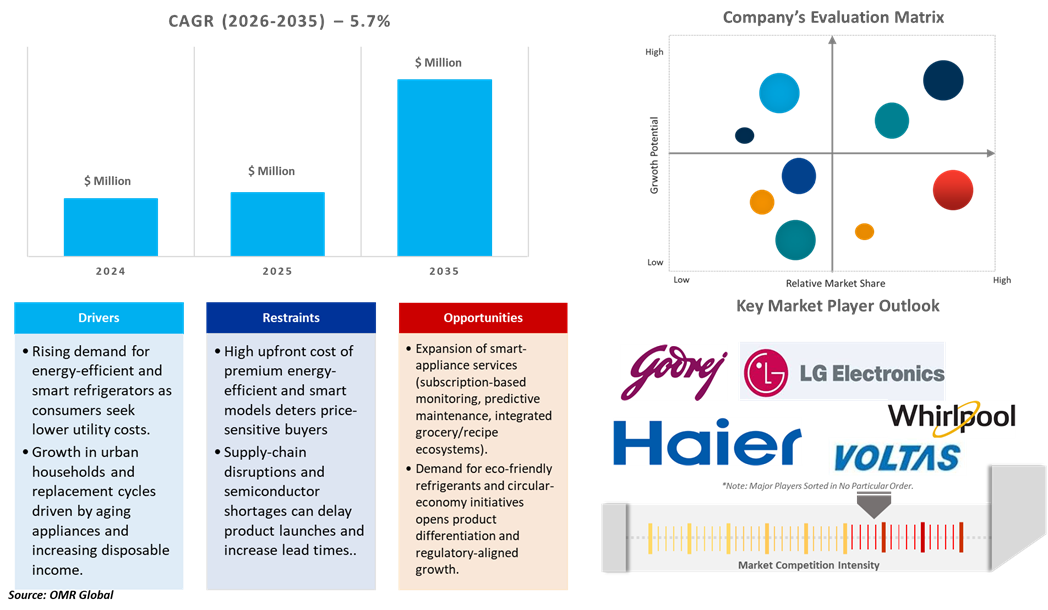
North America refrigerator market was valued at $45.2 billion in 2025 and is projected to reach $78.0 billion in 2035, growing at a CAGR of 5.7% during the forecast period (2026-2035). The North America refrigerator market is increasingly shaped by stringent energy efficiency standards and sustainability initiatives. With governments tightening regulations on energy consumption and refrigerant usage, manufacturers are accelerating innovation in eco-friendly cooling technologies. Rising consumer awareness of energy costs and environmental impact is also driving demand for advanced models equipped with smart sensors, inverter compressors, and low-GWP refrigerants. For instance, in January 2023, the U.S. Department of Energy (DOE) proposed new efficiency standards for household refrigerators and freezers that are projected to save consumers over $36 billion in utility bills while significantly reducing carbon emissions. These updated standards build upon regulations first established in the 1990s and are aligned with the U.S. government’s climate goals to cut greenhouse gas emissions. Once finalized, manufacturers will be required to comply within a set timeline, reinforcing the long-term market shift toward energy-efficient and environmentally sustainable refrigeration solutions across North America.
Moreover, in January 2024, the Department of Energy (DOE) issued a direct final rule and notice of proposed rulemaking to update energy efficiency standards for refrigerators and freezers under the Energy Policy and Conservation Act (EPCA). After evaluating six potential trial standard levels (TSLs), DOE adopted TSL 4, a level jointly recommended by the Association of Home Appliance Manufacturers and environmental groups including Earthjustice and the NRDC.
Market Dynamics
Premiumization and Consumer Lifestyle Shifts
Changing consumer lifestyles, higher disposable incomes, and growing urbanization are fuelling demand for premium refrigerators with advanced features, larger capacities, and aesthetic designs. Built-in models, French-door formats, and luxury finishes such as stainless steel and matte black are increasingly popular. Energy-efficient cooling, faster ice-making, and noise reduction are becoming standard in premium offerings. The rise of luxury housing and kitchen remodelling across the US and Canada further supports this premiumization trend. For instance, in January 2025, Bosch unveiled its first Matter-enabled fridge, the 100 Series French Door Bottom Mount Refrigerator, priced at $2,500 and arriving in the US this spring. First shown at CES, it supports Matter 1.3 for local, secure, and faster smart home integration, allowing features like remote temperature control and door-left-open alerts. Initially compatible with Samsung SmartThings and Amazon Alexa, broader ecosystem support is planned.
Adoption of Immersive Design and Visualization Technologies
Technological innovations in immersive design are reshaping refrigerator development in North America. The use of augmented reality (AR), extended reality (XR), and remote visualization platforms is enabling manufacturers to streamline prototyping, accelerate development cycles, and reduce physical testing costs. These tools enhance accuracy in engineering and foster better collaboration across geographically distributed teams, suppliers, and customers. For instance, In May 2023, ENGIE Refrigeration demonstrated the value of AR by deploying Hololight Space technology for designing and reviewing large-scale chillers and heat pumps. By projecting full-scale, highly detailed CAD models into real-world environments, ENGIE accelerated design validation, minimized errors, and improved customer presentations without transporting physical prototypes. Hololight Stream further ensured secure, real-time rendering by transmitting encrypted visual data to XR devices, reinforcing collaboration while maintaining data confidentiality.
Market Segmentation
- Based on the product type, the market is segmented into single door, double door, side by side door, french door, and others.
- Based on the application, the market is segmented into household, and commercial.
- Based on the distribution channel, the market is segmented into online channel and offline channel
French Door Segment to Lead with Premium Features and Smart Integration
The French door refrigerator segment is expected to remain the leading category in the North American market, supported by rising consumer preference for premium, large-capacity appliances with modern aesthetics and versatile storage. Increasing urbanization, higher disposable incomes, and lifestyle-driven kitchen remodelling trends are fuelling adoption among mid- to high-income households. Advanced features such as dual cooling systems, convertible compartments, AI-driven freshness monitoring, and app-based controls are expanding the segment’s reach. For instance, in January 2025, LG Electronics showcased its next-generation refrigerators at CES in Las Vegas, highlighting AI-powered freshness sensors, energy optimization, and smart food management through the ThinQ app. These models also integrate voice assistance, predictive cooling for energy savings, and enhanced design elements such as matte finishes and seamless handles, appealing to consumers seeking both functionality and luxury in their kitchen appliances.
US Dominates the Market with Major Share
The US continues to dominate the North America refrigerator market, driven by significant manufacturing investments and strong consumer demand for energy-efficient and technologically advanced appliances. Rising household incomes, growing urbanization, and the trend toward premium kitchens are further fueling demand for built-in, smart, and large-capacity refrigerators. Consumers are increasingly prioritizing appliances that integrate seamlessly with connected home ecosystems, offering features such as remote monitoring, voice control, and energy optimization. For instance, In August 2025, GE Appliances, a Haier company, announced a $3 billion, five-year investment to expand US manufacturing, creating 1,000 jobs across five states. The plan includes adding new product lines, modernizing plants with automation, and increasing production capacity at facilities in Kentucky, Alabama, Georgia, Tennessee, and South Carolina. This includes insourcing six new refrigerator models at the Decatur, Alabama plant and expanding laundry appliance production in Louisville. The investment brings GE Appliances’ total US spending since 2016 to $6.5 billion.
Market Players Outlook
The major companies operating in the US refrigerator market include Godrej Group, Haier Group Corp., LG Electronics Inc., Samsung Electronics Co., Ltd., Whirlpool Corp., among others. Market players are leveraging partnerships, collaborations, mergers, and acquisition strategies for business expansion and innovative product development to maintain their market positioning.
Recent Developments
- In November 2023, Whirlpool Corp. unveiled SlimTech insulation, the first North American refrigerator vacuum insulated structure (VIS) technology. Rather than using bulky polyurethane foam like conventional insulation, SlimTech features a proprietary vacuum-sealed material that can reduce wall thickness as much as 66%, increasing interior space by as much as 25%. Its recyclable value potential may displace non-recyclable foam insulation, aligning with Whirlpool's circular economy aspirations.
- In February 2023, PHC Corporation of North America launched the PHCbi VIP ECO SMART ultra-low temperature freezer series, designed for medical, pharmaceutical, and research facilities. Building on PHCbi’s legacy of reliable preservation equipment, the new models cut energy consumption by nearly 30% compared to previous series, achieving top ENERGY STAR® efficiency. The freezers feature HFC-free refrigerants, an advanced dual inverter compressor system, and enhanced usability with a larger 10.1-inch LCD touchscreen.
- In March 2021, Samsung launched 4-Door Flex refrigerator lineup globally, introducing models in Stainless Steel, Bespoke, and Family Hub versions. Designed for personalization inside and out, the refrigerators feature customizable door panels, flexible shelving, and Samsung’s Flex Zone for fridge-to-freezer conversion. Key upgrades include the Beverage Center with a hidden water dispenser and autofill pitcher, and the Dual Auto Ice Maker that produces both Cubed Ice and Ice Bites. The Family Hub model adds AI-powered meal planning, shopping lists, and grocery ordering.
The Report Covers
- Market value data analysis of 2025 and forecast to 2035.
- Annualized market revenues ($ million) for each market segment.
- Country-wise analysis of major geographical regions.
- Key companies operating in the North America refrigerator market. Based on the availability of data, information related to new products and relevant news is also available in the report.
- Analysis of business strategies by identifying the key market segments positioned for strong growth in the future.
- Analysis of market-entry and market expansion strategies.
- Competitive strategies by identifying ‘who-stands-where’ in the market.
- Report Summary
- Current Industry Analysis and Growth Potential Outlook
- North America Refrigerator Market Sales Analysis – Product Type | Application | Distribution Channel ($ Million)
- North America Refrigerator Market Sales Performance of Top Countries
- Research Methodology
- Primary Research Approach
- Secondary Research Approach
- Market Snapshot
- Market Overview and Insights
- Scope of the Study
- Analyst Insight & Current Market Trends
- Key US Refrigerator Industry Trends
- Market Recommendations
- Market Determinants
- Market Drivers
- Drivers For North America Refrigerator Market: Impact Analysis
- Market Pain Points and Challenges
- Restraints For North America Refrigerator Market: Impact Analysis
- Market Opportunities
- Market Drivers
- Competitive Landscape
- Competitive Dashboard – North America Refrigerator Market Revenue and Share by Manufacturers
- Refrigerator Product Comparison Analysis
- Top Market Player Ranking Matrix
- Key Company Analysis
- Godrej Group
- Overview
- Product Portfolio
- Financial Analysis (Subject to Data Availability)
- SWOT Analysis
- Business Strategy
- Haier Group Corp.
- Overview
- Product Portfolio
- Financial Analysis (Subject to Data Availability)
- SWOT Analysis
- Business Strategy
- LG Electronics Inc.
- Overview
- Product Portfolio
- Financial Analysis (Subject to Data Availability)
- SWOT Analysis
- Business Strategy
- Samsung Electronics Co., Ltd.
- Overview
- Product Portfolio
- Financial Analysis (Subject to Data Availability)
- SWOT Analysis
- Business Strategy
- Whirlpool Corp.
- Overview
- Product Portfolio
- Financial Analysis (Subject to Data Availability)
- SWOT Analysis
- Business Strategy
- Top Winning Strategies by Market Players
- Merger and Acquisition
- Product Launch
- Partnership And Collaboration
- Godrej Group
- Key Company Analysis
- North America Refrigerator Market Sales Analysis by Product Type ($ Million)
- Single Door
- Double Door (Top Freezer & Bottom Freezer)
- Side by Side Door
- French Door
- Other Type (Mini Fridge)
- North America Refrigerator Market Sales Analysis by Application ($ Million)
- Household
- Commercial (Restaurants, Ice Cream parlors, Supermarket, Research, Laboratory, and Pharmaceutical Storage)
- North America Refrigerator Market Sales Analysis by Distribution Channel ($ Million)
- Online Channel
- Offline Channel
- North America Refrigerator Market Sales Analysis by Country ($ Million)
- United States
- Canada
- Company Profiles
- Amana
- Quick Facts
- Company Overview
- Product Portfolio
- Business Strategies
- Dover Corp.
- Quick Facts
- Company Overview
- Product Portfolio
- Business Strategies
- Electrolux AB
- Quick Facts
- Company Overview
- Product Portfolio
- Business Strategies
- Fisher & Paykel Appliances Ltd
- Quick Facts
- Company Overview
- Product Portfolio
- Business Strategies
- Frigidaire
- Quick Facts
- Company Overview
- Product Portfolio
- Business Strategies
- GARVEE
- Quick Facts
- Company Overview
- Product Portfolio
- Business Strategies
- GE Appliances
- Quick Facts
- Company Overview
- Product Portfolio
- Business Strategies
- Godrej Group
- Quick Facts
- Company Overview
- Product Portfolio
- Business Strategies
- Haier Group Corp.
- Quick Facts
- Company Overview
- Product Portfolio
- Business Strategies
- Hisense
- Quick Facts
- Company Overview
- Product Portfolio
- Business Strategies
- Hitachi, Ltd.
- Quick Facts
- Company Overview
- Product Portfolio
- Business Strategies
- Kenmore
- Quick Facts
- Company Overview
- Product Portfolio
- Business Strategies
- LG Electronics Inc.
- Quick Facts
- Company Overview
- Product Portfolio
- Business Strategies
- Liebherr-International Deutschland GmbH
- Quick Facts
- Company Overview
- Product Portfolio
- Business Strategies
- Maytag
- Quick Facts
- Company Overview
- Product Portfolio
- Business Strategies
- Midea Group
- Quick Facts
- Company Overview
- Product Portfolio
- Business Strategies
- Panasonic Corp.
- Quick Facts
- Company Overview
- Product Portfolio
- Business Strategies
- Robert Bosch GmbH
- Quick Facts
- Company Overview
- Product Portfolio
- Business Strategies
- Samsung Electronics Co., Ltd.
- Quick Facts
- Company Overview
- Product Portfolio
- Business Strategies
- Siemens Group
- Quick Facts
- Company Overview
- Product Portfolio
- Business Strategies
- Sub-Zero Group, Inc.
- Quick Facts
- Company Overview
- Product Portfolio
- Business Strategies
- THERMADOR
- Quick Facts
- Company Overview
- Product Portfolio
- Business Strategies
- Viking Range, LLC
- Quick Facts
- Company Overview
- Product Portfolio
- Business Strategies
- Voltas Ltd
- Quick Facts
- Company Overview
- Product Portfolio
- Business Strategies
- Whirlpool Corp.
- Quick Facts
- Company Overview
- Product Portfolio
- Business Strategies
- Amana
1. North America Refrigerator Market Research and Analysis by Product Type, 2025–2035 ($ Million)
2. North America Single Door Refrigerator Market Research and Analysis by Region, 2025–2035 ($ Million)
3. North America Double Door Refrigerator Market Research and Analysis by Region, 2025–2035 ($ Million)
4. North America Side by Side Door Refrigerator Market Research and Analysis by Region, 2025–2035 ($ Million)
5. North America French Door Refrigerator Market Research and Analysis by Region, 2025–2035 ($ Million)
6. North America Other Type Refrigerator Market Research and Analysis by Region, 2025–2035 ($ Million)
7. North America Refrigerator Market Research and Analysis by Application, 2025–2035 ($ Million)
8. North America Refrigerator for Household Market Research and Analysis by Region, 2025–2035 ($ Million)
9. North America Refrigerator for Commercial Market Research and Analysis by Region, 2025–2035 ($ Million)
10. North America Refrigerator Market Research and Analysis by Distribution Channel, 2025–2035 ($ Million)
11. North America Refrigerator in Online Channel Market Research and Analysis by Region, 2025–2035 ($ Million)
12. North America Refrigerator in Offline Channel Market Research and Analysis by Region, 2025–2035 ($ Million)
13. North America Refrigerator Market Sales Analysis by Country, 2025–2035 ($ Million)
14. US Refrigerator Market Research and Analysis by Product Type, 2025–2035 ($ Million)
15. US Refrigerator Market Research and Analysis by Application, 2025–2035 ($ Million)
16. US Refrigerator Market Research and Analysis by Distribution Channel, 2025–2035 ($ Million)
17. Canada Refrigerator Market Research and Analysis by Product Type, 2025–2035 ($ Million)
18. Canada Refrigerator Market Research and Analysis by Application, 2025–2035 ($ Million)
19. Canada Refrigerator Market Research and Analysis by Distribution Channel, 2025–2035 ($ Million)
1. North America Refrigerator Market Share by Product Type, 2025 Vs 2035 (%)
2. North America Single Door Refrigerator Market Share by Region, 2025 Vs 2035 (%)
3. North America Double Door Refrigerator Market Share by Region, 2025 Vs 2035 (%)
4. North America Side by Side Door Refrigerator Market Share by Region, 2025 Vs 2035 (%)
5. North America French Door Refrigerator Market Share by Region, 2025 Vs 2035 (%)
6. North America Other Type Refrigerator Market Share by Region, 2025 Vs 2035 (%)
7. North America Refrigerator Market Share by Application, 2025 Vs 2035 (%)
8. North America Refrigerator for Household Market Share by Region, 2025 Vs 2035 (%)
9. North America Refrigerator for Commercial Market Share by Region, 2025 Vs 2035 (%)
10. North America Refrigerator Market Share by Distribution Channel, 2025 Vs 2035 (%)
11. North America Refrigerator in Online Channel Market Share by Region, 2025 Vs 2035 (%)
12. North America Refrigerator in Offline Channel Market Share by Region, 2025 Vs 2035 (%)
13. North America Refrigerator Market Share by Region, 2025 Vs 2035 (%)
14. US Refrigerator Market Size, 2025–2035 ($ Million)
15. Canada Refrigerator Market Size, 2025–2035 ($ Million)
- Printable version
- No restriction to number of users within the company

