Polyamides Market


Polyamides Market Size, Share & Trends Analysis Report by Type (Polyamide 6 (PA6), Polyamide 66 (PA66), Polyamide 11 (PA11), Polyamide 12 (PA12), and Others), by Source (Bio-Based Polyamides and Petroleum-Based Polyamides), by Application (Automotive & Transportation, Electrical & Electronics, Industrial Machinery & Equipment, Packaging, Consumer Goods, Textiles & Fibers, Medical & Healthcare, Construction & Infrastructure, Oil & Gas, and Others), Forecast Period (2026–2035)
Industry Overview
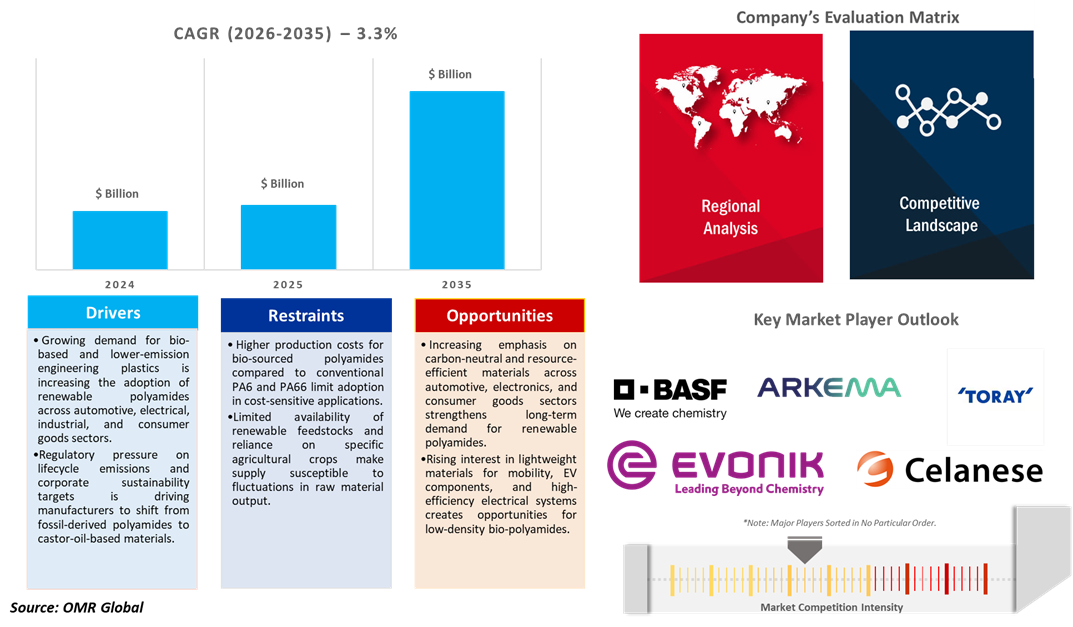
Polyamides market was valued at $26.50 billion in 2025 and is projected to reach around $36.59 billion by 2035, growing at a CAGR of 3.3% during the forecast period (2026–2035). The polyamides market is expanding at a steady pace due to rising demand for lightweight engineering materials, wider adoption of electric mobility, and continuous upgrades in global manufacturing. Growth is reinforced by rising production of electric vehicles, greater use of engineering plastics in thermal and structural components, and stronger regulatory pressure to reduce emissions across automotive and industrial sectors. The shift toward high performance materials in electrical and electronic applications, combined with increased investment in renewable feedstocks for bio-based polyamides, is also accelerating adoption. According to the International Energy Agency (IEA), electric vehicle sales exceeded 14 million units in 2023 and continued to grow through 2024. This increased demand for heat-resistant, flame-retardant, and lightweight polymers used in battery modules, charging systems, and electronic connectors.
Market Dynamics
Rising Adoption of High-Performance Polyamides in Advanced Engineering and Miniaturized Electronics
Demand for high-performance polyamides continues to rise as industries shift toward materials that offer superior mechanical strength, heat resistance, and long-term durability. Polyamides are one of the five major engineering plastics, and their stability under heat and mechanical stress makes it essential in electronics, transportation, and industrial machinery. The rapid expansion of miniaturized and high-density electronics is a major contributor to this trend. According to the National Bureau of Statistics, China’s electronic information manufacturing sector fully recovered in 2024, with value added by manufacturers of computers, communications, and electronic devices rising 11.8%. Imports and exports of electronic information products reached $1.8 trillion, a 6.4% year-on-year increase, reflecting strong global demand for compact electronic components that require precision-molded engineering plastics.
Production of mobile phones grew 7.8%, microcomputers 2.7%, and color TV sets 4.6%, all of which rely on high-temperature, high-strength polyamides for connectors, housings, and structural parts. Software and digital infrastructure growth also accelerated component demand. China’s software industry generated 13.7 trillion yuan ($1.9 trillion) in revenue in 2024, up 10%. As electronic devices become smaller, faster, and thermally demanding, manufacturers are using copolymerization, solid-phase polymerization, and reinforced compounds to improve dimensional accuracy and thermal stability. This shift toward compact, high-performance electronics continues to strengthen long-term polyamide demand across global supply chains.
Volatility in Petrochemical Feedstock and Energy Prices
Polyamide production relies on petrochemical intermediates such as caprolactam, adipic acid, and hexamethylene diamine, fluctuations in crude oil and natural gas prices directly affect cost structures and supply stability. Rising price volatility across major energy markets increases uncertainty for producers, particularly in regions where manufacturing competitiveness is tied to energy-intensive chemical processes. According to the World Bank, commodity prices are forecast to soften marginally in 2024 and 2025, however remain substantially above pre-pandemic levels. Unlike most other prices, crude oil prices are expected to increase in 2024, mainly reflecting geopolitical tensions. Natural gas prices in Europe also remain significantly elevated compared with historical averages, intensifying cost pressures on regional polymer plants. The International Energy Agency (IEA) indicates that large price gaps between natural gas in the US and Europe continue to influence global competitiveness, prompting producers to re-evaluate supply chain locations and long-term investment plans. These dynamics are accelerating the industry’s shift toward bio-derived raw materials, recycling technologies, and integrated value chains aimed at reducing exposure to petrochemical price swings.
Market Segmentation
- Based on the type, the market is segmented into polyamide 6 (PA6), polyamide 66 (PA66), polyamide 11 (PA11), polyamide 12 (PA12), and others.
- Based on the source, the market is segmented into Bio-based polyamides and petroleum-based polyamides.
- Based on the application, the market is segmented into automotive & transportation, electrical & electronics, industrial machinery & equipment, packaging, consumer goods, textiles & fibers, medical & healthcare, construction & infrastructure, oil & gas, and others.
Growing Trade Demand for Polyamide-Based Textiles and Technical Fabrics
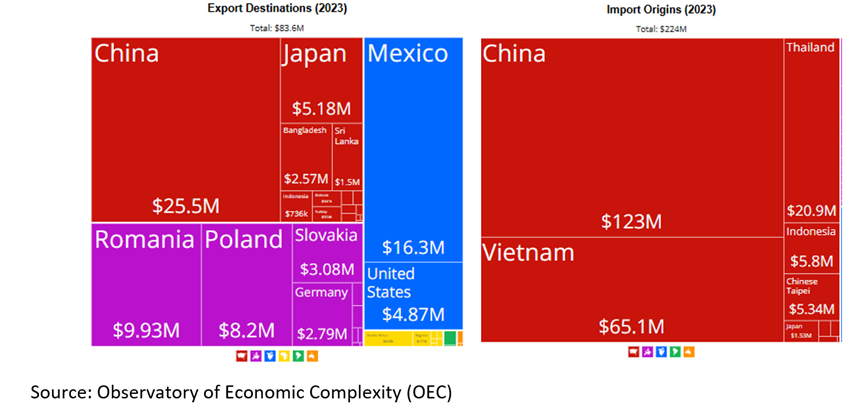
The textiles & fibers application segment is strengthening as global trade in polyamide fabrics expands, reflecting sustained demand for high-strength, abrasion-resistant, and performance-oriented materials. India’s position in this segment is notable. According to the Observatory of Economic Complexity (OEC), India exported $83.6 million worth of polyamide fabric in 2023, making it the 8th largest exporter among 95 countries. Major destinations included China ($25.5 million), Mexico ($16.3 million), Romania ($9.93 million), and Poland ($8.2 million), demonstrating diversified global demand for nylon-based textiles used in apparel, industrial yarns, luggage fabrics, and technical applications.
Export momentum is accelerating, Mexico, Romania, and China were the fastest-growing markets between 2022 and 2023, with Mexico alone increasing by $9.7 million, a 147% year-on-year jump. This combination of high import and export activity highlights strong domestic consumption as well as rising integration with global textile value chains. The movement of coated, laminated, and industrial-use polyamide fabrics, including tyre cord grades, indicates broader adoption in performance textiles, automotive reinforcement materials, and industrial fabrics. Applications such as technical outerwear, sports apparel, ropes, nets, filtration fabrics, and protective textiles rely on PA6 and PA66 for durability and mechanical strength.
Global Trade Partners for Polyamide Based Textiles and Fibers, 2023
Advancements and Rising Demand for Polyamide 6 (PA6)
PA6 remains the most widely used grade due to its mechanical strength, chemical resistance, and cost-efficiency. Demand continued to rise through 2024–2025 as the material remained essential for high-precision automotive and industrial components such as air intake manifolds, engine covers, gear housings, and structural brackets. Innovation in PA6 materials accelerated during 2024 and 2025, reinforcing its market position. Toray Advanced Composites announced a new strengthened PA6 thermoplastic in 2024, designed for high-stress applications in transportation and industrial machinery. Avient Corporation launched PA6-compatible internally lubricated formulations and high-voltage nylon colorants at Chinaplas 2024, expanding PA6 use in electrical and electronic components.
- In 2025, DOMO Chemicals extended ISCC PLUS certification across its entire PA6 base-polymer portfolio, enabling mass-balance and bio-attributed PA6 solutions for manufacturers targeting lower-carbon material options.
Regional Outlook
The global polyamides market is further divided by region, including North America (the US and Canada), Europe (the UK, Germany, France, Italy, Spain, Russia, and the Rest of Europe), Asia-Pacific (India, China, Japan, South Korea, Australia and New Zealand, ASEAN Countries, and the Rest of Asia-Pacific), and the Rest of the World (the Middle East & Africa, and Latin America).
Asia Pacific Leads the Global Polyamides Market Growth
The Asia Pacific region contributes a significant share to the polyamides market, driven by strong manufacturing performance, expanding industrial capacity, and rising consumption across automotive, electronics, textiles, and machinery sectors. China remains the region’s core growth engine. According to the National Bureau of Statistics (NBS), China’s value-added industrial output increased 5.8% year on year in May 2025, while manufacturing output rose 6.2%. Equipment manufacturing and high tech manufacturing, both heavy users of engineering polymers, recorded even stronger growth at 9% and 8.6%, respectively. These sectors rely extensively on PA6, PA66, and specialty polyamides for components such as gears, connectors, housings, and high-temperature structural parts. Earlier NBS data also showed that industrial machinery output grew 6.8% in 2024, reinforcing the upward demand trajectory.
India adds further momentum to the polyamides market as domestic manufacturing and automotive activity continue to strengthen. According to data from the Society of Indian Automobile Manufacturers (SIAM), industry sales grew 7.3% in FY 2024–25, supported by strong demand, infrastructure spending, and favorable policy measures. Exports rose 19.2%, reflecting India’s growing global footprint in vehicle manufacturing. Passenger vehicles posted it highest-ever sales of 4.3 million units in FY 2024–25, registering 2% growth despite a high base the previous year. Utility vehicles remained the primary growth driver, increasing its share to 65% of total PV sales compared with about 60% in FY 2023–24.
Market Players Outlook
The major companies operating in the global polyamides market include BASF SE, Arkema SA, Evonik Industries AG, Toray Industries, Inc., Celanese Corp., among others. Market players are leveraging partnerships, collaborations, mergers, and acquisition strategies for business expansion and innovative product development to maintain their market positioning.
Recent Developments
- In September 2025, BASF launched a thermoplastic polyamide with high water permeability to the market. The unique combination of strength and water permeability makes Ultramid H an innovative material for artificial casings in which sausages can be smoked and then dried.
- In October 2024, with Ultramid LowPCF (reduced CO2 footprint/Product Carbon Footprint, PCF) and Ultramid ZeroPCF (CO2 footprint of net zero greenhouse gas emissions), BASF launched two new product variants within its polyamide value chain in Europe.
- In September 2024, DOMO Chemicals launched new sustainable polyamide solutions at Fakuma 2024. DOMO plans to launch two new PA6 solutions certified for food and water contact, including WRAS hot water temperature certification.
The Report Covers
- Market value data analysis of 2025 and forecast to 2035.
- Annualized market revenues ($ million) for each market segment.
- Country-wise analysis of major geographical regions.
- Key companies operating in the global polyamides Based on the availability of data, information related to new products and relevant news is also available in the report.
- Analysis of business strategies by identifying the key market segments positioned for strong growth in the future.
- Analysis of market-entry and market expansion strategies.
- Competitive strategies by identifying ‘who-stands-where’ in the market.
- Report Summary
- Current Industry Analysis and Growth Potential Outlook
- Global Polyamides Market Sales Analysis – Type | Source |Application ($ Million)
- Polyamides Market Sales Performance of Top Countries
- Research Methodology
- Primary Research Approach
- Secondary Research Approach
- Market Snapshot
- Market Overview and Insights
- Scope of the Study
- Analyst Insight & Current Market Trends
- Key Polyamides Industry Trends
- Market Recommendations
- Porter's Five Forces Analysis for the Polyamides Market
- Competitive Rivalry
- Threat of New Entrants
- Bargaining Power of Suppliers
- Bargaining Power of Buyers
- Threat of Substitutes
- Market Determinants
- Market Drivers
- Drivers For the Global Polyamides Market: Impact Analysis
- Market Pain Points and Challenges
- Restraints For Global Polyamides Market: Impact Analysis
- Market Opportunities
- Opportunities For Global Polyamides Market: Impact Analysis
- Market Drivers
- Competitive Landscape
- Competitive Dashboard – Polyamides Market Revenue and Share by Manufacturers
- Polyamides Product Comparison Analysis
- Top Market Player Ranking Matrix
- Key Company Analysis
- BASF SE
- Overview
- Product Portfolio
- Financial Analysis
- SWOT Analysis
- Business Strategy
- Arkema SA
- Overview
- Product Portfolio
- Financial Analysis
- SWOT Analysis
- Business Strategy
- Evonik Industries AG
- Overview
- Product Portfolio
- Financial Analysis
- SWOT Analysis
- Business Strategy
- Toray Industries, Inc.
- Overview
- Product Portfolio
- Financial Analysis
- SWOT Analysis
- Business Strategy
- Celanese Corp.
- Overview
- Product Portfolio
- Financial Analysis
- SWOT Analysis
- Business Strategy
- BASF SE
- Key Company Analysis
- Top Winning Strategies by Market Players
- Merger and Acquisition
- Product Launch
- Partnership And Collaboration
- Global Polyamides Market Sales Analysis by Type ($ Million)
- Polyamide 6 (PA6)
- Polyamide 66 (PA66)
- Polyamide 11 (PA11)
- Polyamide 12 (PA12)
- Others
- Global Polyamides Market Sales Analysis by Source ($ Million)
- Bio-Based Polyamides
- Petroleum-Based Polyamides
- Global Polyamides Market Sales Analysis by Application ($ Million)
- Automotive & Transportation
- Electrical & Electronics
- Industrial Machinery & Equipment
- Packaging
- Consumer Goods
- Textiles & Fibers
- Medical & Healthcare
- Construction & Infrastructure
- Oil & Gas
- Others
- Regional Analysis
- North American Polyamides Market Sales Analysis – Type | Source |Application | Country ($ Million)
- Macroeconomic Factors for North America
- United States
- Canada
- European Polyamides Market Sales Analysis – Type | Source |Application | Country ($ Million)
- Macroeconomic Factors for Europe
- UK
- Germany
- Italy
- Spain
- France
- Russia
- Rest of Europe
- Asia-Pacific Polyamides Market Sales Analysis – Type | Source |Application | Country ($ Million)
- Macroeconomic Factors for Asia-Pacific
- China
- Japan
- South Korea
- India
- Australia & New Zealand
- ASEAN Countries (Thailand, Indonesia, Vietnam, Singapore, And Other)
- Rest of Asia-Pacific
- Rest of the World Polyamides Market Sales Analysis – Type | Source |Application | Country ($ Million)
- Macroeconomic Factors for the Rest of the World
- Latin America
- Middle East and Africa
- Company Profiles
- Arkema SA
- Quick Facts
- Company Overview
- Product Portfolio
- Business Strategies
- Asahi Kasei Corp.
- Quick Facts
- Company Overview
- Product Portfolio
- Business Strategies
- Ascend Performance Materials Holdings Inc.
- Quick Facts
- Company Overview
- Product Portfolio
- Business Strategies
- BASF SE
- Quick Facts
- Company Overview
- Product Portfolio
- Business Strategies
- Celanese Corp.
- Quick Facts
- Company Overview
- Product Portfolio
- Business Strategies
- DOMO Chemicals
- Quick Facts
- Company Overview
- Product Portfolio
- Business Strategies
- EMS-Chemie Holding AG
- Quick Facts
- Company Overview
- Product Portfolio
- Business Strategies
- Envalior
- Quick Facts
- Company Overview
- Product Portfolio
- Business Strategies
- Evonik Industries AG
- Quick Facts
- Company Overview
- Product Portfolio
- Business Strategies
- Formosa Chemicals & Fibre Corp.
- Quick Facts
- Company Overview
- Product Portfolio
- Business Strategies
- Gujarat State Fertilizers & Chemicals Ltd.
- Quick Facts
- Company Overview
- Product Portfolio
- Business Strategies
- Kingfa SCI. & TECH. CO., LTD.
- Quick Facts
- Company Overview
- Product Portfolio
- Business Strategies
- Kuraray Co., Ltd.
- Quick Facts
- Company Overview
- Product Portfolio
- Business Strategies
- LANXESS AG
- Quick Facts
- Company Overview
- Product Portfolio
- Business Strategies
- Mitsubishi Chemical Group
- Quick Facts
- Company Overview
- Product Portfolio
- Business Strategies
- Mitsui Chemicals, Inc.
- Quick Facts
- Company Overview
- Product Portfolio
- Business Strategies
- NILIT Ltd.
- Quick Facts
- Company Overview
- Product Portfolio
- Business Strategies
- RadiciGroup
- Quick Facts
- Company Overview
- Product Portfolio
- Business Strategies
- Sinopec Baling Petrochemical Co., Ltd.
- Quick Facts
- Company Overview
- Product Portfolio
- Business Strategies
- SRF Ltd.
- Quick Facts
- Company Overview
- Product Portfolio
- Business Strategies
- Toray Industries, Inc.
- Quick Facts
- Company Overview
- Product Portfolio
- Business Strategies
- UBE Corp.
- Quick Facts
- Company Overview
- Product Portfolio
- Business Strategies
- Wanhua Chemical Group Co., Ltd.
- Quick Facts
- Company Overview
- Product Portfolio
- Business Strategies
- Arkema SA
1. Global Polyamides Market Research and Analysis by Type, 2025–2035 ($ Million)
2. Global Polyamide 6 (PA6) Market Research and Analysis by Region, 2025–2035 ($ Million)
3. Global Polyamide 66 (PA66) Market Research and Analysis by Region, 2025–2035 ($ Million)
4. Global Polyamide 11 (PA11) Market Research and Analysis by Region, 2025–2035 ($ Million)
5. Global Polyamide 12 (PA12) Market Research and Analysis by Region, 2025–2035 ($ Million)
6. Global Others Polyamides Market Research and Analysis by Region, 2025–2035 ($ Million)
7. Global Polyamides Market Research and Analysis by Source, 2025–2035 ($ Million)
8. Global Bio-Based Polyamides Market Research and Analysis by Region, 2025–2035 ($ Million)
9. Global Petroleum-Based Polyamides Market Research and Analysis by Region, 2025–2035 ($ Million)
10. Global Polyamides Market Research and Analysis by Application, 2025–2035 ($ Million)
11. Global Polyamides for Automotive & Transportation Market Research and Analysis by Region, 2025–2035 ($ Million)
12. Global Polyamides for Electrical & Electronics Market Research and Analysis by Region, 2025–2035 ($ Million)
13. Global Polyamides for Industrial Machinery & Equipment Market Research and Analysis by Region, 2025–2035 ($ Million)
14. Global Polyamides for Packaging Market Research and Analysis by Region, 2025–2035 ($ Million)
15. Global Polyamides for Consumer Goods Market Research and Analysis by Region, 2025–2035 ($ Million)
16. Global Polyamides for Textiles & Fibers Market Research and Analysis by Region, 2025–2035 ($ Million)
17. Global Polyamides for Medical & Healthcare Market Research and Analysis by Region, 2025–2035 ($ Million)
18. Global Polyamides for Construction & Infrastructure Market Research and Analysis by Region, 2025–2035 ($ Million)
19. Global Polyamides for Oil & Gas Market Research and Analysis by Region, 2025–2035 ($ Million)
20. Global Polyamides for Others Market Research and Analysis by Region, 2025–2035 ($ Million)
21. Global Polyamides Market Research and Analysis by Region, 2025–2035 ($ Million)
22. North American Polyamides Market Research and Analysis by Country, 2025–2035 ($ Million)
23. North American Polyamides Market Research and Analysis by Type, 2025–2035 ($ Million)
24. North American Polyamides Market Research and Analysis by Source, 2025–2035 ($ Million)
25. North American Polyamides Market Research and Analysis by Application, 2025–2035 ($ Million)
26. European Polyamides Market Research and Analysis by Country, 2025–2035 ($ Million)
27. European Polyamides Market Research and Analysis by Type, 2025–2035 ($ Million)
28. European Polyamides Market Research and Analysis by Source, 2025–2035 ($ Million)
29. European Polyamides Market Research and Analysis by Application, 2025–2035 ($ Million)
30. Asia-Pacific Polyamides Market Research and Analysis by Country, 2025–2035 ($ Million)
31. Asia-Pacific Polyamides Market Research and Analysis by Type, 2025–2035 ($ Million)
32. Asia-Pacific Polyamides Market Research and Analysis by Source, 2025–2035 ($ Million)
33. Asia-Pacific Polyamides Market Research and Analysis by Application, 2025–2035 ($ Million)
34. Rest of the World Polyamides Market Research and Analysis by Region, 2025–2035 ($ Million)
35. Rest of the World Polyamides Market Research and Analysis by Type, 2025–2035 ($ Million)
36. Rest of the World Polyamides Market Research and Analysis by Source, 2025–2035 ($ Million)
37. Rest of the World Polyamides Market Research and Analysis by Application, 2025–2035 ($ Million)
1. Global Polyamides Market Research and Analysis by Type, 2025 Vs 2035 (%)
2. Global Polyamide 6 (PA6) Market Research and Analysis by Region, 2025 Vs 2035 (%)
3. Global Polyamide 66 (PA66) Market Research and Analysis by Region, 2025 Vs 2035 (%)
4. Global Polyamide 11 (PA11) Market Research and Analysis by Region, 2025 Vs 2035 (%)
5. Global Polyamide 12 (PA12) Market Research and Analysis by Region, 2025 Vs 2035 (%)
6. Global Others Polyamides Market Research and Analysis by Region, 2025 Vs 2035 (%)
7. Global Polyamides Market Research and Analysis by Source, 2025 Vs 2035 (%)
8. Global Bio-Based Polyamides Market Research and Analysis by Region, 2025 Vs 2035 (%)
9. Global Petroleum-Based Polyamides Market Research and Analysis by Region, 2025 Vs 2035 (%)
10. Global Polyamides Market Research and Analysis by Application, 2025 Vs 2035 (%)
11. Global Polyamides for Automotive & Transportation Market Research and Analysis by Region, 2025 Vs 2035 (%)
12. Global Polyamides for Electrical & Electronics Market Research and Analysis by Region, 2025 Vs 2035 (%)
13. Global Polyamides for Industrial Machinery & Equipment Market Research and Analysis by Region, 2025 Vs 2035 (%)
14. Global Polyamides for Packaging Market Research and Analysis by Region, 2025 Vs 2035 (%)
15. Global Polyamides for Consumer Goods Market Research and Analysis by Region, 2025 Vs 2035 (%)
16. Global Polyamides for Textiles & Fibers Market Research and Analysis by Region, 2025 Vs 2035 (%)
17. Global Polyamides for Medical & Healthcare Market Research and Analysis by Region, 2025 Vs 2035 (%)
18. Global Polyamides for Construction & Infrastructure Market Research and Analysis by Region, 2025 Vs 2035 (%)
19. Global Polyamides for Oil & Gas Market Research and Analysis by Region, 2025 Vs 2035 (%)
20. Global Polyamides for Others Market Research and Analysis by Region, 2025 Vs 2035 (%)
21. Global Polyamides Market Share by Region, 2025 Vs 2035 (%)
22. US Polyamides Market Size, 2025–2035 ($ Million)
23. Canada Polyamides Market Size, 2025–2035 ($ Million)
24. UK Polyamides Market Size, 2025–2035 ($ Million)
25. France Polyamides Market Size, 2025–2035 ($ Million)
26. Germany Polyamides Market Size, 2025–2035 ($ Million)
27. Italy Polyamides Market Size, 2025–2035 ($ Million)
28. Spain Polyamides Market Size, 2025–2035 ($ Million)
29. Russia Polyamides Market Size, 2025–2035 ($ Million)
30. Rest of Europe Polyamides Market Size, 2025–2035 ($ Million)
31. India Polyamides Market Size, 2025–2035 ($ Million)
32. China Polyamides Market Size, 2025–2035 ($ Million)
33. Japan Polyamides Market Size, 2025–2035 ($ Million)
34. South Korea Polyamides Market Size, 2025–2035 ($ Million)
35. Australia and New Zealand Polyamides Market Size, 2025–2035 ($ Million)
36. ASEAN Economies Polyamides Market Size, 2025–2035 ($ Million)
37. Rest of Asia-Pacific Polyamides Market Size, 2025–2035 ($ Million)
38. Latin America Polyamides Market Size, 2025–2035 ($ Million)
39. Middle East and Africa Polyamides Market Size, 2025–2035 ($ Million)
- Printable version
- No restriction to number of users within the company