Teledermatology Market: Growth, Size, Share, and Trends


Teledermatology Market Size, Share & Trends Analysis Report by Technology (Store-and-Forward Teledermatology, Real-time Teledermatology, and Hybrid Teledermatology), by Services (Teleconsultation, Telemonitoring, Tele-education, and Others), and by End Use (Patients, and Providers), Forecast Period (2026-2035)
Teledermatology Market Overview
Global teledermatology market was valued at $13.96 billion in 2025 and is projected to reach $46.4 billion by 2035, growing at a CAGR of 12.8% during the forecast period (2026–2035). The global teledermatology market is experiencing rapid expansion as healthcare systems increasingly adopt remote dermatological care to bridge gaps in specialist access and meet rising demand for dermatology services. Key growth drivers include the escalating prevalence of skin diseases, the shortage of dermatologists in underserved regions, and the maturation of enabling technologies such as high-resolution imaging, mobile apps, and artificial intelligence. Teledermatology is a specialized field within telehealth that uses virtual communication technologies to provide remote dermatological care.
Dermatological conditions are among the most common medical concerns globally. From chronic inflammatory diseases such as eczema, psoriasis, and acne to infectious conditions, allergic reactions, and autoimmune disorders, skin-related ailments affect a significant portion of the population across age groups. According to the World Health Organization (WHO), Skin conditions affect 1.8 billion people globally, with infections being common in tropical areas. Neglected tropical diseases (NTDs) make up 10% of skin diseases in many communities. Similarly, according to the American Academy of Dermatology, Acne is the most common skin condition in the United States, affecting up to 50 million Americans annually.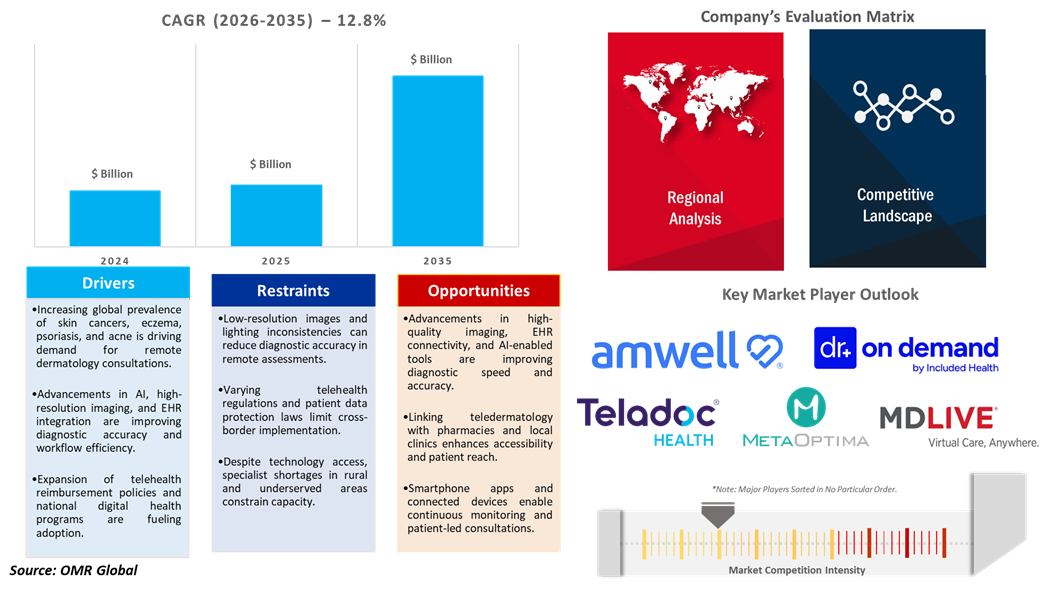
Teledermatology Market Dynamics
Technological Advancements Create Strong Growth Opportunities in the Teledermatology Market
A significant opportunity for the teledermatology market lies in technological innovation, such as high-quality imaging, integration with electronic health records (EHRs), artificial intelligence (AI)-enabled tools, and mobile teledermatology applications. For instance, MetaOptima Technology Inc. offers the DermEngine platform, an intelligent dermatology software designed for remote case management and clinical collaboration. It supports general dermatology and skin cancer cases via video calls or store-and-forward communications, and enables referral, eTriage, and provider-to-provider telemedicine services for shared care coordination. The platform includes EMR and EHR integration, a branded patient portal, and enterprise-level options. Its Store & Forward Services feature allows clinicians to receive high-quality patient images through the MoleScope app for faster triage and diagnosis. DermEngine also enhances workflow efficiency through image-based documentation, analytics, exportable reports, and integrated billing systems.
Public - Private Initiatives Enhancing Access to Dermatology Care
A major driver for the teledermatology market growth is the increasing number of public–private initiatives aimed at expanding dermatology access for underserved populations. Many regions continue to face shortages of dermatologists, leading to delayed diagnoses and untreated skin conditions. Public health agencies and private organizations are therefore investing in digital solutions that extend specialist care to remote and underserved communities.
In October 2025, The George Washington University (GW) School of Medicine and Health Sciences, in collaboration with Pfizer, launched new programs supporting teledermatology projects that focus on chronic skin diseases. Through dedicated grants and extension awards, the initiative funds innovative research and service models that have already enabled more than 200 patients to receive dermatology care remotely. GW's initiative expands on the Teledermatology Help Desk and Free Clinic model, initially funded by Pfizer. The program created a community clinic in Washington, D.C., teaching patients to use telehealth effectively, connect with dermatologists, and access care. This clinic has enhanced care access for patients dealing with long wait times, financial constraints, or limited local dermatology services.
Teledermatology Market Segmentation
- Based on the Technology, the market is segmented into store-and-forward teledermatology, real-time teledermatology, and hybrid teledermatology.
- Based on the Services, the market is segmented into teleconsultation, telemonitoring, tele-education, and others.
- Based on the end use, the market is segmented into patients, and providers.
The Store-and-Forward Technology Segment Continues to Hold a Leading Position
Within the teledermatology market, the store-and-forward technology segment continues to hold a leading position. This approach allows clinicians to transmit high-quality images and patient information to dermatologists, who can review and diagnose cases at a later time. It has proven especially effective in rural or underserved regions where specialist access is limited. Store-and-forward teledermatology facilitates asynchronous communication between patients and healthcare providers, reducing the need for unnecessary in-person visits, shortening diagnosis time, and lowering overall costs.
Recent healthcare initiatives further demonstrate the growing preference for image-based teledermatology systems that enhance diagnostic efficiency and patient reach. In June 2023, the NHS expanded teledermatology for skin cancer diagnosis, using high-res imaging to accelerate treatment for tens of thousands of patients. The technology allows dermatologists to review more patients daily. This initiative aims to improve access to faster diagnosis, especially for rural communities, and has already led to an increase in referrals and treatments for skin cancer.
Teledermatology Market Regional Outlook
The global teledermatology market is further divided by region, including North America (the US and Canada), Europe (the UK, Germany, France, Italy, Spain, Russia, and the Rest of Europe), Asia-Pacific (India, China, Japan, South Korea, Australia and New Zealand, ASEAN Countries, and the Rest of Asia-Pacific), and the Rest of the World (the Middle East & Africa, and Latin America).
North America Maintains a Leading Position in the Global Teledermatology Market
North America continues to hold a dominant position in the global teledermatology market, driven by rapid digital health integration, expanding telemedicine reimbursement, and strong regulatory support for medical imaging innovation. This regulatory focus on digital health product standards, combined with the FDA’s evolving guidance on software and imaging devices used in dermatology, has created a favorable environment for technology developers and clinical providers. For instance, in June 2023, DeepX Diagnostics Inc. announced that its digital dermatoscope DermoSight received clearance from the US Food and Drug Administration (FDA) for teledermatology screening of suspect skin cancer lesions in the US. DermoSight is currently cleared to acquire skin lesion images for teledermatology assessment, like existing digital dermatoscopes. It is also designed for integration with an AI algorithm, empowered by proprietary optical transfer diagnosis (OTD) technology, although the FDA has yet to approve the commercial use of the OTD technology with DermoSight.
Teledermatology Market Players Outlook
The major companies operating in the global teledermatology market include American Well Corp., Included Health, Inc. (Doctor On Demand), Teladoc Health, Inc., MetaOptima Technology Inc., MDLIVE, Inc., among others. Market players are leveraging partnerships, collaborations, mergers, and acquisition strategies for business expansion and innovative product development to maintain their market positioning.
Teledermatology Market Recent Developments
- In September 2025, Miiskin received a $200K grant to enhance its digital dermatology platform with generative AI. This will streamline non-clinical tasks, automate communication, organize patient data, and reduce administrative burden for dermatology providers.
- In September 2025, Medtech Global and DermEngine will integrate to provide skin care services within the Medtech Evolution software. This integration improves workflow for doctors and specialists, leading to faster diagnosis and monitoring of skin conditions. Through the integration with Medtech Evolution's ALEX, doctors can access the dermatology system seamlessly within their practice management software.
- In February 2025, Lohmann & Rauscher (L&R) acquired OnlineDoctor AG. This marks L&R's first digital health start-up acquisition, aligning with their growth strategy focused on digitalization. OnlineDoctor will operate as a subsidiary with its brand intact, founders retained, and both companies collaborating on expanding digital medical products.
- In February 2024, MedX Health Corp. completed a successful pilot project with Health Partners, a UK-based corporate health services company. They are now rolling out teledermatology services to targeted clients, focusing on preventative health care management.
- In May 2024, Well Revolution partnered with Infinity Dermatology in New York to implement the Care Messenger program for same-day dermatology care without appointments or insurance. The collaboration aims to reduce wait times, costs, and expand care hours to meet patient needs and market demands effectively.
The Report Covers
- Market value data analysis of 2025 and forecast to 2035.
- Annualized market revenues ($ million) for each market segment.
- Country-wise analysis of major geographical regions.
- Key companies operating in the global teledermatology market. Based on the availability of data, information related to new products and relevant news is also available in the report.
- Analysis of business strategies by identifying the key market segments positioned for strong growth in the future.
- Analysis of market-entry and market expansion strategies.
- Competitive strategies by identifying ‘who-stands-where’ in the market.
- Report Summary
- Current Industry Analysis and Growth Potential Outlook
- Global Teledermatology Market Sales Analysis – Technology| Services| End-Use ($ Million)
- Teledermatology Market Sales Performance of Top Countries
- Research Methodology
- Primary Research Approach
- Secondary Research Approach
- Market Snapshot
- Market Overview and Insights
- Scope of the Study
- Analyst Insight & Current Market Trends
- Key Teledermatology Industry Trends
- Market Recommendations
- Market Determinants
- Market Drivers
- Drivers For Global Teledermatology Market: Impact Analysis
- Market Pain Points and Challenges
- Restraints For Global Teledermatology Market: Impact Analysis
- Market Opportunities
- Opportunities For Global Teledermatology Market: Impact Analysis
- Market Drivers
- Competitive Landscape
- Competitive Dashboard – Teledermatology Market Revenue and Share by Manufacturers
- Teledermatology Product Comparison Analysis
- Top Market Player Ranking Matrix
- Key Company Analysis
- American Well Corp.
- Overview
- Product Portfolio
- Financial Analysis
- SWOT Analysis
- Business Strategy
- Included Health, Inc. (Doctor On Demand)
- Overview
- Product Portfolio
- Financial Analysis
- SWOT Analysis
- Business Strategy
- MetaOptima Technology Inc.
- Overview
- Product Portfolio
- Financial Analysis
- SWOT Analysis
- Business Strategy
- MDLIVE, Inc.
- Overview
- Product Portfolio
- Financial Analysis
- SWOT Analysis
- Business Strategy
- Teladoc Health, Inc.
- Overview
- Product Portfolio
- Financial Analysis
- SWOT Analysis
- Business Strategy
- Top Winning Strategies by Market Players
- Merger and Acquisition
- Product Launch
- Partnership And Collaboration
- American Well Corp.
- Key Company Analysis
- Global Teledermatology Market Sales Analysis by Technology ($ Million)
- Store-and-Forward Teledermatology
- Real-time Teledermatology
- Hybrid Teledermatology
- Global Teledermatology Market Sales Analysis by Services ($ Million)
- Teleconsultation
- Telemonitoring
- Tele-education
- Others
- Global Teledermatology Market Sales Analysis by End-Use ($ Million)
- Patients
- Providers
- Regional Analysis
- North American Teledermatology Market Sales Analysis – Technology| Services| End-Use| Country ($ Million)
- Macroeconomic Factors for North America
- United States
- Canada
- European Teledermatology Market Sales Analysis – Technology| Services| End-Use| Country ($ Million)
- Macroeconomic Factors for Europe
- UK
- Germany
- Italy
- Spain
- France
- Russia
- Rest of Europe
- Asia-Pacific Teledermatology Market Sales Analysis – Technology| Services| End-Use| Country ($ Million)
- Macroeconomic Factors for Asia-Pacific
- China
- Japan
- South Korea
- India
- Australia & New Zealand
- ASEAN Countries (Thailand, Indonesia, Vietnam, Singapore, And Other)
- Rest of Asia-Pacific
- Rest of the World Teledermatology Market Sales Analysis – Technology| Services| End-Use| Country ($ Million)
- Macroeconomic Factors for the Rest of the World
- Latin America
- Middle East and Africa
- Company Profiles
- 3Derm Systems, Inc.
- Quick Facts
- Company Overview
- Product Portfolio
- Business Strategies
- Ada Health GmbH
- Quick Facts
- Company Overview
- Product Portfolio
- Business Strategies
- Alibaba Health
- Quick Facts
- Company Overview
- Product Portfolio
- Business Strategies
- American Well Corp.
- Quick Facts
- Company Overview
- Product Portfolio
- Business Strategies
- Curology Inc.
- Quick Facts
- Company Overview
- Product Portfolio
- Business Strategies
- me Inc.
- Quick Facts
- Company Overview
- Product Portfolio
- Business Strategies
- Hims & Hers Health, Inc.
- Quick Facts
- Company Overview
- Product Portfolio
- Business Strategies
- iDoc24 Inc. (First Derm)
- Quick Facts
- Company Overview
- Product Portfolio
- Business Strategies
- Included Health, Inc. (Doctor On Demand)
- Quick Facts
- Company Overview
- Product Portfolio
- Business Strategies
- K Health, Inc.
- Quick Facts
- Company Overview
- Product Portfolio
- Business Strategies
- Logical Images, Inc. (VisualDx)
- Quick Facts
- Company Overview
- Product Portfolio
- Business Strategies
- Maple Corp.
- Quick Facts
- Company Overview
- Product Portfolio
- Business Strategies
- MDLIVE, Inc.
- Quick Facts
- Company Overview
- Product Portfolio
- Business Strategies
- MEDLEY, INC.
- Quick Facts
- Company Overview
- Product Portfolio
- Business Strategies
- MetaOptima Technology Inc.
- Quick Facts
- Company Overview
- Product Portfolio
- Business Strategies
- MICIN, Inc.
- Quick Facts
- Company Overview
- Product Portfolio
- Business Strategies
- Miiskin Group ApS
- Quick Facts
- Company Overview
- Product Portfolio
- Business Strategies
- Nexsys Electronics, Inc. (Medweb)
- Quick Facts
- Company Overview
- Product Portfolio
- Business Strategies
- Novocura Tech Health Services Private Ltd. (MFine)
- Quick Facts
- Company Overview
- Product Portfolio
- Business Strategies
- Orane Healthcare India Private Ltd. (iCliniq)
- Quick Facts
- Company Overview
- Product Portfolio
- Business Strategies
- Ping An Healthcare and Technology Company Ltd.
- Quick Facts
- Company Overview
- Product Portfolio
- Business Strategies
- Practo Technologies Private Ltd.
- Quick Facts
- Company Overview
- Product Portfolio
- Business Strategies
- Roman Health Ventures Inc.
- Quick Facts
- Company Overview
- Product Portfolio
- Business Strategies
- Skin Analytics
- Quick Facts
- Company Overview
- Product Portfolio
- Business Strategies
- SkinIO, Inc.
- Quick Facts
- Company Overview
- Product Portfolio
- Business Strategies
- SkinVision
- Quick Facts
- Company Overview
- Product Portfolio
- Business Strategies
- Teladoc Health, Inc.
- Quick Facts
- Company Overview
- Product Portfolio
- Business Strategies
- Trusper Inc. (Musely)
- Quick Facts
- Company Overview
- Product Portfolio
- Business Strategies
- ZocDoc, Inc.
- Quick Facts
- Company Overview
- Product Portfolio
- Business Strategies
- ZappedSkin
- Quick Facts
- Company Overview
- Product Portfolio
- Business Strategies
- 3Derm Systems, Inc.
1. Global Teledermatology Market Research and Analysis by Technology, 2025–2035 ($ Million)
2. Global Store-and-Forward Teledermatology Market Research and Analysis by Region, 2025–2035 ($ Million)
3. Global Real-time Teledermatology Market Research and Analysis by Region, 2025–2035 ($ Million)
4. Global Hybrid Teledermatology Market Research and Analysis by Region, 2025–2035 ($ Million)
5. Global Teledermatology Market Research and Analysis by Services, 2025–2035 ($ Million)
6. Global Teleconsultation in Teledermatology Market Research and Analysis by Region, 2025–2035 ($ Million)
7. Global Telemonitoring in Teledermatology Market Research and Analysis by Region, 2025–2035 ($ Million)
8. Global Tele-education in Teledermatology Market Research and Analysis by Region, 2025–2035 ($ Million)
9. Global Other Teledermatology Services Market Research and Analysis by Region, 2025–2035 ($ Million)
10. Global Teledermatology Market Research and Analysis by End-Use, 2025–2035 ($ Million)
11. Global Teledermatology for Patients Market Research and Analysis by Region, 2025–2035 ($ Million)
12. Global Teledermatology for Providers Market Research and Analysis by Region, 2025–2035 ($ Million)
13. Global Teledermatology Market Research and Analysis by Region, 2025–2035 ($ Million)
14. North American Teledermatology Market Research and Analysis by Country, 2025–2035 ($ Million)
15. North American Teledermatology Market Research and Analysis by Technology, 2025–2035 ($ Million)
16. North American Teledermatology Market Research and Analysis by Services, 2025–2035 ($ Million)
17. North American Teledermatology Market Research and Analysis by End-Use, 2025–2035 ($ Million)
18. European Teledermatology Market Research and Analysis by Country, 2025–2035 ($ Million)
19. European Teledermatology Market Research and Analysis by Technology, 2025–2035 ($ Million)
20. European Teledermatology Market Research and Analysis by Services, 2025–2035 ($ Million)
21. European Teledermatology Market Research and Analysis by End-Use, 2025–2035 ($ Million)
22. Asia-Pacific Teledermatology Market Research and Analysis by Country, 2025–2035 ($ Million)
23. Asia-Pacific Teledermatology Market Research and Analysis by Technology, 2025–2035 ($ Million)
24. Asia-Pacific Teledermatology Market Research and Analysis by Services, 2025–2035 ($ Million)
25. Asia-Pacific Teledermatology Market Research and Analysis by End-Use, 2025–2035 ($ Million)
26. Rest of the World Teledermatology Market Research and Analysis by Region, 2025–2035 ($ Million)
27. Rest of the World Teledermatology Market Research and Analysis by Technology, 2025–2035 ($ Million)
28. Rest of the World Teledermatology Market Research and Analysis by Services, 2025–2035 ($ Million)
29. Rest of the World Teledermatology Market Research and Analysis by End-Use, 2025–2035 ($ Million)
1. Global Teledermatology Market Share by Technology, 2025 Vs 2035 (%)
2. Global Store-and-Forward Teledermatology Market Share by Region, 2025 Vs 2035 (%)
3. Global Real-time Teledermatology Market Share by Region, 2025 Vs 2035 (%)
4. Global Hybrid Teledermatology Market Share by Offering, 2025 Vs 2035 (%)
5. Global Teledermatology Market Share by Services, 2025 Vs 2035 (%)
6. Global Teleconsultation in Teledermatology Market Share by Region, 2025 Vs 2035 (%)
7. Global Telemonitoring in Teledermatology Market Share by Region, 2025 Vs 2035 (%)
8. Global Tele-education in Teledermatology Market Share by Region, 2025 Vs 2035 (%)
9. Global Other Teledermatology Services Market Share by Region, 2025 Vs 2035 (%)
10. Global Teledermatology Market Share by End-Use, 2025 Vs 2035 (%)
11. Global Teledermatology for Patients Market Share by Region, 2025 Vs 2035 (%)
12. Global Teledermatology for Providers Market Share by Region, 2025 Vs 2035 (%)
13. Global Teledermatology Market Share by Region, 2025 Vs 2035 (%)
14. US Teledermatology Market Size, 2025–2035 ($ Million)
15. Canada Teledermatology Market Size, 2025–2035 ($ Million)
16. UK Teledermatology Market Size, 2025–2035 ($ Million)
17. France Teledermatology Market Size, 2025–2035 ($ Million)
18. Germany Teledermatology Market Size, 2025–2035 ($ Million)
19. Italy Teledermatology Market Size, 2025–2035 ($ Million)
20. Spain Teledermatology Market Size, 2025–2035 ($ Million)
21. Russia Teledermatology Market Size, 2025–2035 ($ Million)
22. Rest of Europe Teledermatology Market Size, 2025–2035 ($ Million)
23. India Teledermatology Market Size, 2025–2035 ($ Million)
24. China Teledermatology Market Size, 2025–2035 ($ Million)
25. Japan Teledermatology Market Size, 2025–2035 ($ Million)
26. South Korea Teledermatology Market Size, 2025–2035 ($ Million)
27. Australia and New Zealand Teledermatology Market Size, 2025–2035 ($ Million)
28. ASEAN Economies Teledermatology Market Size, 2025–2035 ($ Million)
29. Rest of Asia-Pacific Teledermatology Market Size, 2025–2035 ($ Million)
30. Latin America Teledermatology Market Size, 2025–2035 ($ Million)
31. Middle East and Africa Teledermatology Market Size, 2025–2035 ($ Million)
- Printable version
- No restriction to number of users within the company