Warehouse Management Systems Market


Warehouse Management Systems Market Size, Share & Trends Analysis Report by Component (Software and Services), by Deployment (On-premise and Cloud), by Function (Labor Management System, Analytics and Optimization, Billing and Yard Management, Systems Integration and Maintenance, Consulting Services), and by Application (Transportation & Logistics, Retail, Healthcare, Manufacturing, Food & Beverage, Others), Forecast Period (2025-2035)
Industry Overview
Warehouse management systems (WMS) market was valued at $4.2 billion in 2024 and is projected to reach $21.6 billion by 2035, growing at a CAGR of 16.1% during the forecast period (2025-2035). The global warehouse management systems market is growing owing to pivotal factors such as the need for supply chain processes to be effectively optimized, an increase in regulatory compliance and sustainability targets, and smart warehouse management solutions. The global warehousing industry is experiencing significant growth, with projections indicating a rise to 180,000 warehouses worldwide by 2025. This growth is fueled by the expansion of e-commerce, increased international trade, and the adoption of automation technologies.
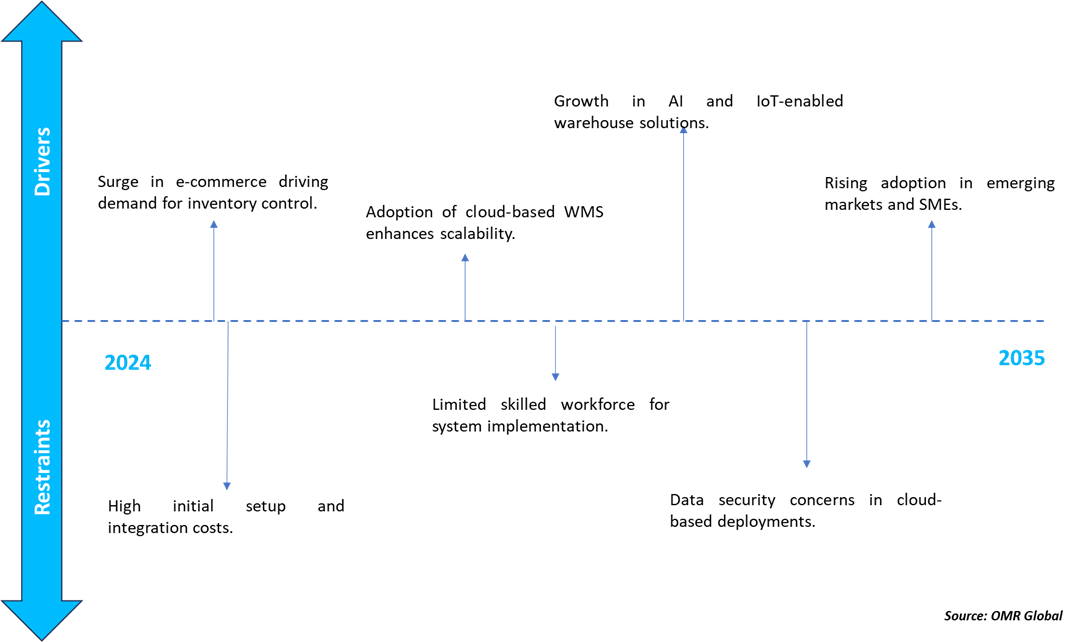
The demand for WMS adoption is driven by the need for real-time inventory visibility, labor efficiency, and data-led decisions and activities. The rapid growth of e-commerce is contributing to the demand for high-speed and highly accurate fulfilment solutions, supported by modern WMS platforms. To benefit from more scalable, flexible, integrated, and cost-effective infrastructure, companies are investing in cloud WMS. Additionally, advanced analytics and automation capabilities are driving efficiency in complex logistics networks and distribution centers.

Market Dynamics
Growing Adoption of Automation across Distribution Networks
The increasing complexity of global supply chains is encouraging organizations to adopt warehouse management systems that enable them to automate scale solutions. Automated systems are needed for precision, speed, and accuracy of order processing. For instance, Honeywell International Inc.'s Momentum WMS software connects to robotic systems for complete automation in a warehouse environment, while providing visibility, labor management, and demand forecasting. Logistics providers are embracing solutions to improve operational efficiency to reduce human error. Industries ranging from retail to manufacturing are growing more dependent on order automation solutions to provide a level of responsiveness and continuity in their distribution execution.
Optimizing Cloud-Driven and Operational Resilience
The transformation of operational capabilities across industries, with the migration and adoption of cloud-native warehouse management systems, is being driven by more efficient inventory management of shipped units through resource allocation for better workflow productivity. Companies such as Manhattan Associates offer cloud-first WMS solutions, offering companies the ability to utilize cloud-based inventory management to streamline enhancements through operations, leveraging forecasting and modelling to improve end-to-end supply chain operations usage and management. The ability to embrace ecosystem-based models for inventory management can allow companies to improvise through economic fluctuations, and robotic automation could increase uptime through resource management in times of disruption. The speed at which operations can evolve, where companies can operate multiple warehouse sites via a digital platform for products, services, and customers, is an advantage in competition. Implementing cloud-based supply chain solutions is inevitable for logistics to create a future-proof structure.
Market Segmentation
- Based on the component, the market is segmented into software and services.
- Based on the deployment, the market is segmented into on-premise and cloud.
- Based on the function, the market is segmented into labor management system, analytics and optimization, billing and yard management, systems integration and maintenance, and consulting services.
- Based on the application, the market is segmented into transportation & logistics, retail, healthcare, manufacturing, food & beverage, and others.
Software Segment to Lead the Market with the Largest Share
One of the most essential drivers impacting the growth of the warehouse management systems market is the increasing adoption of advanced software. Many organizations use software solutions to manage inventory control and order fulfillment. For instance, using SAP Extended Warehouse Management (EWM), users obtain visibility and control of supply chain processes in a real-time environment. These solutions provide information that can help organizations improve decision-making associated with managing operations, minimize the risk of operational errors. Moreover, the demand for SaaS-based warehouse management solutions is increasing penetration and acceptance in the warehouse management systems market. Continuous improvement of products is noted to be ongoing across many vendors in this area of the software market.
Regional Outlook
The global warehouse management systems market is further divided by geography, including North America (the US and Canada), Europe (the UK, Germany, France, Italy, Spain, Russia, and the Rest of Europe), Asia-Pacific (India, China, Japan, South Korea, Australia and New Zealand, ASEAN Countries, and the Rest of Asia-Pacific), and the Rest of the World (the Middle East & Africa, and Latin America).
Growing Demand for Shifting Retail Models and Regulatory Requirements in Europe
The European warehouse management systems market is driven by shifting retail models and regulatory requirements focused on logistics efficiency. Many regional businesses are implementing intelligent warehouse control systems to meet sustainability targets. For instance, Swisslog has developed a WMS platform that is automated-centric and extensively used in European logistics facilities. The growth in omni-channel retail, along with the increased driver for speed of delivery, is driving investments. Furthermore, the EU's attention towards green logistics and increasing demand for energy-efficient WMS solutions sensibly drives demand, establishing newer dynamics.
North America Region Dominates the Market with Major Share
North America continues to lead in warehouse automation and warehouse digitization and is spurring the growth of the WMS market in the region. It has an advanced e-commerce environment and mature cloud infrastructure. For instance, Oracle Corp.'s WMS solutions tailored to US retailers and manufacturers allow companies to be more agile in their operational processes, including the growth in the usage of more AI-powered warehouse tools owing to labor shortages. In addition, the presence of major technology vendors allows for an overall faster implementation cycle.
Market Players Outlook
The major companies operating in the global warehouse management systems market include IBM Corp., Manhattan Associates, Inc., Oracle Corp., SAP SE, and Zebra Technologies Corp., among others. Market players are leveraging partnerships, collaborations, mergers, and acquisition strategies for business expansion and innovative product development to maintain their market positioning.
Recent Developments
- In June 2025, Zebra Technologies Corp. announced that Lorsa, a provider of comprehensive laundry, drying, and finishing solutions, had a major upgrade to its warehouse operations, fixing the inefficiencies of the previous operations to improve inventory management with Zebra's cutting-edge technology. To address the inefficiencies affecting the expeditious handling of laundry products through the inventory management process, Lorsa implemented an advanced warehouse modernization solution with a robust mix of Zebra MC3300 mobile computers and ZT411 industrial printers, and supplies. Based on the warehouse modernization solution, Lorsa chose the In Action Warehouse Management System (WMS) from Dataware, a Zebra PartnerConnect premier Solution Provider.
- In May 2025, Mantis and MAI announced a strategic partnership to improve warehouse management solutions in Southeast Europe. Mantis' flagship Logistics Vision Suite (LVS) - a powerful, customizable WMS used by hundreds of companies in over 30 countries - and MAI's local industry expertise and long-standing relationships in the area, the partnership allows companies in third-party logistics, wholesale and distribution, multi-channel retail, and across many different vertical markets including food and beverage, consumer products, pharma logistics, fashion, and others, to improve their supply chain performance and efficiency.
- In March 2025, SnapFulfil, the award-winning warehouse management system (WMS) provider for rapid deployment and configurable technology, showcased their groundbreaking solutions at IntraLogisteX UK 2025. This leading logistics event takes place at the NEC Birmingham and gives logistics professionals and industry leaders the chance to experience the future of warehouse effectiveness first-hand. Attendees can visit SnapFulfil at the NEC Birmingham's Stand 110 to see just how the company's flexible warehouse technology can facilitate a multitude of operational environments and improve service levels during peak trading.
The Report Covers
- Market value data analysis of 2024 and forecast to 2035.
- Annualized market revenues ($ million) for each market segment.
- Country-wise analysis of major geographical regions.
- Key companies operating in the global warehouse management systems market. Based on the availability of data, information related to new products and relevant news is also available in the report.
- Analysis of business strategies by identifying the key market segments positioned for strong growth in the future.
- Analysis of market-entry and market expansion strategies.
- Competitive strategies by identifying ‘who-stands-where’ in the market.
1. Report Summary
• Current Industry Analysis and Growth Potential Outlook
• Global Warehouse Management Systems Market Sales Analysis – Component | Deployment| Function| Application ($ Million)
• Warehouse Management Systems Market Sales Performance of Top Countries
1.1. Research Methodology
• Primary Research Approach
• Secondary Research Approach
1.2. Market Snapshot
2. Market Overview and Insights
2.1. Scope of the Study
2.2. Analyst Insight & Current Market Trends
2.2.1. Key Warehouse Management Systems Industry Trends
2.2.2. Market Recommendations
2.3. Porter's Five Forces Analysis for the Warehouse Management Systems Market
2.3.1. Competitive Rivalry
2.3.2. Threat of New Entrants
2.3.3. Bargaining Power of Suppliers
2.3.4. Bargaining Power of Buyers
2.3.5. Threat of Substitutes
3. Market Determinants
3.1. Market Drivers
3.1.1. Drivers For Global Warehouse Management Systems Market: Impact Analysis
3.2. Market Pain Points and Challenges
3.2.1. Restraints For Global Warehouse Management Systems Market: Impact Analysis
3.3. Market Opportunities
3.3.1. Opportunities For Global Warehouse Management Systems Market: Impact Analysis
4. Competitive Landscape
4.1. Competitive Dashboard – Warehouse Management Systems Market Revenue and Share by Manufacturers
• Warehouse Management Systems Product Comparison Analysis
• Top Market Player Ranking Matrix
4.2. Key Company Analysis
4.2.1. IBM Corp.
4.2.1.1. Overview
4.2.1.2. Product Portfolio
4.2.1.3. Financial Analysis (Subject to Data Availability)
4.2.1.4. SWOT Analysis
4.2.1.5. Business Strategy
4.2.2. Manhattan Associates, Inc.
4.2.2.1. Overview
4.2.2.2. Product Portfolio
4.2.2.3. Financial Analysis (Subject to Data Availability)
4.2.2.4. SWOT Analysis
4.2.2.5. Business Strategy
4.2.3. Oracle Corp.
4.2.3.1. Overview
4.2.3.2. Product Portfolio
4.2.3.3. Financial Analysis (Subject to Data Availability)
4.2.3.4. SWOT Analysis
4.2.3.5. Business Strategy
4.2.4. SAP SE
4.2.4.1. Overview
4.2.4.2. Product Portfolio
4.2.4.3. Financial Analysis (Subject to Data Availability)
4.2.4.4. SWOT Analysis
4.2.4.5. Business Strategy
4.2.5. Zebra Technologies Corp.
4.2.5.1. Overview
4.2.5.2. Product Portfolio
4.2.5.3. Financial Analysis (Subject to Data Availability)
4.2.5.4. SWOT Analysis
4.2.5.5. Business Strategy
4.3. Top Winning Strategies by Market Players
4.3.1. Merger and Acquisition
4.3.2. Product Launch
4.3.3. Partnership And Collaboration
5. Global Warehouse Management Systems Market Sales Analysis by Component ($ Million)
5.1. Software
5.2. Services
6. Global Warehouse Management Systems Market Sales Analysis by Deployment ($ Million)
6.1. On-Premises
6.2. Cloud
7. Global Warehouse Management Systems Market Sales Analysis by Function ($ Million)
7.1. Labor Management System
7.2. Analytics and Optimization
7.3. Billing and Yard Management
7.4. Systems Integration and Maintenance
7.5. Consulting Services
8. Global Warehouse Management Systems Market Sales Analysis by Application ($ Million)
8.1. Transportation and Logistics
8.2. Retail
8.3. Healthcare
8.4. Manufacturing
8.5. Food and Beverage
8.6. Others
9. Regional Analysis
9.1. North American Warehouse Management Systems Market Sales Analysis – Component | Deployment| Function| Application| Country ($ Million)
• Macroeconomic Factors for North America
9.1.1. United States
9.1.2. Canada
9.2. European Warehouse Management Systems Market Sales Analysis – Component | Deployment| Function| Application| Country ($ Million)
• Macroeconomic Factors for Europe
9.2.1. UK
9.2.2. Germany
9.2.3. Italy
9.2.4. Spain
9.2.5. France
9.2.6. Russia
9.2.7. Rest of Europe
9.3. Asia-Pacific Warehouse Management Systems Market Sales Analysis – Component | Deployment| Function| Application| Country ($ Million)
• Macroeconomic Factors for Asia-Pacific
9.3.1. China
9.3.2. Japan
9.3.3. South Korea
9.3.4. India
9.3.5. Australia & New Zealand
9.3.6. ASEAN Countries (Thailand, Indonesia, Vietnam, Singapore, And Other)
9.3.7. Rest of Asia-Pacific
9.4. Rest of the World Warehouse Management Systems Market Sales Analysis – Component | Deployment| Function| Application| Country ($ Million)
• Macroeconomic Factors for the Rest of the World
9.4.1. Latin America
9.4.2. Middle East and Africa
10. Company Profiles
10.1. Aptean Group
10.1.1. Quick Facts
10.1.2. Company Overview
10.1.3. Product Portfolio
10.1.4. Business Strategies
10.2. Blue Link ERP
10.2.1. Quick Facts
10.2.2. Company Overview
10.2.3. Product Portfolio
10.2.4. Business Strategies
10.3. Blue Yonder Group, Inc.
10.3.1. Quick Facts
10.3.2. Company Overview
10.3.3. Product Portfolio
10.3.4. Business Strategies
10.4. Daifuku Co., Ltd.
10.4.1. Quick Facts
10.4.2. Company Overview
10.4.3. Product Portfolio
10.4.4. Business Strategies
10.5. Datex Inc.
10.5.1. Quick Facts
10.5.2. Company Overview
10.5.3. Product Portfolio
10.5.4. Business Strategies
10.6. Epicor Software Corp.
10.6.1. Quick Facts
10.6.2. Company Overview
10.6.3. Product Portfolio
10.6.4. Business Strategies
10.7. Fishbowl
10.7.1. Quick Facts
10.7.2. Company Overview
10.7.3. Product Portfolio
10.7.4. Business Strategies
10.8. IBM Corp.
10.8.1. Quick Facts
10.8.2. Company Overview
10.8.3. Product Portfolio
10.8.4. Business Strategies
10.9. Infoplus Commerce
10.9.1. Quick Facts
10.9.2. Company Overview
10.9.3. Product Portfolio
10.9.4. Business Strategies
10.10. Infor
10.10.1. Quick Facts
10.10.2. Company Overview
10.10.3. Product Portfolio
10.10.4. Business Strategies
10.11. Körber Supply Chain GmbH
10.11.1. Quick Facts
10.11.2. Company Overview
10.11.3. Product Portfolio
10.11.4. Business Strategies
10.12. Logiwa Technology Inc.
10.12.1. Quick Facts
10.12.2. Company Overview
10.12.3. Product Portfolio
10.12.4. Business Strategies
10.13. Made4net
10.13.1. Quick Facts
10.13.2. Company Overview
10.13.3. Product Portfolio
10.13.4. Business Strategies
10.14. Manhattan Associates, Inc.
10.14.1. Quick Facts
10.14.2. Company Overview
10.14.3. Product Portfolio
10.14.4. Business Strategies
10.15. Mecalux S.A.
10.15.1. Quick Facts
10.15.2. Company Overview
10.15.3. Product Portfolio
10.15.4. Business Strategies
10.16. Microlistics (WiseTech Global Group)
10.16.1. Quick Facts
10.16.2. Company Overview
10.16.3. Product Portfolio
10.16.4. Business Strategies
10.17. Oracle Corp.
10.17.1. Quick Facts
10.17.2. Company Overview
10.17.3. Product Portfolio
10.17.4. Business Strategies
10.18. PathGuide Technologies
10.18.1. Quick Facts
10.18.2. Company Overview
10.18.3. Product Portfolio
10.18.4. Business Strategies
10.19. PSI Software SE
10.19.1. Quick Facts
10.19.2. Company Overview
10.19.3. Product Portfolio
10.19.4. Business Strategies
10.20. Reply S.p.A.
10.20.1. Quick Facts
10.20.2. Company Overview
10.20.3. Product Portfolio
10.20.4. Business Strategies
10.21. SAP SE
10.21.1. Quick Facts
10.21.2. Company Overview
10.21.3. Product Portfolio
10.21.4. Business Strategies
10.22. Softeon
10.22.1. Quick Facts
10.22.2. Company Overview
10.22.3. Product Portfolio
10.22.4. Business Strategies
10.23. Sphere WMS
10.23.1. Quick Facts
10.23.2. Company Overview
10.23.3. Product Portfolio
10.23.4. Business Strategies
10.24. SSI SCHÄFER Group
10.24.1. Quick Facts
10.24.2. Company Overview
10.24.3. Product Portfolio
10.24.4. Business Strategies
10.25. Tecsys Inc.
10.25.1. Quick Facts
10.25.2. Company Overview
10.25.3. Product Portfolio
10.25.4. Business Strategies
10.26. Synergy Logistics Ltd. (SnapFulfil WMS)
10.26.1. Quick Facts
10.26.2. Company Overview
10.26.3. Product Portfolio
10.26.4. Business Strategies
10.27. Zebra Technologies Corp.
10.27.1. Quick Facts
10.27.2. Company Overview
10.27.3. Product Portfolio
10.27.4. Business Strategies
1. Global Warehouse Management Systems Market Research and Analysis by Component, 2024–2035 ($ Million)
2. Global Warehouse Management Software Market Research and Analysis by Region, 2024–2035 ($ Million)
3. Global Warehouse Management Services Market Research and Analysis by Region, 2024–2035 ($ Million)
4. Global Warehouse Management Systems Market Research and Analysis by Deployment, 2024–2035 ($ Million)
5. Global On-Premises Warehouse Management Systems Market Research and Analysis by Region, 2024–2035 ($ Million)
6. Global Cloud Warehouse Management Systems Market Research and Analysis by Region, 2024–2035 ($ Million)
7. Global Warehouse Management Systems Market Research and Analysis by Function, 2024–2035 ($ Million)
8. Global Warehouse Management Systems For Labor Management System Market Research and Analysis by Region, 2024–2035 ($ Million)
9. Global Warehouse Management Systems For Analytics and Optimization Market Research and Analysis by Region, 2024–2035 ($ Million)
10. Global Warehouse Management Systems For Billing and Yard Management Market Research and Analysis by Region, 2024–2035 ($ Million)
11. Global Warehouse Management Systems For Systems Integration and Maintenance Market Research and Analysis by Region, 2024–2035 ($ Million)
12. Global Warehouse Management Systems For Consulting Services Market Research and Analysis by Region, 2024–2035 ($ Million)
13. Global Warehouse Management Systems Market Research and Analysis by Application, 2024–2035 ($ Million)
14. Global Warehouse Management Systems For Transportation and Logistics Market Research and Analysis by Region, 2024–2035 ($ Million)
15. Global Warehouse Management Systems For Retail Market Research and Analysis by Region, 2024–2035 ($ Million)
16. Global Warehouse Management Systems For Healthcare Market Research and Analysis by Region, 2024–2035 ($ Million)
17. Global Warehouse Management Systems For Manufacturing Market Research and Analysis by Region, 2024–2035 ($ Million)
18. Global Warehouse Management Systems For Food and Beverage Market Research and Analysis by Region, 2024–2035 ($ Million)
19. Global Warehouse Management Systems For Other Application Market Research and Analysis by Region, 2024–2035 ($ Million)
20. Global Warehouse Management Systems Market Research and Analysis by Region, 2024–2035 ($ Million)
21. North American Warehouse Management Systems Market Research and Analysis by Country, 2024–2035 ($ Million)
22. North American Warehouse Management Systems Market Research and Analysis by Component, 2024–2035 ($ Million)
23. North American Warehouse Management Systems Market Research and Analysis by Deployment, 2024–2035 ($ Million)
24. North American Warehouse Management Systems Market Research and Analysis by Function, 2024–2035 ($ Million)
25. North American Warehouse Management Systems Market Research and Analysis by Application, 2024–2035 ($ Million)
26. European Warehouse Management Systems Market Research and Analysis by Country, 2024–2035 ($ Million)
27. European Warehouse Management Systems Market Research and Analysis by Component, 2024–2035 ($ Million)
28. European Warehouse Management Systems Market Research and Analysis by Deployment, 2024–2035 ($ Million)
29. European Warehouse Management Systems Market Research and Analysis by Function, 2024–2035 ($ Million)
30. European Warehouse Management Systems Market Research and Analysis by Application, 2024–2035 ($ Million)
31. Asia-Pacific Warehouse Management Systems Market Research and Analysis by Country, 2024–2035 ($ Million)
32. Asia-Pacific Warehouse Management Systems Market Research and Analysis by Component, 2024–2035 ($ Million)
33. Asia-Pacific Warehouse Management Systems Market Research and Analysis by Deployment, 2024–2035 ($ Million)
34. Asia-Pacific Warehouse Management Systems Market Research and Analysis by Function, 2024–2035 ($ Million)
35. Asia-Pacific Warehouse Management Systems Market Research and Analysis by Application, 2024–2035 ($ Million)
36. Rest of the World Warehouse Management Systems Market Research and Analysis by Region, 2024–2035 ($ Million)
37. Rest of the World Warehouse Management Systems Market Research and Analysis by Component, 2024–2035 ($ Million)
38. Rest of the World Warehouse Management Systems Market Research and Analysis by Deployment, 2024–2035 ($ Million)
39. Rest of the World Warehouse Management Systems Market Research and Analysis by Function, 2024–2035 ($ Million)
40. Rest of the World Warehouse Management Systems Market Research and Analysis by Application, 2024–2035 ($ Million)
1. Global Warehouse Management Systems Market Share by Component, 2024 Vs 2035 (%)
2. Global Warehouse Management Software Market Share by Region, 2024 Vs 2035 (%)
3. Global Warehouse Management Services Market Share by Region, 2024 Vs 2035 (%)
4. Global Warehouse Management Systems Market Share by Deployment, 2024 Vs 2035 (%)
5. Global On-Premises Warehouse Management Systems Market Share by Region, 2024 Vs 2035 (%)
6. Global Cloud Warehouse Management Systems Market Share by Region, 2024 Vs 2035 (%)
7. Global Warehouse Management Systems Market Share by Function, 2024 Vs 2035 (%)
8. Global Warehouse Management Systems For Labor Management System Market Share by Region, 2024 Vs 2035 (%)
9. Global Warehouse Management Systems For Analytics and Optimization Market Share by Region, 2024 Vs 2035 (%)
10. Global Warehouse Management Systems For Billing and Yard Management Market Share by Region, 2024 Vs 2035 (%)
11. Global Warehouse Management Systems For Systems Integration and Maintenance Market Share by Region, 2024 Vs 2035 (%)
12. Global Warehouse Management Systems For Consulting Services Market Share by Region, 2024 Vs 2035 (%)
13. Global Warehouse Management Systems Market Share by Application, 2024 Vs 2035 (%)
14. Global Warehouse Management Systems For Transportation and Logistics Market Share by Region, 2024 Vs 2035 (%)
15. Global Warehouse Management Systems For Retail Market Share by Region, 2024 Vs 2035 (%)
16. Global Warehouse Management Systems For Healthcare Market Share by Region, 2024 Vs 2035 (%)
17. Global Warehouse Management Systems For Manufacturing Market Share by Region, 2024 Vs 2035 (%)
18. Global Warehouse Management Systems For Food and Beverage Market Share by Region, 2024 Vs 2035 (%)
19. Global Warehouse Management Systems For Other Application Market Share by Region, 2024 Vs 2035 (%)
20. Global Warehouse Management Systems Market Share by Region, 2024 Vs 2035 (%)
21. US Warehouse Management Systems Market Size, 2024–2035 ($ Million)
22. Canada Warehouse Management Systems Market Size, 2024–2035 ($ Million)
23. UK Warehouse Management Systems Market Size, 2024–2035 ($ Million)
24. France Warehouse Management Systems Market Size, 2024–2035 ($ Million)
25. Germany Warehouse Management Systems Market Size, 2024–2035 ($ Million)
26. Italy Warehouse Management Systems Market Size, 2024–2035 ($ Million)
27. Spain Warehouse Management Systems Market Size, 2024–2035 ($ Million)
28. Russia Warehouse Management Systems Market Size, 2024–2035 ($ Million)
29. Rest of Europe Warehouse Management Systems Market Size, 2024–2035 ($ Million)
30. India Warehouse Management Systems Market Size, 2024–2035 ($ Million)
31. China Warehouse Management Systems Market Size, 2024–2035 ($ Million)
32. Japan Warehouse Management Systems Market Size, 2024–2035 ($ Million)
33. South Korea Warehouse Management Systems Market Size, 2024–2035 ($ Million)
34. Australia and New Zealand Warehouse Management Systems Market Size, 2024–2035 ($ Million)
35. ASEAN Economies Warehouse Management Systems Market Size, 2024–2035 ($ Million)
36. Rest of Asia-Pacific Warehouse Management Systems Market Size, 2024–2035 ($ Million)
37. Latin America Warehouse Management Systems Market Size, 2024–2035 ($ Million)
38. Middle East and Africa Warehouse Management Systems Market Size, 2024–2035 ($ Million)
- Printable version
- No restriction to number of users within the company