Water-Soluble Polymers Market: Growth, Size, Share, and Trends


Water-Soluble Polymers Market Size, Share & Trends Analysis Report by Product (Natural Polymers, Semi-Synthetic Polymers, and Synthetic Polymers, by Application (Food and Beverage, Pharmaceuticals and Nutraceuticals, Personal Care and Cosmetics, Home Care / Detergents and Cleaning Products, Oil and Gas, Water and Wastewater Treatment, Mining and Mineral Processing, Construction and Building Materials, and Others), Forecast Period (2026–2035)
Industry Overview
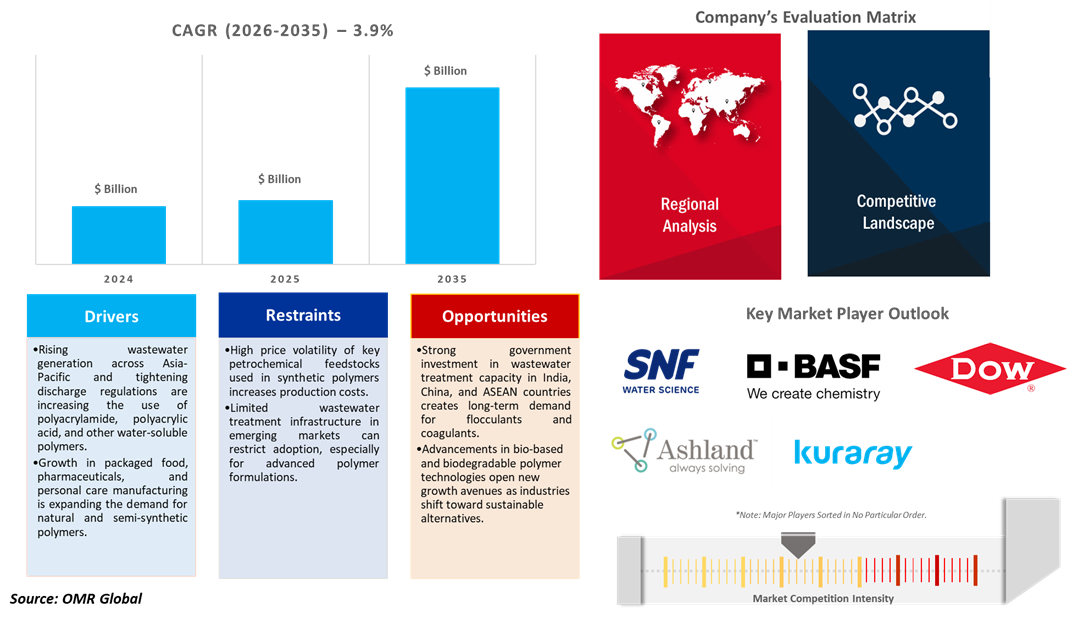
Water-soluble polymers market is valued at $34.20 billion in 2025 and is projected to reach $49.47 billion by 2035, reflecting a 3.9% CAGR over the 2026–2035 period. The market is expanding rapidly owing to the rising demand for clean water, a shift in oil and natural gas operations, the growth of food, pharma, and personal care manufacturing, and a growing emphasis on sustainability. Countries are tightening rules around industrial discharge, municipal wastewater treatment, and water reuse. Policies from the US EPA, EU Water Framework Directive, and India’s National Mission for Clean Ganga continue to push utilities and industries toward higher volumes of flocculants and coagulants, benefitting polymer producers. In July 2025, under the Namami Gange Programme (India), the government sanctioned 212 sewage infrastructure projects for polluted river stretches, with a combined treatment capacity of 6,540 Million Litres per Day (MLD). Of this, 136 STP projects (3,780 MLD) have been completed and made operational.
Market Dynamics
Substitution toward Bio-Based and Soluble Polymer Alternatives
The shift toward bio-based and water-soluble polymer alternatives is gaining momentum as firms and regulators alike seek greener performance materials. For instance, companies like Kemira Oyj have begun full-scale production of a biomass-balanced polyacrylamide water-soluble polymer, replacing a majority of fossil feedstock with ISCC-Plus certified renewable raw materials. Concurrently, research reported by the European Chemical Industry Council’s LRI project states that water-soluble polymers have largely been understudied in biodegradation tests, despite a strong regulatory emphasis on biodegradability and environmental fate. Water-soluble polymers dissolve and disperse rather than persist as particulates, their appeal in regulated applications rises. The combination of a major manufacturer launching renewable-feedstock polymer lines and the growing data on biodegradability testing signals that substitution toward bio-based, water-soluble alternatives is becoming a tangible driver of the market.
Stringent Environmental Fate and Biodegradability Regulatory Requirements.
Regulatory bodies are increasingly scrutinising the environmental fate of polymers. The Organisation for Economic Co?operation and Development notes that water-soluble polymers have remained by far less investigated in terms of biodegradation despite broad use in home-care and agrochemical formulations. The European Commission’s microplastics restriction defines microplastics as synthetic water-insoluble polymers of certain dimensions, polymers that are water-soluble or biodegradable are exempt. The practical consequence is that polymer manufacturers must invest in the development and documentation of new grades with defined biodegradability or solubility profiles, raising formulation costs and possibly slowing time to market. Thus, the requirement for certified soluble or biodegradable performance acts as a moderating factor on market expansion.
Market Segmentation
- Based on the product, the market is segmented into natural, semi-synthetic polymers, and synthetic polymers.
- Based on the natural products, the market is segmented into carboxymethyl cellulose (CMC), hydroxyethyl cellulose (HEC), hydroxypropyl methylcellulose (HPMC), and other semi-synthetic polymers.
- Based on the semi-synthetic polymers, the market is segmented into carboxymethyl cellulose (CMC), hydroxyethyl cellulose (HEC), hydroxypropyl methylcellulose (HPMC), and other semi-synthetic polymer derivatives.
- Based on the synthetic polymers, the market is segmented into polyacrylamide (PAM), polyvinyl alcohol (PVA), polyacrylic acid (PAA), polyethylene glycol (PEG), polyvinylpyrrolidone (PVP), and other synthetic polymers.
- Based on the application, the market is segmented into food and beverage, pharmaceuticals and nutraceuticals, personal care and cosmetics, home care/detergents and cleaning products, oil and gas, water and wastewater treatment, mining and mineral processing, construction and building materials, and other industrial uses.
Polyacrylamide (PAM) Segment is Driving Growth in the Water-Soluble Polymers Market
PAM is increasingly used in the oil & gas sector as part of enhanced oil recovery (EOR) methods. According to Beijing Sinofloc Chemical Co., Ltd., high-viscosity aqueous solutions of PAM can be injected into reservoirs to improve the mobility ratio between the flood fluid and the reservoir oil, thereby boosting vertical and areal sweep efficiencies. Historically, PAM was delivered as a powder and hydrated on-site, but there has been a shift toward emulsion-based liquid forms for greater efficiency in deployment. These enhanced EOR capabilities and improved delivery formats, PAM occupies a strong position within the synthetic polymers segment of the water-soluble polymers market. Its adoption in oil & gas augments the size and growth prospects of the synthetic segment, especially in heavy-industry and upstream hydrocarbon applications.
Regional Outlook
The global water-soluble polymers market is further divided by region, including North America (the US and Canada), Europe (the UK, Germany, France, Italy, Spain, Russia, and the Rest of Europe), Asia-Pacific (India, China, Japan, South Korea, Australia and New Zealand, ASEAN Countries, and the Rest of Asia-Pacific), and the Rest of the World (the Middle East & Africa, and Latin America).
Asia-Pacific Leads the Global Water-Soluble Polymers Market Growth
The Asia-Pacific region contributes the largest share to the global water-soluble polymers market, supported by rapid industrialization, rising water-treatment demand, and strong public-sector investment in environmental compliance. According to NITI Aayog, in 2022, urban centers generated 72,368 MLD of wastewater while treatment capacity covered only 28%, creating a sustained need for flocculants and coagulants such as polyacrylamide and polyacrylic acid in municipal and industrial systems.
Moreover, China’s strong industrial momentum further supports Asia-Pacific’s leadership in the water-soluble polymers market, as rising manufacturing activity directly boosts demand for synthetic polymers used in water treatment, textiles, chemicals, papermaking, and oilfield operations. According to the National Bureau of Statistics, China’s value-added industrial output grew 5.8% in 2024, accelerating from 4.6% in 2023, with high-tech manufacturing expanding 8.9% and equipment manufacturing rising 7.7%. The manufacturing sector alone grew 6.1%, emphasizing sustained use of water-soluble polymers in process industries that require flocculants, thickeners, binders, and stabilizers.
Market Players Outlook
The major companies operating in the global water-soluble polymer market include SNF Group, BASF SE, Dow Inc., Ashland Inc., Kuraray Co., Ltd., among others. Market players are leveraging partnerships, collaborations, mergers, and acquisition strategies for business expansion and innovative product development to maintain their market positioning.
Recent Developments
- In January 2025, GELITA, a manufacturer of collagen and gelatin, announced the launch of its Endotoxin Controlled Excipients (ECE) portfolio.
- In July 2023, Lygos, Inc., announced the launch of Soltellus, a line of multi-functional, water-soluble polymers for home care, agronomy, and water treatment. Soltellus provides performance in target applications and is a nontoxic and biodegradable alternative to persistent polyacrylate and polycarboxylate polymers.
- In September 2020, Givaudan announced that it had divested its pectin business, part of the Naturex portfolio, to Herbstreith & Fox (H&F Group), a family-owned producer of pectin based in Neuenbürg, Germany.
The Report Covers
- Market value data analysis of 2025 and forecast to 2035.
- Annualized market revenues ($ million) for each market segment.
- Country-wise analysis of major geographical regions.
- Key companies operating in the global water-soluble polymer market. Based on the availability of data, information related to new products and relevant news is also available in the report.
- Analysis of business strategies by identifying the key market segments positioned for strong growth in the future.
- Analysis of market-entry and market expansion strategies.
- Competitive strategies by identifying ‘who-stands-where’ in the market.
- Report Summary
- Current Industry Analysis and Growth Potential Outlook
- Global Water-Soluble Polymers Market Sales Analysis – Product | End User ($ Million)
- Water-Soluble Polymers Market Sales Performance of Top Countries
- Research Methodology
- Primary Research Approach
- Secondary Research Approach
- Market Snapshot
- Market Overview and Insights
- Scope of the Study
- Analyst Insight & Current Market Trends
- Key Water-Soluble Polymers Industry Trends
- Market Recommendations
- Porter's Five Forces Analysis for the Water-Soluble Polymers Market
- Competitive Rivalry
- Threat of New Entrants
- Bargaining Power of Suppliers
- Bargaining Power of Buyers
- Threat of Substitutes
- Market Determinants
- Market Drivers
- Drivers For the Global Water-Soluble Polymers Market: Impact Analysis
- Market Pain Points and Challenges
- Restraints For Global Water-Soluble Polymers Market: Impact Analysis
- Market Opportunities
- Opportunities For Global Water-Soluble Polymers Market: Impact Analysis
- Market Drivers
- Competitive Landscape
- Competitive Dashboard – Water-Soluble Polymers Market Revenue and Share by Manufacturers
- Water-Soluble Polymers Product Comparison Analysis
- Top Market Player Ranking Matrix
- Key Company Analysis
- SNF Group
- Overview
- Product Portfolio
- Financial Analysis
- SWOT Analysis
- Business Strategy
- BASF SE
- Overview
- Product Portfolio
- Financial Analysis
- SWOT Analysis
- Business Strategy
- The Dow Chemical Company
- Overview
- Product Portfolio
- Financial Analysis
- SWOT Analysis
- Business Strategy
- Ashland Inc.
- Overview
- Product Portfolio
- Financial Analysis
- SWOT Analysis
- Business Strategy
- Kuraray Co., Ltd.
- Overview
- Product Portfolio
- Financial Analysis
- SWOT Analysis
- Business Strategy
- SNF Group
- Key Company Analysis
- Top Winning Strategies by Market Players
- Merger and Acquisition
- Product Launch
- Partnership And Collaboration
- Global Water-Soluble Polymers Market Sales Analysis by Product ($ Million)
- Natural Polymers
- Gum
- Gelatin
- Pectin
- Other Natural Polymers
- Semi-Synthetic Polymers
- Carboxymethyl cellulose (CMC)
- Hydroxyethyl cellulose (HEC)
- Hydroxypropyl methylcellulose (HPMC)
- Other Semi-Synthetic Polymers
- Synthetic Polymers
- Polyacrylamide (PAM)
- Polyvinyl alcohol (PVA)
- Polyacrylic acid (PAA)
- Polyethylene glycol (PEG)
- Polyvinylpyrrolidone (PVP)
- Other Synthetic Polymers
- Natural Polymers
- Global Water-Soluble Polymers Market Sales Analysis by End-User ($ Million)
- Food & Beverage
- Pharmaceuticals & Nutraceuticals
- Personal Care & Cosmetics
- Home Care / Detergents & Cleaning Products
- Oil & Gas
- Water & Wastewater Treatment
- Mining & Mineral Processing
- Construction & Building Materials
- Other
- Regional Analysis
- North American Water-Soluble Polymers Market Sales Analysis – Product | End User | Country ($ Million)
- Macroeconomic Factors for North America
- United States
- Canada
- European Water-Soluble Polymers Market Sales Analysis – Product | End User | Country ($ Million)
- Macroeconomic Factors for Europe
- UK
- Germany
- Italy
- Spain
- France
- Russia
- Rest of Europe
- Asia-Pacific Water-Soluble Polymers Market Sales Analysis – Product |End User | Country ($ Million)
- Macroeconomic Factors for Asia-Pacific
- China
- Japan
- South Korea
- India
- Australia & New Zealand
- ASEAN Countries (Thailand, Indonesia, Vietnam, Singapore, And Other)
- Rest of Asia-Pacific
- Rest of the World Water-Soluble Polymers Market Sales Analysis – Product | End User | Country ($ Million)
- Macroeconomic Factors for the Rest of the World
- Latin America
- Middle East and Africa
- Company Profiles
- Anhui Tianrun Chemical Co., Ltd.
- Quick Facts
- Company Overview
- Product Portfolio
- Business Strategies
- Arkema group
- Quick Facts
- Company Overview
- Product Portfolio
- Business Strategies
- Ashland Inc.
- Quick Facts
- Company Overview
- Product Portfolio
- Business Strategies
- BASF SE
- Quick Facts
- Company Overview
- Product Portfolio
- Business Strategies
- Bharat Starch
- Quick Facts
- Company Overview
- Product Portfolio
- Business Strategies
- Cargill, Incorporated
- Quick Facts
- Company Overview
- Product Portfolio
- Business Strategies
- Chinafloc
- Quick Facts
- Company Overview
- Product Portfolio
- Business Strategies
- Gongyi Xinqi Polymer Co. Ltd.
- Quick Facts
- Company Overview
- Product Portfolio
- Business Strategies
- Kemira Oyj
- Quick Facts
- Company Overview
- Product Portfolio
- Business Strategies
- Kuraray Co., Ltd.
- Quick Facts
- Company Overview
- Product Portfolio
- Business Strategies
- LG Chem Ltd.
- Quick Facts
- Company Overview
- Product Portfolio
- Business Strategies
- Lubrizol Corp.
- Quick Facts
- Company Overview
- Product Portfolio
- Business Strategies
- Mitsubishi Chemical Corp.
- Quick Facts
- Company Overview
- Product Portfolio
- Business Strategies
- Nippon Shokubai Co., Ltd.
- Quick Facts
- Company Overview
- Product Portfolio
- Business Strategies
- Nitta Gelatin, Inc.
- Quick Facts
- Company Overview
- Product Portfolio
- Business Strategies
- Nouryon Chemicals Holding B.V.
- Quick Facts
- Company Overview
- Product Portfolio
- Business Strategies
- Patel Chem Specialities Ltd.
- Quick Facts
- Company Overview
- Product Portfolio
- Business Strategies
- SNF Group
- Quick Facts
- Company Overview
- Product Portfolio
- Business Strategies
- Solvay
- Quick Facts
- Company Overview
- Product Portfolio
- Business Strategies
- Sumitomo Seika Chemicals Co.,Ltd.
- Quick Facts
- Company Overview
- Product Portfolio
- Business Strategies
- The Dow Chemical Company
- Quick Facts
- Company Overview
- Product Portfolio
- Business Strategies
- Wuxi Lansen Chemicals Co., Ltd.
- Quick Facts
- Company Overview
- Product Portfolio
- Business Strategies
- Yixing Bluwat Chemicals Co., Ltd.
- Quick Facts
- Company Overview
- Product Portfolio
- Business Strategies
- Anhui Tianrun Chemical Co., Ltd.
1. Global Water-Soluble Polymers Market Research and Analysis by Product, 2025–2035 ($ Million)
2. Global Natural Polymers Market Research and Analysis by Region, 2025–2035 ($ Million)
3. Global Gum Market Research and Analysis by Region, 2025–2035 ($ Million)
4. Global Gelatin Market Research and Analysis by Region, 2025–2035 ($ Million)
5. Global Pectin Market Research and Analysis by Region, 2025–2035 ($ Million)
6. Global Other Natural Polymers Market Research and Analysis by Region, 2025–2035 ($ Million)
7. Global Semi-Synthetic Polymers Market Research and Analysis by Region, 2025–2035 ($ Million)
8. Global Carboxymethyl Cellulose (CMC) Market Research and Analysis by Region, 2025–2035 ($ Million)
9. Global Hydroxyethyl Cellulose (HEC) Market Research and Analysis by Region, 2025–2035 ($ Million)
10. Global Hydroxypropyl Methylcellulose (HPMC) Market Research and Analysis by Region, 2025–2035 ($ Million)
11. Global Other Semi-Synthetic Polymers Market Research and Analysis by Region, 2025–2035 ($ Million)
12. Global Synthetic Polymers Market Research and Analysis by Region, 2025–2035 ($ Million)
13. Global Polyacrylamide (PAM) Market Research and Analysis by Region, 2025–2035 ($ Million)
14. Global Polyvinyl Alcohol (PVA) Market Research and Analysis by Region, 2025–2035 ($ Million)
15. Global Polyacrylic Acid (PAA) Market Research and Analysis by Region, 2025–2035 ($ Million)
16. Global Polyethylene Glycol (PEG) Market Research and Analysis by Region, 2025–2035 ($ Million)
17. Global Polyvinylpyrrolidone (PVP) Market Research and Analysis by Region, 2025–2035 ($ Million)
18. Global Other Synthetic Polymers Market Research and Analysis by Region, 2025–2035 ($ Million)
19. Global Water-Soluble Polymers Market Research and Analysis by Application, 2025–2035 ($ Million)
20. Global Water-Soluble Polymers for Food & Beverage Market Research and Analysis by Region, 2025–2035 ($ Million)
21. Global Water-Soluble Polymers for Pharmaceuticals & Nutraceuticals Market Research and Analysis by Region, 2025–2035 ($ Million)
22. Global Water-Soluble Polymers for Personal Care & Cosmetics Market Research and Analysis by Region, 2025–2035 ($ Million)
23. Global Water-Soluble Polymers for Home Care / Detergents & Cleaning Products Market Research and Analysis by Region, 2025–2035 ($ Million)
24. Global Water-Soluble Polymers for Oil & Gas Market Research and Analysis by Region, 2025–2035 ($ Million)
25. Global Water-Soluble Polymers for Water & Wastewater Treatment Market Research and Analysis by Region, 2025–2035 ($ Million)
26. Global Water-Soluble Polymers for Mining & Mineral Processing Market Research and Analysis by Region, 2025–2035 ($ Million)
27. Global Water-Soluble Polymers for Construction & Building Materials Market Research and Analysis by Region, 2025–2035 ($ Million)
28. Global Water-Soluble Polymers for Other Applications Market Research and Analysis by Region, 2025–2035 ($ Million)
29. Global Water-Soluble Polymers Market Research and Analysis by Region, 2025–2035 ($ Million)
30. North America Water-Soluble Polymers Market Research and Analysis by Country, 2025–2035 ($ Million)
31. North America Water-Soluble Polymers Market Research and Analysis by Product, 2025–2035 ($ Million)
32. North America Water-Soluble Polymers Market Research and Analysis by Application, 2025–2035 ($ Million)
33. Europe Water-Soluble Polymers Market Research and Analysis by Country, 2025–2035 ($ Million)
34. Europe Water-Soluble Polymers Market Research and Analysis by Product, 2025–2035 ($ Million)
35. Europe Water-Soluble Polymers Market Research and Analysis by Application, 2025–2035 ($ Million)
36. Asia-Pacific Water-Soluble Polymers Market Research and Analysis by Country, 2025–2035 ($ Million)
37. Asia-Pacific Water-Soluble Polymers Market Research and Analysis by Product, 2025–2035 ($ Million)
38. Asia-Pacific Water-Soluble Polymers Market Research and Analysis by Application, 2025–2035 ($ Million)
39. Rest of the World Water-Soluble Polymers Market Research and Analysis by Region, 2025–2035 ($ Million)
40. Rest of the World Water-Soluble Polymers Market Research and Analysis by Product, 2025–2035 ($ Million)
41. Rest of the World Water-Soluble Polymers Market Research and Analysis by Application, 2025–2035 ($ Million)
- Printable version
- No restriction to number of users within the company

