Intersection of Diesel Dominance and Fuel Cell Bus Expansion Creates Opportunities for Bus Body Building Market Industry
Bus body building market was valued at $35.0 billion in 2024 and is projected to reach $79.6 billion by 2035, growing at a CAGR of 7.2% during the forecast period (2025–2035). Diesel buses, as significant contributors to urban air pollution and greenhouse gas emissions, have increasingly become a major environmental and public health liability. However, a substantial number of diesel buses continue to operate across the globe, owing to their established infrastructure, dependability, and cost-effectiveness. Diesel engines have long been the standard for public and private bus fleets, many nations where alternatives such as electric or hybrid vehicles are still being developed.
Browse the full report description of “Bus Body Building Market Size, Share & Trends Analysis Report by Propulsion Type (Diesel, Petrol, CNG/LNG, Electric and Others) by Seats (16 - 24 Seats, 25 – 40 seats, and >40 Seats) by Application (City/Suburban Transit, School & Staff Transport, Intercity / Long-haul and Special Purpose), Forecast Period (2025-2035)” at https://www.omrglobal.com/industry-reports/bus-body-building-market
These buses are popular because of their longevity and ability to travel long distances with large passenger loads. Despite ongoing efforts to transition to cleaner options, diesel buses continue to dominate the European Union's (EU) public transportation industry. In 2023, diesel-powered buses remained the most popular in the EU, accounting for 62.3% of all new bus sales.
Meanwhile, electrically-chargeable buses continued to gain ground, accounting for 15.9% of the total EU bus market in 2023. Despite increasing interest in alternative propulsion technologies, diesel bus body building remains a key segment of the industry, driven by the ongoing demand for reliable and cost-effective public transport solutions.
New EU Bus Sales By Power Source, 2023
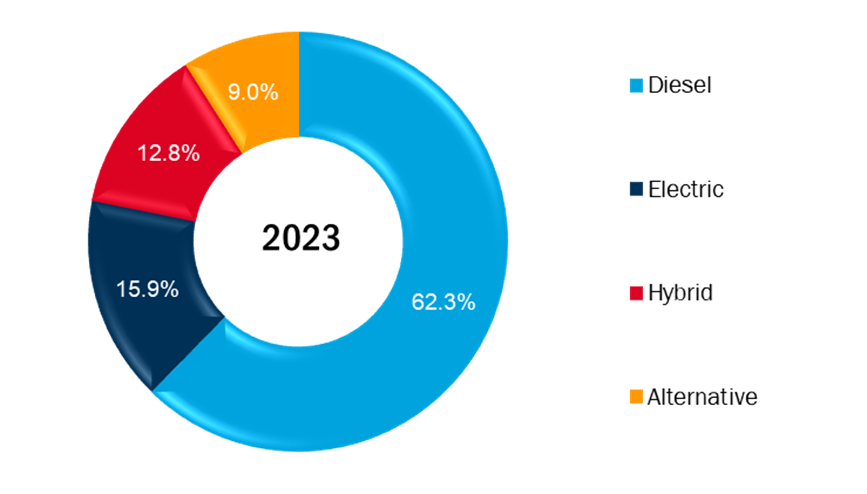
Source: The European Automobile Manufacturers' Association, or ACEA
Fuel cell buses are gaining appeal as a clean and environmentally friendly alternative to regular diesel-powered vehicles. Considering technological developments and increased investment in hydrogen infrastructure, several cities across the globe are starting to deploy fuel cell buses as part of their attempts to transition to zero-emission public transportation systems. As of January 2023, a total of 370 fuel cell buses were in operation in Europe, with plans to get over 1,200 by 2025. In the first half of 2025, a total of 279 units were registered, a 426% growth on the 53 registered in January–June of last year. Furthermore, nations such as India are promoting sustainable transportation solutions with advancements in green hydrogen mobility. As of October 2024, eight fuel cell buses, including one each for the Indian Army and Indian Navy, are operational in the Delhi NCR region, with an additional four buses deployed in Vadodara.
Market Coverage
- The market number available for – 2024-2035
- Base year- 2024
- Forecast period- 2025-2035
- Segment Covered-
- By Propulsion Type
- By Seat
- By Application
- Regions Covered-
- North America
- Europe
- Asia-Pacific
- Rest of the World
- Competitive Landscape - Anhui Ankai Automobile Co., Ltd, Blue Bird Corp, IRIZAR S. Coop., Marcopolo S.A., Tata Marcopolo Motors Ltd., among others.
Key questions addressed by the report.
- What is the market growth rate?
- Which segment and region dominate the market in the base year?
- Which segment and region will project the fastest growth in the market?
- Who is the leader in the market?
- How are players addressing challenges to sustain growth?
- Where is the investment opportunity?
Global Bus Body Building Market Report Segment
By Propulsion Type
- Diesel
- Petrol
- CNG/LNG (Natural Gas)
- Electric
- Others
By Seat
- 16 - 24 Seats
- 25 – 40 seats
- >40 Seats
By Application
- City / Suburban Transit
- School & Staff Transport
- Intercity / Long-haul
- Special Purpose
Global Bus Body Building Market Report Segment by Region
North America
- United States
- Canada
Europe
- UK
- Germany
- Italy
- Spain
- France
- Russia
- Rest of Europe
Asia-Pacific
- China
- India
- Japan
- South Korea
- Australia and New Zealand
- ASEAN Economies
- Rest of Asia-Pacific
Rest of the World
- Latin America
- Middle East & Africa
To learn more about this report request a sample copy @ https://www.omrglobal.com/request-sample/bus-body-building-market