Bus Body Building Market


Bus Body Building Market Size, Share & Trends Analysis Report by Propulsion Type (Diesel, Petrol, CNG/LNG, Electric and Others) by Seats (16 - 24 Seats, 25 – 40 seats, and >40 Seats) by Application (City/Suburban Transit, School & Staff Transport, Intercity / Long-haul and Special Purpose), Forecast Period (2025-2035)
Industry Overview
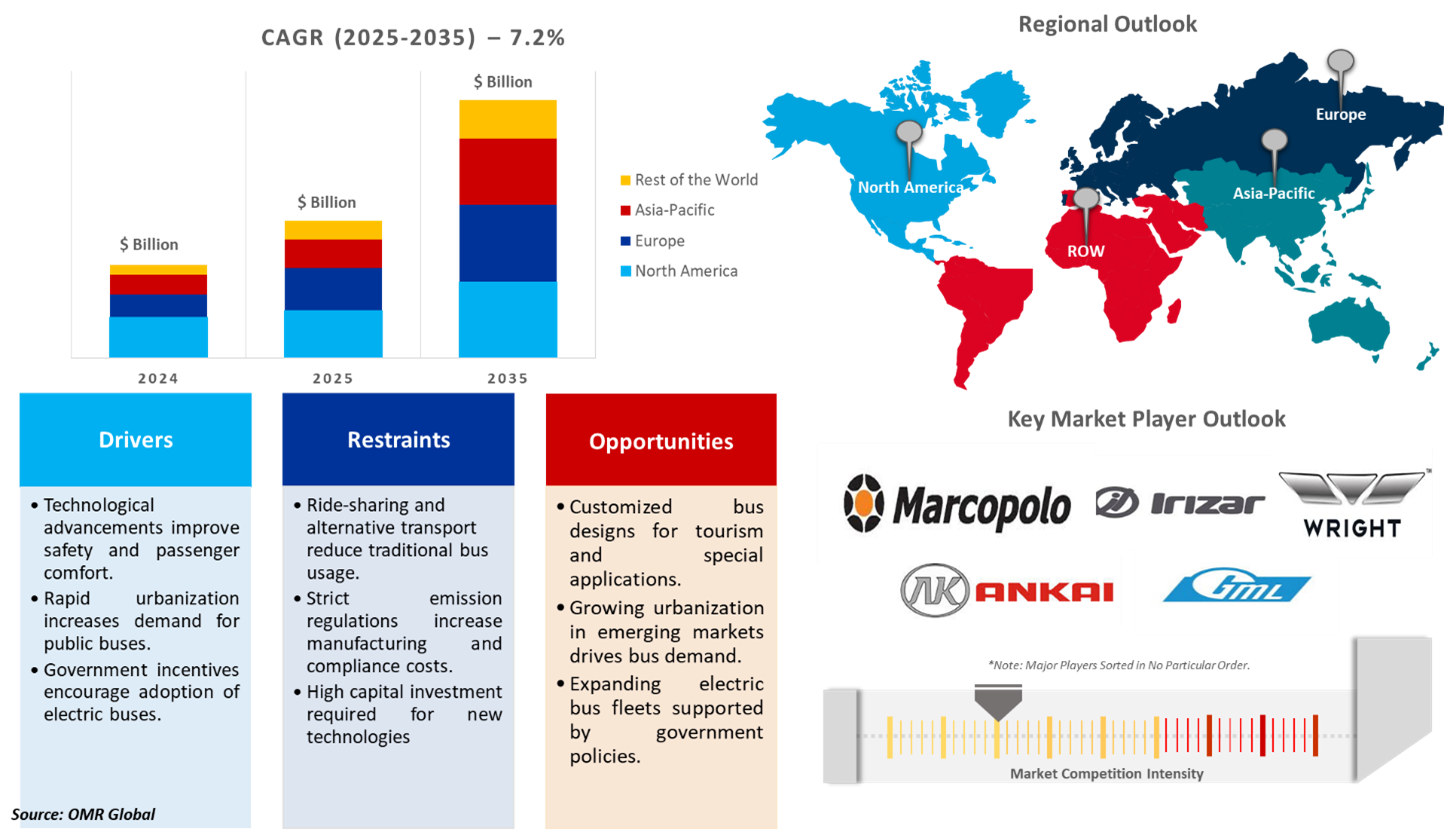
Bus body building market was valued at $35.0 billion in 2024 and is projected to reach $79.6 billion by 2035, growing at a CAGR of 7.2% during the forecast period (2025–2035). The global bus body building market is expanding at a fast pace owing to the urbanization & rising demand for public transit, shift toward sustainable and clean energy buses, increasing government regulations on safety and technological innovations, and smart integration. Many nations across the globe maintain large bus fleets to meet the growing demand for public transportation. In India, the existing bus fleet stands at 1.5 million, most of which run on diesel. Meanwhile, China has made significant strides in sustainable transport, with 554,000 new energy buses representing 81.2% of its total bus fleet.
Market Dynamics
Government Regulations on Safety and Comfort Play a Crucial Role in Shaping the Bus Body Building Market
Government rules on safety and comfort fuel the growth of the bus body building industry by mandating advanced structural designs, better materials, and improved passenger features. Builders must meet regulations for crash protection, emergency exits, and accessibility, which has boosted demand for certified and customized body structures. This encourages innovation and increases revenue for complying manufacturers. For instance, in October 2023, the Indian road transport ministry proposed two norms to increase vehicle and passenger safety: required certification of all buses constructed by both vehicle manufacturers and bus body builders, and the provision of 'indirect vision' equipment in addition to the rear-view mirror. Mandatory bus body certification from government-recognized testing agencies will be mandatory by mid-2025. However, the provision of 'indirect vision' devices inside vehicles will be voluntary. These devices aim to guide drivers in addition to the rear-view mirror. Furthermore, in January 2025, major bus and coach safety reforms were introduced following the fatal Hunter Valley crash in Australia in 2023. The federal government announced changes to the Australian Design Rule (ADR). The federal government requires the fitting of seatbelts to all new buses and coaches manufactured from November 2026. This requirement will be implemented for all new and existing buses and coaches by November 2027. Additionally, audio and video prompts encouraging passengers to use seatbelts while seated will be installed, similar to those used on airplanes. The measures also close a "loophole" that previously permitted some coaches to operate without seatbelts.
Expansion of Bus Production Capacity to Meet Growing Demand
Major bus manufacturers across the globe have been actively expanding their production capacities to meet the rising demand for public transportation, electric mobility, and sustainable transit solutions. Companies like BYD, Volvo, Daimler, and Tata Motors are investing in new manufacturing facilities, upgrading existing plants, and enhancing automation to scale up output. For instance, in July 2025, BYD announced the expansion of its production footprint in Europe with a new facility in northern Hungary. The company plans to invest 32 billion forints (approximately $94 million) in the construction of a new plant in Komárom, tripling its local production capacity to 1,250 electric buses and trucks annually. Furthermore, in February 2025, the Volvo Group signed an MoU with the Karnataka government to invest ?1,400 crore in setting up its fourth international manufacturing hub in Hosakote, Bengaluru. The new facility will boost production capacity from 3,000 to 20,000 trucks and buses annually. This expansion is expected to enhance exports and strengthen India’s role in the global supply chain.
Market Segmentation
- Based on the propulsion type, the market is segmented into diesel, petrol, CNG/LNG, electric, and others.
- Based on the seat, the market is segmented into 16 - 24 Seats, 25 – 40 seats, and more than 40 Seats.
- Based on the application, the market is segmented into city/suburban transit, school & staff transport, intercity/long-haul, and special purpose (airport).
Electric: A Key Segment in Market Growth
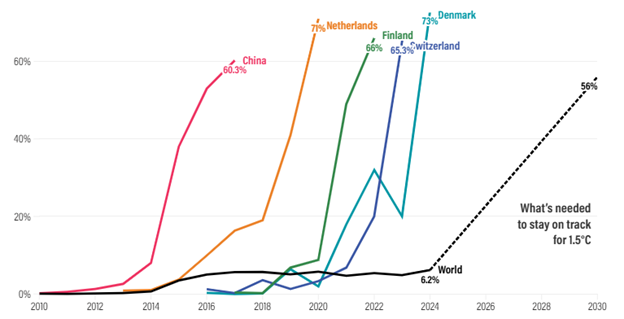
Electric buses are necessary for reducing carbon dioxide emissions in the transport sector. Buses, including city, coach, and school buses, make up approximately 5% of global transport carbon dioxide emissions. A nation such as India is rapidly advancing its electric bus industry as part of its broader commitment to sustainable and clean transportation. In 2023, India rolled out a large, unified tender of 5,450 e-buses worth over $1 billion and spread across five states. While nations such as China, the Netherlands, Finland, Switzerland, and Denmark all grew their electric bus sales from less than 6% to more than 60% in six years or less. China’s export of new energy buses (NEBs) grew +28% in 2024, reaching 15,444 units with a length of over 3.5 meters. BYD maintained the lead with 3,582 new energy buses shipped. It’s the only OEM to exceed the figure of 3,000 units. Yutong exported 2,700 electric buses, gaining the second position with a market share of 17.5%.
Electric Buses as Share of Bus Sales
Source: IEA EV Data Explorer 2025; IEA Net Zero Emissions Roadmap 2023
Furthermore, market players are upgrading their electric buses with greater capacity, extended range, and longer service life, all of which are contributing to overall market growth. For instance, from 2026, all Mercedes-Benz eCitaro models will be fitted with new NMC4 batteries, allowing for even greater capacity, longer ranges, and longer service life, even with regular quick charging processes capable of up to 300 kW charging capacity.
>40 Seats Segment of the Bus Body Building Market Is Expanding at the Highest Rate
There has been a continuous demand for high-capacity seat buses by various public transportation agencies across the globe. These transport agencies often introduce or expand their fleet of buses to meet growing public demand, reduce traffic congestion, improve efficiency, and promote environmentally friendly travel. For instance, in December 2024, Alexander Dennis delivered the first two of seven Enviro500 double-decker buses to the Spokane Transit Authority (STA). Each vehicle delivered to STA is capable of seating up to 82 passengers and carrying up to 108 at full capacity. Furthermore, double-decker buses are gaining popularity internationally, considering that they can transport more passengers while providing a better travel experience. These buses offer panoramic views, making them ideal for tourism and sightseeing.
Regional Outlook
The global bus body building market is further divided by region, including North America (the US and Canada), Europe (the UK, Germany, France, Italy, Spain, Russia, and the Rest of Europe), Asia-Pacific (India, China, Japan, South Korea, Australia and New Zealand, ASEAN Countries, and the Rest of Asia-Pacific), and the Rest of the World (the Middle East & Africa, and Latin America).
Asia-Pacific is Leading the Global Bus Body Building Market
Asia–Pacific is leading the global bus body building market, driven by robust domestic manufacturing capabilities, government policies & green incentives, and rapid urbanization and expansion of public transportation networks, especially in nations such as India, China, Indonesia, and Vietnam. Government initiatives are promoting the adoption of electric and hybrid buses in the Asia-Pacific area. In recent years, China has made progress in vehicle electrification, establishing itself as a global leader in electric mobility while pushing for significant reductions in greenhouse gas (GHG) emissions. China has additionally made substantial progress in extending its electric bus, or e-bus, fleet in key cities. According to the International Council on Clean Transportation (ICCT), sales of zero-emission trucks and buses in China reached a historic high of more than 230,000 units in 2024. As of 2024, battery electric, hybrid electric, and fuel-cell electric city buses accounted for almost 100% of the market. In 2023, the country had a total bus fleet of 682,500, of which 69% were fully electric and 11% were hybrid electric. Additionally, companies from Europe are increasingly establishing or expanding their capabilities and products in the region to tap into its growing demand for sustainable and technologically advanced public transportation solutions. For instance, companies such as Irizar, following a successful 2023, are continuing to grow their presence in Australia by expanding both their capabilities and product range as leading and well-regarded bus bodybuilders.
Furthermore, Bus Rapid Transit (BRT) systems are gaining popularity in the Asia-Pacific region as an efficient way to reduce urban congestion and improve public transportation. BRT systems include dedicated bus lanes, pre-board ticketing, and modern, high-capacity buses, resulting in a quicker and more dependable means of transportation. Major cities in Asia have already successfully deployed BRT systems. These systems reduce travel times and promote the use of public transportation.
North America Continues To Be a Stronghold for the Bus Body Building Market Globally
North America holds a significant share bus body building market owing to the government funding and policy support, rising demand for electric and hybrid buses, urbanization and public transit expansion, and replacement of aging fleets. In a nation like the US, one of the primary drivers of the bus body building market is substantial support from federal and state government initiatives targeted at enhancing public transportation and lowering carbon emissions. For instance, in 2023, the Federal Transit Administration (FTA) announced to award more than $1.7 billion to support the purchase of more than 1,700 new buses, including over 1,100 zero-emission buses. This initiative is part of a larger federal effort to upgrade the country's transportation infrastructure and promote clean energy options. Furthermore, major US cities such as Los Angeles, New York, and Seattle have declared ambitious plans to convert their entire bus fleets to electric vehicles within the next decade.
Furthermore, there is a continuous demand for bus services in many cities in Canada, prompting transit authorities to include more service routes for the public. Metro Vancouver's transit authority is adding more service to 53 crowded bus routes starting September 2026. While so many other North American cities had to make transit cuts following the pandemic, TransLink is instead investing in the biggest increase to bus service since 2018. As public transport becomes more central to urban mobility, there's a push for buses with better safety, comfort, fuel efficiency, and accessibility—creating opportunities for innovation in the bus body building sector.
Market Players Outlook
The major companies operating in the global bus body building market include Anhui Ankai Automobile Co., Ltd, Blue Bird Corp, IRIZAR S. Coop., Marcopolo S.A., Tata Marcopolo Motors Ltd., among others. Market players are leveraging partnerships, collaborations, mergers, and acquisition strategies for business expansion and innovative product development to maintain their market positioning.
Recent Developments
- In October 2024, FlixBus India and S.M. Kannappa (SMK) Automobiles Private Limited signed a Memorandum of Understanding (MoU) aimed at enhancing the mobility experience by combining SMK’s advanced bus body manufacturing capabilities with FlixBus’s technology-driven platform for passenger transport.
The Report Covers
- Market value data analysis of 2024 and forecast to 2035.
- Annualized market revenues ($ million) for each market segment.
- Country-wise analysis of major geographical regions.
- Key companies operating in the global bus body building market. Based on the availability of data, information related to new products and relevant news is also available in the report.
- Analysis of business strategies by identifying the key market segments positioned for strong growth in the future.
- Analysis of market-entry and market expansion strategies.
- Competitive strategies by identifying ‘who-stands-where’ in the market.
- Report Summary
- Current Industry Analysis and Growth Potential Outlook
- Global Bus Body Building Market Sales Analysis – Propulsion Type | Seat | Application ($ Million)
- Bus Body Building Market Sales Market Sales Performance of Top Countries
- Research Methodology
- Primary Research Approach
- Secondary Research Approach
- Market Snapshot
- Market Overview and Insights
- Scope of the Study
- Analyst Insight & Current Market Trends
- Key Bus Body Building Trends
- Market Recommendations
- Market Determinants
- Market Drivers
- Drivers For Global Bus Body Building Market: Impact Analysis
- Market Pain Points and Challenges
- Restraints For Global Bus Body Building Market: Impact Analysis
- Market Opportunities
- Opportunities For Global Bus Body Building Market: Impact Analysis
- Market Drivers
- Competitive Landscape
- Competitive Dashboard – Bus Body Building Market Revenue and Share by Manufacturers
- Bus Body Building Manufacturer Comparison Analysis
- Top Market Player Ranking Matrix
- Key Company Analysis
- Anhui Ankai Automobile Co., Ltd
- Overview
- Battery Type Portfolio
- Financial Analysis (Subject to Data Availability)
- SWOT Analysis
- Business Strategy
- Blue Bird Corp
- Overview
- Battery Type Portfolio
- Financial Analysis (Subject to Data Availability)
- SWOT Analysis
- Business Strategy
- IRIZAR S. Coop.
- Overview
- Battery Type Portfolio
- Financial Analysis (Subject to Data Availability)
- SWOT Analysis
- Business Strategy
- Marcopolo S.A
- Overview
- Battery Type Portfolio
- Financial Analysis (Subject to Data Availability)
- SWOT Analysis
- Business Strategy
- Tata Marcopolo Motors Ltd.
- Overview
- Battery Type Portfolio
- Financial Analysis (Subject to Data Availability)
- SWOT Analysis
- Business Strategy
- Anhui Ankai Automobile Co., Ltd
- Key Company Analysis
- Top Winning Strategies by Market Players
- Merger and Acquisition
- Battery Type Launch
- Partnership And Collaboration
- Global Bus Body Building Market Sales Analysis By Propulsion Type ($ Million)
- Diesel
- Petrol
- CNG/LNG
- Electric
- Others
- Global Bus Body Building Market Sales Analysis By Seat ($ Million)
- 16 - 24 Seats
- 25 – 40 seats
- >40 Seats
- Global Bus Body Building Market Sales Analysis By Application ($ Million)
- City / Suburban Transit
- School & Staff Transport
- Intercity / Long-haul
- Special Purpose
- Regional Analysis
- North American Bus Body Building Market Sales Analysis – Propulsion Type | Seat | Application | Country ($ Million)
- Macroeconomic Factors for North America
- United States
- Canada
- European Bus Body Building Market Sales Analysis – Propulsion Type | Seat | Application | Country ($ Million)
- Macroeconomic Factors for Europe
- UK
- Germany
- Italy
- Spain
- France
- Russia
- Rest of Europe
- Asia-Pacific Bus Body Building Market Sales Analysis – Propulsion Type | Seat | Application | Country ($ Million)
- Macroeconomic Factors for Asia-Pacific
- China
- Japan
- South Korea
- India
- Australia & New Zealand
- ASEAN Countries (Thailand, Indonesia, Vietnam, Singapore, And others)
- Rest of Asia-Pacific
- Rest of the World Bus Body Building Market Sales Analysis – Propulsion Type | Seat | Application ($ Million)
- Macroeconomic Factors for the Rest of the World
- Latin America
- Middle East and Africa
- Company Profiles
- Anhui Ankai Automobile Co., Ltd
- Quick Facts
- Company Overview
- Product Portfolio
- Business Strategies
- Automobile Corp. of Goa Ltd.
- Quick Facts
- Company Overview
- Product Portfolio
- Business Strategies
- Blue Bird Corp
- Quick Facts
- Company Overview
- Product Portfolio
- Business Strategies
- BusTech Group.
- Quick Facts
- Company Overview
- Product Portfolio
- Business Strategies
- CaetanoBus
- Quick Facts
- Company Overview
- Product Portfolio
- Business Strategies
- Castrosua Group
- Quick Facts
- Company Overview
- Product Portfolio
- Business Strategies
- Global TVS Bus Body Builders Ltd.
- Quick Facts
- Company Overview
- Product Portfolio
- Business Strategies
- Gemilang International Ltd.
- Quick Facts
- Company Overview
- Product Portfolio
- Business Strategies
- IC Bus, LLC
- Quick Facts
- Company Overview
- Product Portfolio
- Business Strategies
- IRIZAR S. Coop.
- Quick Facts
- Company Overview
- Product Portfolio
- Business Strategies
- J-Bus Ltd.
- Quick Facts
- Company Overview
- Product Portfolio
- Business Strategies
- JCBL Ltd.
- Quick Facts
- Company Overview
- Product Portfolio
- Business Strategies
- MAN Truck & Bus SE
- Quick Facts
- Company Overview
- Product Portfolio
- Business Strategies
- Marcopolo S.A
- Quick Facts
- Company Overview
- Product Portfolio
- Business Strategies
- MCV Group
- Quick Facts
- Company Overview
- Product Portfolio
- Business Strategies
- Prevost
- Quick Facts
- Company Overview
- Product Portfolio
- Business Strategies
- Adiputro Wirasejati
- Quick Facts
- Company Overview
- Product Portfolio
- Business Strategies
- Sanatan Bus Body Builders Pvt Ltd
- Quick Facts
- Company Overview
- Product Portfolio
- Business Strategies
- M. Kannappa Automobiles Pvt. Ltd.
- Quick Facts
- Company Overview
- Product Portfolio
- Business Strategies
- Sunlong Bus
- Quick Facts
- Company Overview
- Product Portfolio
- Business Strategies
- Thomas Built Buses, Inc
- Quick Facts
- Company Overview
- Product Portfolio
- Business Strategies
- Volgren Australia Pty Ltd
- Quick Facts
- Company Overview
- Product Portfolio
- Business Strategies
- Business Strategies
- Wrightbus
- Quick Facts
- Company Overview
- Product Portfolio
- Business Strategies
- Business Strategies
- Xiamen King Long International Trading Co., Ltd.
- Quick Facts
- Company Overview
- Product Portfolio
- Business Strategies
- Business Strategies
- Zhongtong Bus Co., Ltd.
- Quick Facts
- Company Overview
- Product Portfolio
- Business Strategies
- Business Strategies
- Anhui Ankai Automobile Co., Ltd
1. Global Bus Body Building Market Research and Analysis By Propulsion Type, 2024-2035 ($ Million)
2. Global Diesel Bus Body Building Market Research and Analysis By Region, 2024-2035 ($ Million)
3. Global Petrol Bus Body Building Market Research and Analysis By Region, 2024-2035 ($ Million)
4. Global CNG/LNG Bus Body Building Market Research and Analysis By Region, 2024-2035 ($ Million)
5. Global Electric Bus Body Building Market Research and Analysis By Region, 2024-2035 ($ Million)
6. Global Others Other Propulsion Type Bus Body Building Market Research and Analysis By Region, 2024-2035 ($ Million)
7. Global Bus Body Building Market Research and Analysis By Seat, 2024-2035 ($ Million)
8. Global 16 - 24 Seats Bus Body Building Market Research and Analysis By Region, 2024-2035 ($ Million)
9. Global 25 – 40 seats Market Research and Analysis By Region, 2024-2035 ($ Million)
10. Global >40 Seats Bus Body Building Market Research and Analysis By Region, 2024-2035 ($ Million)
11. Global Bus Body Building Market Research and Analysis By Application, 2024-2035 ($ Million)
12. Global Bus Body Building For City / Suburban Transit Market Research and Analysis By Region, 2024-2035 ($ Million)
13. Global Bus Body Building For School & Staff Transport Market Research and Analysis By Region, 2024-2035 ($ Million)
14. Global Bus Body Building For Intercity / Long-haul Market Research and Analysis By Region, 2024-2035 ($ Million)
15. Global Bus Body Building For Special Purpose Market Research and Analysis By Region, 2024-2035 ($ Million)
16. Global Bus Body Building Market Research and Analysis By Region, 2024-2035 ($ Million)
17. North American Bus Body Building Market Research and Analysis By Country, 2024-2035 ($ Million)
18. North American Bus Body Building Market Research and Analysis By Propulsion Type, 2024-2035 ($ Million)
19. North American Bus Body Building Market Research and Analysis By Seat, 2024-2035 ($ Million)
20. North American Bus Body Building Market Research and Analysis By Application, 2024-2035 ($ Million)
21. European Bus Body Building Market Research and Analysis By Country, 2024-2035 ($ Million)
22. European Bus Body Building Market Research and Analysis By Propulsion Type, 2024-2035 ($ Million)
23. European Bus Body Building Market Research and Analysis By Seat, 2024-2035 ($ Million)
24. European Bus Body Building Market Research and Analysis By Application, 2024-2035 ($ Million)
25. Asia-Pacific Bus Body Building Market Research and Analysis By Country, 2024-2035 ($ Million)
26. Asia-Pacific Bus Body Building Market Research and Analysis By Propulsion Type, 2024-2035 ($ Million)
27. Asia-Pacific Bus Body Building Market Research and Analysis By Seat, 2024-2035 ($ Million)
28. Asia-Pacific Bus Body Building Market Research and Analysis By Application, 2024-2035 ($ Million)
29. Rest of The World Bus Body Building Market Research and Analysis By Country, 2024-2035 ($ Million)
30. Rest of The World Bus Body Building Market Research and Analysis By Propulsion Type, 2024-2035 ($ Million)
31. Rest Of The World Bus Body Building Market Research and Analysis By Seat, 2024-2035 ($ Million)
32. Rest of The World Bus Body Building Market Research and Analysis By Application, 2024-2035 ($ Million)
1. Global Bus Body Building Market Share By Propulsion Type, 2024 Vs 2035 (%)
2. Global Diesel Bus Body Building Market Share By Region, 2024 Vs 2035 (%)
3. Global Petrol Bus Body Building Market Share By Region, 2024 Vs 2035 (%)
4. Global CNG/LNG Bus Body Building Market Share By Region, 2024 Vs 2035 (%)
5. Global Electric Bus Body Building Market Share By Region, 2024 Vs 2035 (%)
6. Global Other Propulsion Type Bus Body Building Market Share By Region, 2024 Vs 2035 (%)
7. Global Bus Body Building Market Share By Seat, 2024 Vs 2035 (%)
8. Global 16 - 24 Seats Bus Body Building Market Share By Region, 2024 Vs 2035 (%)
9. Global 25 – 40 seats Bus Body Building Market Share By Region, 2024 Vs 2035 (%)
10. Global >40 Seats Bus Body Building Market Share By Region, 2024 Vs 2035 (%)
11. Global Bus Body Building Market Share By Application, 2024 Vs 2035 (%)
12. Global Bus Body Building For City/Suburban Transit Market Share By Region, 2024 Vs 2035 (%)
13. Global Bus Body Building For Diagnostics Market Share By Region, 2024 Vs 2035 (%)
14. Global Bus Body Building For School & Staff Transport Market Share By Region, 2024 Vs 2035 (%)
15. Global Bus Body Building For Intercity/Long-haul Market Share By Region, 2024 Vs 2035 (%)
16. Global Bus Body Building For Special Purpose Market Share By Region, 2024 Vs 2035 (%)
17. US Bus Body Building Market Size, 2024-2035 ($ Million)
18. Canada Bus Body Building Market Size, 2024-2035 ($ Million)
19. UK Bus Body Building Market Size, 2024-2035 ($ Million)
20. France Bus Body Building Market Size, 2024-2035 ($ Million)
21. Germany Bus Body Building Market Size, 2024-2035 ($ Million)
22. Italy Bus Body Building Market Size, 2024-2035 ($ Million)
23. Spain Bus Body Building Market Size, 2024-2035 ($ Million)
24. Russia Bus Body Building Market Size, 2024-2035 ($ Million)
25. Rest of Europe Bus Body Building Market Size, 2024-2035 ($ Million)
26. India Bus Body Building Market Size, 2024-2035 ($ Million)
27. China Bus Body Building Market Size, 2024-2035 ($ Million)
28. Japan Bus Body Building Market Size, 2024-2035 ($ Million)
29. South Korea Bus Body Building Market Size, 2024-2035 ($ Million)
30. Australia and New Zealand Bus Body Building Market Size, 2024-2035 ($ Million)
31. ASEAN Economies Bus Body Building Market Size, 2024-2035 ($ Million)
32. Rest of Asia-Pacific Bus Body Building Market Size, 2024-2035 ($ Million)
33. Latin America Bus Body Building Market Size, 2024-2035 ($ Million)
34. Middle East and Africa Bus Body Building Market Size, 2024-2035 ($ Million)
- Printable version
- No restriction to number of users within the company