Asia-Pacific Smart Air Purifier Market


Asia-Pacific Smart Air Purifier Market Size, Share & Trends Analysis Report by Type (Dust Collectors, Fume & Smoke Collectors, and Others), by Technology (High-efficiency Particulate Air (HEPA), Thermodynamic Sterilization System (TSS), and Others), and by End-Use (Residential, and Commercial), Forecast Period (2026-2035)
Industry Overview
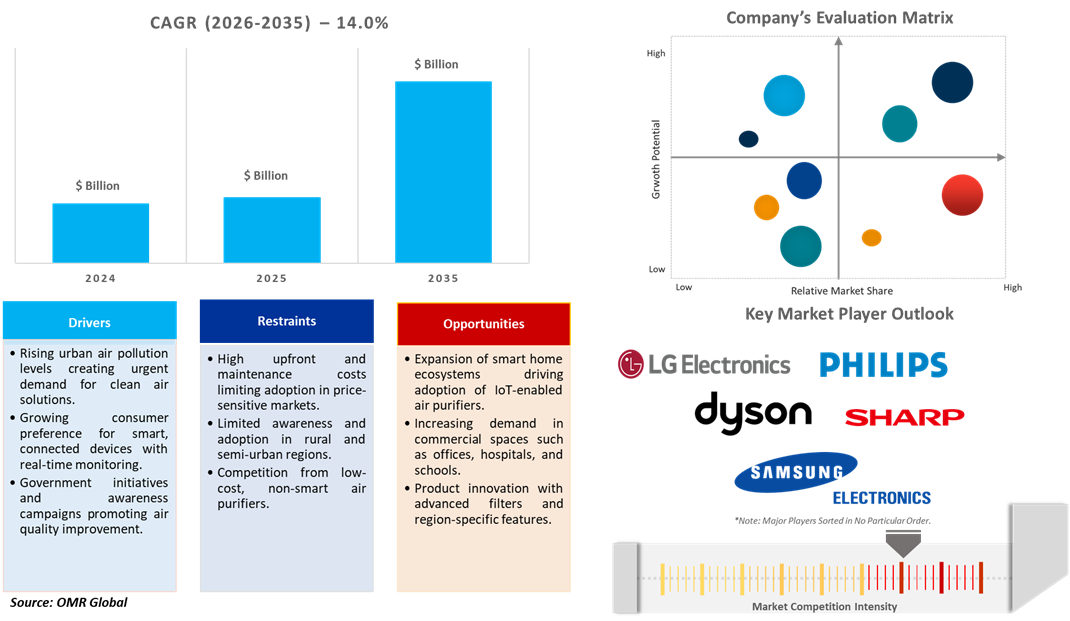
Asia-Pacific smart air purifier market was valued at $1,523.5 million in 2025 and is projected to reach $6,428.1 million by 2035, growing at a CAGR of 14.0% during the forecast period (2026–2035). The Asia-Pacific region is emerging as a key driver of growth in the smart air purifier market, largely due to rapid urbanization, industrialization, and increasing awareness of air quality issues. Countries such as India, China, Japan, and South Korea frequently face hazardous pollution levels, prompting both government involvement and consumer demand for clean air solutions. Government initiatives aimed at combating air pollution also play a pivotal role in market expansion. Additionally, growth in the Asia-Pacific smart air purifier market is further supported by rapid technological advancements. Features such as IoT integration, along with the rising popularity of smart home devices, are making these products more appealing and accessible to consumers.
Market Dynamics
Rising Demand for Sensor-Enabled and IoT-Integrated Purifiers
A key trend shaping the market is the growing demand for air purifiers with integrated sensors and Air Quality Indicators (AQI) that deliver real-time data. These tools go beyond simply filtering air; they monitor pollutants and provide users with clear insights that support healthier lifestyle choices. Rising health concerns are encouraging both households and businesses to invest in solutions that actively track indoor conditions rather than relying on basic filtration alone.
At the same time, there is strong uptake of devices offering Wi-Fi connectivity, mobile app control, and integration with smart home platforms, which give users the flexibility to manage their air quality remotely and automate operation. In response to this shift, leading companies in the region are increasingly embedding smart features and IoT connectivity into their product lines to meet evolving consumer expectations.
For instance, in September 2024, Havells India launched new air purifiers, Studio Meditate AP 400 and AP 250, with enhanced SpaceTech Air Purification tech. The Studio Meditate AP 400 and AP 250 air purifiers are equipped with IoT connectivity, offering features like real-time air quality monitoring, wireless charging, predictive analytics, and scheduling for smart home integration and convenience.
Rising Pollution Levels Fueling Demand for Smart Air Purifiers in Asia
Across Asia, worsening outdoor and indoor pollution has become a major driver of demand for smart air purifiers. Rapid urbanization and industrial growth in countries such as China, India, and Japan have led to critical air quality challenges.
According to the Air Quality Report 2024, Asia ranked as the top continent for the highest AQI levels globally as with 31 countries facing Moderate to Poor air quality levels annually. Besides, out of 2309 Cities, only 2.3% of cities met the WHO Annual PM2.5 guidelines of 5?g/m3. Major cities with the highest air quality levels are reported in South, Central, and East Asia.
With outdoor pollution worsening, households and businesses are increasingly prioritizing indoor air safety. This shift has accelerated demand for advanced smart air purifiers featuring HEPA filters, activated carbon layers, and real-time AQI monitoring, as consumers look for reliable ways to reduce exposure to harmful pollutants.
Market Segmentation
- Based on the type, the market is segmented into dust collectors, fume & smoke collectors, and others.
- Based on technology, the market is segmented into high-efficiency particulate air (HEPA), thermodynamic sterilization systems (TSS), and others.
- Based on the end-use, the market is segmented into residential and commercial.
Rising Adoption of Smart Air Purifiers in the Residential Segment
The residential segment of the smart air purifier market in Asia is witnessing strong growth, driven by rising consumer awareness and the need for advanced indoor air purification solutions. Households are increasingly looking for devices that go beyond basic filtration and address specific lifestyle needs, including challenges related to pets. Market players are capitalizing on this trend by introducing smart purifiers equipped with automatic sensors and specialized features, such as pet-focused functions that target allergens and dander.
For instance, in January 2025, South Korea-headquartered Coway launched the 'Noble Air Purifier 2', offering 30-pyeong cleaning performance in a 35% smaller size than the previous model. It features a top and bottom 4D cleaning system, pet functions, and customizable air care options.
Dominance of HEPA Technology in the Market
The High Efficiency Particulate Air (HEPA) technology segment is projected to lead the Asia-Pacific smart air purifier market due to its high filtration efficiency and increasing adoption rate. HEPA filters work by trapping harmful particles such as pollen, pet dander, dust mites, and tobacco smoke, and are widely used in residential air purifiers. These filters are effective in removing particulate matter and formaldehyde from the air, with filtration efficiencies reaching up to 99.97%.
Recognizing this demand, several leading players in the market are rolling out smart air purifiers sealed with HEPA filters. For instance, in April 2023, Acerpure Inc. introduced the Acerpure Pro Vero Air Purifier with smart features. The air purifier features a 3-in-1+ HEPA Filter that captures bacteria and 99.9% of PM2.5 particles. Its 4-layer protection system filters out harmful gases and allergens. Third-party tests confirm its effectiveness in removing formaldehyde and other harmful substances. It is launched in Taiwan and will later be expanded to other markets in the Pan Asia Pacific.
Regional Outlook
The Asia-Pacific smart air purifier market is further divided by countries, including India, China, Japan, and the Rest of Asia-Pacific.
China Dominates the Market with a Major Share
China is one of the most vital markets for the Asia-Pacific smart air purifier market, driven by persistently high pollution levels and strong government and consumer focus on health and wellness. In major cities like Beijing, Shanghai, and Guangzhou, air quality index (AQI) levels frequently exceed WHO safety guidelines, prompting homeowners to invest in air purifiers with multi-layer HEPA and activated carbon units. Additionally, government-led initiatives and policies aimed at improving air quality are accelerating the use of air purification technologies. In China, Governments are supporting clean air initiatives through public health campaigns, air quality regulations, and consumer incentives. For instance, in September 2024, China introduced a national trade-in program offering up to 2,000 yuan in subsidies on selected home appliances, including air purifiers.
Market Players Outlook
The major companies operating in the Asia-Pacific smart air purifier market include Dyson Group., Koninklijke Philips N.V., LG Electronics Inc., Samsung Electronics Co., Ltd., and Sharp Corp., among others. Market players are leveraging partnerships, collaborations, mergers and acquisitions strategies for business expansion and innovative product development to maintain their market positioning.
Recent Developments
- In October 2024, SHARP Business Systems (India) Pvt. Ltd launched PureFit series air purifiers in India to improve air quality in homes. The models include FX-S120, FP-S42M-L, and FP-S40M-T/W, featuring Plasmacluster tech to neutralize pollutants, Coanda Airflow for uniform air distribution, and advanced filters for effective purification.
- In July 2024, Xiaomi launched the MIJIA All-Effect Air Purifier Ultra Enhanced Edition in China. It boasts advanced features to eliminate various air pollutants effectively. The air purifier offers deep purification by removing 95 types of air pollutants through multiple specialized filter layers.
- In October 2024, Versuni, previously Philips Domestic Appliances, released a new line of air purifiers in India. The range consists of models like 3200, 4200 Pro, 900 Mini, and 900 Mini Wi-Fi. These purifiers combine power, efficiency, and modern design to cater to different user needs, ensuring a quiet and clean space.
- In October 2024, Secure Connection introduced new Honeywell air purifiers in India. The Air Touch V1 and V5 models feature advanced filters, user-friendly functions like filter change indicators and reset buttons. The Air Touch V5 air purifier comes with additional features like a real-time PM2.5 display, touch control panel, child lock, Wi-Fi, and Amazon Alexa integration.
- In 2023, Samsung introduced cutting-edge air purifier technology with the Samsung Smart Air Purifier 60m. It features a sleek design, a user-friendly interface, and a multi-layered purification system for clean air at home.
The Report Covers
- Market value data analysis of 2025 and forecast to 2035.
- Annualized market revenues ($ million) for each market segment.
- Country-wise analysis of major geographical regions.
- Key companies operating in the Asia-Pacific smart air purifier market.
- Based on the availability of data, information related to new products and relevant news is also available in the report.
- Analysis of business strategies by identifying the key market segments positioned for strong growth in the future.
- Analysis of market-entry and market expansion strategies.
- Competitive strategies by identifying ‘who-stands-where’ in the market.
- Report Summary
- Current Industry Analysis and Growth Potential Outlook
- Asia-Pacific Smart Air Purifier Market Sales Analysis – Type |Technology |End-Use ($ Million)
- Asia-Pacific Smart Air Purifier Market Sales Performance of Top Countries
- Research Methodology
- Primary Research Approach
- Secondary Research Approach
- Market Snapshot
- Market Overview and Insights
- Scope of the Study
- Analyst Insight & Current Market Trends
- Key Asia-Pacific Smart Air Purifier Industry Trends
- Market Recommendations
- Market Determinants
- Market Drivers
- Drivers For the Asia-Pacific Smart Air Purifier Market: Impact Analysis
- Market Pain Points and Challenges
- Restraints For the Asia-Pacific Smart Air Purifier Market: Impact Analysis
- Market Opportunities
- Opportunities For the Asia-Pacific Smart Air Purifier Market: Impact Analysis
- Market Drivers
- Competitive Landscape
- Competitive Dashboard – Asia-Pacific Smart Air Purifier Market Revenue and Share by Manufacturers
- Smart Air Purifier Product Comparison Analysis
- Top Market Player Ranking Matrix
- Key Company Analysis
- Dyson Group
- Overview
- Product Portfolio
- Financial Analysis (Subject to Data Availability)
- SWOT Analysis
- Business Strategy
- Koninklijke Philips N.V.
- Overview
- Product Portfolio
- Financial Analysis (Subject to Data Availability)
- SWOT Analysis
- Business Strategy
- LG Electronics Inc.
- Overview
- Product Portfolio
- Financial Analysis (Subject to Data Availability)
- SWOT Analysis
- Business Strategy
- Samsung Electronics Co., Ltd.
- Overview
- Product Portfolio
- Financial Analysis (Subject to Data Availability)
- SWOT Analysis
- Business Strategy
- Sharp Corporation
- Overview
- Product Portfolio
- Financial Analysis (Subject to Data Availability)
- SWOT Analysis
- Business Strategy
- Top Winning Strategies by Market Players
- Merger and Acquisition
- Product Launch
- Partnership And Collaboration
- Dyson Group
- Key Company Analysis
- Asia-Pacific Smart Air Purifier Market Sales Analysis by Type ($ Million)
- Dust Collectors
- Fume & Smoke Collectors
- Others
- Asia-Pacific Smart Air Purifier Market Sales Analysis by Technology ($ Million)
- High-efficiency Particulate Air (HEPA)
- Thermodynamic Sterilization System (TSS)
- Others
- Asia-Pacific Smart Air Purifier Market Sales Analysis by End-Use ($ Million)
- Conventional Stores (Offline)
- Online Retail
- Regional Analysis
- Asia-Pacific Smart Air Purifier Market Sales Analysis – Type |Technology |End-Use |Country ($ Million)
- Macroeconomic Factors for Asia-Pacific
- India
- China
- Japan
- South Korea
- Australia and New Zealand
- ASEAN Economies
- Rest of Asia-Pacific
- Company Profiles
- Acerpure
- Quick Facts
- Company Overview
- Product Portfolio
- Business Strategies
- AOSmith Corp.
- Quick Facts
- Company Overview
- Product Portfolio
- Business Strategies
- Blueair Inc.
- Quick Facts
- Company Overview
- Product Portfolio
- Business Strategies
- Blue Star Ltd.
- Quick Facts
- Company Overview
- Product Portfolio
- Business Strategies
- Carrier Global Corp.
- Quick Facts
- Company Overview
- Product Portfolio
- Business Strategies
- Coway Co., Ltd.
- Quick Facts
- Company Overview
- Product Portfolio
- Business Strategies
- Daikin Industries, Ltd.
- Quick Facts
- Company Overview
- Product Portfolio
- Business Strategies
- Daiohs Corp.
- Quick Facts
- Company Overview
- Product Portfolio
- Business Strategies
- Dyson Group
- Quick Facts
- Company Overview
- Product Portfolio
- Business Strategies
- Guangzhou Haike Electronics Technology Co., Ltd.
- Quick Facts
- Company Overview
- Product Portfolio
- Business Strategies
- Havells India Ltd.
- Quick Facts
- Company Overview
- Product Portfolio
- Business Strategies
- Hitachi, Ltd.
- Quick Facts
- Company Overview
- Product Portfolio
- Business Strategies
- Honeywell International Inc.
- Quick Facts
- Company Overview
- Product Portfolio
- Business Strategies
- IQAir AG
- Quick Facts
- Company Overview
- Product Portfolio
- Business Strategies
- Koninklijke Philips N.V.
- Quick Facts
- Company Overview
- Product Portfolio
- Business Strategies
- LG Electronics Inc.
- Quick Facts
- Company Overview
- Product Portfolio
- Business Strategies
- Olansi Healthcare Co.
- Quick Facts
- Company Overview
- Product Portfolio
- Business Strategies
- Panasonic Corp.
- Quick Facts
- Company Overview
- Product Portfolio
- Business Strategies
- Rabbit Air Japan Co., Ltd.
- Quick Facts
- Company Overview
- Product Portfolio
- Business Strategies
- Samsung Electronics Co., Ltd.
- Quick Facts
- Company Overview
- Product Portfolio
- Business Strategies
- Sharp Corporation
- Quick Facts
- Company Overview
- Product Portfolio
- Business Strategies
- Shenzhen HisoAir Co., Ltd.
- Quick Facts
- Company Overview
- Product Portfolio
- Business Strategies
- SK Magic Retails Malaysia Sdn Bhd
- Quick Facts
- Company Overview
- Product Portfolio
- Business Strategies
- Whirlpool of India Ltd.
- Quick Facts
- Company Overview
- Product Portfolio
- Business Strategies
- Xiaomi Technologies Singapore Pte. Ltd.
- Quick Facts
- Company Overview
- Product Portfolio
- Business Strategies
- Acerpure
1. Asia-Pacific Smart Air Purifier Market Research and Analysis by Type, 2025–2035 ($ Million)
2. Asia-Pacific Dust Collectors Smart Air Purifier Market Research and Analysis by Region, 2025–2035 ($ Million)
3. Asia-Pacific Fume & Smoke Collectors Smart Air Purifier Market Research and Analysis by Region, 2025–2035 ($ Million)
4. Asia-Pacific Others Type Smart Air Purifier Market Research and Analysis by Region, 2025–2035 ($ Million)
5. Asia-Pacific Smart Air Purifier Market Research and Analysis by Technology, 2025–2035 ($ Million)
6. Asia-Pacific High-efficiency Particulate Air (HEPA) Smart Air Purifier Market Research and Analysis by Region, 2025–2035 ($ Million)
7. Asia-Pacific Thermodynamic Sterilization System (TSS) Smart Air Purifier Market Research and Analysis by Region, 2025–2035 ($ Million)
8. Asia-Pacific Other Technology Smart Air Purifier Market Research and Analysis by Region, 2025–2035 ($ Million)
9. Asia-Pacific Smart Air Purifier Market Research and Analysis by End-Use, 2025–2035 ($ Million)
10. Asia-Pacific Residential Smart Air Purifier Market Research and Analysis by Region, 2025–2035 ($ Million)
11. Asia-Pacific Commercial Smart Air Purifier Market Research and Analysis by Region, 2025–2035 ($ Million)
12. Asia-Pacific Smart Air Purifier Market Research and Analysis by Region, 2025–2035 ($ Million)
13. Asia-Pacific Smart Air Purifier Market Research and Analysis by Country, 2025–2035 ($ Million)
14. Asia-Pacific Smart Air Purifier Market Research and Analysis by Type, 2025–2035 ($ Million)
15. Asia-Pacific Smart Air Purifier Market Research and Analysis by Technology, 2025–2035 ($ Million)
16. Asia-Pacific Smart Air Purifier Market Research and Analysis by End-Use, 2025–2035 ($ Million)
1. Asia-Pacific Smart Air Purifier Market Share by Type, 2025 Vs 2035 (%)
2. Asia-Pacific Dust Collectors Smart Air Purifier Market Share by Region, 2025 Vs 2035 (%)
3. Asia-Pacific Fume & Smoke Collectors Smart Air Purifier Market Share by Region, 2025 Vs 2035 (%)
4. Asia-Pacific Others Type Smart Air Purifier Market Share by Region, 2025 Vs 2035 (%)
5.
6. Asia-Pacific Smart Air Purifier Market Research and Analysis by Technology, 2025 Vs 2035 (%)
7. Asia-Pacific High-efficiency Particulate Air (HEPA) Smart Air Purifier Market Share by Region, 2025 Vs 2035 (%)
8. Asia-Pacific Thermodynamic Sterilization System (TSS) Smart Air Purifier Market Share by Region, 2025 Vs 2035 (%)
9. Asia-Pacific Other Technology Smart Air Purifier Market Share by Region, 2025 Vs 2035 (%)
10. Asia-Pacific Smart Air Purifier Market Share by End-Use, 2025 Vs 2035 (%)
11. Asia-Pacific Residential Smart Air Purifier Market Share by Region, 2025 Vs 2035 (%)
12. Asia-Pacific Commercial Smart Air Purifier Market Share by Region, 2025 Vs 2035 (%)
13. Asia-Pacific Smart Air Purifier Market Share by Region, 2025 Vs 2035 (%)
14. India Smart Air Purifier Market Size, 2025–2035 ($ Million)
15. China Smart Air Purifier Market Size, 2025–2035 ($ Million)
16. Japan Smart Air Purifier Market Size, 2025–2035 ($ Million)
17. South Korea Smart Air Purifier Market Size, 2025–2035 ($ Million)
18. Australia and New Zealand Smart Air Purifier Market Size, 2025–2035 ($ Million)
19. ASEAN Economies Smart Air Purifier Market Size, 2025–2035 ($ Million)
20. Rest of Asia-Pacific Smart Air Purifier Market Size, 2025–2035 ($ Million)
- Printable version
- No restriction to number of users within the company

