Canned Seafood Market


Canned Seafood Market Size, Share & Trends Analysis Report by Seafood Type (Tuna, Salmon, Sardines, Mackerel, Shrimp and Prawns, and Others), and By Distribution Channel (Food Service, and Retail), Forecast Period (2026-2035)
Industry Overview
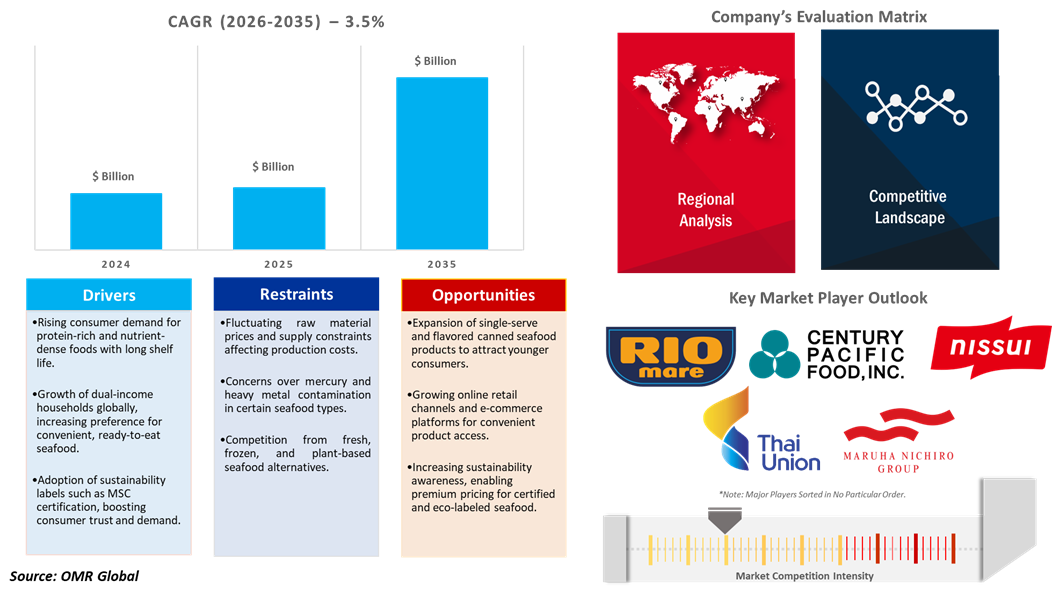
Global canned seafood market was valued at $37.2 billion in 2025 and is projected to reach $52.1 billion by 2035, growing at a CAGR of 3.5% during the forecast period (2026–2035). The global canned seafood market continues to grow as consumers look for convenient, shelf-stable sources of high-quality protein. Products like canned tuna, salmon, sardines, mackerel, shrimp, and prawns remain popular because they offer essential nutrients, including omega-3 fatty acids, while providing long storage life and easy meal preparation. The category has also expanded through wider retail availability and steady demand from food service operators that rely on consistent product quality and year-round supply.
A key driver for the market is rising health awareness. As more consumers prioritize nutrient-dense foods, canned seafood benefits from its established perception as a natural source of protein, minerals, and healthy fats. This has increased the value placed on canned fish products, fish sausages, and related offerings among health-focused buyers. The combination of nutritional appeal and long shelf-life continues to support steady demand across both developed and emerging regions.
Market Dynamics
Growing Appeal of Flavor-Forward, Single-Serve Seafood Formats Strengthens Category Demand
Flavored canned tuna is becoming a stronger growth segment as consumers look for convenient products that offer more variety without relying on pouches. While pouches have long dominated the single-serve segment, a large share of shoppers in the US still prefer cans for ease of use, spill-free eating, and simple pantry storage. This preference supports the shift toward compact seafood products that fit quick meals and snacking occasions without compromising flavor or nutrition. According to the Marine Stewardship Council, nearly 1 in 4 tuna consumers (23%) eat canned tuna at least once a week, with an estimated 1 million cans consumed across the country every day.
Producers are leaning into this demand by introducing seafood products that offer bold flavors, smaller serving sizes, and more versatile formats. For Instance, in August 2025, Bumble Bee Seafoods launched Bumble Bee Snackers, a new line of single-serve flavored tuna cans aimed at millennials. Available in six bold flavors: Tuna Salad, Chunk Light Tuna, Sweet Heat, Thai Chili, Lemon Pepper, and Hickory Smoke. They can be enjoyed straight from the can or added to salads, sandwiches, and wraps. Bumble Bee Snackers meet the demand for flavorful, protein-rich, easy, and affordable options with 3-ounce single-serve cans of wild-caught tuna, available in flavored and unflavored varieties.
MSC Certification Drives Global Demand and Sustainability in Canned Seafood
The adoption of Marine Stewardship Council (MSC) certification is increasingly shaping consumer preference and market growth in the global canned seafood sector. MSC-labeled products provide assurance that seafood comes from well-managed, sustainable fisheries, addressing concerns over overfishing, environmental impact, and ethical sourcing. This certification enhances brand credibility and encourages purchases among environmentally conscious consumers in both developed and emerging markets.
Globally, more than 200,000 metric tons of MSC-labeled canned tuna are sold. As sustainably caught tuna has become more widely available, businesses, particularly in Europe and North America, have expanded their MSC-certified product ranges, rewarding fisheries committed to certification. Germany remained the largest market for certified tuna, while Canada, the US, and Italy registered the highest growth within Europe and North America. Major retailers and brands such as Walmart, Bumble Bee, Clover Leaf, Ocean’s, Aldi Süd, Aldi Nord, and Bolton-owned Rio Mare have strengthened their sourcing from MSC-certified fisheries, driving further adoption.
Market Segmentation
- Based on the seafood type, the market is segmented into tuna, salmon, sardines, mackerel, shrimp and prawns, and others.
- Based on the distribution channel, the market is segmented into food service, and retail.
Tuna Dominates as the Leading Seafood Type in the Global Canned Market
Tuna continues to be the largest and most widely traded seafood type in the global canned seafood market, outperforming other segments such as salmon, sardines, mackerel, and shrimp. Its dominance is driven by a combination of factors, including high nutritional value, long shelf life, versatility in preparation, and broad consumer acceptance across multiple regions. According to FAO (Globefish) data, canned tuna accounted for 43% of all imports under the processed fish category (HS 1604) in 2023, highlighting its preeminence in international trade. This share is significantly higher than other canned seafood types, emphasizing tuna’s central role in global consumption patterns.
Retail Emerges as the Dominant Channel in the Canned Seafood Market
The retail channel is emerging as the leading distribution segment in the global canned seafood market, driven by the increasing share of dual-earner households worldwide. Consumers in these households often seek convenient, shelf-stable foods that require minimal preparation and can be used quickly at home.
This shift toward convenience has encouraged companies to expand ready-to-use canned seafood offerings, directly supporting retail growth. For Instance, in October 2024, Bumble Bee Seafoods launched 11 new canned, pouched, and kit-based seafood products for National Seafood Month. The range emphasizes convenience, flavor, and quality, catering to consumers seeking healthy, ready-to-eat seafood that can be purchased directly from retail outlets. By aligning with evolving household needs, retail remains the preferred channel for accessing canned seafood globally.
Regional Outlook
The global Canned Seafood market is further divided by region, including North America (the US and Canada), Europe (the UK, Germany, France, Italy, Spain, Russia, and the Rest of Europe), Asia-Pacific (India, China, Japan, South Korea, Australia and New Zealand, ASEAN Countries, and the Rest of Asia-Pacific), and the Rest of the World (the Middle East & Africa, and Latin America).
Strong North American Demand Reinforces Global Market Growth
North America continues to register steady demand for canned seafood, supported by high consumption frequency, convenience needs, and a preference for ready-to-eat protein. The region’s sustained intake plays a central role in shaping global trade patterns and supporting production scale among major exporters. This influence is evident in recent export activity. In 2023, the US remained the leading destination for Thailand’s canned tuna shipments, reaching $482 million and representing 23.1% of its total export value. The strength of US demand provides a stable market base for manufacturers and contributes to the broader expansion of the global canned seafood sector.
Market Players Outlook
The major companies operating in the global canned seafood market include Bolton Group S.r.l. (Rio Mare), Century Pacific Food Incorporated (CNPF), Maruha Nichiro Group, Nissui Corp., Thai Union Group Public Company Ltd., among others. Market players are leveraging partnerships, collaborations, mergers, and acquisition strategies for business expansion and innovative product development to maintain their market positioning.
Recent Developments
- In April 2024, Fishwife expanded nationally into select Whole Foods Market stores. The brand focuses on premium, thoughtfully sourced tinned seafood and will be sold exclusively at Whole Foods.
- In December 2023, Sustainable US tuna brand Tonnino introduced a new range of prepared yellowfin tuna tins featuring six flavors. They launched tuna cans specifically for children, combining tasty, protein-rich tuna with fresh diced vegetables. The kid-friendly meal cans come in two flavors: Yellowfin Tuna with sweet corn and Yellowfin Tuna with carrots and peas. The new items are available to purchase at select US retailers, including Wholefoods, Walmart, and Fairway.
- In June 2023, Bumble Bee Seafoods expanded its tuna product line with 12 new items now available nationally at major retailers. New offerings include Bumble Bee Prime Yellowfin in Extra Virgin Olive Oil with three flavors (Lemon & Pepper, Balsamic & Herb, Basil Pesto & Roasted Garlic), Snack on the Run! Tuna Salad & Crackers Kit in Ranch flavor, MSC-certified Chunk Light Tuna in oil and water across various pack sizes, pouched Wild-Caught Tuna in Teriyaki flavor and Light Tuna in water (3-pack), and low-sodium Solid White Albacore cans. Many products feature sustainable MSC-certified tuna and recyclable packaging.
- In July 2023, Wild Planet Foods launched five new sustainably caught seafood products at Whole Foods Market nationwide. These premium canned seafood items focus on delivering great taste while promoting health and environmental sustainability.
- In November 2023, Nauterra replaced Grupo Calvo as the global corporate identity, uniting all its brands under one name. Reflecting over 80 years of commitment to the sea and earth, Nauterra introduces a new visual identity and purpose focused on delivering healthy food while preserving nature. This rebranding aims to unify the company's image across nearly 70 countries.
- In September 2022, Ocean Brands launched its Ocean's line of sustainably caught, affordable tinned seafood in the US. The range includes eight varieties of Brisling sardines and Mackerel filets, all wild caught using sustainable methods and hand packed without artificial ingredients.
The Report Covers
- Market value data analysis of 2025 and forecast to 2035.
- Annualized market revenues ($ million) for each market segment.
- Country-wise analysis of major geographical regions.
- Key companies operating in the global Canned Seafood market. Based on the availability of data, information related to new products and relevant news is also available in the report.
- Analysis of business strategies by identifying the key market segments positioned for strong growth in the future.
- Analysis of market-entry and market expansion strategies.
- Competitive strategies by identifying ‘who-stands-where’ in the market.
- Report Summary
- Current Industry Analysis and Growth Potential Outlook
- Global Canned Seafood Market Sales Analysis – Seafood Type| Distribution Channel ($ Million)
- Canned Seafood Market Sales Performance of Top Countries
- Research Methodology
- Primary Research Approach
- Secondary Research Approach
- Market Snapshot
- Market Overview and Insights
- Scope of the Study
- Analyst Insight & Current Market Trends
- Key Canned Seafood Industry Trends
- Market Recommendations
- Market Determinants
- Market Drivers
- Drivers For Global Canned Seafood Market: Impact Analysis
- Market Pain Points and Challenges
- Restraints For Global Canned Seafood Market: Impact Analysis
- Market Opportunities
- Opportunities For Global Canned Seafood Market: Impact Analysis
- Market Drivers
- Competitive Landscape
- Competitive Dashboard – Canned Seafood Market Revenue and Share by Manufacturers
- Canned Seafood Product Comparison Analysis
- Top Market Player Ranking Matrix
- Key Company Analysis
- Bolton Group S.r.l. (Rio Mare)
- Overview
- Product Portfolio
- Financial Analysis
- SWOT Analysis
- Business Strategy
- Century Pacific Food Incorporated (CNPF)
- Overview
- Product Portfolio
- Financial Analysis
- SWOT Analysis
- Business Strategy
- Maruha Nichiro Group
- Overview
- Product Portfolio
- Financial Analysis
- SWOT Analysis
- Business Strategy
- Karavela SIA
- Overview
- Product Portfolio
- Financial Analysis
- SWOT Analysis
- Business Strategy
- Nissui Corp.
- Overview
- Product Portfolio
- Financial Analysis
- SWOT Analysis
- Business Strategy
- Thai Union Group Public Company Ltd.
- Overview
- Product Portfolio
- Financial Analysis
- SWOT Analysis
- Business Strategy
- Top Winning Strategies by Market Players
- Merger and Acquisition
- Product Launch
- Partnership And Collaboration
- Bolton Group S.r.l. (Rio Mare)
- Key Company Analysis
- Global Canned Seafood Market Sales Analysis by Seafood Type ($ Million)
- Tuna
- Salmon
- Sardines
- Mackerel
- Shrimp and Prawns
- Others
- Global Canned Seafood Market Sales Analysis by Distribution Channel ($ Million)
- Food Service
- Retail
- Regional Analysis
- North American Canned Seafood Market Sales Analysis – Seafood Type| Distribution Channel| Country ($ Million)
- Macroeconomic Factors for North America
- United States
- Canada
- European Canned Seafood Market Sales Analysis – Seafood Type| Distribution Channel| Country ($ Million)
- Macroeconomic Factors for Europe
- UK
- Germany
- Italy
- Spain
- France
- Russia
- Rest of Europe
- Asia-Pacific Canned Seafood Market Sales Analysis – Seafood Type| Distribution Channel| Country ($ Million)
- Macroeconomic Factors for Asia-Pacific
- China
- Japan
- South Korea
- India
- Australia & New Zealand
- ASEAN Countries (Thailand, Indonesia, Vietnam, Singapore, And Other)
- Rest of Asia-Pacific
- Rest of the World Canned Seafood Market Sales Analysis – Seafood Type| Distribution Channel| Country ($ Million)
- Macroeconomic Factors for Rest of the World
- Latin America
- Middle East and Africa
- Company Profiles
- Alimentos Prosalud de (Tonnino)
- Quick Facts
- Company Overview
- Product Portfolio
- Business Strategies
- Bolton Group S.r.l. (Rio Mare)
- Quick Facts
- Company Overview
- Product Portfolio
- Business Strategies
- Bumble Bee Foods, LLC
- Quick Facts
- Company Overview
- Product Portfolio
- Business Strategies
- Century Pacific Food Incorporated (CNPF)
- Quick Facts
- Company Overview
- Product Portfolio
- Business Strategies
- Clover Leaf Seafoods Corp. (Brunswick Seafood)
- Quick Facts
- Company Overview
- Product Portfolio
- Business Strategies
- CONSERVAS ORTIZ, S.A.
- Quick Facts
- Company Overview
- Product Portfolio
- Business Strategies
- Dongwon Industries
- Quick Facts
- Company Overview
- Product Portfolio
- Business Strategies
- Fishwife Tinned Seafood Co
- Quick Facts
- Company Overview
- Product Portfolio
- Business Strategies
- Frinsa Group
- Quick Facts
- Company Overview
- Product Portfolio
- Business Strategies
- GDC Alimentos SA
- Quick Facts
- Company Overview
- Product Portfolio
- Business Strategies
- Jealsa Foods, S.A.U.
- Quick Facts
- Company Overview
- Product Portfolio
- Business Strategies
- John West Foods Ltd.
- Quick Facts
- Company Overview
- Product Portfolio
- Business Strategies
- JOSE Gourmet
- Quick Facts
- Company Overview
- Product Portfolio
- Business Strategies
- King Oscar, Inc.
- Quick Facts
- Company Overview
- Product Portfolio
- Business Strategies
- La Tienda de las Conservas
- Quick Facts
- Company Overview
- Product Portfolio
- Business Strategies
- Maruha Nichiro Group
- Quick Facts
- Company Overview
- Product Portfolio
- Business Strategies
- Nauterra (Calvo/Gomes da Costa)
- Quick Facts
- Company Overview
- Product Portfolio
- Business Strategies
- Nissui Corp.
- Quick Facts
- Company Overview
- Product Portfolio
- Business Strategies
- Princes Group plc
- Quick Facts
- Company Overview
- Product Portfolio
- Business Strategies
- Season Brand LLC
- Quick Facts
- Company Overview
- Product Portfolio
- Business Strategies
- StarKist Co.
- Quick Facts
- Company Overview
- Product Portfolio
- Business Strategies
- Thai Union Group Public Company Ltd.
- Quick Facts
- Company Overview
- Product Portfolio
- Business Strategies
- Wild Planet Foods
- Quick Facts
- Company Overview
- Product Portfolio
- Business Strategies
- Alimentos Prosalud de (Tonnino)
1. Global Canned Seafood Market Research and Analysis by Seafood Type, 2025–2035 ($ Million)
2. Global Canned Tuna Market Research and Analysis by Region, 2025–2035 ($ Million)
3. Global Canned Salmon Market Research and Analysis by Region, 2025–2035 ($ Million)
4. Global Canned Sardines Market Research and Analysis by Region, 2025–2035 ($ Million)
5. Global Canned Mackerel Market Research and Analysis by Region, 2025–2035 ($ Million)
6. Global Canned Shrimp and Prawns Market Research and Analysis by Region, 2025–2035 ($ Million)
7. Global Others Canned Seafood Market Research and Analysis by Region, 2025–2035 ($ Million)
8. Global Canned Seafood Market Research and Analysis by Distribution Channel, 2025–2035 ($ Million)
9. Global Canned Seafood for Food Service Market Research and Analysis by Region, 2025–2035 ($ Million)
10. Global Canned Seafood for Retail Market Research and Analysis by Region, 2025–2035 ($ Million)
11. Global Canned Seafood Market Research and Analysis by Region, 2025–2035 ($ Million)
12. North American Canned Seafood Market Research and Analysis by Country, 2025–2035 ($ Million)
13. North American Canned Seafood Market Research and Analysis by Seafood Type, 2025–2035 ($ Million)
14. North American Canned Seafood Market Research and Analysis by Distribution Channel, 2025–2035 ($ Million)
15. European Canned Seafood Market Research and Analysis by Country, 2025–2035 ($ Million)
16. European Canned Seafood Market Research and Analysis by Seafood Type, 2025–2035 ($ Million)
17. European Canned Seafood Market Research and Analysis by Distribution Channel, 2025–2035 ($ Million)
18. Asia-Pacific Canned Seafood Market Research and Analysis by Country, 2025–2035 ($ Million)
19. Asia-Pacific Canned Seafood Market Research and Analysis by Seafood Type, 2025–2035 ($ Million)
20. Asia-Pacific Canned Seafood Market Research and Analysis by Distribution Channel, 2025–2035 ($ Million)
21. Rest of the World Canned Seafood Market Research and Analysis by Region, 2025–2035 ($ Million)
22. Rest of the World Canned Seafood Market Research and Analysis by Seafood Type, 2025–2035 ($ Million)
23. Rest of the World Canned Seafood Market Research and Analysis by Distribution Channel, 2025–2035 ($ Million)
1. Global Canned Seafood Market Share by Seafood Type, 2025 Vs 2035 (%)
2. Global Canned Tuna Market Share by Region, 2025 Vs 2035 (%)
3. Global Canned Salmon Market Share by Region, 2025 Vs 2035 (%)
4. Global Canned Sardines Market Share by Region, 2025 Vs 2035 (%)
5. Global Canned Mackerel Market Share by Region, 2025 Vs 2035 (%)
6. Global Canned Shrimp and Prawns Market Share by Region, 2025 Vs 2035 (%)
7. Global Others Canned Seafood Market Share by Region, 2025 Vs 2035 (%)
8. Global Canned Seafood Market Share by Distribution Channel, 2025 Vs 2035 (%)
9. Global Canned Seafood for Food Service Market Share by Region, 2025 Vs 2035 (%)
10. Global Canned Seafood for Retail Market Share by Region, 2025 Vs 2035 (%)
11. Global Canned Seafood Market Share by Region, 2025 Vs 2035 (%)
12. US Canned Seafood Market Size, 2025–2035 ($ Million)
13. Canada Canned Seafood Market Size, 2025–2035 ($ Million)
14. UK Canned Seafood Market Size, 2025–2035 ($ Million)
15. France Canned Seafood Market Size, 2025–2035 ($ Million)
16. Germany Canned Seafood Market Size, 2025–2035 ($ Million)
17. Italy Canned Seafood Market Size, 2025–2035 ($ Million)
18. Spain Canned Seafood Market Size, 2025–2035 ($ Million)
19. Russia Canned Seafood Market Size, 2025–2035 ($ Million)
20. Rest of Europe Canned Seafood Market Size, 2025–2035 ($ Million)
21. India Canned Seafood Market Size, 2025–2035 ($ Million)
22. China Canned Seafood Market Size, 2025–2035 ($ Million)
23. Japan Canned Seafood Market Size, 2025–2035 ($ Million)
24. South Korea Canned Seafood Market Size, 2025–2035 ($ Million)
25. Australia and New Zealand Canned Seafood Market Size, 2025–2035 ($ Million)
26. ASEAN Economies Canned Seafood Market Size, 2025–2035 ($ Million)
27. Rest of Asia-Pacific Canned Seafood Market Size, 2025–2035 ($ Million)
28. Latin America Canned Seafood Market Size, 2025–2035 ($ Million)
29. Middle East and Africa Canned Seafood Market Size, 2025–2035 ($ Million)
- Printable version
- No restriction to number of users within the company