Soy Protein Market: Growth, Size, Share, and Trends


Soy Protein Market Size, Share & Trends Analysis Report by Type (Concentrated Soy Protein, Isolated Soy Protein, Textured Soy Protein, and Soy Protein Flours), By Application (Meat Products, Dairy Alternatives, Bakery and Confectionery, Functional Foods and Sports Nutrition, Beverage, Animal Feed, Pharmaceuticals, and Others) By Form (Dry, and Liquid), By Distribution Channel (Online, And Offline), Forecast Period (2026-2035)
Industry Overview
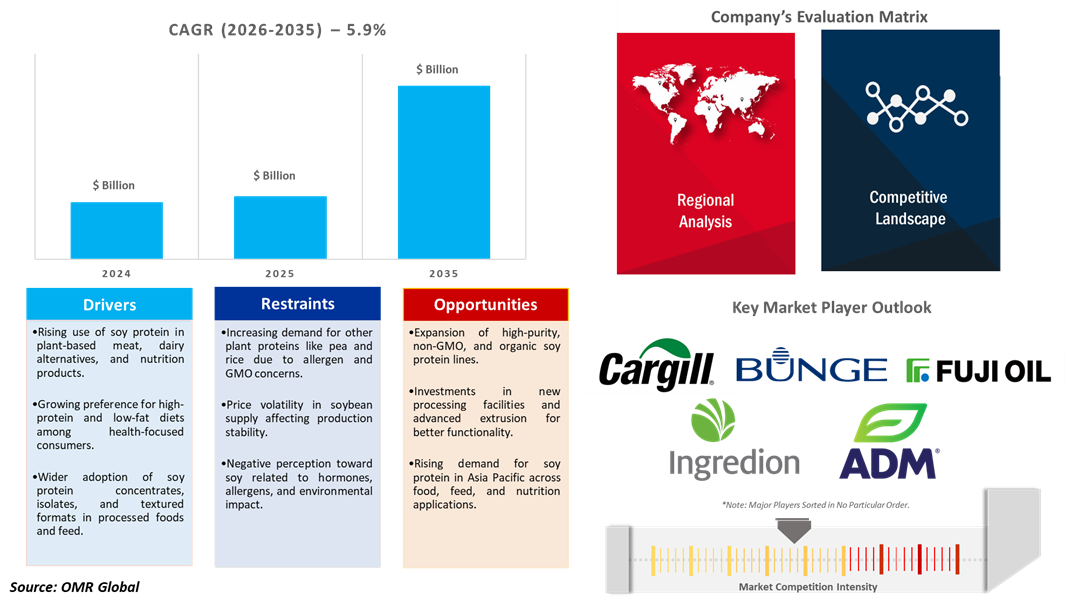
Soy protein market was valued at $10.8 billion in 2025 and is projected to reach $19.2 billion by 2035, growing at a CAGR of 5.9% during the forecast period (2026–2035). The global soy protein market continues to expand as manufacturers and consumers shift toward plant-based nutrition and functional ingredients that offer reliable performance in processed food applications. Soy protein isolates and concentrates remain the dominant ingredient categories due to their high protein levels and functional properties. These ingredients are now widely used in processed and ready-to-eat foods because they provide stability, texture, and nutritional value without significantly increasing formulation costs.
Growing interest in organic and minimally processed products is also shaping the market, particularly in applications such as functional foods, infant nutrition, bakery and confectionery, meat alternatives, and dairy alternatives. Broader awareness of health risks linked to poor dietary habits has further encouraged adoption. Beyond human nutrition, soy protein continues to gain traction in pet food and feed applications, where consistent quality and reliable supply are important purchasing factors.
Market Dynamics
Shift Toward Plant-Based Diets Strengthens Soy Protein Demand
More consumers are choosing plant-based protein, which is directly supporting the growth of the soy protein market. Consumers are rethinking animal-based proteins due to concerns about weight gain, food safety, and ethical issues, and are increasingly turning to plant-derived options that align with healthier lifestyles. Soy protein fits directly into this shift because it delivers essential nutrients with lower fat and calorie content, making it suitable for weight-management and wellness-oriented diets.
This trend is reflected in consumer views reported in ADM’s 2025 Alternative Protein Landscape Report. In the study, 83% of plant-focused consumers said soy protein is a good source of protein for building or maintaining muscle. About 81% felt it helps reduce fat intake, and 79% linked it to a healthy and active lifestyle. These views continue to support steady demand across categories such as sports nutrition, functional foods, dairy alternatives, and plant-based meat.
Growing Availability of Alternative Plant Proteins Limits Market Expansion
The soy protein market faces steady pressure from other plant-based proteins that are now widely used in food and beverage applications. Manufacturers often turn to pea, wheat, rice, canola, and pulse-based proteins when soy is not preferred or when they want to avoid concerns linked to soy. Many consumers carry negative perceptions about soy due to allergens, hormones, GMO use, or its environmental impact, which encourages brands to look for substitutes. Pea protein in particular has become a leading alternative because it offers a neutral taste, good functionality, and fewer allergen concerns. Wheat and rice proteins also serve as regular replacements in several processed food categories.
Market Segmentation
- Based on the type, the market is segmented into concentrated soy protein, isolated soy protein, textured soy protein, and soy protein flours.
- Based on the application, the market is segmented into meat products, dairy alternatives, bakery and confectionery, functional foods and sports nutrition, beverages, animal feed, pharmaceuticals, and others.
- Based on the form, the market is segmented into dry, and liquid.
- Based on the distribution channel, the market is segmented into online, and offline.
Textured Soy Protein Gains Strong Leadership in the Market
Textured soy protein is expected to remain the leading type in the market because it plays a central role in the development of meat analogues and value-added processed meat. Its ability to deliver a realistic meat-like texture keeps it ahead of other protein types, especially as demand for plant-based meat continues to rise in both retail and foodservice. Improvements in extrusion systems have also helped reduce off-flavors and create stronger fibrous structures, which makes it easier for manufacturers to increase usage levels in meat analogues and hybrid meat products.
A recent development supports this trend. In November 2024, ICL Food Specialties and DAIZ Engineering launched ROVITARIS SprouTx, a new soy protein using proprietary germination technology. This innovative textured soy protein aims to improve taste, texture, and nutrition in plant-based meat and seafood products. ROVITARIS SprouTx offers an innovative soy protein without the typical ‘beany’ or bitter taste, enhancing plant-based meat and seafood products.
Regional Outlook
The global soy protein market is further divided by region, including North America (the US and Canada), Europe (the UK, Germany, France, Italy, Spain, Russia, and the Rest of Europe), Asia-Pacific (India, China, Japan, South Korea, Australia and New Zealand, ASEAN Countries, and the Rest of Asia-Pacific), and the Rest of the World (the Middle East & Africa, and Latin America).
North America Leads the Global Soy Protein Market Growth
North America maintains a leading position in the soy protein market as manufacturers continue to adopt higher protein ingredients and upgrade processing capacity. The United States and Canada show consistent demand for soy protein concentrates, isolates, and functional flours across food, beverage, and nutrition applications. A recent development that supports this trend is ADM’s decision to process Benson Hill’s ultra-high protein soybeans and launch related products in early 2023. ADM obtained exclusive North American rights to produce and sell these high-protein soy ingredients. The soybeans provide higher protein levels and require fewer processing steps, which reduces their carbon footprint. ADM is using them to make soy protein concentrates, isolates, and high-protein flours. This agreement builds on ADM’s earlier steps in the region, including its acquisition of Sojaprotein and a $300 million investment to expand soy protein concentrate capacity in Decatur, Illinois.
Market Players Outlook
The major companies operating in the global soy protein market include Archer Daniels Midland Company (ADM), Bunge Global SA, Cargill, Inc., Fuji Oil Holdings Inc., Ingredion Inc., among others. Market players are leveraging partnerships, collaborations, mergers, and acquisition strategies for business expansion and innovative product development to maintain their market positioning.
Recent Developments
- In May 2025, Bunge launched a new line of soy protein concentrates aimed at solving common plant-based protein challenges. Produced at their nearly completed $550 million Morristown, Indiana, facility—the largest food-grade plant protein site globally—these concentrates offer a clean taste, neutral color, and cost-effective solution. They contain about 70% protein and 17% fiber (dry basis), available in non-GMO and conventional options, and come in powdered and textured forms for use in snacks, baked goods, meat alternatives, and beverages.
- In April 2025, ADM launched Arcon Specialty Food Protein (SFP), a soy protein from Brazil designed to partially replace eggs in pasta, cakes, panettones, and mayonnaise. This product can reduce costs by up to 45% without affecting food quality. Tests showed savings of 30% in pasta and cakes, and 45% in panettones.
The Report Covers
- Market value data analysis of 2025 and forecast to 2035.
- Annualized market revenues ($ million) for each market segment.
- Country-wise analysis of major geographical regions.
- Key companies operating in the global soy protein market. Based on the availability of data, information related to new products and relevant news is also available in the report.
- Analysis of business strategies by identifying the key market segments positioned for strong growth in the future.
- Analysis of market-entry and market expansion strategies.
- Competitive strategies by identifying ‘who-stands-where’ in the market.
- Report Summary
- Current Industry Analysis and Growth Potential Outlook
- Global Soy Protein Market Sales Analysis – Type| Application| Form| Distribution Channel ($ Million)
- Soy Protein Market Sales Performance of Top Countries
- Research Methodology
- Primary Research Approach
- Secondary Research Approach
- Market Snapshot
- Market Overview and Insights
- Scope of the Study
- Analyst Insight & Current Market Trends
- Key Soy Protein Industry Trends
- Market Recommendations
- Porter's Five Forces Analysis for the Soy Protein Market
- Competitive Rivalry
- Threat of New Entrants
- Bargaining Power of Suppliers
- Bargaining Power of Buyers
- Threat of Substitutes
- Market Determinants
- Market Drivers
- Drivers For the Global Soy Protein Market: Impact Analysis
- Market Pain Points and Challenges
- Restraints For the Global Soy Protein Market: Impact Analysis
- Market Opportunities
- Opportunities For the Global Soy Protein Market: Impact Analysis
- Market Drivers
- Competitive Landscape
- Competitive Dashboard – Soy Protein Market Revenue and Share by Manufacturers
- Soy Protein Product Comparison Analysis
- Top Market Player Ranking Matrix
- Key Company Analysis
- Archer Daniels Midland Company (ADM)
- Overview
- Product Portfolio
- Financial Analysis
- SWOT Analysis
- Business Strategy
- Bunge Global SA
- Overview
- Product Portfolio
- Financial Analysis
- SWOT Analysis
- Business Strategy
- Cargill, Inc.
- Overview
- Product Portfolio
- Financial Analysis
- SWOT Analysis
- Business Strategy
- Fuji Oil Holdings Inc.
- Overview
- Product Portfolio
- Financial Analysis
- SWOT Analysis
- Business Strategy
- Ingredion Inc.
- Overview
- Product Portfolio
- Financial Analysis
- SWOT Analysis
- Business Strategy
- Top Winning Strategies by Market Players
- Merger and Acquisition
- Product Launch
- Partnership And Collaboration
- Archer Daniels Midland Company (ADM)
- Key Company Analysis
- Global Soy Protein Market Sales Analysis by Type ($ Million)
- Concentrated Soy Protein
- Isolated Soy Protein
- Textured Soy Protein
- Soy Protein Flours
- Global Soy Protein Market Sales Analysis by Application ($ Million)
- Meat Products
- Dairy Alternatives
- Bakery and Confectionery
- Functional Foods and Sports Nutrition
- Beverage
- Animal Feed
- Pharmaceuticals
- Others
- Global Soy Protein Market Sales Analysis by Form ($ Million)
- Dry
- Liquid
- Global Soy Protein Market Sales Analysis by Distribution Channel ($ Million)
- Online
- Offline
- Regional Analysis
- North American Soy Protein Market Sales Analysis – Type| Application| Form| Distribution Channel| Country ($ Million)
- Macroeconomic Factors for North America
- United States
- Canada
- European Soy Protein Market Sales Analysis – Type| Application| Form| Distribution Channel| Country ($ Million)
- Macroeconomic Factors for Europe
- UK
- Germany
- Italy
- Spain
- France
- Russia
- Rest of Europe
- Asia-Pacific Soy Protein Market Sales Analysis – Type| Application| Form| Distribution Channel| Country ($ Million)
- Macroeconomic Factors for Asia-Pacific
- China
- Japan
- South Korea
- India
- Australia & New Zealand
- ASEAN Countries (Thailand, Indonesia, Vietnam, Singapore, and Other)
- Rest of Asia-Pacific
- Rest of the World Soy Protein Market Sales Analysis – Type| Application| Form| Distribution Channel| Country ($ Million)
- Macroeconomic Factors for the Rest of the World
- Latin America
- Middle East and Africa
- Company Profiles
- Archer Daniels Midland Company (ADM)
- Quick Facts
- Company Overview
- Product Portfolio
- Business Strategies
- Bunge Global SA
- Quick Facts
- Company Overview
- Product Portfolio
- Business Strategies
- Cargill, Inc.
- Quick Facts
- Company Overview
- Product Portfolio
- Business Strategies
- Crown Soya Protein Group
- Quick Facts
- Company Overview
- Product Portfolio
- Business Strategies
- Devansoy Inc.
- Quick Facts
- Company Overview
- Product Portfolio
- Business Strategies
- Farbest-Tallman Foods Corp.
- Quick Facts
- Company Overview
- Product Portfolio
- Business Strategies
- Foodchem International Corp.
- Quick Facts
- Company Overview
- Product Portfolio
- Business Strategies
- Fuji Oil Holdings Inc.
- Quick Facts
- Company Overview
- Product Portfolio
- Business Strategies
- Ingredion Inc.
- Quick Facts
- Company Overview
- Product Portfolio
- Business Strategies
- International Flavors & Fragrances Inc.
- Quick Facts
- Company Overview
- Product Portfolio
- Business Strategies
- Kerry Group plc
- Quick Facts
- Company Overview
- Product Portfolio
- Business Strategies
- Linyi Shansong Biological Products Co., Ltd.
- Quick Facts
- Company Overview
- Product Portfolio
- Business Strategies
- PURIS
- Quick Facts
- Company Overview
- Product Portfolio
- Business Strategies
- Scoular Company
- Quick Facts
- Company Overview
- Product Portfolio
- Business Strategies
- Shandong Wonderful Biotech Co., Ltd.
- Quick Facts
- Company Overview
- Product Portfolio
- Business Strategies
- Shandong Yuwang Ecological Food Industry Co., Ltd.
- Quick Facts
- Company Overview
- Product Portfolio
- Business Strategies
- Shandong Yuxin Bio-Tech Co, Ltd.
- Quick Facts
- Company Overview
- Product Portfolio
- Business Strategies
- Solbar Ningbo Protein Technology Co., Ltd.
- Quick Facts
- Company Overview
- Product Portfolio
- Business Strategies
- SunOpta, Inc.
- Quick Facts
- Company Overview
- Product Portfolio
- Business Strategies
- Wilmar Group
- Quick Facts
- Company Overview
- Product Portfolio
- Business Strategies
- Archer Daniels Midland Company (ADM)
1. Global Soy Protein Market Research and Analysis by Type, 2025–2035 ($ Million)
2. Global Concentrated Soy Protein Market Research and Analysis by Region, 2025–2035 ($ Million)
3. Global Concentrated Soy Protein Market Research and Analysis by Region, 2025–2035 ($ Million)
4. Global Isolated Soy Protein Market Research and Analysis by Region, 2025–2035 ($ Million)
5. Global Textured Soy Protein Market Research and Analysis by Region, 2025–2035 ($ Million)
6. Global Soy Protein Flours Market Research and Analysis by Region, 2025–2035 ($ Million)
7. Global Soy Protein Market Research and Analysis by Application, 2025–2035 ($ Million)
8. Global Soy Protein for Meat Products Market Research and Analysis by Region, 2025–2035 ($ Million)
9. Global Soy Protein for Dairy Alternatives Market Research and Analysis by Region, 2025–2035 ($ Million)
10. Global Soy Protein for Bakery and Confectionery Market Research and Analysis by Region, 2025–2035 ($ Million)
11. Global Soy Protein for Functional Foods and Sports Nutrition Market Research and Analysis by Region, 2025–2035 ($ Million)
12. Global Soy Protein for Beverage Market Research and Analysis by Region, 2025–2035 ($ Million)
13. Global Soy Protein for Animal Feed Market Research and Analysis by Region, 2025–2035 ($ Million)
14. Global Soy Protein for Pharmaceuticals Market Research and Analysis by Region, 2025–2035 ($ Million)
15. Global Soy Protein for Other Applications Market Research and Analysis by Region, 2025–2035 ($ Million)
16. Global Soy Protein Market Research and Analysis by Form, 2025–2035 ($ Million)
17. Global Dry Soy Protein Market Research and Analysis by Region, 2025–2035 ($ Million)
18. Global Liquid Soy Protein Market Research and Analysis by Region, 2025–2035 ($ Million)
19. Global Soy Protein Market Research and Analysis by Distribution Channel, 2025–2035 ($ Million)
20. Global Soy Protein by Online Distribution Market Research and Analysis by Region, 2025–2035 ($ Million)
21. Global Soy Protein by Offline Distribution Market Research and Analysis by Region, 2025–2035 ($ Million)
22. Global Soy Protein Market Research and Analysis by Region, 2025–2035 ($ Million)
23. North American Soy Protein Market Research and Analysis by Country, 2025–2035 ($ Million)
24. North American Soy Protein Market Research and Analysis by Type, 2025–2035 ($ Million)
25. North American Soy Protein Market Research and Analysis by Application, 2025–2035 ($ Million)
26. North American Soy Protein Market Research and Analysis by Form, 2025–2035 ($ Million)
27. North American Soy Protein Market Research and Analysis by Distribution Channel, 2025–2035 ($ Million)
28. European Soy Protein Market Research and Analysis by Country, 2025–2035 ($ Million)
29. European Soy Protein Market Research and Analysis by Type, 2025–2035 ($ Million)
30. European Soy Protein Market Research and Analysis by Application, 2025–2035 ($ Million)
31. European Soy Protein Market Research and Analysis by Form, 2025–2035 ($ Million)
32. European Soy Protein Market Research and Analysis by Distribution Channel, 2025–2035 ($ Million)
33. Asia-Pacific Soy Protein Market Research and Analysis by Country, 2025–2035 ($ Million)
34. Asia-Pacific Soy Protein Market Research and Analysis by Type, 2025–2035 ($ Million)
35. Asia-Pacific Soy Protein Market Research and Analysis by Application, 2025–2035 ($ Million)
36. Asia-Pacific Soy Protein Market Research and Analysis by Form, 2025–2035 ($ Million)
37. Asia-Pacific Soy Protein Market Research and Analysis by Distribution Channel, 2025–2035 ($ Million)
38. Rest of the World Soy Protein Market Research and Analysis by Region, 2025–2035 ($ Million)
39. Rest of the World Soy Protein Market Research and Analysis by Type, 2025–2035 ($ Million)
40. Rest of the World Soy Protein Market Research and Analysis by Application, 2025–2035 ($ Million)
41. Rest of the World Soy Protein Market Research and Analysis by Form, 2025–2035 ($ Million)
42. Rest of the World Soy Protein Market Research and Analysis by Distribution Channel, 2025–2035 ($ Million)
1. Global Soy Protein Market Share by Type, 2025 Vs 2035 (%)
2. Global Concentrated Soy Protein Market Share by Region, 2025 vs 2035 (%)
3. Global Isolated Soy Protein Market Share by Region, 2025 vs 2035 (%)
4. Global Textured Soy Protein Market Share by Region, 2025 vs 2035 (%)
5. Global Soy Protein Flours Market Share by Region, 2025 vs 2035 (%)
6. Global Soy Protein Market Share by Application, 2025 Vs 2035 (%)
7. Global Soy Protein for Meat Products Market Share by Region, 2025 vs 2035 (%)
8. Global Soy Protein for Dairy Alternatives Market Share by Region, 2025 vs 2035 (%)
9. Global Soy Protein for Bakery and Confectionery Market Share by Region, 2025 vs 2035 (%)
10. Global Soy Protein for Functional Foods and Sports Nutrition Market Share by Region, 2025 vs 2035 (%)
11. Global Soy Protein for Beverage Market Share by Region, 2025 vs 2035 (%)
12. Global Soy Protein for Animal Feed Market Share by Region, 2025 vs 2035 (%)
13. Global Soy Protein for Pharmaceuticals Market Share by Region, 2025 vs 2035 (%)
14. Global Soy Protein for Other Applications Market Share by Region, 2025 vs 2035 (%)
15. Global Soy Protein Market Share by Form, 2025 Vs 2035 (%)
16. Global Dry Soy Protein Market Share by Region, 2025 vs 2035 (%)
17. Global Liquid Soy Protein Market Share by Region, 2025 vs 2035 (%)
18. Global Soy Protein Market Share by Distribution Channel, 2025 Vs 2035 (%)
19. Global Soy Protein by Online Distribution Market Share by Region, 2025 vs 2035 (%)
20. Global Soy Protein by Offline Distribution Market Share by Region, 2025 vs 2035 (%)
21. Global Soy Protein Market Share by Region, 2025 Vs 2035 (%)
22. US Soy Protein Market Size, 2025–2035 ($ Million)
23. Canada Soy Protein Market Size, 2025–2035 ($ Million)
24. UK Soy Protein Market Size, 2025–2035 ($ Million)
25. France Soy Protein Market Size, 2025–2035 ($ Million)
26. Germany Soy Protein Market Size, 2025–2035 ($ Million)
27. Italy Soy Protein Market Size, 2025–2035 ($ Million)
28. Spain Soy Protein Market Size, 2025–2035 ($ Million)
29. Russia Soy Protein Market Size, 2025–2035 ($ Million)
30. Rest of Europe Soy Protein Market Size, 2025–2035 ($ Million)
31. India Soy Protein Market Size, 2025–2035 ($ Million)
32. China Soy Protein Market Size, 2025–2035 ($ Million)
33. Japan Soy Protein Market Size, 2025–2035 ($ Million)
34. South Korea Soy Protein Market Size, 2025–2035 ($ Million)
35. Australia and New Zealand Soy Protein Market Size, 2025–2035 ($ Million)
36. ASEAN Economies Soy Protein Market Size, 2025–2035 ($ Million)
37. Rest of Asia-Pacific Soy Protein Market Size, 2025–2035 ($ Million)
38. Latin America Soy Protein Market Size, 2025–2035 ($ Million)
39. Middle East and Africa Soy Protein Market Size, 2025–2035 ($ Million)
- Printable version
- No restriction to number of users within the company