European Textile Market


European Textile Market Size, Share & Trends Analysis Report by Material (Cotton, Jute, Silk, Synthetic, Wool, and Others (Linen)), and by Application (Fashion and Clothing, Industrial/Technical, and Defense and Household), Forecast Period (2025-2035)
Industry Overview
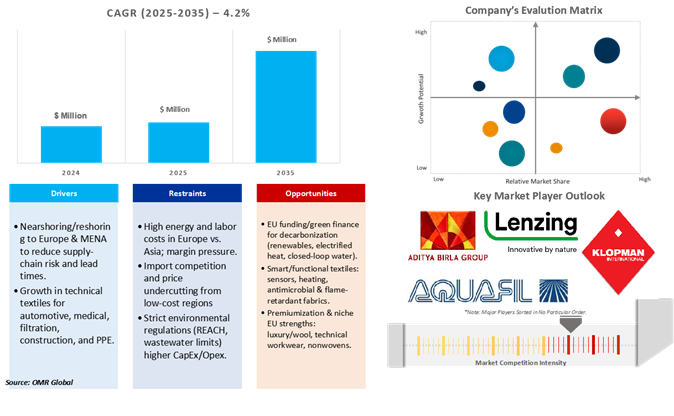
European textile market was valued at $260 billion in 2024 and is projected to reach $403.2 billion by 2035, growing at a CAGR of 4.2% during the forecast period (2025–2035). The European textiles market is fueled by the increasing focus on sustainability, the circular economy, and technological advances in recycling technologies. Increased environmental regulations, consumer pressure on environmentally friendly materials, and the carbon emission reduction ambitions of the industry are driving the implementation of textile-to-textile recycling technologies, especially for polyester and other synthetic materials. For instance, in October 2024, Reju opened Regeneration Hub Zero in Frankfurt, Germany—its inaugural textile-to-textile recycling plant. Fueled by IBM-created technology and backed by Technip Energies, the facility has expertise in recycling polyester with a 50% lower carbon footprint. The effort looks to support a circular textile economy, upcycling the world's textile waste into sustainable, forever-renewable polyester.
Market Dynamics
Adoption of Sustainable Textile Production
European textile manufacturers are increasingly making environmentally friendly practices a top priority by incorporating renewable energy inputs, sustainable raw material sourcing, and closed-loop recycling into their business practices. Through investments in clean energy infrastructure and long-term green power contracts, these producers are not only minimizing their carbon footprint but also optimizing energy independence and protection from market uncertainty. These align with wider industry objectives to reduce emissions, enable circular economy practices, and achieve ambitious environmental standards, enhancing competitiveness in a marketplace where sustainability is increasingly becoming an essential differentiator. For instance, in September 2022, the Lenzing Group entered into a joint venture with green power producers Enery and Energie Steiermark to develop a 5.5 MWpeak solar power plant in Styria, Austria, which is due to start supplying Lenzing's fiber and pulp plant with renewable electricity in late 2023 under a 20-year deal. The project, which can supply more than 1,700 homes per year with electricity, aligns with Lenzing's 50% reduction of carbon emissions by 2030 and climate neutrality in 2050 targets, reducing dependence on fluctuating global energy markets and furthering its transition towards a circular economy.
Technological Innovations in High-Performance Textiles
The European textile industry is advancing through the development of cutting-edge materials, the integration of digital technologies in design and manufacturing, and the adoption of sustainable production methods. Innovations range from ultra-lightweight, abrasion-resistant fabrics for automotive and aerospace applications to smart textiles embedded with sensors for healthcare monitoring and sports performance tracking. The sector is also embracing circular economy principles, using recycled fibers, bio-based polymers, and low-impact dyeing processes to reduce environmental impact. For instance, in March 2025, the European Commission launched the Textiles of the Future partnership under Horizon Europe’s 2025–2027 Strategic Plan, co-managed by Textile ETP. Focused on the green and digital transition, it will fund collaborative projects involving SMEs, industry, research organisations, and universities to advance high-TRL innovations for rapid industrial deployment. Backed by at least €60 million from public and private stakeholders supplemented by additional EU, national, and regional investments, the programme will support demonstration, pilot testing, new manufacturing facilities, market replication, and start-up creation in the European textile sector.
Market Segmentation
- Based on the Material, the market is segmented into cotton, jute, silk, synthetic, wool, and others (linen).
- Based on the application, the market is segmented into fashion and clothing, industrial/technical, and household.
Cotton Segment to Dominate the Market with Strong Consumer Demand
The cotton segment is anticipated to dominate the textile industry, spearheaded by its global consumer demand for comfort, breathability, and versatility. Demand is further driven by breakthroughs in environmentally friendly cotton manufacturing and recycling technology, with increased environmental awareness. Brands ramp up and incorporate recycled and responsibly sourced cotton into products and appeal to environmentally conscious consumers while curbing virgin material dependency. Moreover, new improvements in the sorting, processing, and blending techniques are upgrading recycled cotton's performance and quality, and it is a good alternative to fashion and industrial applications. It supports the circular economy and builds resilience of the market against supply variations of raw materials. For instance, in March 2024, The New Cotton Project (2020–2024), funded by the EU, managed to show a full circular textile value chain through the transformation of end-of-life garments into new Infinna fibres, which were then produced into goods by adidas and H&M. The project has picked out eight enablers most important for scaling fibre-to-fibre recycling: embracing circular value chains via cross-sector collaboration, designing for recallability, upscaling sorting and recycling infrastructure, enhancing textile flow data, ongoing R&D along the supply chain, seeing beyond low-impact fibres, involving consumers, and establishing unified legislation. While Infinna has potential to lower environmental effect versus traditional fibres, the results emphasize the need for systemic transformation—encompassing design, manufacturing, consumption, and policy to make circular clothing scalable and genuinely sustainable.
Fashion and Clothing: The Leading Application Segment
Fashion and clothing continue to be the largest application segment of Europe's textile market, fueled by changing consumer demand for improved quality material, varied style, and environmentally friendly fabric options. The segment is influenced by the interplay between fast-fashion and the increasing slow-fashion movement, offering opportunities for both mass-market and luxury brands. Growing focus on circularity, durability, and ethical sourcing is shaping design, production, and retailing strategies, and mounting regulatory pressures and changing consumer values are driving the industry towards more sustainable behavior. For instance, in May 2025, the EU is stepping up pressure on fashion companies to reduce clothing waste by legislation, such as extended producer responsibility schemes that will finance collection, recycling, and repair. Although some brands — Pangaia, Decathlon, and Mud Jeans — are testing circular business models such as take-back, leasing, and repair systems, change is gradual as a result of the low price of virgin synthetic fibers and deep-seated fast-fashion culture. Activists caution against greenwashing and emphasize system change, transparency, and overproduction cutbacks to address climate targets.
Germany Dominates the Market with a Major Share
Germany holds a leading position in the European textile market, backed by its advanced manufacturing capacity, robust fashion sector, and sustainable production focus. The nation's emphasis on high-quality textiles, technical textiles, and design innovation has immensely improved both local consumption and exports. For instance, in February 2022, the German fashion luxury brand HUGO BOSS collaborated with HeiQ, investing $5 million in its HeiQ AeoniQ technology, a closed-loop, sustainable cellulosic yarn produced from renewable bio-based cellulose. Comparable in strength and elasticity to polyester and nylon but with a much lower environmental impact, this technology reduces microplastic pollution, saves arable land, and sequesters atmospheric carbon, aligning with HUGO BOSS's objectives to reduce environmental footprint and make fashion more sustainable.
Market Players Outlook
The major companies operating in the European textile market include Aditya Birla Group, Aquafil S.p.A., Lenzing AG, Marzotto Group, and Prada, among others. Market players are leveraging partnerships, collaborations, mergers, and acquisition strategies for business expansion and innovative product development to maintain their market positioning.
Recent Developments
- In January 2024, BASF and Inditex introduced Loopamid, the first circular nylon 6 made entirely from textile waste, marking a major step in textile-to-textile recycling. The innovation allows discarded nylon 6 garments to be transformed into virgin-quality fibers and materials that can be recycled repeatedly without losing performance. Zara has launched a jacket made entirely from Loopamid, with every component — from fabric to zippers — derived from this material. The project involved a wide network of partners, including ModaRe for textile collection, RadiciGroup for yarn production, and companies like YKK and Velcro for garment components.
- In July 2024, Lenzing launched its Black Towel Collection, featuring six reusable personal care items from makeup removal pads to beach towels made with TENCEL Modal and LENZING ECOVERO Viscose black fibers. Designed for long-lasting softness and durability, the towels retain their gentle feel and rich color even after repeated washes, thanks to a spin-dyeing process that embeds pigments directly into the fibers. Made from certified wood sources with lower environmental impact, the collection offers a sustainable alternative to disposable and easily discolored cotton towels.
- In June 2024, Lenzing partnered with Exponent Envirotech and knitwear manufacturer Cobalt Fashion to introduce ECOHUES, a waterless dyeing technology for wood-based cellulosic fibers. Using a recyclable non-aqueous solvent that is 99.8% reusable, ECOHUES cuts water usage by 95% and dye consumption by 40% compared to conventional dyeing, while eliminating salt and reducing processing time by nearly half. Combined with Lenzing’s low-impact fibers, ECOHUES offers a scalable, resource-efficient alternative for fashion production, starting with a sustainable knitwear collection from Cobalt Fashion.
The Report Covers
- Market value data analysis of 2024 and forecast to 2035.
- Annualized market revenues ($ million) for each market segment.
- Country-wise analysis of major geographical regions.
- Key companies operating in the European textile market. Based on the availability of data, information related to new products and relevant news is also available in the report.
- Analysis of business strategies by identifying the key market segments positioned for strong growth in the future.
- Analysis of market-entry and market expansion strategies.
- Competitive strategies by identifying ‘who-stands-where’ in the market.
1. Report Summary
• Current Industry Analysis and Growth Potential Outlook
• European Textile Market Sales Analysis – Material | Application ($ Million)
• European Textile Market Sales Performance of Top Countries
1.1. Research Methodology
• Primary Research Approach
• Secondary Research Approach
1.2. Market Snapshot
2. Market Overview and Insights
2.1. Scope of the Study
2.2. Analyst Insight & Current Market Trends
2.2.1. Key European Textile Industry Trends
2.2.2. Market Recommendations
3. Market Determinants
3.1. Market Drivers
3.1.1. Drivers for the European Textile Market: Impact Analysis
3.2. Market Pain Points and Challenges
3.2.1. Restraints for the European Textile Market: Impact Analysis
3.3. Market Opportunities
3.3.1. Opportunities for the European Textile Market: Impact Analysis
4. Competitive Landscape
4.1. Competitive Dashboard – European Textile Market Revenue and Share by Manufacturers
• Textile Product Comparison Analysis
• Top Market Player Ranking Matrix
4.2. Key Company Analysis
4.2.1. Lenzing AG
4.2.1.1. Overview
4.2.1.2. Product Portfolio
4.2.1.3. Financial Analysis (Subject to Data Availability)
4.2.1.4. SWOT Analysis
4.2.1.5. Business Strategy
4.2.2. Aditya Birla Group
4.2.2.1. Overview
4.2.2.2. Product Portfolio
4.2.2.3. Financial Analysis (Subject to Data Availability)
4.2.2.4. SWOT Analysis
4.2.2.5. Business Strategy
4.2.3. Aquafil S.p.A.
4.2.3.1. Overview
4.2.3.2. Product Portfolio
4.2.3.3. Financial Analysis (Subject to Data Availability)
4.2.3.4. SWOT Analysis
4.2.3.5. Business Strategy
4.2.4. Marzotto Group
4.2.4.1. Overview
4.2.4.2. Product Portfolio
4.2.4.3. Financial Analysis (Subject to Data Availability)
4.2.4.4. SWOT Analysis
4.2.4.5. Business Strategy
4.2.5. Prada
4.2.5.1. Overview
4.2.5.2. Product Portfolio
4.2.5.3. Financial Analysis (Subject to Data Availability)
4.2.5.4. SWOT Analysis
4.2.5.5. Business Strategy
4.3. Top Winning Strategies by Market Players
4.3.1. Merger and Acquisition
4.3.2. Product Launch
4.3.3. Partnership and Collaboration
5. European Textile Market Sales Analysis by Material ($ Million)
5.1. Cotton
5.2. Jute
5.3. Silk
5.4. Synthetic
5.5. Wool
5.6. Others
6. European Textile Market Sales Analysis by Application ($ Million)
6.1. Fashion and Clothing
6.2. Industrial/Technical
6.3. Household
7. European Textile Market Sales Analysis by Country ($ Million)
7.1. UK
7.2. Germany
7.3. Italy
7.4. Spain
7.5. France
7.6. Russia
7.7. Rest of Europe
8. Company Profiles
8.1. Aditya Birla Group
8.1.1. Quick Facts
8.1.2. Company Overview
8.1.3. Product Portfolio
8.1.4. Business Strategies
8.2. Albini Group
8.2.1. Quick Facts
8.2.2. Company Overview
8.2.3. Product Portfolio
8.2.4. Business Strategies
8.3. Aquafil S.p.A.
8.3.1. Quick Facts
8.3.2. Company Overview
8.3.3. Product Portfolio
8.3.4. Business Strategies
8.4. Elis SA
8.4.1. Quick Facts
8.4.2. Company Overview
8.4.3. Product Portfolio
8.4.4. Business Strategies
8.5. Heimbach Group
8.5.1. Quick Facts
8.5.2. Company Overview
8.5.3. Product Portfolio
8.5.4. Business Strategies
8.6. Inditex, S.A.
8.6.1. Quick Facts
8.6.2. Company Overview
8.6.3. Product Portfolio
8.6.4. Business Strategies
8.7. John Cotton Group
8.7.1. Quick Facts
8.7.2. Company Overview
8.7.3. Product Portfolio
8.7.4. Business Strategies
8.8. Klopman International
8.8.1. Quick Facts
8.8.2. Company Overview
8.8.3. Product Portfolio
8.8.4. Business Strategies
8.9. Lenzing AG
8.9.1. Quick Facts
8.9.2. Company Overview
8.9.3. Product Portfolio
8.9.4. Business Strategies
8.10. LPP SA
8.10.1. Quick Facts
8.10.2. Company Overview
8.10.3. Product Portfolio
8.10.4. Business Strategies
8.11. Marzotto Group
8.11.1. Quick Facts
8.11.2. Company Overview
8.11.3. Product Portfolio
8.11.4. Business Strategies
8.12. POLLACK
8.12.1. Quick Facts
8.12.2. Company Overview
8.12.3. Product Portfolio
8.12.4. Business Strategies
8.13. Prada
8.13.1. Quick Facts
8.13.2. Company Overview
8.13.3. Product Portfolio
8.13.4. Business Strategies
8.14. Ralph Lauren Corp.
8.14.1. Quick Facts
8.14.2. Company Overview
8.14.3. Product Portfolio
8.14.4. Business Strategies
8.15. Reliance Industries, Ltd.
8.15.1. Quick Facts
8.15.2. Company Overview
8.15.3. Product Portfolio
8.15.4. Business Strategies
8.16. River Island
8.16.1. Quick Facts
8.16.2. Company Overview
8.16.3. Product Portfolio
8.16.4. Business Strategies
8.17. Salvatore Ferragamo S.P.A.
8.17.1. Quick Facts
8.17.2. Company Overview
8.17.3. Product Portfolio
8.17.4. Business Strategies
8.18. Scabal
8.18.1. Quick Facts
8.18.2. Company Overview
8.18.3. Product Portfolio
8.18.4. Business Strategies
8.19. Schoeller Textil AG
8.19.1. Quick Facts
8.19.2. Company Overview
8.19.3. Product Portfolio
8.19.4. Business Strategies
8.20. Solvay S.A.
8.20.1. Quick Facts
8.20.2. Company Overview
8.20.3. Product Portfolio
8.20.4. Business Strategies
8.21. Successori REDA SpA
8.21.1. Quick Facts
8.21.2. Company Overview
8.21.3. Product Portfolio
8.21.4. Business Strategies
8.22. Tavelmo (The Movelta Group)
8.22.1. Quick Facts
8.22.2. Company Overview
8.22.3. Product Portfolio
8.22.4. Business Strategies
8.23. TenCate Protective Fabrics
8.23.1. Quick Facts
8.23.2. Company Overview
8.23.3. Product Portfolio
8.23.4. Business Strategies
8.24. Toray Industries, Inc.
8.24.1. Quick Facts
8.24.2. Company Overview
8.24.3. Product Portfolio
8.24.4. Business Strategies
8.25. Zalando SE
8.25.1. Quick Facts
8.25.2. Company Overview
8.25.3. Product Portfolio
8.25.4. Business Strategies
1. European Textile Market Research and Analysis by Material, 2024–2035 ($ Million)
2. European Cotton Market Research and Analysis by Region, 2024–2035 ($ Million)
3. European Jute Market Research and Analysis by Region, 2024–2035 ($ Million)
4. European Silk Market Research and Analysis by Region, 2024–2035 ($ Million)
5. European Synthetic Market Research and Analysis by Region, 2024–2035 ($ Million)
6. European Wool Market Research and Analysis by Region, 2024–2035 ($ Million)
7. European Others Market Research and Analysis by Region, 2024–2035 ($ Million)
8. European Textile Market Research and Analysis by Application, 2024–2035 ($ Million)
9. European Fashion and Clothing Market Research and Analysis by Region, 2024–2035 ($ Million)
10. European Industrial/Technical Market Research and Analysis by Region, 2024–2035 ($ Million)
11. European Household Market Research and Analysis by Region, 2024–2035 ($ Million)
1. European Textile Market Share by Material, 2024 Vs 2035 (%)
2. European Cotton Market Share by Region, 2024 Vs 2035 (%)
3. European Jute Market Share by Region, 2024 Vs 2035 (%)
4. European Silk Market Share by Region, 2024 Vs 2035 (%)
5. European Synthetic Market Share by Region, 2024 Vs 2035 (%)
6. European Wool Market Share by Region, 2024 Vs 2035 (%)
7. European Others Market Share by Region, 2024 Vs 2035 (%)
8. European Textile Market Share by Application, 2024 Vs 2035 (%)
9. European Fashion and Clothing Market Share by Region, 2024 Vs 2035 (%)
10. European Industrial/Technical Market Share by Region, 2024 Vs 2035 (%)
11. European Household Market Share by Region, 2024 Vs 2035 (%)
12. UK Textile Market Research and Analysis by Region, 2024–2035 ($ Million)
13. Germany Textile Market Research and Analysis by Region, 2024–2035 ($ Million)
14. Italy Textile Market Research and Analysis by Region, 2024–2035 ($ Million)
15. Spain Textile Market Research and Analysis by Region, 2024–2035 ($ Million)
16. France Textile Market Research and Analysis by Region, 2024–2035 ($ Million)
17. Russia Textile Market Research and Analysis by Region, 2024–2035 ($ Million)
18. Rest of Europe Textile Market Research and Analysis by Region, 2024–2035 ($ Million)
- Printable version
- No restriction to number of users within the company