Gesture Recognition Market


Gesture Recognition Market Size, Share & Trends Analysis Report by Type (Touch-based Gesture Recognition, and Touchless Gesture Recognition), and by Application (Consumer Electronics, Security, Automotive, and Others) Forecast Period (2025-2035)
Industry Overview
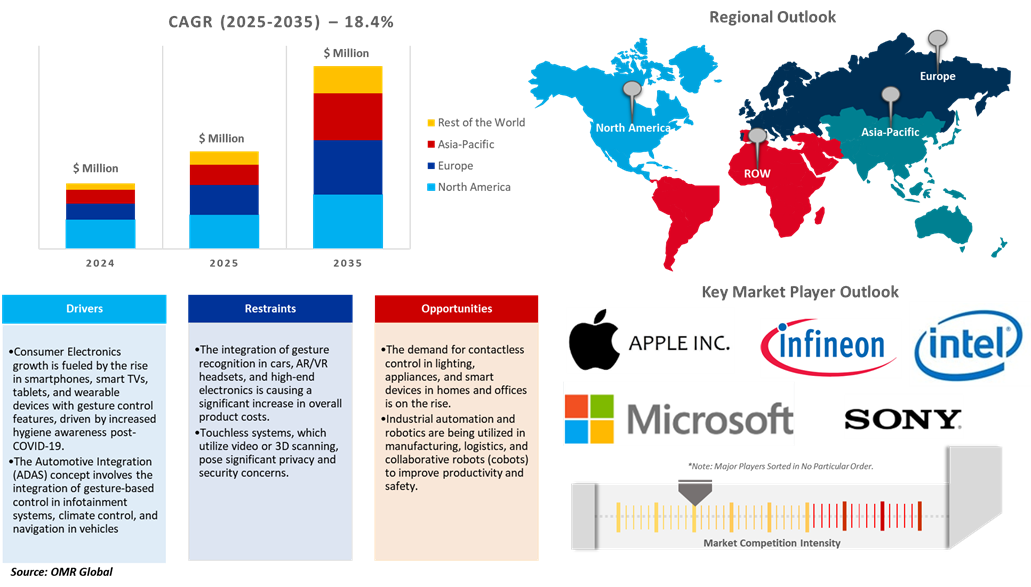
Gesture recognition market was valued at $25.4 million in 2024 and is projected to reach $162.3 billion by 2035, growing at a CAGR of 18.4% during the forecast period (2025–2035). Gesture recognition technology uses cameras, sensors, and advanced algorithms to interpret and respond to human gestures for touchless and intuitive human-machine interaction. Cameras or sensors detect movement in real-time, convert the movements into recognizable patterns, interpret the data to identify the gestures, and execute tasks like scrolling, zooming, or selecting options. It improves user experience, minimizes physical touch for hygiene, enhances accessibility for those with limited mobility, and inspires innovation in AI, machine learning, and sensor technology, leading to smarter, more responsive systems. It is applied in numerous sectors, including consumer electronics, gaming, healthcare, automotive, industrial automation, security, education, and training. It provides touchless control over smartphones, tablets, and TV devices, and enhances user immersion and control. It also facilitates healthcare, automotive, industrial automation, security, and authentication. It also assists users with restricted mobility and drives development in AI, machine learning, and sensor technology.
Market Dynamics
Automotive Integration: ADAS and HMI with Gesture Recognition
As ADAS continues to gain popularity, the need for non-distracting driver interfaces like gesture recognition increases, providing safer control, touch-free authentication, and in-cabin monitoring. In automotive systems, the integration of ADAS with HMI, particularly with gesture recognition, has been essential in improving user experience and safety. According to the National Safety Council Org., in 2024, the integration of ADAS features into the existing passenger vehicle fleet is expected to take time due to the increasing average age of vehicles, which, in the US, is currently 12.6 years. According to projections, a sizable percentage of cars will have certain ADAS systems by 2028: 22% will have lane departure warning, 55% will have front crash prevention, 53% will have blind spot monitoring, 76% will have back cameras, and 65% will have rear parking sensors. Approximately 14% of cars are expected to have curve-adaptive headlights, and 22% will have adaptive cruise control with lane positioning.
Advancements in AI and Computer Vision
The company's sophisticated algorithms power market growth by integrating AI and computer vision, providing high-performance gesture recognition with low latency. For instance, in June 2025, Apple's patent proposes a system that applies image and 3D sensing tech to convert physical surfaces into virtual input devices. Computers utilize gestures and image recognition to split real-world surfaces into specific areas for use in tactile input functions, in addition to examining user interactions, presenting input as if it were a live device. The invention brings hardware and software together, allowing dynamic user interaction with animated graphics and real objects in projected graphics. The technology provides intuitive, gesture-based interaction with common surfaces, turning tables into smart touch interfaces.
Growth of AR/VR & the Metaverse Ecosystem
The widespread adoption of immersive technology such as VR, AR, and the metaverse is driving market expansion in industries such as gaming, healthcare, automotive, and retail due to requirements for ease of control and gesture recognition. According to the Arts Management & Technology Laboratory Org., in August 2024, VR, AR, and the metaverse are quickly becoming consumer technologies that allow immersive interaction with virtual environments. The worldwide VR market is likely to be worth $20.8 billion, with the AR market set to increase to $31.3 billion by 2027 and gaming alone accounting for more than $7 billion. In contrast to VR, which is based on headsets, AR is primarily accessed through mobile devices, making it more accessible. While more than 80% of US homes use VR headsets for gaming, consumers are increasingly using them to experience virtual environments such as museums, concerts, fitness, cooking classes, social gatherings, and shopping, creating demand for easy-to-use, gesture-based interfaces.
Market Segmentation
- Based on the type, the market is segmented into touch-based gesture recognition and touchless gesture recognition.
- Based on the application, the market is segmented into consumer electronics, security, automotive, and others.
Touch-based Gesture Recognition: A Key Segment in Market Growth
Touch gesture recognition is based on sensors and software to recognize and interpret touch contact gestures on touch screens to translate them into actions on devices such as smartphones, tablets, and kiosks. Recognition of touch gestures provides friendly interaction, accessibility, and UX to consumer devices by restricting the application of traditional methods, speeding up input, and designing operations that are more responsive and in demand. Touch-based gesture recognition finds applications across numerous industries such as consumer electronics, retail, gaming, healthcare, automotive, banking/finance, and education, enabling secure multi-touch login and navigation.
Regional Outlook
The global gesture recognition market is further divided by region, including North America (the US and Canada), Europe (the UK, Germany, France, Italy, Spain, Russia, and the Rest of Europe), Asia-Pacific (India, China, Japan, South Korea, Australia and New Zealand, ASEAN Countries, and the Rest of Asia-Pacific), and the Rest of the World (the Middle East & Africa, and Latin America).
Growth of 5G Networks in North America
Expansion of 5G networks, which offer higher connectivity, makes integration of gesture recognition systems in smart homes, gaming, automotive systems, and healthcare applications market development. According to the Global 5G, connections increased by 185 million, reaching a total of nearly two billion, as reported by 5G Americas and Omdia. The North American region accounted for 32% of all wireless cellular connections, showing an 11% growth with 22 million new connections. The global adoption of 5G is set to expand further, with projections estimating 7.7 billion connections by 2028.
Asia-Pacific Maintains Strong Market Position
Asia-Pacific holds a significant share, due to the growing need for sophisticated interface technologies, such as gesture control, smartphones, and smart TVs are growing at a rapid rate. According to the India Brand Equity Foundation (IBEF), in February 2025, India's consumer electronics and appliances Industry is poised to become the globe's fifth largest, with the Indian appliances and consumer electronics (ACE) market anticipated to nearly double, reaching approximately $17.93 billion by 2025. In FY24, smartphones emerged as the fourth-largest export category for India, growing by 42% to $15.6 billion. The industry, valued at $9.84 billion in 2021, 2025 is anticipated to more than double to $21.18 billion. Additionally, electronics hardware production in India reached $87 billion in 2022, and the room air conditioner market is projected to hit $5.6 billion by FY29.
Market Players Outlook
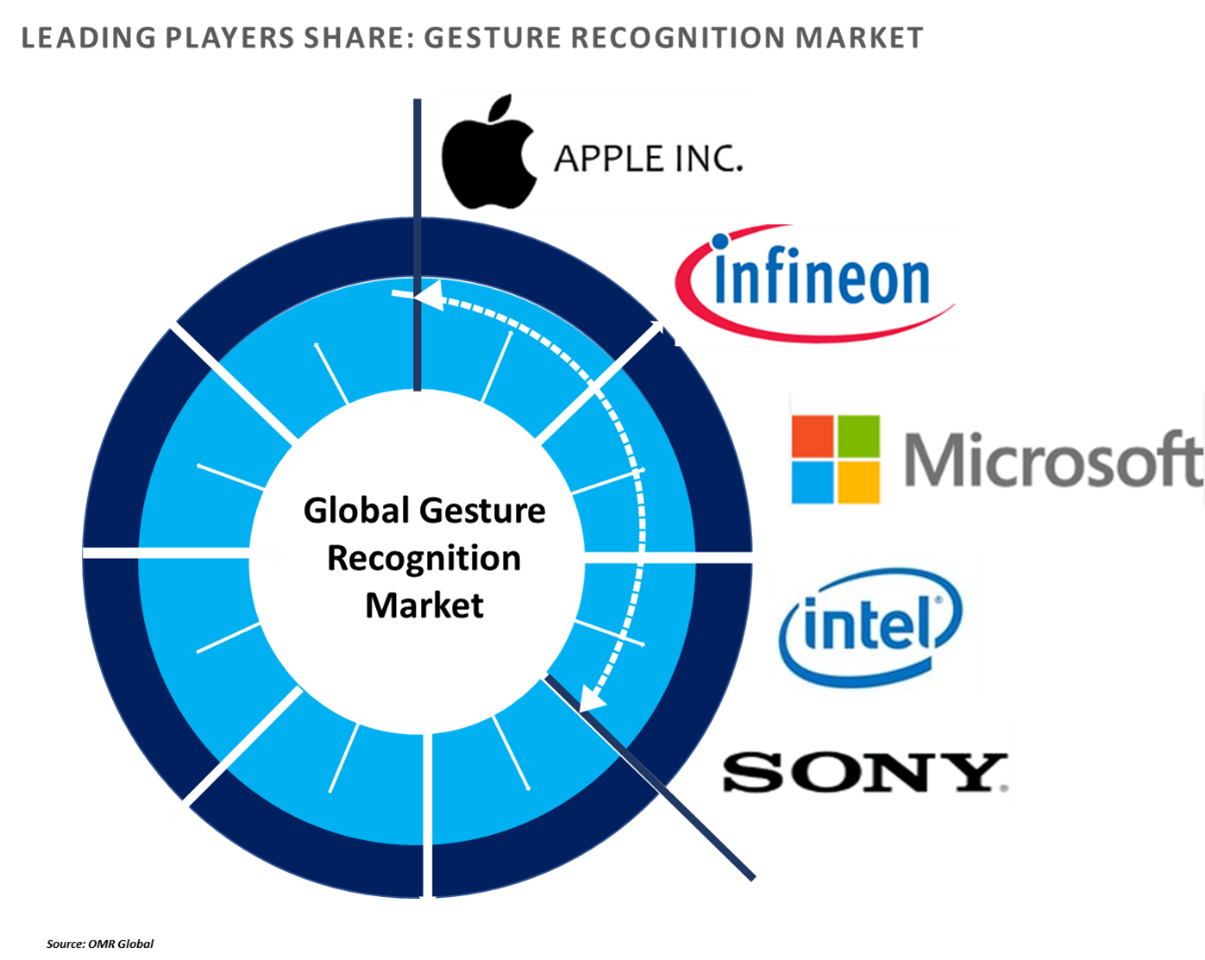
The major companies operating in the global gesture recognition market include Apple Inc., Infineon Technologies AG, Intel Corp., Microsoft Corp., and Sony Corp., among others. Market players are leveraging partnerships, collaborations, mergers, and acquisition strategies for business expansion and innovative product development to maintain their market positioning.
Recent Developments
- In June 2025, Sony acquired Softkinetic, a gesture-recognition company that creates body-sensing and image-recognition technology. The acquisition aims to create a next-generation user interface for computers, game machines, and mobile devices. Softkinetic's technology uses light to resolve distance to objects, calculate distance and shape, and map 3D spaces.
- In January 2025, BrainChip unveiled the Edge AI Box Partner Ecosystem for Gestures, a cost-effective appliance with AI/ML processing power for various markets, focusing on gestures, cybersecurity, image recognition, and computer vision. The device, developed in partnership with VVDN Technologies, is an embedded Linux solution with Ethernet, Bluetooth, and USB interfaces, offering a complete edge AI computing platform.
- In July 2022, STMicroelectronics introduced STGesture Recognition for touchless control, a free engineering software for use with ST's VL53L5CX FlightSense time-of-flight sensor. This technology enables sophisticated interactions with various devices, including kitchen appliances, thermostats, smart-home controls, laptops, AR/VR headsets, tablets, and smartphones, preventing infections.
The Report Covers
- Market value data analysis of 2024 and forecast to 2035.
- Annualized market revenues ($ million) for each market segment.
- Country-wise analysis of major geographical regions.
- Key companies operating in the global gesture recognition market. Based on the availability of data, information related to new products and relevant news is also available in the report.
- Analysis of business strategies by identifying the key market segments positioned for strong growth in the future.
- Analysis of market-entry and market expansion strategies.
- Competitive strategies by identifying ‘who-stands-where’ in the market.
- Report Summary
- Current Industry Analysis and Growth Potential Outlook
- Global Gesture Recognition Market Sales Analysis – Type | Application ($ Million)
- Gesture Recognition Market Sales Performance of Top Countries
- Research Methodology
- Primary Research Approach
- Secondary Research Approach
- Market Snapshot
- Market Overview and Insights
- Scope of the Study
- Analyst Insight & Current Market Trends
- Key Gesture Recognition Market Trends
- Market Recommendations
- Market Determinants
- Market Drivers
- Drivers For Global Gesture Recognition Market: Impact Analysis
- Market Pain Points and Challenges
- Restraints For Global Gesture Recognition Market: Impact Analysis
- Market Opportunities
- Opportunities For Global Gesture Recognition Market: Impact Analysis
- Market Drivers
- Competitive Landscape
- Competitive Dashboard – Gesture Recognition Market Revenue and Share by Manufacturers
- Gesture Recognition Type Comparison Analysis
- Top Market Player Ranking Matrix
- Key Company Analysis
- Apple Inc.
- Overview
- Type Portfolio
- Financial Analysis (Subject to Data Availability)
- SWOT Analysis
- Business Strategy
- Infineon Technologies AG
- Overview
- Type Portfolio
- Financial Analysis (Subject to Data Availability)
- SWOT Analysis
- Business Strategy
- Intel Corp.
- Overview
- Type Portfolio
- Financial Analysis (Subject to Data Availability)
- SWOT Analysis
- Business Strategy
- Microsoft Corp.
- Overview
- Type Portfolio
- Financial Analysis (Subject to Data Availability)
- SWOT Analysis
- Business Strategy
- Sony Corp.
- Overview
- Type Portfolio
- Financial Analysis (Subject to Data Availability)
- SWOT Analysis
- Business Strategy
- Apple Inc.
- Key Company Analysis
- Top Winning Strategies by Market Players
- Merger and Acquisition
- Type Launch
- Partnership And Collaboration
- Global Gesture Recognition Market Sales Analysis by Type ($ Million)
- Touch-based Gesture Recognition
- Touchless Gesture Recognition
- Global Gesture Recognition Market Sales Analysis by Application ($ Million)
- Consumer Electronics
- Security
- Automotive
- Others
- Regional Analysis
- North American Gesture Recognition Market Sales Analysis – Type | Application ($ Million)
- Macroeconomic Factors for North America
- United States
- Canada
- European Gesture Recognition Market Sales Analysis – Type | Application ($ Million)
- Macroeconomic Factors for Europe
- UK
- Germany
- Italy
- Spain
- France
- Russia
- Rest of Europe
- Asia-Pacific Gesture Recognition Market Sales Analysis – Type | Application ($ Million)
- Macroeconomic Factors for Asia-Pacific
- China
- Japan
- South Korea
- India
- Australia & New Zealand
- ASEAN Countries (Thailand, Indonesia, Vietnam, Singapore, And Other)
- Rest of Asia-Pacific
- Rest of the World Gesture Recognition Market Sales Analysis – Type | Application ($ Million)
- Macroeconomic Factors for the Rest of the World
- Latin America
- Middle East and Africa
- Company Profiles
- Apple Inc.
- Quick Facts
- Company Overview
- Product Portfolio
- Business Strategies
- Aptiv
- Quick Facts
- Company Overview
- Product Portfolio
- Business Strategies
- Autovrse (TDW Technologies Inc.)
- Quick Facts
- Company Overview
- Product Portfolio
- Business Strategies
- Beijing Kuangshi Technology Co., Ltd.
- Quick Facts
- Company Overview
- Product Portfolio
- Business Strategies
- Elliptic Laboratories AS
- Quick Facts
- Company Overview
- Product Portfolio
- Business Strategies
- Infineon Technologies AG
- Quick Facts
- Company Overview
- Product Portfolio
- Business Strategies
- Intel Corp.
- Quick Facts
- Company Overview
- Product Portfolio
- Business Strategies
- Intellias Global Ltd.
- Quick Facts
- Company Overview
- Product Portfolio
- Business Strategies
- Jabil Inc.
- Quick Facts
- Company Overview
- Product Portfolio
- Business Strategies
- Microchip Technology Inc.
- Quick Facts
- Company Overview
- Product Portfolio
- Business Strategies
- Microsoft Corp.
- Quick Facts
- Company Overview
- Product Portfolio
- Business Strategies
- Motion Gestures
- Quick Facts
- Company Overview
- Product Portfolio
- Business Strategies
- Nestack Technologies Pvt Ltd.
- Quick Facts
- Company Overview
- Product Portfolio
- Business Strategies
- Nuvoton Technology Corp.
- Quick Facts
- Company Overview
- Product Portfolio
- Business Strategies
- Qualcomm Technologies, Inc.
- Quick Facts
- Company Overview
- Product Portfolio
- Business Strategies
- Samsung Electronics Co., Ltd.
- Quick Facts
- Company Overview
- Product Portfolio
- Business Strategies
- Sony Corp.
- Quick Facts
- Company Overview
- Product Portfolio
- Business Strategies
- STMicroelectronics International N.V
- Quick Facts
- Company Overview
- Product Portfolio
- Business Strategies
- Tensorway
- Quick Facts
- Company Overview
- Product Portfolio
- Business Strategies
- Texas Instruments Inc.
- Quick Facts
- Company Overview
- Product Portfolio
- Business Strategies
- Thoughtworks, Inc.
- Quick Facts
- Company Overview
- Product Portfolio
- Business Strategies
- Virtusa Corp.
- Quick Facts
- Company Overview
- Product Portfolio
- Business Strategies
- Zoom Communications, Inc.
- Quick Facts
- Company Overview
- Product Portfolio
- Business Strategies
- Apple Inc.
1. Global Gesture Recognition Market Research and Analysis By Type, 2024-2035 ($ Million)
2. Global Touch-based Gesture Recognition Market Research and Analysis By Region, 2024-2035 ($ Million)
3. Global Touchless Gesture Recognition Market Research and Analysis By Region, 2024-2035 ($ Million)
4. Global Gesture Recognition Market Research and Analysis By Application, 2024-2035 ($ Million)
5. Global Gesture Recognition In Consumer Electronics Market Research and Analysis By Region, 2024-2035 ($ Million)
6. Global Gesture Recognition In Security Market Research and Analysis By Region, 2024-2035 ($ Million)
7. Global Gesture Recognition In Automotive Market Research and Analysis By Region, 2024-2035 ($ Million)
8. Global Gesture Recognition In Other Application Market Research and Analysis By Region, 2024-2035 ($ Million)
9. Global Gesture Recognition Market Research and Analysis By Region, 2024-2035 ($ Million)
10. North American Gesture Recognition Market Research and Analysis By Country, 2024-2035 ($ Million)
11. North American Gesture Recognition Market Research and Analysis By Type, 2024-2035 ($ Million)
12. North American Gesture Recognition Market Research and Analysis By Application, 2024-2035 ($ Million)
13. European Gesture Recognition Market Research and Analysis By Country, 2024-2035 ($ Million)
14. European Gesture Recognition Market Research and Analysis By Type, 2024-2035 ($ Million)
15. European Gesture Recognition Market Research and Analysis By Application, 2024-2035 ($ Million)
16. Asia-Pacific Gesture Recognition Market Research and Analysis By Country, 2024-2035 ($ Million)
17. Asia-Pacific Gesture Recognition Market Research and Analysis By Type, 2024-2035 ($ Million)
18. Asia-Pacific Gesture Recognition Market Research and Analysis By Application, 2024-2035 ($ Million)
19. Rest Of The World Gesture Recognition Market Research and Analysis By Region, 2024-2035 ($ Million)
20. Rest Of The World Gesture Recognition Market Research and Analysis By Type, 2024-2035 ($ Million)
21. Rest Of The World Gesture Recognition Market Research and Analysis By Application, 2024-2035 ($ Million)
1. Global Gesture Recognition Market Share By Type, 2024 Vs 2035 (%)
2. Global Touch-based Gesture Recognition Market Share By Region, 2024 Vs 2035 (%)
3. Global Touchless Gesture Recognition Market Share By Region, 2024 Vs 2035 (%)
4. Global Gesture Recognition Market Share By Application, 2024 Vs 2035 (%)
5. Global Gesture Recognition In Consumer Electronics Market Share By Region, 2024 Vs 2035 (%)
6. Global Gesture Recognition In Security Market Share By Region, 2024 Vs 2035 (%)
7. Global Gesture Recognition In Automotive Market Share By Region, 2024 Vs 2035 (%)
8. Global Gesture Recognition In Other Application Market Share By Region, 2024 Vs 2035 (%)
9. US Gesture Recognition Market Size, 2024-2035 ($ Million)
10. Canada Gesture Recognition Market Size, 2024-2035 ($ Million)
11. UK Gesture Recognition Market Size, 2024-2035 ($ Million)
12. France Gesture Recognition Market Size, 2024-2035 ($ Million)
13. Germany Gesture Recognition Market Size, 2024-2035 ($ Million)
14. Italy Gesture Recognition Market Size, 2024-2035 ($ Million)
15. Spain Gesture Recognition Market Size, 2024-2035 ($ Million)
16. Russia Gesture Recognition Market Size, 2024-2035 ($ Million)
17. Rest of Europe Gesture Recognition Market Size, 2024-2035 ($ Million)
18. India Gesture Recognition Market Size, 2024-2035 ($ Million)
19. China Gesture Recognition Market Size, 2024-2035 ($ Million)
20. Japan Gesture Recognition Market Size, 2024-2035 ($ Million)
21. South Korea Gesture Recognition Market Size, 2024-2035 ($ Million)
22. Australia and New Zealand Gesture Recognition Market Size, 2024-2035 ($ Million)
23. ASEAN Economies Gesture Recognition Market Size, 2024-2035 ($ Million)
24. Rest of Asia-Pacific Gesture Recognition Market Size, 2024-2035 ($ Million)
25. Latin America Gesture Recognition Market Size, 2024-2035 ($ Million)
26. Middle East and Africa Gesture Recognition Market Size, 2024-2035 ($ Million)
- Printable version
- No restriction to number of users within the company