Internet of Things (IoT) Market


Internet of Things (IoT) Market Size, Share & Trends Analysis Report by Component (Hardware, Software, and Services) by Connectivity Technology (Cellular (4G/LTE, 5G), Wi-Fi, Bluetooth, Zigbee, LoRaWAN, NFC, Satellite Communication, and Ethernet) by Deployment Mode (On-Premise, and Cloud-Based), By Organization Size (Small and Medium-sized Enterprises (SMEs), and Large Enterprises) and by End User (BFSI, IT & Telecom, Manufacturing, Transportation, Healthcare, Retail, Energy& Utilities, Residential, Government & Defense, and Others) Forecast Period (2025-2035)
Industry Overview
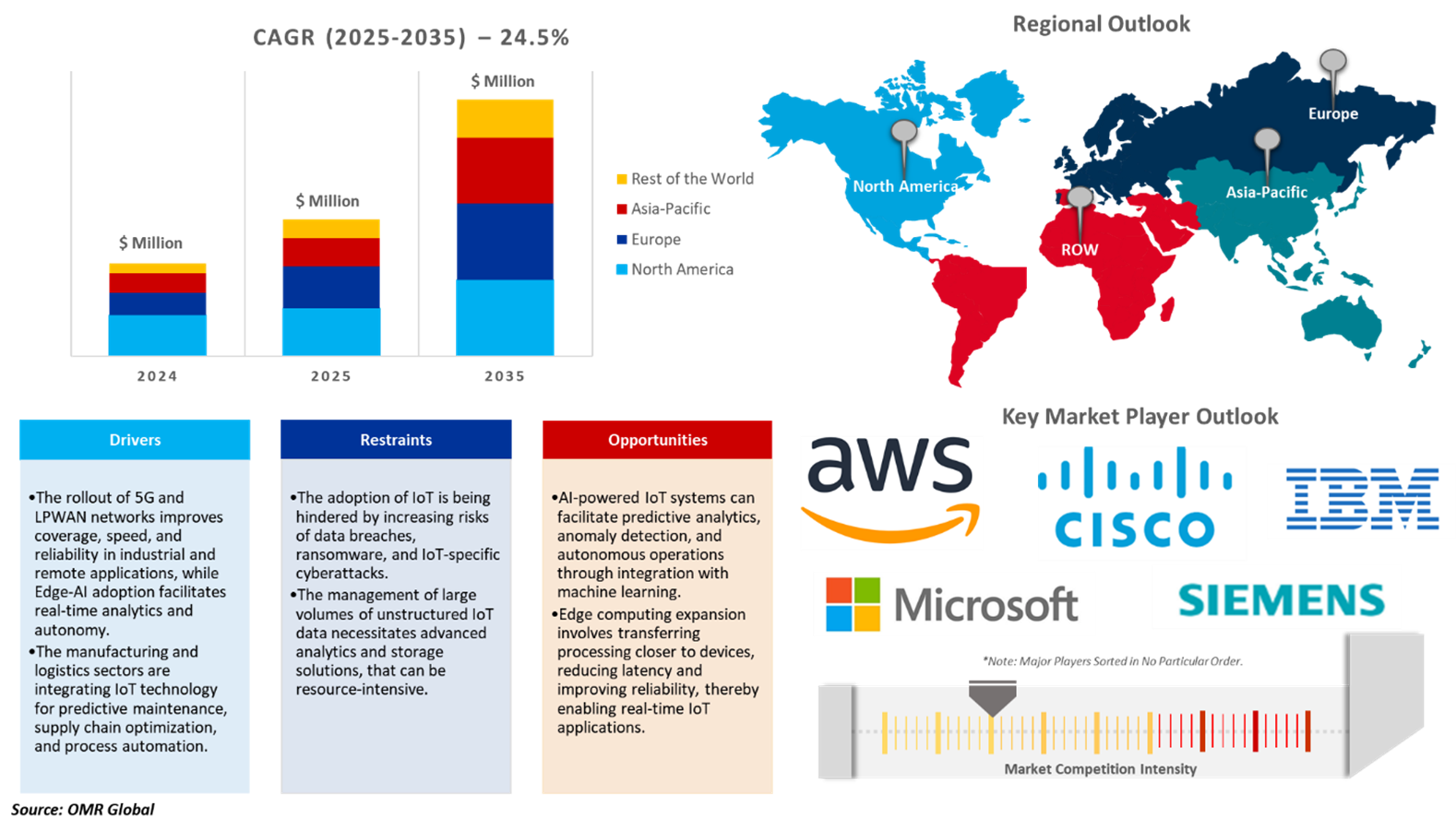
Internet of Things (IoT) market was valued at $173.8 billion in 2025 and is projected to reach $1,515,5 billion by 2035, growing at a CAGR of 24.5% during the forecast period (2025–2035). LoRaWAN is a low-power wireless network protocol used in IoT-based applications such as smart cities, agriculture, logistics, and healthcare, for real-time monitoring, smart locks, energy management, and fire evacuation sensors. Market development is mainly fueled by increasing adoption of low-power, wide-area network (LPWAN) technologies for long-range connectivity and long battery life for IoT devices. For instance, in April 2024, the LoRa Alliance revealed a development roadmap for the LoRaWAN standard, a network protocol to connect battery-powered devices over the internet wirelessly in regional, national, or global networks. The LoRaWAN standard improved scalability and interoperability between industries, serving core IoT requirements such as bi-directional communication, end-to-end security, mobility, and localisation services. The roadmap also outlines the future growth of the LoRaWAN open standard for IoT communications, including the enhancements to the long-range frequency hopping spread spectrum (LR-FHSS) and relay enhancements.
Market Dynamics
Healthcare Digital Transformation
The healthcare digital transformation market is gaining momentum due to the growing use of connected medical devices like Vodafone's IoT monitor for real-time diagnostics and improved treatment outcomes. For instance, in April 2025, Vodafone connected its 200 million Internet of Things (IoT) devices to a healthcare monitor to its global IoT network. The device provides doctors with vital information about a patient's cardiac health and vital signs remotely. Over the last five years, Vodafone has doubled its IoT connections to over 200 million, with more than a quarter of these located in Germany. IoT enables companies to operate more efficiently and sustainably, with over half of all connections directly enabling customers to reduce their emissions. Additionally, it integrated its IoT SIM into device chipsets, simplifying processes, reducing costs, and automating network deployment for large-scale IoT deployments.
Advancements in Wireless Communication Standards
Wireless technologies of high speed and low latency are advancing IoT device performance, which makes it possible to have faster data transmission, higher reliability, and more interoperability among devices, propelling market growth. For instance, in April 2025, Synaptics launched its first Veros Wi-Fi 7 family, encompassing Wi-Fi, Bluetooth, and Zigbee/Thread combo SoCs. The scalable SoCs promote high peak speed and low latency for diverse Internet of Things IoT applications such as gaming, AR/VR, entertainment, security, and automotive. Triple-combo SoCs combine Wi-Fi 7 with Bluetooth 6.0 and Zigbee/Thread, reducing system cost and power consumption. They provide consistent performance across a spectrum of applications. The Wi-Fi 7 IoT portfolio provides flexible home hubs on Wi-Fi, Bluetooth, and Zigbee/Thread networks, Matter, and triple combo design, and supports maximum speeds of up to 5.8 Gbps.
Market Segmentation
- Based on the component, the market is segmented into hardware, software, and services.
- Based on the connectivity technology, the market is segmented into cellular (4G/LTE, 5G), Wi-Fi, Bluetooth, Zigbee, LoRaWAN, NFC, satellite communication, and Ethernet.
- Based on the deployment mode, the market is segmented into on-premise and cloud-based.
- Based on the Organization Size, the market is segmented into small and medium-sized enterprises (SMEs) and large enterprises.
- Based on the End-User, the market is segmented into BFSI, IT & telecom, manufacturing, transportation, healthcare, retail, energy& utilities, residential, government & defense, and others. (education & edtech, hospitality & tourism, sports & entertainment, and environmental monitoring)
Manufacturing: A Key Segment in Market Growth
Manufacturing, an essential industrial process, makes use of automation across industries such as automobiles, electronics, aviation, consumer durables, pharmaceuticals, textiles, and heavy equipment to achieve precision, quality assurance, and production efficiency. The Internet of Things (IoT) is transforming the manufacturing industry by making automation, preventive maintenance, quality assurance, asset tracking, energy monitoring, and worker safety possible. IoT networks machines, sensors, and systems to facilitate real-time communication, remote monitoring, and control. It additionally facilitates machine failure prediction, early defect detection, supply chain optimization, and assistance towards sustainability initiatives.
Regional Outlook
The global internet of things (IoT) is further divided by region, including North America (the US and Canada), Europe (the UK, Germany, France, Italy, Spain, Russia, and the Rest of Europe), Asia-Pacific (India, China, Japan, South Korea, Australia and New Zealand, ASEAN Countries, and the Rest of Asia-Pacific), and the Rest of the World (the Middle East & Africa, and Latin America).
North America Maintains Strong Market Position
North America holds a significant share, owing to the market growth is primarily driven by the increasing demand for real-time analysis and predictive maintenance for industrial environments. For instance, in January 2025, the US implemented a Cyber Trust Mark for IoT products, enabling consumers to evaluate their cybersecurity levels. Those manufacturers who achieved the mark showed a clear shield logo, indicating their adherence to the cybersecurity requirements of NIST. The voluntary mark is intended to increase IoT device security by motivating manufacturers to implement better secure design practices.
Market Players Outlook
The major companies operating in the global Internet of Things (IoT) market include Amazon Web Services, Inc., Cisco Systems, Inc., IBM Corp., Microsoft, Siemens AG, among others. Market players are leveraging partnerships, collaborations, mergers, and acquisition strategies for business expansion and innovative product development to maintain their market positioning.
Recent Developments
- In July 2025, Siemens collaborated with Microsoft to enhance IoT interoperability in buildings. The collaboration facilitates interoperability between Siemens' Building X digital building platform and Microsoft Azure IoT Operations, bringing data and tools together for edge devices. This will increase the availability of IoT-based data for big enterprise customers to support sustainability and operations. The solution will enable the customers to create their IoT architecture and incorporate Siemens' hardware and software building blocks without being locked into one vendor ecosystem. The partnership employs open industry standards such as W3C Web of Things and Open Platform Communications Unified Architecture to provide accessibility, interoperability, privacy, and security.
- In February 2023, Semtech and TTI collaborated to introduce hybrid LoRaWAN and cellular IoT offerings. The collaboration is designed to make it possible to support more IoT applications, accelerate adoption, simplify integration, and speed time-to-market. TTI offers cloud-based LoRaWAN server infrastructure and services, and Semtech is set to collaborate with other LoRaWAN partners to take advantage of cellular IoT, such as NB-IoT and LTE-M, as an extension to LoRaWAN.
The Report Covers
- Market value data analysis of 2024 and forecast to 2035.
- Annualized market revenues ($ million) for each market segment.
- Country-wise analysis of major geographical regions.
- Key companies operating in the global Internet of Things (IoT) market. Based on the availability of data, information related to new products and relevant news is also available in the report.
- Analysis of business strategies by identifying the key market segments positioned for strong growth in the future.
- Analysis of market-entry and market expansion strategies.
- Competitive strategies by identifying ‘who-stands-where’ in the market.
1. Report Summary
• Current Industry Analysis and Growth Potential Outlook
• Global Internet of Things (IoT) Market Sales Analysis – Component | Connectivity Technology | Deployment Mode | Organization Size | End-User ($ Million)
• Internet of Things (IoT) Market Sales Performance of Top Countries
1.1. Research Methodology
• Primary Research Approach
• Secondary Research Approach
1.2. Market Snapshot
2. Market Overview and Insights
2.1. Scope of the Study
2.2. Analyst Insight & Current Market Trends
2.2.1. Key Internet of Things (IoT) Trends
2.2.2. Market Recommendations
3. Market Determinants
3.1. Market Drivers
3.1.1. Drivers For the Global Internet of Things (IoT) Market: Impact Analysis
3.2. Market Pain Points and Challenges
3.2.1. Restraints For the Global Internet of Things (IoT) Market: Impact Analysis
3.3. Market Opportunities
3.3.1. Opportunities For the Global Internet of Things (IoT) Market: Impact Analysis
4. Competitive Landscape
4.1. Competitive Dashboard – Internet of Things (IoT) Market Revenue and Share by Manufacturers
• Internet of Things (IoT) Component Comparison Analysis
• Top Market Player Ranking Matrix
4.2. Key Company Analysis
4.2.1. Amazon Web Services, Inc.
4.2.1.1. Overview
4.2.1.2. Component Portfolio
4.2.1.3. Financial Analysis (Subject to Data Availability)
4.2.1.4. SWOT Analysis
4.2.1.5. Business Strategy
4.2.2. Cisco Systems, Inc.
4.2.2.1. Overview
4.2.2.2. Component Portfolio
4.2.2.3. Financial Analysis (Subject to Data Availability)
4.2.2.4. SWOT Analysis
4.2.2.5. Business Strategy
4.2.3. IBM Corp.
4.2.3.1. Overview
4.2.3.2. Component Portfolio
4.2.3.3. Financial Analysis (Subject to Data Availability)
4.2.3.4. SWOT Analysis
4.2.3.5. Business Strategy
4.2.4. Microsoft Corp.
4.2.4.1. Overview
4.2.4.2. Component Portfolio
4.2.4.3. Financial Analysis (Subject to Data Availability)
4.2.4.4. SWOT Analysis
4.2.4.5. Business Strategy
4.2.5. Siemens AG
4.2.5.1. Overview
4.2.5.2. Component Portfolio
4.2.5.3. Financial Analysis (Subject to Data Availability)
4.2.5.4. SWOT Analysis
4.2.5.5. Business Strategy
4.3. Top Winning Strategies by Market Players
4.3.1. Merger and Acquisition
4.3.2. Product Launch
4.3.3. Partnership And Collaboration
5. Global Internet of Things (IoT) Market Sales Analysis By Component ($ Million)
5.1. Hardware
5.2. Software
5.3. Services
6. Global Internet of Things (IoT) Market Sales Analysis By Connectivity Technology ($ Million)
6.1. Cellular (4G/LTE, 5G)
6.2. Wi-Fi
6.3. Bluetooth
6.4. Zigbee
6.5. LoRaWAN
6.6. NFC
6.7. Satellite Communication
6.8. Ethernet
7. Global Internet of Things (IoT) Market Sales Analysis By Deployment Mode ($ Million)
7.1. On-Premise
7.2. Cloud-Based
8. Global Internet of Things (IoT) Market Sales Analysis By Organization Size ($ Million)
8.1. Small and Medium-sized Enterprises (SMEs)
8.2. Large Enterprises
9. Global Internet of Things (IoT) Market Sales Analysis By End-User ($ Million)
9.1. Foliar Spray
9.2. Seed Treatment
9.3. Soil Treatment
9.4. Post-Harvest
10. Regional Analysis
10.1. North American Internet of Things (IoT) Market Sales Analysis – Component | Connectivity Technology | Deployment Mode | Organization Size | End-User | Country ($ Million)
• Macroeconomic Factors for North America
10.1.1. United States
10.1.2. Canada
10.2. European Internet of Things (IoT) Market Sales Analysis – Component | Connectivity Technology | Deployment Mode | Organization Size | End-User | Country ($ Million)
• Macroeconomic Factors for Europe
10.2.1. UK
10.2.2. Germany
10.2.3. Italy
10.2.4. Spain
10.2.5. France
10.2.6. Russia
10.2.7. Rest of Europe
10.3. Asia-Pacific Internet of Things (IoT) Market Sales Analysis – Component | Connectivity Technology | Deployment Mode | Organization Size | End-User| Country ($ Million)
• Macroeconomic Factors for Asia-Pacific
10.3.1. China
10.3.2. Japan
10.3.3. South Korea
10.3.4. India
10.3.5. Australia & New Zealand
10.3.6. ASEAN Countries (Thailand, Indonesia, Vietnam, Singapore, And others)
10.3.7. Rest of Asia-Pacific
10.4. Rest of the World Internet of Things (IoT) Market Sales Analysis – Component | Connectivity Technology | Deployment Mode | Organization Size | End-User| Country ($ Million)
• Macroeconomic Factors for the Rest of the World
10.4.1. Latin America
10.4.2. Middle East and Africa
11. Company Profiles
11.1. A3Logics Inc.
11.1.1. Quick Facts
11.1.2. Company Overview
11.1.3. Product Portfolio
11.1.4. Business Strategies
11.2. ABB, Ltd.
11.2.1. Quick Facts
11.2.2. Company Overview
11.2.3. Product Portfolio
11.2.4. Business Strategies
11.3. Aeris Communications Inc.
11.3.1. Quick Facts
11.3.2. Company Overview
11.3.3. Product Portfolio
11.3.4. Business Strategies
11.4. Amazon Web Services, Inc.
11.4.1. Quick Facts
11.4.2. Company Overview
11.4.3. Product Portfolio
11.4.4. Business Strategies
11.5. Bosch Global Software Technologies Pvt. Ltd.
11.5.1. Quick Facts
11.5.2. Company Overview
11.5.3. Product Portfolio
11.5.4. Business Strategies
11.6. Cisco Systems, Inc.
11.6.1. Quick Facts
11.6.2. Company Overview
11.6.3. Product Portfolio
11.6.4. Business Strategies
11.7. Fujitsu Ltd.
11.7.1. Quick Facts
11.7.2. Company Overview
11.7.3. Product Portfolio
11.7.4. Business Strategies
11.8. Gadgeon Systems Inc.
11.8.1. Quick Facts
11.8.2. Company Overview
11.8.3. Product Portfolio
11.8.4. Business Strategies
11.9. Google LLC
11.9.1. Quick Facts
11.9.2. Company Overview
11.9.3. Product Portfolio
11.9.4. Business Strategies
11.10. Honeywell International Inc.
11.10.1. Quick Facts
11.10.2. Company Overview
11.10.3. Product Portfolio
11.10.4. Business Strategies
11.11. HQSoftware
11.11.1. Quick Facts
11.11.2. Company Overview
11.11.3. Product Portfolio
11.11.4. Business Strategies
11.12. IBM Corp.
11.12.1. Quick Facts
11.12.2. Company Overview
11.12.3. Product Portfolio
11.12.4. Business Strategies
11.13. Indeema Software Inc.
11.13.1. Quick Facts
11.13.2. Company Overview
11.13.3. Product Portfolio
11.13.4. Business Strategies
11.14. Intel Corp.
11.14.1. Quick Facts
11.14.2. Company Overview
11.14.3. Product Portfolio
11.14.4. Business Strategies
11.15. Microsoft Corp.
11.15.1. Quick Facts
11.15.2. Company Overview
11.15.3. Product Portfolio
11.15.4. Business Strategies
11.16. Oracle Corp.
11.16.1. Quick Facts
11.16.2. Company Overview
11.16.3. Product Portfolio
11.16.4. Business Strategies
11.17. PTC Inc.
11.17.1. Quick Facts
11.17.2. Company Overview
11.17.3. Product Portfolio
11.17.4. Business Strategies
11.18. Qualcomm Technologies, Inc.
11.18.1. Quick Facts
11.18.2. Company Overview
11.18.3. Product Portfolio
11.18.4. Business Strategies
11.19. Samsara Inc.
11.19.1. Quick Facts
11.19.2. Company Overview
11.19.3. Product Portfolio
11.19.4. Business Strategies
11.20. SAP SE
11.20.1. Quick Facts
11.20.2. Company Overview
11.20.3. Product Portfolio
11.20.4. Business Strategies
11.21. Siemens AG
11.21.1. Quick Facts
11.21.2. Company Overview
11.21.3. Product Portfolio
11.21.4. Business Strategies
11.22. Telefonaktiebolaget LM Ericsson
11.22.1. Quick Facts
11.22.2. Company Overview
11.22.3. Product Portfolio
11.22.4. Business Strategies
11.23. Wipro Ltd.
11.23.1. Quick Facts
11.23.2. Company Overview
11.23.3. Product Portfolio
11.23.4. Business Strategies
1. Global Internet of Things (IoT) Market Research and Analysis By Component, 2024-2035 ($ Million)
2. Global Internet of Things (IoT) Hardware Market Research and Analysis By Region, 2024-2035 ($ Million)
3. Global Internet of Things (IoT) Software Market Research and Analysis By Region, 2024-2035 ($ Million)
4. Global Internet of Things (IoT) Services Market Research and Analysis By Region, 2024-2035 ($ Million)
5. Global Internet of Things (IoT) Market Research and Analysis By Connectivity Technology, 2024-2035 ($ Million)
6. Global Internet of Things (IoT) Cellular (4G/LTE, 5G) Market Research and Analysis By Region, 2024-2035 ($ Million)
7. Global Internet of Things (IoT) Wi-Fi Market Research and Analysis By Region, 2024-2035 ($ Million)
8. Global Internet of Things (IoT) Bluetooth Market Research and Analysis By Region, 2024-2035 ($ Million)
9. Global Internet of Things (IoT) Zigbee Market Research and Analysis By Region, 2024-2035 ($ Million)
10. Global Internet of Things (IoT) LoRaWAN Market Research and Analysis By Region, 2024-2035 ($ Million)
11. Global Internet of Things (IoT) NFC Market Research and Analysis By Region, 2024-2035 ($ Million)
12. Global Internet of Things (IoT) Satellite Communication Market Research and Analysis By Region, 2024-2035 ($ Million)
13. Global Internet of Things (IoT) Ethernet Market Research and Analysis By Region, 2024-2035 ($ Million)
14. Global Internet of Things (IoT) Market Research and Analysis By Deployment Mode, 2024-2035 ($ Million)
15. Global Based On-Premise Internet of Things (IoT) Market Research and Analysis By Region, 2024-2035 ($ Million)
16. Global Cloud-Based Internet of Things (IoT) Market Research and Analysis By Region, 2024-2035 ($ Million)
17. Global Internet of Things (IoT) Market Research and Analysis By Organization Size, 2024-2035 ($ Million)
18. Global Internet of Things (IoT) For Small and Medium-sized Enterprises (SMEs) Market Research and Analysis By Region, 2024-2035 ($ Million)
19. Global Internet of Things (IoT) For Large Enterprises Market Research and Analysis By Region, 2024-2035 ($ Million)
20. Global Internet of Things (IoT) Market Research and Analysis By End-User, 2024-2035 ($ Million)
21. Global Internet of Things (IoT) BFSI Market Research and Analysis By Region, 2024-2035 ($ Million)
22. Global Internet of Things (IoT) IT & Telecom Market Research and Analysis By Region, 2024-2035 ($ Million)
23. Global Internet of Things (IoT) Manufacturing Market Research and Analysis By Region, 2024-2035 ($ Million)
24. Global Internet of Things (IoT) Transportation Market Research and Analysis By Region, 2024-2035 ($ Million)
25. Global Internet of Things (IoT) Healthcare Market Research and Analysis By Region, 2024-2035 ($ Million)
26. Global Internet of Things (IoT) Retail Market Research and Analysis By Region, 2024-2035 ($ Million)
27. Global Internet of Things (IoT) Energy& Utilities Market Research and Analysis By Region, 2024-2035 ($ Million)
28. Global Internet of Things (IoT) Residential Market Research and Analysis By Region, 2024-2035 ($ Million)
29. Global Internet of Things (IoT) Government & Defense Market Research and Analysis By Region, 2024-2035 ($ Million)
30. Global Internet of Things (IoT) Other End User Market Research and Analysis By Region, 2024-2035 ($ Million)
31. Global Internet of Things (IoT) Market Research and Analysis By Region, 2024-2035 ($ Million)
32. North American Internet of Things (IoT) Market Research and Analysis By Country, 2024-2035 ($ Million)
33. North American Internet of Things (IoT) Market Research and Analysis By Component, 2024-2035 ($ Million)
34. North American Internet of Things (IoT) Market Research and Analysis By Connectivity Technology, 2024-2035 ($ Million)
35. North American Internet of Things (IoT) Market Research and Analysis By Deployment Mode, 2024-2035 ($ Million)
36. North American Internet of Things (IoT) Market Research and Analysis By Organization Size, 2024-2035 ($ Million)
37. North American Internet of Things (IoT) Market Research and Analysis By End-User, 2024-2035 ($ Million)
38. European Internet of Things (IoT) Market Research and Analysis By Country, 2024-2035 ($ Million)
39. European Internet of Things (IoT) Market Research and Analysis By Component, 2024-2035 ($ Million)
40. European Internet of Things (IoT) Market Research and Analysis By Connectivity Technology, 2024-2035 ($ Million)
41. European Internet of Things (IoT) Market Research and Analysis By Deployment Mode, 2024-2035 ($ Million)
42. European Internet of Things (IoT) Market Research and Analysis By Organization Size, 2024-2035 ($ Million)
43. European Internet of Things (IoT) Market Research and Analysis By End-User, 2024-2035 ($ Million)
44. Asia-Pacific Internet of Things (IoT) Market Research and Analysis By Country, 2024-2035 ($ Million)
45. Asia-Pacific Internet of Things (IoT) Market Research and Analysis By Component, 2024-2035 ($ Million)
46. Asia-Pacific Internet of Things (IoT) Market Research and Analysis By Connectivity Technology, 2024-2035 ($ Million)
47. Asia-Pacific Internet of Things (IoT) Market Research and Analysis By Deployment Mode, 2024-2035 ($ Million)
48. Asia-Pacific Internet of Things (IoT) Market Research and Analysis By Organization Size, 2024-2035 ($ Million)
49. Asia-Pacific Internet of Things (IoT) Market Research and Analysis By End-User, 2024-2035 ($ Million)
50. Rest Of The World Internet of Things (IoT) Market Research and Analysis By Country, 2024-2035 ($ Million)
51. Rest Of The World Internet of Things (IoT) Market Research and Analysis By Component, 2024-2035 ($ Million)
52. Rest Of The World Internet of Things (IoT) Market Research and Analysis By Connectivity Technology, 2024-2035 ($ Million)
53. Rest Of The World Internet of Things (IoT) Market Research and Analysis By Deployment Mode, 2024-2035 ($ Million)
54. Rest Of The World Internet of Things (IoT) Market Research and Analysis By Organization Size, 2024-2035 ($ Million)
55. Rest Of The World Internet of Things (IoT) Market Research and Analysis By End-User, 2024-2035 ($ Million)
1. Global Internet of Things (IoT) Market Share By Component, 2024 Vs 2035 (%)
2. Global Internet of Things (IoT) Hardware Market Share By Region, 2024 Vs 2035 (%)
3. Global Internet of Things (IoT) Software Market Share By Region, 2024 Vs 2035 (%)
4. Global Internet of Things (IoT) Services Market Share By Region, 2024 Vs 2035 (%)
5. Global Internet of Things (IoT) Market Share By Connectivity Technology, 2024 Vs 2035 (%)
6. Global Internet of Things (IoT) Cellular (4G/LTE, 5G) Market Share By Region, 2024 Vs 2035 (%)
7. Global Internet of Things (IoT) Wi-Fi Market Share By Region, 2024 Vs 2035 (%)
8. Global Internet of Things (IoT) Bluetooth Market Share By Region, 2024 Vs 2035 (%)
9. Global Internet of Things (IoT) Zigbee Market Share By Region, 2024 Vs 2035 (%)
10. Global Internet of Things (IoT) LoRaWAN Market Share By Region, 2024 Vs 2035 (%)
11. Global Internet of Things (IoT) NFC Market Share By Region, 2024 Vs 2035 (%)
12. Global Internet of Things (IoT) Satellite Communication Market Share By Region, 2024 Vs 2035 (%)
13. Global Internet of Things (IoT) Wi-Fi Ethernet Market Share By Region, 2024 Vs 2035 (%)
14. Global Internet of Things (IoT) Market Share By Deployment Mode, 2024 Vs 2035 (%)
15. Global Based On-Premise Internet of Things (IoT) Market Share By Region, 2024 Vs 2035 (%)
16. Global Cloud-Based Internet of Things (IoT) Market Share By Region, 2024 Vs 2035 (%)
17. Global Internet of Things (IoT) Market Share By Organization Size, 2024 Vs 2035 (%)
18. Global Internet of Things (IoT) For Small and Medium-sized Enterprises (SMEs) Market Share By Region, 2024 Vs 2035 (%)
19. Global Internet of Things (IoT) For Large Enterprises Market Share By Region, 2024 Vs 2035 (%)
20. Global Internet of Things (IoT) Market Share By End-User, 2024 Vs 2035 (%)
21. Global Internet of Things (IoT) For BFSI Market Share By Region, 2024 Vs 2035 (%)
22. Global Internet of Things (IoT) For IT & Telecom Market Share By Region, 2024 Vs 2035 (%)
23. Global Internet of Things (IoT) For Manufacturing Market Share By Region, 2024 Vs 2035 (%)
24. Global Internet of Things (IoT) For Transportation Market Share By Region, 2024 Vs 2035 (%)
25. Global Internet of Things (IoT) For Healthcare Market Share By Region, 2024 Vs 2035 (%)
26. Global Internet of Things (IoT) For Retail Market Share By Region, 2024 Vs 2035 (%)
27. Global Internet of Things (IoT) For Energy& Utilities Market Share By Region, 2024 Vs 2035 (%)
28. Global Internet of Things (IoT) For Residential Market Share By Region, 2024 Vs 2035 (%)
29. Global Internet of Things (IoT) For Government & Defense Market Share By Region, 2024 Vs 2035 (%)
30. Global Internet of Things (IoT) For Other End User Market Share By Region, 2024 Vs 2035 (%)
31. US Internet of Things (IoT) Market Size, 2024-2035 ($ Million)
32. Canada Internet of Things (IoT) Market Size, 2024-2035 ($ Million)
33. UK Internet of Things (IoT) Market Size, 2024-2035 ($ Million)
34. France Internet of Things (IoT) Market Size, 2024-2035 ($ Million)
35. Germany Internet of Things (IoT) Market Size, 2024-2035 ($ Million)
36. Italy Internet of Things (IoT) Market Size, 2024-2035 ($ Million)
37. Spain Internet of Things (IoT) Market Size, 2024-2035 ($ Million)
38. Russia Internet of Things (IoT) Market Size, 2024-2035 ($ Million)
39. Rest of Europe Internet of Things (IoT) Market Size, 2024-2035 ($ Million)
40. India Internet of Things (IoT) Market Size, 2024-2035 ($ Million)
41. China Internet of Things (IoT) Market Size, 2024-2035 ($ Million)
42. Japan Internet of Things (IoT) Market Size, 2024-2035 ($ Million)
43. South Korea Internet of Things (IoT) Market Size, 2024-2035 ($ Million)
44. Australia and New Zealand Internet of Things (IoT) Market Size, 2024-2035 ($ Million)
45. ASEAN Economies Internet of Things (IoT) Market Size, 2024-2035 ($ Million)
46. Rest of Asia-Pacific Internet of Things (IoT) Market Size, 2024-2035 ($ Million)
47. Latin America Internet of Things (IoT) Market Size, 2024-2035 ($ Million)
48. Middle East and Africa Internet of Things (IoT) Market Size, 2024-2035 ($ Million)
- Printable version
- No restriction to number of users within the company