Military Radars Market


Military Radars Market Size, Share & Trends Analysis Report by Frequency Band (VHF/UHF Radar, L-Band Radar, S-Band Radar, C-Band Radar, and Others), by Application (Surveillance & Airborne Early Warning, Tracking & Fire Control, Weapon Locating, Ground Penetrating, Weather Monitoring, Air Traffic Control, and Others), and by End User (Navy, Army, Airborne, and Space), Forecast Period (2026–2035)
Industry Overview
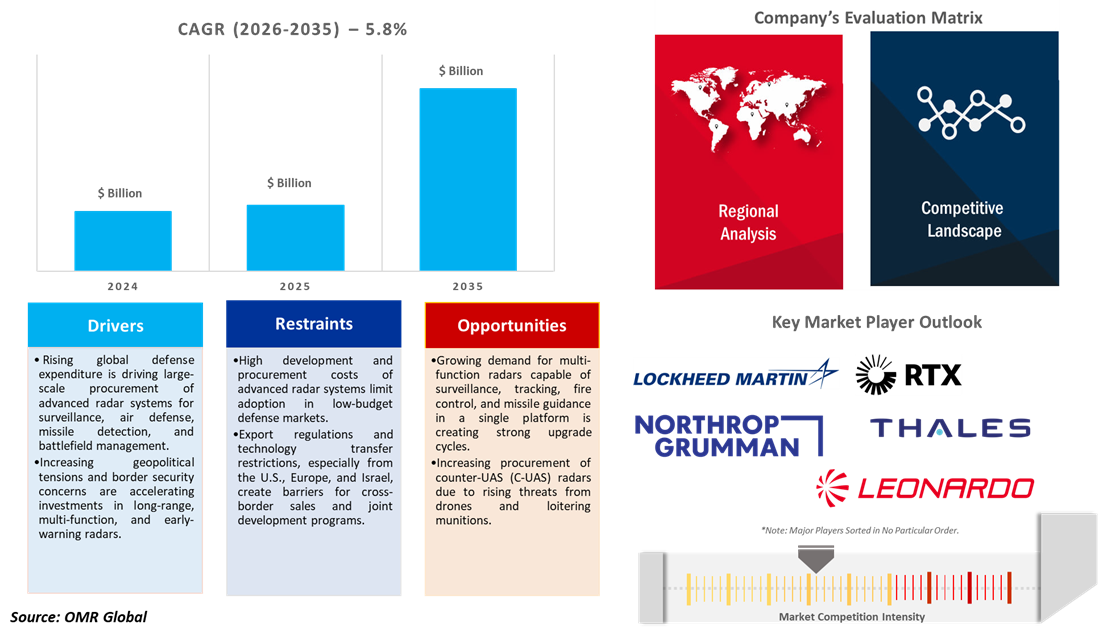
Military radars market was valued at $15.1 billion in 2025 and is projected to reach $26.6 billion by 2035, growing at a CAGR of 5.8% during the forecast period (2026-2035). The market is expanding as governments strengthen integrated air and missile defence networks, raise defence spending, and roll out large radar modernization and indigenization programmes across land, naval, airborne, and space domains. According to Stockholm International Peace Research Institute (SIPRI), the military expenditure rose by 9.4% to $2,718 billion in 2024, the highest level ever recorded and the tenth consecutive annual increase. This sustained rise in defence budgets is directly translating into increased procurement of advanced radar systems, as nations prioritize the modernization of air surveillance, early-warning networks, tracking and fire-control systems, and integrated air and missile defence (IAMD) capabilities. Higher allocations for equipment and technology upgrades are enabling ministries of defence to accelerate investments in VHF/UHF long-range radars, L- and S-band tracking radars, C-band weather and ATC radars, and multifunction AESA platforms, thereby driving steady expansion in the market.
Market Dynamics
Growing Radar Deployments for Border Security and Counter-UAS Operations
Governments are strengthening border surveillance infrastructure as unmanned aerial systems (UAS), smuggling drones, and low-flying threats increase in frequency and sophistication. These security pressures have accelerated investments in ground-based surveillance radars, low-altitude detection systems, and counter-UAS tracking radars. For instance, according to US Customs and Border Protection (CBP), in March 2024, the US Northern Command’s top general testified before Congress that there are more than 1,000 monthly drone incursions along the southern border.
In 2024, the U.S. Customs and Border Protection (CBP) Air and Marine Operations announced the launch of the Argos 2 tethered aerostat, which will operate alongside the long-running Tethered Aerostat Radar System (TARS), a radar network first deployed in 1980. According to the US Department of Homeland Security, the deployment of Argos 2 was initiated in response to significant upticks in illegal smuggling, low-altitude aircraft incursions, unregistered maritime traffic, and irregular border movement. TARS aerostats, which can operate at altitudes of 10,000–12,000 feet, carry long-range surveillance radars capable of overcoming curvature of the earth and terrain-driven line of sight limits, enabling persistent monitoring of low-level aircraft and small vessels approaching US borders. As border-security agencies adopt more persistent, high-altitude radar platforms to monitor increasingly complex aerial and maritime threats, procurement of VHF/UHF long-range radars, S-band coastal radars, and specialized counter-UAS radar systems continues to accelerate, directly supporting market growth.
Modernization of Naval Radar Suites as Maritime Tensions Intensify
Navies globally are accelerating upgrades to shipborne surveillance, fire-control, and air defence radars as maritime competition intensifies across the Indo-Pacific, Arctic, and North Atlantic regions. The shift toward multi-mission frigates, integrated mast architectures, and ballistic-missile-defence capable destroyers is driving adoption of next-generation AESA naval radars, C- and S-band multifunction radars, and maritime air-surveillance systems. The operational footprint of major naval forces reinforces this demand with 292 US battle-force ships, including 36% deployed globally and 20% underway, and more than 49,000 sailors and 30,000 Marines positioned across key maritime theatres. This extensive forward presence requires continuous radar coverage for situational awareness, missile-defence readiness, and threat detection, directly accelerating procurement of advanced shipborne surveillance radars, navigation radars, fire control radars, and long-range maritime air defence radars across the market.
Global Navy and Marine Corps
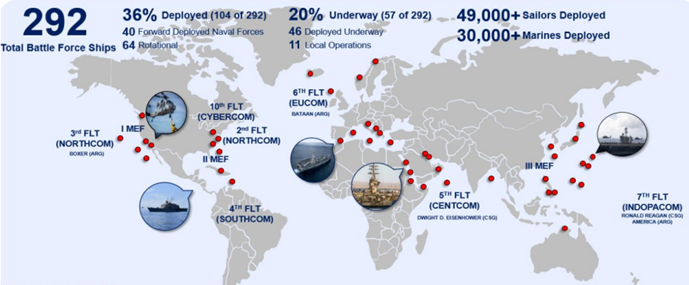
Source: Department of the Navy
Market Segmentation
- Based on the frequency band, the market is segmented into VHF/UHF Radar, L-Band Radar, S-Band Radar, C-Band Radar, and Others.
- Based on the application, the market is segmented into surveillance & airborne early warning, tracking & fire control, weapon locating, ground penetrating, weather monitoring, air traffic control, and others.
- Based on the end user, the market is segmented into Navy, Army, Airborne, and Space.
VHF/UHF radar systems Segment Driving Growth in the Military Radars Market
The interest in VHF/UHF radar systems is rising as militaries prioritize technologies capable of detecting low-observable and stealth aircraft, which are increasingly deployed across contested airspaces. In 2025, India’s development of the Surya VHF radar, designed by Alpha Design Technologies Ltd., reflects this growing emphasis. The radar operates in the VHF band, enabling improved tracking of stealth-shaped aircraft that are more difficult to detect with higher-frequency systems. With reported detection ranges of up to 400 km and strong performance across varied terrain, Surya indicated the expanding reliance on long wavelength radars for wide-area air surveillance and early warning missions. As nations strengthen air-defence postures against low-RCS targets such as fifth-generation fighters and advanced UAVs, demand for VHF/UHF radars is expected to increase steadily. This trend emphasizes the segment’s rising importance within the global military radars market as defence forces seek resilient, all-weather sensing capabilities.
Growing Importance of Surveillance & AEW Radars in Modern Defence Networks
The Surveillance & Airborne Early Warning (AEW) segment encompasses radar systems deployed on ground, maritime, and airborne platforms to provide wide-area detection, persistent air-space monitoring, and early threat warning. It plays a foundational role in defence networks by enabling timely situational awareness and cueing of tracking, fire-control, and missile-defence systems. Technological advancements are spurring this segment. Next-generation systems are incorporating Active Electronically Scanned Array (AESA) antennas, Gallium Nitride (GaN) components, and software defined radar architectures, improving detection of low-observable aircraft and extending range in contested environments. These developments are enabling the surveillance & AEW segment to address evolving threats in the domains of air, maritime, and land.
Regional Outlook
The global military radars market is further divided by region, including North America (the US and Canada), Europe (the UK, Germany, France, Italy, Spain, Russia, and the Rest of Europe), Asia-Pacific (India, China, Japan, South Korea, Australia and New Zealand, ASEAN Countries, and the Rest of Asia-Pacific), and the Rest of the World (the Middle East & Africa, and Latin America).
North America Leads the Global Military Radars Market Growth
North America remains the leading region in the global military radars market, supported by strong defence spending, an extensive radar infrastructure, and continuous modernization across land, air, naval, and space operations. A key driver of regional growth is the presence of highly advanced radar networks used for defense and also for aviation safety and environmental monitoring capabilities that directly complement military radar innovation. For instance, the Next Generation Weather Radar (NEXRAD) system comprises a network of 160 high-resolution S-band Doppler radars jointly operated by the National Weather Service (NWS), the Federal Aviation Administration (FAA), and the US Air Force. The NEXRAD system supports wide area atmospheric surveillance, wind detection, and precipitation tracking, and has accumulated a significant dataset used for algorithm development and system verification.
Market Players Outlook
The major companies operating in the global military radar market include Lockheed Martin Corp., RTX Corp., Northrop Grumman, Thales Group, Leonardo S.p.A., among others. Market players are leveraging partnerships, collaborations, mergers, and acquisition strategies for business expansion and innovative product development to maintain their market positioning.
Recent Developments
- In October 2024, Raytheon Co., Woburn, Massachusetts, received a $900 million contract modification, raising the total ceiling of its existing radar support contract from $1.7 billion to $2.6 billion. The two-year extension, awarded through a sole-source process, allows Raytheon to continue operations and sustainment support for the Sea-Based X-Band Radar (SBX) and 13 Army-Navy Transportable Radar Surveillance and Control (AN/TPY-2) systems under mixed contract types, including cost-plus and firm-fixed-price line items.
- In February 2025, The Deep Space Advanced Radar Capability (DARC) program, a trilateral partnership between the United States, the United Kingdom, and Australia, has made significant progress in its first year. Designed to provide an all-weather global network capable of tracking very small objects in geosynchronous orbit, DARC strengthens space-domain awareness and protection of allied satellite services.
- In July 2024, HENSOLDT expanded its position as a national technology champion for air defence sensors. Rheinmetall Air Defence has awarded HENSOLDT a contract to supply SPEXER air defence radars for use in the new Skyranger 30 anti-aircraft gun tank (FlakPz).
The Report Covers
- Market value data analysis of 2025 and forecast to 2035.
- Annualized market revenues ($ million) for each market segment.
- Country-wise analysis of major geographical regions.
- Key companies operating in the global military radars market. Based on the availability of data, information related to new products and relevant news is also available in the report.
- Analysis of business strategies by identifying the key market segments positioned for strong growth in the future.
- Analysis of market-entry and market expansion strategies.
- Competitive strategies by identifying ‘who-stands-where’ in the market.
- Report Summary
- Current Industry Analysis and Growth Potential Outlook
- Global Military Radars Market Sales Analysis – Frequency Band | Application | End User ($ Million)
- Military Radars Market Sales Performance of Top Countries
- Research Methodology
- Primary Research Approach
- Secondary Research Approach
- Market Snapshot
- Market Overview and Insights
- Scope of the Study
- Analyst Insight & Current Market Trends
- Key Military Radars Industry Trends
- Market Recommendations
- Market Determinants
- Market Drivers
- Drivers For the Global Military Radars Market: Impact Analysis
- Market Pain Points and Challenges
- Restraints For Global Military Radars Market: Impact Analysis
- Market Opportunities
- Opportunities For Global Military Radars Market: Impact Analysis
- Market Drivers
- Competitive Landscape
- Competitive Dashboard – Military Radars Market Revenue and Share by Manufacturers
- Military Radars Product Comparison Analysis
- Top Market Player Ranking Matrix
- Key Company Analysis
- Lockheed Martin Corp.
- Overview
- Product Portfolio
- Financial Analysis
- SWOT Analysis
- Business Strategy
- RTX Corp.
- Overview
- Product Portfolio
- Financial Analysis
- SWOT Analysis
- Business Strategy
- Northrop Grumman
- Overview
- Product Portfolio
- Financial Analysis
- SWOT Analysis
- Business Strategy
- Thales Group
- Overview
- Product Portfolio
- Financial Analysis
- SWOT Analysis
- Business Strategy
- Leonardo S.p.A.
- Overview
- Product Portfolio
- Financial Analysis
- SWOT Analysis
- Business Strategy
- Lockheed Martin Corp.
- Key Company Analysis
- Top Winning Strategies by Market Players
- Merger and Acquisition
- Product Launch
- Partnership And Collaboration
- Global Military Radars Market Sales Analysis by Frequency Band ($ Million)
- VHF/ UHF Radar
- L-Band Radar
- S-Band Radar
- C-Band Radar
- Other
- Global Military Radars Market Sales Analysis by Application ($ Million)
- Surveillance & Airborne Early Warning
- Tracking & Fire Control
- Weapon Locating
- Ground Penetrating
- Weather Monitoring
- Air Traffic Control
- Others
- Global Military Radars Market Sales Analysis by End User ($ Million)
- Navy
- Army
- Airborne
- Space
- Regional Analysis
- North American Military Radars Market Sales Analysis – Frequency Band | Application | Solution| End User| Country ($ Million)
- Macroeconomic Factors for North America
- United States
- Canada
- European Military Radars Market Sales Analysis – Frequency Band | Application | Solution| End User | Country ($ Million)
- Macroeconomic Factors for Europe
- UK
- Germany
- Italy
- Spain
- France
- Russia
- Rest of Europe
- Asia-Pacific Military Radars Market Sales Analysis – Frequency Band | Application | Solution| End User | Country ($ Million)
- Macroeconomic Factors for Asia-Pacific
- China
- Japan
- South Korea
- India
- Australia & New Zealand
- ASEAN Countries (Thailand, Indonesia, Vietnam, Singapore, And Other)
- Rest of Asia-Pacific
- Rest of the World Military Radars Market Sales Analysis – Frequency Band | Application | Solution| End User | Country ($ Million)
- Macroeconomic Factors for the Rest of the World
- Latin America
- Middle East and Africa
- Company Profiles
- Airbus
- Quick Facts
- Company Overview
- Product Portfolio
- Business Strategies
- Aselsan A.S.
- Quick Facts
- Company Overview
- Product Portfolio
- Business Strategies
- BAE Systems plc.
- Quick Facts
- Company Overview
- Product Portfolio
- Business Strategies
- Bharat Electronics Ltd. (BEL)
- Quick Facts
- Company Overview
- Product Portfolio
- Business Strategies
- Boeing Company
- Quick Facts
- Company Overview
- Product Portfolio
- Business Strategies
- Elbit Systems Deutschland
- Quick Facts
- Company Overview
- Product Portfolio
- Business Strategies
- General Dynamics Mission Systems, Inc.
- Quick Facts
- Company Overview
- Product Portfolio
- Business Strategies
- Hensoldt AG
- Quick Facts
- Company Overview
- Product Portfolio
- Business Strategies
- Israel Aerospace Industries Ltd. (IAI)
- Quick Facts
- Company Overview
- Product Portfolio
- Business Strategies
- L3Harris Technologies, Inc.
- Quick Facts
- Company Overview
- Product Portfolio
- Business Strategies
- Leonardo S.p.A.
- Quick Facts
- Company Overview
- Product Portfolio
- Business Strategies
- LIG Nex1
- Quick Facts
- Company Overview
- Product Portfolio
- Business Strategies
- Lockheed Martin Corp.
- Quick Facts
- Company Overview
- Product Portfolio
- Business Strategies
- Meteksan Defence Industry Inc.
- Quick Facts
- Company Overview
- Product Portfolio
- Business Strategies
- Mitsubishi Electric Corp.
- Quick Facts
- Company Overview
- Product Portfolio
- Business Strategies
- NEC Corp.
- Quick Facts
- Company Overview
- Product Portfolio
- Business Strategies
- Northrop Grumman
- Quick Facts
- Company Overview
- Product Portfolio
- Business Strategies
- Rheinmetall AG
- Quick Facts
- Company Overview
- Product Portfolio
- Business Strategies
- RTX Corp.
- Quick Facts
- Company Overview
- Product Portfolio
- Business Strategies
- Saab AB
- Quick Facts
- Company Overview
- Product Portfolio
- Business Strategies
- Sistemas, S.A. (Indra)
- Quick Facts
- Company Overview
- Product Portfolio
- Business Strategies
- Terma Group
- Quick Facts
- Company Overview
- Product Portfolio
- Business Strategies
- Thales Group
- Quick Facts
- Company Overview
- Product Portfolio
- Business Strategies
- Airbus
1. Global Military Radars Market Research and Analysis by Frequency Band, 2025–2035 ($ Million)
2. Global VHF/UHF Military Radars Market Research and Analysis by Region, 2025–2035 ($ Million)
3. Global L-Band Military Radars Market Research and Analysis by Region, 2025–2035 ($ Million)
4. Global S-Band Military Radars Market Research and Analysis by Region, 2025–2035 ($ Million)
5. Global C-Band Military Radars Market Research and Analysis by Region, 2025–2035 ($ Million)
6. Global Other Frequency Band Military Radars Market Research and Analysis by Region, 2025–2035 ($ Million)
7. Global Military Radars Market Research and Analysis by Application, 2025–2035 ($ Million)
8. Global Military Radars for Surveillance & Airborne Early Warning Market Research and Analysis by Region, 2025–2035 ($ Million)
9. Global Military Radars for Tracking & Fire Control Market Research and Analysis by Region, 2025–2035 ($ Million)
10. Global Military Radars for Weapon Locating Market Research and Analysis by Region, 2025–2035 ($ Million)
11. Global Military Radars for Ground Penetrating Applications Market Research and Analysis by Region, 2025–2035 ($ Million)
12. Global Military Radars for Weather Monitoring Market Research and Analysis by Region, 2025–2035 ($ Million)
13. Global Military Radars for Air Traffic Control Market Research and Analysis by Region, 2025–2035 ($ Million)
14. Global Military Radars for Other Applications Market Research and Analysis by Region, 2025–2035 ($ Million)
15. Global Military Radars Market Research and Analysis by End User, 2025–2035 ($ Million)
16. Global Military Radars for Navy Market Research and Analysis by Region, 2025–2035 ($ Million)
17. Global Military Radars for Army Market Research and Analysis by Region, 2025–2035 ($ Million)
18. Global Military Radars for Airborne Market Research and Analysis by Region, 2025–2035 ($ Million)
19. Global Military Radars for Space Market Research and Analysis by Region, 2025–2035 ($ Million)
20. North American Military Radars Market Research and Analysis by Country, 2025–2035 ($ Million)
21. North American Military Radars Market Research and Analysis by Frequency Band, 2025–2035 ($ Million)
22. North American Military Radars Market Research and Analysis by Application, 2025–2035 ($ Million)
23. North American Military Radars Market Research and Analysis by End User, 2025–2035 ($ Million)
24. European Military Radars Market Research and Analysis by Country, 2025–2035 ($ Million)
25. European Military Radars Market Research and Analysis by Frequency Band, 2025–2035 ($ Million)
26. European Military Radars Market Research and Analysis by Application, 2025–2035 ($ Million)
27. European Military Radars Market Research and Analysis by End User, 2025–2035 ($ Million)
28. Asia-Pacific Military Radars Market Research and Analysis by Country, 2025–2035 ($ Million)
29. Asia-Pacific Military Radars Market Research and Analysis by Frequency Band, 2025–2035 ($ Million)
30. Asia-Pacific Military Radars Market Research and Analysis by Application, 2025–2035 ($ Million)
31. Asia-Pacific Military Radars Market Research and Analysis by End User, 2025–2035 ($ Million)
32. Rest of the World Military Radars Market Research and Analysis by Country, 2025–2035 ($ Million)
33. Rest of the World Military Radars Market Research and Analysis by Frequency Band, 2025–2035 ($ Million)
34. Rest of the World Military Radars Market Research and Analysis by Application, 2025–2035 ($ Million)
35. Rest of the World Military Radars Market Research and Analysis by End User, 2025–2035 ($ Million)
36. Global Military Radars Market Research and Analysis by Frequency Band, 2025 Vs 2035 (%)
37. Global VHF/UHF Military Radars Market Research and Analysis by Region, 2025 Vs 2035 (%)
38. Global L-Band Military Radars Market Research and Analysis by Region, 2025 Vs 2035 (%)
39. Global S-Band Military Radars Market Research and Analysis by Region, 2025 Vs 2035 (%)
40. Global C-Band Military Radars Market Research and Analysis by Region, 2025 Vs 2035 (%)
41. Global Other Frequency Band Military Radars Market Research and Analysis by Region, 2025 Vs 2035 (%)
42. Global Military Radars Market Research and Analysis by Application, 2025 Vs 2035 (%)
43. Global Military Radars for Surveillance & Airborne Early Warning Market Research and Analysis by Region, 2025 Vs 2035 (%)
44. Global Military Radars for Tracking & Fire Control Market Research and Analysis by Region, 2025 Vs 2035 (%)
45. Global Military Radars for Weapon Locating Market Research and Analysis by Region, 2025 Vs 2035 (%)
46. Global Military Radars for Ground Penetrating Applications Market Research and Analysis by Region, 2025 Vs 2035 (%)
47. Global Military Radars for Weather Monitoring Market Research and Analysis by Region, 2025 Vs 2035 (%)
48. Global Military Radars for Air Traffic Control Market Research and Analysis by Region, 2025 Vs 2035 (%)
49. Global Military Radars for Other Applications Market Research and Analysis by Region, 2025 Vs 2035 (%)
50. Global Military Radars Market Research and Analysis by End User, 2025 Vs 2035 (%)
51. Global Military Radars for Navy Market Research and Analysis by Region, 2025 Vs 2035 (%)
52. Global Military Radars for Army Market Research and Analysis by Region, 2025 Vs 2035 (%)
53. Global Military Radars for Airborne Market Research and Analysis by Region, 2025 Vs 2035 (%)
54. Global Military Radars for Space Market Research and Analysis by Region, 2025 Vs 2035 (%)
55. Global Military Radars Market Share by Region, 2025 Vs 2035 (%)
56. US Military Radars Market Size, 2025–2035 ($ Million)
57. Canada Military Radars Market Size, 2025–2035 ($ Million)
58. UK Military Radars Market Size, 2025–2035 ($ Million)
59. France Military Radars Market Size, 2025–2035 ($ Million)
60. Germany Military Radars Market Size, 2025–2035 ($ Million)
61. Italy Military Radars Market Size, 2025–2035 ($ Million)
62. Spain Military Radars Market Size, 2025–2035 ($ Million)
63. Russia Military Radars Market Size, 2025–2035 ($ Million)
64. Rest of Europe Military Radars Market Size, 2025–2035 ($ Million)
65. India Military Radars Market Size, 2025–2035 ($ Million)
66. China Military Radars Market Size, 2025–2035 ($ Million)
67. Japan Military Radars Market Size, 2025–2035 ($ Million)
68. South Korea Military Radars Market Size, 2025–2035 ($ Million)
69. Australia and New Zealand Military Radars Market Size, 2025–2035 ($ Million)
70. ASEAN Economies Military Radars Market Size, 2025–2035 ($ Million)
71. Rest of Asia-Pacific Military Radars Market Size, 2025–2035 ($ Million)
72. Latin America Military Radars Market Size, 2025–2035 ($ Million)
73. Middle East and Africa Military Radars Market Size, 2025–2035 ($ Million)
- Printable version
- No restriction to number of users within the company