RF Antenna Market: Growth, Size, Share, and Trends


RF Antenna Market Size, Share & Trends Analysis Report by Type (Dipole Antennas, Monopole Antennas, Patch/Microstrip Antennas, Others), by Frequency Band (VHF/UHF Band, L-Band, S-Band, and C-Band), by End User (Automotive, Construction & Mining, Energy & Power, Manufacturing Machinery, Marine, Agriculture, and Others), Forecast Period (2026–2035)
Industry Overview
RF antenna market was valued at $2.95 billion in 2025 and is projected to reach $4.25 billion by 2035, growing at a CAGR of 3.8% during the forecast period. The market is expanding due to rising deployment of wireless communication systems, accelerating adoption of satellite navigation technologies, and broader use of RF based sensing across different industries. For instance, in May 2024, Abracon launched a new line of high-precision GNSS antennas engineered for full band support, including L1/L2/L5 and L-band correction services. These antennas deliver centimeter-level precision, fast signal acquisition, improved tracking, and low-power operation, enabling next-generation performance across agriculture, surveying, mapping, industrial IoT, defense, and aviation. Abracon’s multi-band approach reflects a wider industry trend toward advanced RF antenna architectures that support high-precision positioning, resilient navigation, and mission critical sensing.

Market Dynamics
Surge in Spectrum Allocation and Wireless Infrastructure Expansion
Governments globally are releasing new frequency allocations and accelerating telecom infrastructure modernization, resulting in increased deployment of RF antennas across VHF/UHF, L-Band, S-Band, and C-Band. In October 2025, the Federal Communications Commission (FCC) circulated a proposal to seek public comments on repurposing spectrum in the 3.98–4.2 GHz Upper C-Band for next-generation wireless services. The initiative reflects ongoing regulatory efforts to expand mid-band spectrum availability for 5G and future 6G networks. Increasing attention to spectrum reallocation and more efficient use of existing bands supports continued growth in wireless infrastructure deployment across the US. This increases the demand for RF antennas designed for mid-brand applications, including macro-cell, small-cell, and fixed wireless systems.
Broadband Coverage Programs Driving RF Antenna Deployment
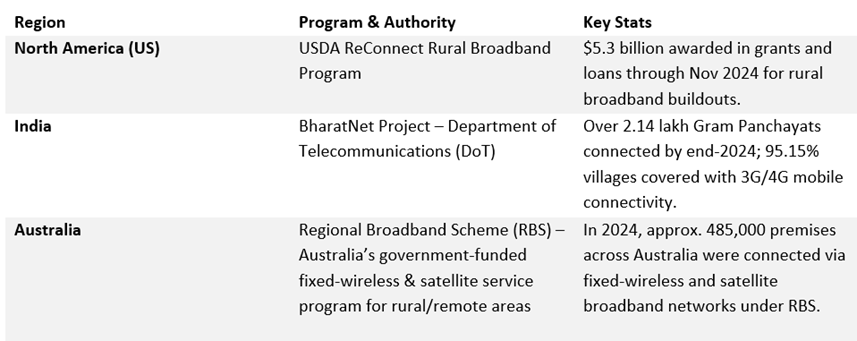
Governments are expanding broadband connectivity initiatives to bridge digital divides in underserved and remote regions, creating substantial demand for RF antennas across fixed wireless, satellite, and mobile access networks. National broadband missions increasingly rely on multi-band antenna systems to deliver last-mile and middle-mile connectivity where fiber deployment is costly or impractical. Programs supporting rural villages, agricultural communities, island territories, and low-density regions heavily depend on VHF/UHF, L-Band, S-Band, and C-Band antenna architectures.
Large-scale funding commitments to rural broadband and universal service obligations are accelerating procurement of base-station antennas, point-to-point microwave antennas, and customer-premise antennas. Increased adoption of wireless backhauls, satellite broadband terminals, and community Wi-Fi infrastructure further amplifies antenna requirements. These government-led broadband programs are directly expanding the operational environment for RF antenna manufacturers and driving new opportunities across telecom, industrial, and public-sector deployments.
Broadband Coverage Programs
Market Segmentation
- Based on the type, the market is segmented into dipole antennas, monopole antennas, patch/microstrip antennas and others.
- Based on the frequency band, the market is segmented into the VHF/UHF band, L-band, S-band, and C-band.
- Based on the end user, the market is segmented into automotive, construction & mining, energy & power, manufacturing machinery, marine, agriculture, and others.
Microstrip Antenna Segment Driving Growth in the RF Antenna Market
In the market, the Microstrip Antenna segment is emerging as a key growth driver, supported by the rising integration of compact, low-profile antennas across wireless communication systems, GNSS devices, aerospace platforms, and consumer electronics. Microstrip antennas, also known as microstrip patch antennas, feature a flat, two-dimensional conductive patch mounted over a dielectric substrate, offering lightweight construction, low volume, and easy integration into compact devices. Its rectangular or circular patch designs enable efficient performance while maintaining a small footprint, which is critical for smartphones, IoT devices, UAVs, radars, and satellite receivers. The construction of microstrip antennas, typically using copper patches over a ground plane with controlled dielectric materials, ensures consistent signal resonance, low radiation loss, and compatibility with monolithic microwave integrated circuits (MMICs). Wireless systems evolve toward multi-band and high-precision operation, microstrip antennas support advanced feeding mechanisms including microstrip line feed, coaxial probe feed, aperture coupled feed, and proximity-coupled feed, each improving bandwidth, polarization purity, or radiation efficiency. These design advantages make microstrip antennas indispensable in modern RF applications such as satellites, missiles, aircraft, mobile phones, and remote sensing systems.
Regional Outlook
The global RF antenna market is further divided by region, including North America (the US and Canada), Europe (the UK, Germany, France, Italy, Spain, Russia, and the Rest of Europe), Asia-Pacific (India, China, Japan, South Korea, Australia and New Zealand, ASEAN Countries, and the Rest of Asia-Pacific), and the Rest of the World (the Middle East & Africa, and Latin America).
Asia Pacific Leads the Global RF Antenna Market Growth
The Asia Pacific region is increasingly driving growth in the global RF antenna market through investment in satellite navigation and remote sensing systems, robust electronics manufacturing, and expanding wireless infrastructure. According to the State Council of China, the output value of the satellite navigation and positioning-service industry reached $79.9 billion in 2024, up 7.39 % year-on-year. Approximately 288 million mobile phones in China were equipped with the BeiDou Navigation Satellite System (BDS), and the system covered more than 99 % of urban and rural roads nationwide.
In February 2025, in Japan, advanced synthetic-aperture radar (SAR) satellite programmers were underway, including small satellite constellations and deployable antennas, in support of disaster monitoring and defense communications missions. These developments expand demand for high precision antennas, including patch/microstrip, helical, and parabolic types for GNSS, satellite links, aerospace platforms, and IoT devices. The region’s large electronics fabrication base, combined with strong government driven satellite and navigation programmes, creates a favorable environment for RF antenna manufacturers.
Market Players Outlook
The major companies operating in the global RF antenna market include Amphenol RF (Amphenol Corporation), CommScope Holding Company, Inc., Airgain, Inc., TE Connectivity plc, Yageo Group (Pulse Electronics Antennas), among others. Market players are leveraging partnerships, collaborations, mergers, and acquisition strategies for business expansion and innovative product development to maintain their market positioning.
Recent Developments
- In October 2024, Taoglas launched AntJack, a Wi-Fi antenna that is mounted on a standard RJ45 Ethernet connector. The new FXM100 Wi-Fi antenna can be mounted on Taoglas’ TMJG4926HENL or any standard 1x1 RJ45 connector to create a 2-in-1 solution, providing designers space saving options and layout flexibility to improve wireless coverage across 2.4 GHz, 5.8 GHz, and 7.1 GHz bands.
- In May 2024, RF SPIN designed and manufactured an antenna for Airbus Defence and Space’s compact range measurement system. The custom antenna, weighing 31 kg, delivered unmatched precision and power while meeting the client’s stringent requirements, including a frequency range of 500-700 MHz.
- In March 2024, Laird Connectivity announced the release of the sub-GHz FlexDipole Antenna. This antenna is designed to support the 863 MHz - 928 MHz frequency range for sub-GHz solutions such as LoRaWAN, Sigfox, and Proprietary RF.
The Report Covers
- Market value data analysis of 2025 and forecast to 2035.
- Annualized market revenues ($ million) for each market segment.
- Country-wise analysis of major geographical regions.
- Key companies operating in the global RF antenna market. Based on the availability of data, information related to new products and relevant news is also available in the report.
- Analysis of business strategies by identifying the key market segments positioned for strong growth in the future.
- Analysis of market-entry and market expansion strategies.
- Competitive strategies by identifying ‘who-stands-where’ in the market.
- Report Summary
- Current Industry Analysis and Growth Potential Outlook
- Global RF Antenna Market Sales Analysis – Types | Frequency Band | End User ($ Million)
- RF Antenna Market Sales Performance of Top Countries
- Research Methodology
- Primary Research Approach
- Secondary Research Approach
- Market Snapshot
- Market Overview and Insights
- Scope of the Study
- Analyst Insight & Current Market Trends
- Key RF Antenna Industry Trends
- Market Recommendations
- Porter's Five Forces Analysis for the RF Antenna Market
- Competitive Rivalry
- Threat of New Entrants
- Bargaining Power of Suppliers
- Bargaining Power of Buyers
- Threat of Substitutes
- Market Determinants
- Market Drivers
- Drivers For the Global RF Antenna Market: Impact Analysis
- Market Pain Points and Challenges
- Restraints For Global RF Antenna Market: Impact Analysis
- Market Opportunities
- Opportunities For Global RF Antenna Market: Impact Analysis
- Market Drivers
- Competitive Landscape
- Competitive Dashboard – RF Antenna Market Revenue and Share by Manufacturers
- RF Antenna Product Comparison Analysis
- Top Market Player Ranking Matrix
- Key Company Analysis
- Amphenol RF (Amphenol Corporation)
- Overview
- Product Portfolio
- Financial Analysis
- SWOT Analysis
- Business Strategy
- CommScope, Inc.
- Overview
- Product Portfolio
- Financial Analysis
- SWOT Analysis
- Business Strategy
- Airgain, Inc.
- Overview
- Product Portfolio
- Financial Analysis
- SWOT Analysis
- Business Strategy
- TE Connectivity plc
- Overview
- Product Portfolio
- Financial Analysis
- SWOT Analysis
- Business Strategy
- Yageo Group
- Overview
- Product Portfolio
- Financial Analysis
- SWOT Analysis
- Business Strategy
- Amphenol RF (Amphenol Corporation)
- Key Company Analysis
- Top Winning Strategies by Market Players
- Merger and Acquisition
- Product Launch
- Partnership And Collaboration
- Global RF Antenna Market Sales Analysis by Type ($ Million)
- Dipole Antennas
- Monopole Antennas
- Patch/Microstrip Antennas
- Others
- Global RF Antenna Market Sales Analysis by Frequency Band ($ Million)
- HF/VHF
- UHF
- SHF
- EHF/mmWave
- Global RF Antenna Market Sales Analysis by End User ($ Million)
- Automotive
- Construction & Mining
- Energy & Power
- Manufacturing Machinery
- Marine
- Agriculture
- Others
- Regional Analysis
- North American RF Antenna Market Sales Analysis – Types | Frequency Band | End User | Country ($ Million)
- Macroeconomic Factors for North America
- United States
- Canada
- European RF Antenna Market Sales Analysis – Types | Frequency Band | End User | Country ($ Million)
- Macroeconomic Factors for Europe
- UK
- Germany
- Italy
- Spain
- France
- Russia
- Rest of Europe
- Asia-Pacific RF Antenna Market Sales Analysis – Types | Frequency Band | End User | Country ($ Million)
- Macroeconomic Factors for Asia-Pacific
- China
- Japan
- South Korea
- India
- Australia & New Zealand
- ASEAN Countries (Thailand, Indonesia, Vietnam, Singapore, And Other)
- Rest of Asia-Pacific
- Rest of the World RF Antenna Market Sales Analysis – Types | Frequency Band | End User | Country ($ Million)
- Macroeconomic Factors for the Rest of the World
- Latin America
- Middle East and Africa
- Company Profiles
- H. Systems, inc.
- Quick Facts
- Company Overview
- Product Portfolio
- Business Strategies
- Abracon LLC
- Quick Facts
- Company Overview
- Product Portfolio
- Business Strategies
- Airgain, Inc.
- Quick Facts
- Company Overview
- Product Portfolio
- Business Strategies
- Amphenol RF (Amphenol Corporation)
- Quick Facts
- Company Overview
- Product Portfolio
- Business Strategies
- Anywaves
- Quick Facts
- Company Overview
- Product Portfolio
- Business Strategies
- Barker & Williamson
- Quick Facts
- Company Overview
- Product Portfolio
- Business Strategies
- CAES (Honeywell)
- Quick Facts
- Company Overview
- Product Portfolio
- Business Strategies
- Chengdu RF Miso Co., Ltd.
- Quick Facts
- Company Overview
- Product Portfolio
- Business Strategies
- CommScope, Inc.
- Quick Facts
- Company Overview
- Product Portfolio
- Business Strategies
- Com-Power Corp.
- Quick Facts
- Company Overview
- Product Portfolio
- Business Strategies
- Digi International Inc
- Quick Facts
- Company Overview
- Product Portfolio
- Business Strategies
- GCT (Global Connector Technology)
- Quick Facts
- Company Overview
- Product Portfolio
- Business Strategies
- HUBER+SUHNER AG
- Quick Facts
- Company Overview
- Product Portfolio
- Business Strategies
- INPAQ Technology Co., Ltd.
- Quick Facts
- Company Overview
- Product Portfolio
- Business Strategies
- Molex, LLC
- Quick Facts
- Company Overview
- Product Portfolio
- Business Strategies
- RF Antenna Technology Corp.
- Quick Facts
- Company Overview
- Product Portfolio
- Business Strategies
- Sharvi Electronics
- Quick Facts
- Company Overview
- Product Portfolio
- Business Strategies
- Siretta Ltd.
- Quick Facts
- Company Overview
- Product Portfolio
- Business Strategies
- Suntsu Electronics, Inc
- Quick Facts
- Company Overview
- Product Portfolio
- Business Strategies
- TE Connectivity plc
- Quick Facts
- Company Overview
- Product Portfolio
- Business Strategies
- Tesswave Technology Limited
- Quick Facts
- Company Overview
- Product Portfolio
- Business Strategies
- Valcom Manufacturing Group Inc
- Quick Facts
- Company Overview
- Product Portfolio
- Business Strategies
- Williams AV, LLC
- Quick Facts
- Company Overview
- Product Portfolio
- Business Strategies
- Yageo Group
- Quick Facts
- Company Overview
- Product Portfolio
- Business Strategies
- H. Systems, inc.
1. Global RF Antenna Market Research and Analysis by Type, 2025–2035 ($ Million
2. Global Dipole Antennas Market Research and Analysis by Region, 2025–2035 ($ Million)
3. Global Monopole Antennas Market Research and Analysis by Region, 2025–2035 ($ Million)
4. Global Patch/Microstrip Antennas Market Research and Analysis by Region, 2025–2035 ($ Million)
5. Global Other RF Antennas Market Research and Analysis by Region, 2025–2035 ($ Million)
6. Global RF Antenna Market Research and Analysis by Frequency Band, 2025–2035 ($ Million)
7. Global VHF/UHF Band RF Antenna Market Research and Analysis by Region, 2025–2035 ($ Million)
8. Global L-Band RF Antenna Market Research and Analysis by Region, 2025–2035 ($ Million)
9. Global S-Band RF Antenna Market Research and Analysis by Region, 2025–2035 ($ Million)
10. Global C-Band RF Antenna Market Research and Analysis by Region, 2025–2035 ($ Million)
11. Global RF Antenna Market Research and Analysis by End User, 2025–2035 ($ Million)
12. Global RF Antenna for Automotive Market Research and Analysis by Region, 2025–2035 ($ Million)
13. Global RF Antenna for Construction & Mining Market Research and Analysis by Region, 2025–2035 ($ Million)
14. Global RF Antenna for Energy & Power Market Research and Analysis by Region, 2025–2035 ($ Million)
15. Global RF Antenna for Manufacturing Machinery Market Research and Analysis by Region, 2025–2035 ($ Million)
16. Global RF Antenna for Marine Market Research and Analysis by Region, 2025–2035 ($ Million)
17. Global RF Antenna for Agriculture Market Research and Analysis by Region, 2025–2035 ($ Million)
18. Global RF Antenna for End-User Market Research and Analysis by Region, 2025–2035 ($ Million)
19. Global RF Antenna Market Research and Analysis by Region, 2025–2035 ($ Million)
20. North American RF Antenna Market Research and Analysis by Country, 2025–2035 ($ Million)
21. North American RF Antenna Market Research and Analysis by Type, 2025–2035 ($ Million)
22. North American RF Antenna Market Research and Analysis by Frequency Band, 2025–2035 ($ Million)
23. North American RF Antenna Market Research and Analysis by End User, 2025–2035 ($ Million)
24. European RF Antenna Market Research and Analysis by Country, 2025–2035 ($ Million)
25. European RF Antenna Market Research and Analysis by Type, 2025–2035 ($ Million)
26. European RF Antenna Market Research and Analysis by Frequency Band, 2025–2035 ($ Million)
27. European RF Antenna Market Research and Analysis by End User, 2025–2035 ($ Million)
28. Asia-Pacific RF Antenna Market Research and Analysis by Country, 2025–2035 ($ Million)
29. Asia-Pacific RF Antenna Market Research and Analysis by Type, 2025–2035 ($ Million)
30. Asia-Pacific RF Antenna Market Research and Analysis by Frequency Band, 2025–2035 ($ Million)
31. Asia-Pacific RF Antenna Market Research and Analysis by End User, 2025–2035 ($ Million)
32. Rest of the World RF Antenna Market Research and Analysis by Region, 2025–2035 ($ Million)
33. Rest of the World RF Antenna Market Research and Analysis by Type, 2025–2035 ($ Million)
34. Rest of the World RF Antenna Market Research and Analysis by Frequency Band, 2025–2035 ($ Million)
35. Rest of the World RF Antenna Market Research and Analysis by End User, 2025–2035 ($ Million)
1. Global RF Antenna Market Research and Analysis by Type, 2025 Vs 2035 (%)
2. Global Dipole Antennas Market Research and Analysis by Region, 2025 Vs 2035 (%)
3. Global Monopole Antennas Market Research and Analysis by Region, 2025 Vs 2035 (%)
4. Global Patch/Microstrip Antennas Market Research and Analysis by Region, 2025 Vs 2035 (%)
5. Global Other RF Antennas Market Research and Analysis by Region, 2025 Vs 2035 (%)
6. Global RF Antenna Market Research and Analysis by Frequency Band, 2025 Vs 2035 (%)
7. Global VHF/UHF Band RF Antenna Market Research and Analysis by Region, 2025 Vs 2035 (%)
8. Global L-Band RF Antenna Market Research and Analysis by Region, 2025 Vs 2035 (%)
9. Global S-Band RF Antenna Market Research and Analysis by Region, 2025 Vs 2035 (%)
10. Global C-Band RF Antenna Market Research and Analysis by Region, 2025 Vs 2035 (%)
11. Global RF Antenna Market Research and Analysis by End User, 2025 Vs 2035 (%)
12. Global RF Antenna for Automotive Market Research and Analysis by Region, 2025 Vs 2035 (%)
13. Global RF Antenna for Construction & Mining Market Research and Analysis by Region, 2025 Vs 2035 (%)
14. Global RF Antenna for Energy & Power Market Research and Analysis by Region, 2025 Vs 2035 (%)
15. Global RF Antenna for Manufacturing Machinery Market Research and Analysis by Region, 2025 Vs 2035 (%)
16. Global RF Antenna for Marine Market Research and Analysis by Region, 2025 Vs 2035 (%)
17. Global RF Antenna for Agriculture Market Research and Analysis by Region, 2025 Vs 2035 (%)
18. Global RF Antenna for End-User Market Research and Analysis by Region, 2025 Vs 2035 (%)
19. Global RF Antenna Market Research and Analysis by Region, 2025 Vs 2035 (%)
20. US RF Antenna Market Size, 2025–2035 ($ Million)
21. Canada RF Antenna Market Size, 2025–2035 ($ Million)
22. UK RF Antenna Market Size, 2025–2035 ($ Million)
23. France RF Antenna Market Size, 2025–2035 ($ Million)
24. Germany RF Antenna Market Size, 2025–2035 ($ Million)
25. Italy RF Antenna Market Size, 2025–2035 ($ Million)
26. Spain RF Antenna Market Size, 2025–2035 ($ Million)
27. Russia RF Antenna Market Size, 2025–2035 ($ Million)
28. Rest of Europe RF Antenna Market Size, 2025–2035 ($ Million)
29. India RF Antenna Market Size, 2025–2035 ($ Million)
30. China RF Antenna Market Size, 2025–2035 ($ Million)
31. Japan RF Antenna Market Size, 2025–2035 ($ Million)
32. South Korea RF Antenna Market Size, 2025–2035 ($ Million)
33. Australia and New Zealand RF Antenna Market Size, 2025–2035 ($ Million)
34. ASEAN Economies RF Antenna Market Size, 2025–2035 ($ Million)
35. Rest of Asia-Pacific RF Antenna Market Size, 2025–2035 ($ Million)
36. Latin America RF Antenna Market Size, 2025–2035 ($ Million)
37. Middle East and Africa RF Antenna Market Size, 2025–2035 ($ Million)
- Printable version
- No restriction to number of users within the company