Oil Condition Monitoring Market


Oil Condition Monitoring Market Size, Share & Trends Analysis Report by Type (Rental, and Lease) by Technology (Filtration, Ultrafiltration, Reverse Osmosis, Softening, Disinfection, Others (deionization, clarification, degassing, seawater desalination)) by Service Model (Emergency, Planned, and Multi-Year), By End-User (Oil and Gas, Petrochemical and Chemical, Power and Utility, Paper and Pulp, Mining, Pharmaceuticals, Food and Beverages, and Other (Automotive, Metal industry)) Forecast Period (2025-2035)
Industry Overview
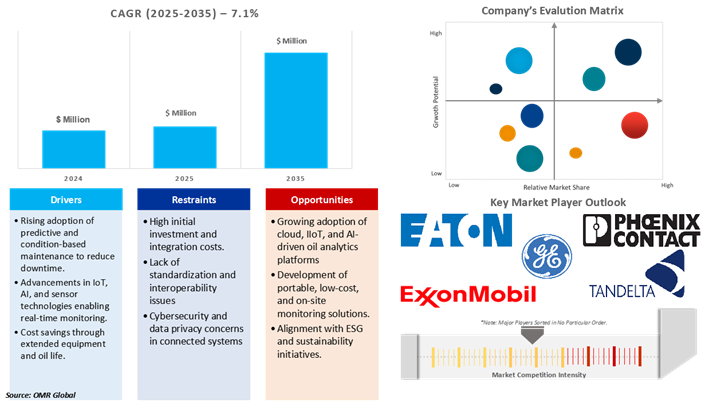
Oil condition monitoring market was valued at $1.3 billion in 2024 and is projected to reach $2.7 billion by 2035, growing at a CAGR of 7.1% during the forecast period (2025–2035). Oil condition monitoring is the process of analyzing lubricants and hydraulic fluids to assess equipment health, detect early signs of wear, and prevent costly failures. Using advanced sensors, laboratory testing, and predictive analytics, OCM provides real-time insights into oil quality, contamination levels, and machine performance, enabling proactive maintenance strategies and extending asset life.
The global oil condition monitoring market is experiencing strong growth as industries increasingly prioritize operational efficiency, equipment reliability, and sustainability. Rising demand from sectors such as power generation, transportation, manufacturing, and oil & gas is fueling adoption, with oil condition monitoring (OCM) solutions helping operators minimize downtime, reduce maintenance costs, and improve safety. The shift toward predictive maintenance, supported by IoT-enabled sensors and AI-driven analytics, further strengthens the role of oil condition monitoring in modern industrial ecosystems. As global industries face mounting pressure to optimize performance while addressing environmental and economic challenges, OCM is emerging as a key enabler of efficiency, resilience, and long-term asset sustainability.
- In August 2021, Shell and Baker Hughes partnered to launch VitalyX, an AI- and IIoT-powered oil condition monitoring and equipment health service for the marine sector. Using advanced analytics and machine learning, VitalyX enables ship operators to move from time-based to health-based maintenance, improving uptime, lowering costs, and extending equipment life while enhancing safety and operational efficiency.
Market Dynamics
Regulatory Support & Fast-Track Approvals
Supportive regulatory frameworks and government initiatives are driving the adoption of the advanced oil condition monitoring market globally. Regulations targeting emissions reduction, energy efficiency, and industrial equipment safety increasingly mandate real-time monitoring of lubricants, engine health, and mechanical performance. Agencies such as the U.S. Department of Energy (DOE), European Environment Agency (EEA), and national transportation authorities across Asia-Pacific are implementing standards for monitoring lubricant degradation, engine wear, and performance optimization. F
- In December 2024, the U.S. Departments of Energy, Transportation, and Housing published an action plan for medium and heavy-duty vehicle emissions innovation, targeting 30% zero-emission vehicle sales by 2030 and 100% by 2040. The plan emphasizes enhanced monitoring requirements for remaining internal combustion engines and sustainable liquid fuel applications, highlighting the role of regulatory support in accelerating the deployment of oil condition monitoring solutions.
Industry-Specific Solutions & Sector Adoption
The growing complexity of industrial operations, particularly in mining, mineral processing, and heavy machinery, is driving demand for tailored oil condition monitoring solutions. Sector-specific systems enable precise detection of lubricant degradation, contamination, and mechanical wear, helping operators prevent equipment failures, reduce maintenance costs, and improve operational efficiency. For instance, in January 2024, Tan Delta Systems launched SENSE-2, a real-time oil condition monitoring kit designed for the mining and mineral processing sectors. The system leverages advanced sensors and analytics to provide full-spectrum, molecular-level analysis of machine oil, allowing early detection of wear and contamination before significant damage occurs. Such innovations highlight how targeted solutions for specific industries are shaping market growth and encouraging the adoption of advanced OCM technologies.
Market Segmentation
- Based on the sampling type, the market is segmented into on-site sampling and off-site sampling.
- Based on the product type, the market is segmented into turbine, compressor, engine, gear systems, and hydraulic systems.
- Based on the end-user, the market is segmented into transportation, industrial, oil & gas, power generation, and mining.
Oil and Gas Dominate the Market with Operational Reliability Advantage
The oil & gas sector is projected to remain the largest end-user segment in the global oil condition monitoring market, driven by its continuous need for operational reliability and precision in machinery performance. The sector relies heavily on complex upstream, midstream, and downstream equipment, where unplanned downtime can lead to substantial financial losses and safety risks. Continuous monitoring of lubricant and machinery health enables predictive maintenance, reduces equipment failures, and extends asset life. Additionally, stringent regulatory standards, high operational costs, and the critical importance of uninterrupted production further propel the adoption of advanced oil condition monitoring solutions across the industry.
- Cambridge Applied Systems launched the SPL571 viscometer for real-time oil viscosity monitoring, enabling dashboard-based condition assessment that captures transient chemistry changes undetectable by traditional sampling methods, helping engine manufacturers reduce new model development times and improve oil change recommendation accuracy.
Regional Outlook
The global oil condition monitoring market is further divided by region, including North America (the US and Canada), Europe (the UK, Germany, France, Italy, Spain, Russia, and the Rest of Europe), Asia-Pacific (India, China, Japan, South Korea, Australia and New Zealand, ASEAN Countries, and the Rest of Asia-Pacific), and the Rest of the World (the Middle East & Africa, and Latin America).
North America Leading the Global Oil Condition Monitoring Market Growth
North America continues to lead the global oil condition monitoring market, supported by its advanced industrial infrastructure, early adoption of predictive maintenance technologies, and strong focus on operational efficiency and regulatory compliance. The region’s stringent environmental and safety standards, combined with growing investment in smart monitoring systems, have accelerated the adoption of solutions that track lubricant condition, machinery wear, and emissions in real time, helping operators reduce downtime, optimize performance, and meet sustainability goals. Major providers in North America are driving innovation in sensor-based monitoring, vibration analysis, spectroscopy, and emissions tracking, strengthening the region’s position as a hub for oil condition monitoring solutions. These efforts reflect global trends toward operational reliability, energy efficiency, and environmental stewardship.
- In February 2025, Kuva Systems received a $5 million contract from the U.S. Department of Energy under the Methane Emissions Reduction Program to enhance and expand its remote emissions monitoring technology across 175 oil and gas sites. Kuva’s stationary, low-cost cameras detect emissions, identify root causes, and help field staff prioritize repairs, supporting regulatory compliance and workflow optimization. The DOE funding enables Kuva to expand its workforce and accelerate adoption among midsize and smaller operators, illustrating how North American innovations in monitoring technology continue to set the pace for the global oil condition monitoring market.
Market Players Outlook
The major companies operating in the global oil condition monitoring market include BP plc, Eaton Corp, Exxon Mobil Corp, General Electric Company, Tan Delta Systems PLC, among others. Market players are leveraging partnerships, collaborations, mergers, and acquisition strategies for business expansion and innovative product development to maintain their market positioning.
Recent Developments
- In October 2024, SKF completed the acquisition of John Sample Group’s (JSG) Lubrication and Flow Management businesses, a provider of lubrication systems and full-service solutions. The acquisition strengthens SKF’s presence in South-East Asia and Oceania, enhancing capabilities for customers in engineered solutions, heavy industries, and mobile equipment.
- In March 2021, NSK Ltd. completed the acquisition of Brüel & Kjær Vibro (B&K Vibro), a global condition monitoring systems (CMS) business, from Spectris Plc. This move strengthens NSK’s presence in the growing CMS market and supports its focus on automation, labor savings, smart technologies, and sustainable solutions. By leveraging NSK’s expertise and data from its core products—bearings, ball screws, and linear guides.
- In January 2019, Baker Hughes, a GE Company (BHGE), partnered with Emirates National Oil Company (ENOC) to co-develop VitalyX, a real-time lubricant monitoring system. Designed for large machinery across multiple industries, VitalyX leverages cloud-based software and machine learning to measure key lubricant properties and convert the data into actionable insights, enabling predictive maintenance, reducing downtime, and extending equipment life.
The Report Covers
- Market value data analysis of 2024 and forecast to 2035.
- Annualized market revenues ($ million) for each market segment.
- Country-wise analysis of major geographical regions.
- Key companies operating in the global oil condition monitoring market. Based on the availability of data, information related to new products and relevant news is also available in the report.
- Analysis of business strategies by identifying the key market segments positioned for strong growth in the future.
- Analysis of market-entry and market expansion strategies.
- Competitive strategies by identifying ‘who-stands-where’ in the market.
- Report Summary
- Current Industry Analysis and Growth Potential Outlook
- Global Oil Condition Monitoring Market Sales Analysis – Sampling Type | Product Type |End-User ($ Million)
- Oil Condition Monitoring Market Sales Market Sales Performance of Top Countries
- Research Methodology
- Primary Research Approach
- Secondary Research Approach
- Market Snapshot
- Market Overview and Insights
- Scope of the Study
- Analyst Insight & Current Market Trends
- Key Oil Condition Monitoring Market Trends
- Market Recommendations
- Market Determinants
- Market Drivers
- Drivers for Global Oil Condition Monitoring Market: Impact Analysis
- Market Pain Points and Challenges
- Restraints for Global Oil Condition Monitoring Market: Impact Analysis
- Market Opportunities
- Opportunities for Global Oil Condition Monitoring Market: Impact Analysis
- Market Drivers
- Competitive Landscape
- Competitive Dashboard – Oil Condition Monitoring Market Revenue and Share by Manufacturers
- Oil Condition Monitoring Type Comparison Analysis
- Top Market Player Ranking Matrix
- Key Company Analysis
- BP plc
- Overview
- Battery Type Portfolio
- Financial Analysis (Subject to Data Availability)
- SWOT Analysis
- Business Strategy
- Eaton Corp
- Overview
- Battery Type Portfolio
- Financial Analysis (Subject to Data Availability)
- SWOT Analysis
- Business Strategy
- Exxon Mobil Corp
- Overview
- Battery Type Portfolio
- Financial Analysis (Subject to Data Availability)
- SWOT Analysis
- Business Strategy
- General Electric Company
- Overview
- Battery Type Portfolio
- Financial Analysis (Subject to Data Availability)
- SWOT Analysis
- Business Strategy
- Tan Delta Systems PLC
- Overview
- Battery Type Portfolio
- Financial Analysis (Subject to Data Availability)
- SWOT Analysis
- Business Strategy
- BP plc
- Key Company Analysis
- Top Winning Strategies by Market Players
- Merger and Acquisition
- Oil Condition Monitoring Type Launch
- Partnership And Collaboration
- Global Oil Condition Monitoring Market Sales Analysis by Sampling Type ($ Million)
- On-Site Sampling
- Off-Site Sampling
- Global Oil Condition Monitoring Market Sales Analysis by Product Type ($ Million)
- Turbine
- Compressor
- Engine
- Gear Systems
- Hydraulic Systems
- Global Oil Condition Monitoring Market Sales Analysis by End-User ($ Million)
- Transportation
- Industrial
- Oil & Gas
- Power Generation
- Mining
- Regional Analysis
- North American Oil Condition Monitoring Market Sales Analysis – Sampling Type | Product Type | End-User| Country ($ Million)
- Macroeconomic Factors for North America
- United States
- Canada
- European Oil Condition Monitoring Market Sales Analysis – Sampling Type | Product Type | End-User| Country ($ Million)
- Macroeconomic Factors for Europe
- UK
- Germany
- Italy
- Spain
- France
- Russia
- Rest of Europe
- Asia-Pacific Oil Condition Monitoring Market Sales Analysis – Sampling Type | Product Type | End-User| Country ($ Million)
- Macroeconomic Factors for Asia-Pacific
- China
- Japan
- South Korea
- India
- Australia & New Zealand
- ASEAN Countries (Thailand, Indonesia, Vietnam, Singapore, And others)
- Rest of Asia-Pacific
- Rest of the World Oil Condition Monitoring Market Sales Analysis – Sampling Type | Product Type | End-User| Country ($ Million)
- Macroeconomic Factors for the Rest of the World
- Latin America
- Middle East and Africa
- Company Profiles
- Avenisense
- Quick Facts
- Company Overview
- Product Portfolio
- Business Strategies
- BP plc
- Quick Facts
- Company Overview
- Product Portfolio
- Business Strategies
- Bureau Veritas Group
- Quick Facts
- Company Overview
- Product Portfolio
- Business Strategies
- Castrol Ltd
- Quick Facts
- Company Overview
- Product Portfolio
- Business Strategies
- Chevron USA Inc
- Quick Facts
- Company Overview
- Product Portfolio
- Business Strategies
- Des-Case Corp
- Quick Facts
- Company Overview
- Product Portfolio
- Business Strategies
- Eaton Corp
- Quick Facts
- Company Overview
- Product Portfolio
- Business Strategies
- Exxon Mobil Corp
- Quick Facts
- Company Overview
- Product Portfolio
- Business Strategies
- General Electric Company
- Quick Facts
- Company Overview
- Product Portfolio
- Business Strategies
- Hydac International
- Quick Facts
- Company Overview
- Product Portfolio
- Business Strategies
- ifm electronic gmbh
- Quick Facts
- Company Overview
- Product Portfolio
- Business Strategies
- Intertek Group plc
- Quick Facts
- Company Overview
- Product Portfolio
- Business Strategies
- Parker-Hannifin Corp
- Quick Facts
- Company Overview
- Product Portfolio
- Business Strategies
- Poseidon Systems
- Quick Facts
- Company Overview
- Product Portfolio
- Business Strategies
- Schaeffler AG
- Quick Facts
- Company Overview
- Product Portfolio
- Business Strategies
- Shell plc
- Quick Facts
- Company Overview
- Product Portfolio
- Business Strategies
- SKF AB
- Quick Facts
- Company Overview
- Product Portfolio
- Business Strategies
- Société Générale de Surveillance SA (SGS)
- Quick Facts
- Company Overview
- Product Portfolio
- Business Strategies
- Spectro Scientific
- Quick Facts
- Company Overview
- Product Portfolio
- Business Strategies
- Tan Delta Systems PLC
- Quick Facts
- Company Overview
- Product Portfolio
- Business Strategies
- TE Connectivity
- Quick Facts
- Company Overview
- Product Portfolio
- Business Strategies
- Business Strategies
- Techenomics International
- Quick Facts
- Company Overview
- Product Portfolio
- Business Strategies
- Business Strategies
- TotalEnergies SE
- Quick Facts
- Company Overview
- Product Portfolio
- Business Strategies
- Business Strategies
- Tribomar GmbH
- Quick Facts
- Company Overview
- Product Portfolio
- Business Strategies
- Business Strategies
- Unimarine
- Quick Facts
- Company Overview
- Product Portfolio
- Business Strategies
- Business Strategies
- Avenisense
1. Global Oil Condition Monitoring Market Research and Analysis By Sampling Type, 2024-2035 ($ Million)
2. Global On-Site Sampling Oil Condition Monitoring Market Research And Analysis By Region, 2024-2035 ($ Million)
3. Global Off-Site Sampling Oil Condition Monitoring Market Research And Analysis By Region, 2024-2035 ($ Million)
4. Global Oil Condition Monitoring Market Research and Analysis By Product Type, 2024-2035 ($ Million)
5. Global Turbine Oil Condition Monitoring Market Research and Analysis By Region, 2024-2035 ($ Million)
6. Global Compressor Oil Condition Monitoring Market Research and Analysis By Region, 2024-2035 ($ Million)
7. Global Engine Oil Condition Monitoring Market Research and Analysis By Region, 2024-2035 ($ Million)
8. Global Gear Systems Oil Condition Monitoring Market Research and Analysis By Region, 2024-2035 ($ Million)
9. Global Hydraulic Systems Oil Condition Monitoring Market Research and Analysis By Region, 2024-2035 ($ Million)
10. Global Oil Condition Monitoring Market Research and Analysis By End-User, 2024-2035 ($ Million)
11. Global Oil Condition Monitoring for Transportation Market Research and Analysis By Region, 2024-2035 ($ Million)
12. Global Oil Condition Monitoring for Industrial and Chemical Market Research and Analysis By Region, 2024-2035 ($ Million)
13. Global Oil Condition Monitoring for Oil & Gas Market Research and Analysis By Region, 2024-2035 ($ Million)
14. Global Oil Condition Monitoring for Power Generation Market Research and Analysis By Region, 2024-2035 ($ Million)
15. Global Oil Condition Monitoring for Mining Market Research and Analysis By Region, 2024-2035 ($ Million)
16. Global Oil Condition Monitoring Market Research and Analysis By Region, 2024-2035 ($ Million)
17. North American Oil Condition Monitoring Market Research and Analysis By Country, 2024-2035 ($ Million)
18. North American Oil Condition Monitoring Market Research and Analysis By Sampling Type, 2024-2035 ($ Million)
19. North American Oil Condition Monitoring Market Research and Analysis By Product Type, 2024-2035 ($ Million)
20. North American Oil Condition Monitoring Market Research and Analysis By End-User, 2024-2035 ($ Million)
21. European Oil Condition Monitoring Market Research and Analysis By Country, 2024-2035 ($ Million)
22. European Oil Condition Monitoring Market Research and Analysis By Sampling Type, 2024-2035 ($ Million)
23. European Oil Condition Monitoring Market Research and Analysis By Product Type, 2024-2035 ($ Million)
24. European Oil Condition Monitoring Market Research and Analysis By End-User, 2024-2035 ($ Million)
25. Asia-Pacific Oil Condition Monitoring Market Research and Analysis By Country, 2024-2035 ($ Million)
26. Asia-Pacific Oil Condition Monitoring Market Research and Analysis By Sampling Type, 2024-2035 ($ Million)
27. Asia-Pacific Oil Condition Monitoring Market Research and Analysis By Product Type, 2024-2035 ($ Million)
28. Asia-Pacific Oil Condition Monitoring Market Research and Analysis By End-User, 2024-2035 ($ Million)
29. Rest of The World Oil Condition Monitoring Market Research and Analysis By Country, 2024-2035 ($ Million)
30. Rest of The World Oil Condition Monitoring Market Research and Analysis By Sampling Type, 2024-2035 ($ Million)
31. Rest of The World Oil Condition Monitoring Market Research and Analysis By Product Type, 2024-2035 ($ Million)
32. Rest of The World Oil Condition Monitoring Market Research and Analysis By End-User, 2024-2035 ($ Million)
1. Global Oil Condition Monitoring Market Share By Sampling Type, 2024 Vs 2035 (%)
2. Global On-site Sampling Oil Condition Monitoring Market Share By Region, 2024 Vs 2035 (%)
3. Global Off-site Sampling Oil Condition Monitoring Market Share By Region, 2024 Vs 2035 (%)
4. Global Turbine Condition Monitoring Market Share By Product Type, 2024 Vs 2035 (%)
5. Global Compressor Oil Condition Monitoring Market Share By Region, 2024 Vs 2035 (%)
6. Global Engine Oil Condition Monitoring Market Share By Region, 2024 Vs 2035 (%)
7. Global Gear Systems Oil Condition Monitoring Market Share By Region, 2024 Vs 2035 (%)
8. Global Hydraulic Systems Oil Condition Monitoring Market Share By Region, 2024 Vs 2035 (%)
9. Global Oil Condition Monitoring Market Share By End-User, 2024 Vs 2035 (%)
10. Global Oil Condition Monitoring for Transportation Market Share By Region, 2024 Vs 2035 (%)
11. Global Oil Condition Monitoring for Industrial Market Share By Region, 2024 Vs 2035 (%)
12. Global Oil Condition Monitoring for Oil & Gas Market Share By Region, 2024 Vs 2035 (%)
13. Global Oil Condition Monitoring for Power Generation Market Share By Region, 2024 Vs 2035 (%)
14. Global Oil Condition Monitoring for Mining Market Share By Region, 2024 Vs 2035 (%)
15. US Oil Condition Monitoring Market Size, 2024-2035 ($ Million)
16. Canada Oil Condition Monitoring Market Size, 2024-2035 ($ Million)
17. UK Oil Condition Monitoring Market Size, 2024-2035 ($ Million)
18. France Oil Condition Monitoring Market Size, 2024-2035 ($ Million)
19. Germany Oil Condition Monitoring Market Size, 2024-2035 ($ Million)
20. Italy Oil Condition Monitoring Market Size, 2024-2035 ($ Million)
21. Spain Oil Condition Monitoring Market Size, 2024-2035 ($ Million)
22. Russia Oil Condition Monitoring Market Size, 2024-2035 ($ Million)
23. Rest of Europe Oil Condition Monitoring Market Size, 2024-2035 ($ Million)
24. India Oil Condition Monitoring Market Size, 2024-2035 ($ Million)
25. China Oil Condition Monitoring Market Size, 2024-2035 ($ Million)
26. Japan Oil Condition Monitoring Market Size, 2024-2035 ($ Million)
27. South Korea Oil Condition Monitoring Market Size, 2024-2035 ($ Million)
28. Australia and New Zealand Oil Condition Monitoring Market Size, 2024-2035 ($ Million)
29. ASEAN Economies Oil Condition Monitoring Market Size, 2024-2035 ($ Million)
30. Rest of Asia-Pacific Oil Condition Monitoring Market Size, 2024-2035 ($ Million)
31. Latin America Oil Condition Monitoring Market Size, 2024-2035 ($ Million)
32. Middle East and Africa Oil Condition Monitoring Market Size, 2024-2035 ($ Million)
- Printable version
- No restriction to number of users within the company