Reverse Logistics Market


Reverse Logistics Market Size, Share & Trends Analysis Report by Return Type (Recalls, Commercial Returns, Repairable Returns, End-of-Use Returns and End of Life Return), by Service (Transportation, Warehousing, Reselling, Replacement Management, Refund Management Authorization and Others), and by End-User (E-Commerce, Retail, Automotive, Consumer Electronics, Pharmaceutical and Other), Forecast Period (2025-2035)
Industry Overview
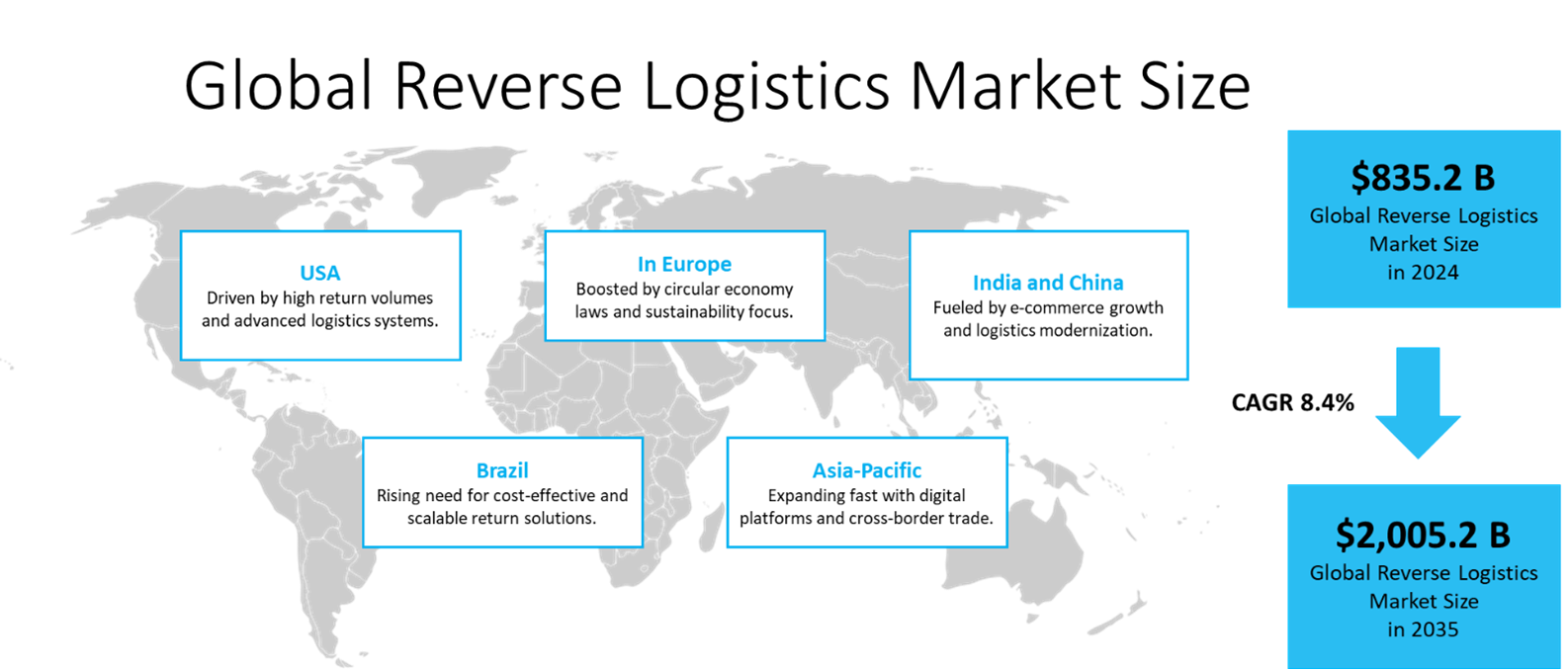
Reverse logistics market was valued at $835.2 billion in 2024 and is projected to reach $2,005.2 billion by 2035, growing at a CAGR of 8.4% during the forecast period (2025-2035). The reverse logistics market is propelled by factors such as the expanding e-commerce sector that increases the pounds and volume of product returns, necessitating companies to spend further resources on reverse processing. Additionally, the growing expectations of consumers to have convenient and simple transparent return processes have made return logistics a key competitive area, while advancements in digital technologies, including innovations for real-time tracking and route optimization, are improving operations through technology. Furthermore, increasing regulatory pressure to keep returns, refurbishment, and recycling sustainable and environmentally responsible, the growth of globalization and cross-border trade requires the need for well-developed reverse supply chains.
Market Dynamics
Blockchain for Return Validation and Transparency
The reverse logistics landscape is changing quickly, using blockchain technology. Blockchain provides unalterable return records, ensuring the integrity and quality of the returned product. This creates substantial value to certain industries highly susceptible to counterfeit products and warranty fraud. Blockchain mitigates the severity and impact of returns by fostering real-time data sharing for various stakeholders, ultimately increasing coordination, collaboration, and decision-making in the return process. Furthermore, smart contracts facilitate the automated approval of a returned product and settlement to a consumer's account, which minimizes manual processing and approvals as much as possible. Transparency generates trust in end consumers, manufacturers, and logistics providers. Lastly, the blockchain provides comprehensive documentation to support compliance with regulations.
Smart Packaging for Return Efficiency
The adoption of smart packaging is starting to emerge as a key driver of efficiencies in the reverse logistics market. Smart packaging contains components such as embedded sensors, RFID tags, or QR codes to help track and record returns that were designed to assist in the verification of the returns process. This ability to monitor the real-time condition of items being returned reduces conflicts related to product damage and helps identify accountability for claims throughout the return journey. Featuring pre-programmed return instructions or already-completed labels, smart packaging helps ease returns processing for consumers. This leads to improved customer satisfaction while also simplifying the operations side of the return process. Additionally, smart packaging allows companies to collect data on return patterns and helps them improve inventory control.
Market Segmentation
- Based on the return type, the market is segmented into recalls, commercial returns, repairable returns, end-of-use returns, and end-of-life returns.
- Based on the service, the market is segmented into transportation, warehousing, reselling, replacement management, refund management authorization, and other (including packaging and refurbishment of goods).
- Based on the end-user, the market is segmented into e-commerce, retail, automotive, consumer electronics, pharmaceutical, and other (luxury goods).
Transportation Segment to Lead the Market with the Largest Share
The advancement of the reverse logistics market has brought increased attention to efficient transport management, recognizing its critical role in optimizing the return supply chain. As companies increasingly prioritize the ability to move products quickly and cost-effectively from end-users back to warehouses, processing centers, or manufacturers, effective transportation systems have become essential. Well-structured transport networks help reduce delays, lower handling costs, and improve overall resource management. With the growing e-commerce and expanding cross-border trade, there has been an increased demand for effective reverse transport networks and systems. The integration of technology further facilitates the integration of reverse transport networks through means that support real-time tracking and route optimization, increasing transparency and reliability. As companies want more flexibility and control over their returns, transport is a key part of their planning. For instance, DHL Supply Chain provides a complete reverse logistics solution, including transport and return route optimization specific to many different verticals.
E-Commerce: A Key Segment in Market Growth
The growth of e-commerce continues to be a major contributor to the reverse logistics industry. The desire to buy online continues to grow, resulting in an increase in returns requiring companies to focus on developing return processing capabilities. Efficient returns processing, restocking, and remittance assist a company to be more effective in reverse logistics operations. E-commerce companies are focused on providing a seamless return experience to their customers builds satisfaction and ultimately retention. The need for flexible, scalable, and technology-enabled return services has never been higher. Companies are integrating gamification aspects of reverse logistics, such as real-time tracking, automation, and analytics, to manage the rapidly increasing complexity of online returns. In recent years, the move to manage effective reverse logistics networks for cross-border returns has introduced more businesses and challenges.
Regional Outlook
The global reverse logistics market is further divided by geography, including North America (the US and Canada), Europe (the UK, Germany, France, Italy, Spain, Russia, and the Rest of Europe), Asia-Pacific (India, China, Japan, South Korea, Australia and New Zealand, ASEAN Countries, and the Rest of Asia-Pacific), and the Rest of the World (the Middle East & Africa, and Latin America).
Growing Expansion of E-Commerce Trade in the Asia Pacific
The Asia-Pacific reverse logistics market is growing rapidly, mainly due to the expansion of e-commerce trade and progressively cross-border trade in the region. As the online volume of sales increases, the numbers of returns increase, leading companies to develop flexible and scalable communications regarding the handling of returns. Government-supported initiatives to encourage sustainability and promote waste reduction have driven companies to develop programs to support take-back, remanufacturing, and recycling activities. The rapid expansion of smartphones and digital platform penetration supports the efficient coordination of returns in an often fragmented logistics network. Urbanization, along with improved transport infrastructure in growing economies such as India, China, and Indonesia, is developing the reverse supply chain.
North America Region Dominates the Market with Major Share
The North American reverse logistics market is primarily driven by the extremely high number of returns from the e-commerce and retail industries in mature markets. Fast-growing consumer expectations for flexible return policies have pushed organizations to put in place efficient and transparent reverse logistics processes. Increasing regulatory focus on environmental sustainability also requires organizations to have systems in place for the refurbishment, recycling, and proper disposal of products. The integration of advanced infrastructure and technologies helps minimize challenges in the reverse logistics operation and aids in streamlining the reverse operation across transportation, warehousing, and resale. Companies are not only willing to invest and are investing in digital tracking tools in the customer return process to increase the visibility of the return and the customer experience. The increasing movement towards a circular economy has also positively influenced the demand for reverse logistics solutions. For instance, FedEx Corp. is actively involved in the reverse logistics space, offering comprehensive services such as returns processing, refurbishment, and restocking. This demonstrates the strategic importance of reverse logistics in the evolving market landscape.
Market Players Outlook
The major companies operating in the global reverse logistics market include CEVA Logistics (CMA CGM Group), DHL Supply Chain (Deutsche Post AG), FedEx Corp., United Parcel Service, Inc. (UPS), and XPO Logistics, Inc., among others. Market players are leveraging partnerships, collaborations, mergers and acquisition strategies for business expansion and innovative product development to maintain their market positioning.
Recent Developments
- In June 2025, GEODIS, a logistics organization, announced the release of two new returns solutions: a returns workflow automation module to create a more straightforward initiation process for the customer and a returns management module designed to improve inventory management after it has arrived in the warehouse. As the return rate continues to grow across the industry, driven largely by the rapid expansion of e-commerce, GEODIS is actively addressing the rising demand by helping retailers streamline and optimize their reverse logistics frameworks.
- In February 2024, Loop, the innovative returns management platform, announced its latest service releases of new features, integrations, and partnerships to support merchants and their logistics partners in enhancing their reverse logistics operations and margins. The latest suite of new features, integrations, and partnerships allows logistics partners to share enriched data between Loop and their merchants' warehouses, as well as providing brands the ability to ship and move their returns more effectively.
The Report Covers
- Market value data analysis of 2024 and forecast to 2035.
- Annualized market revenues ($ million) for each market segment.
- Country-wise analysis of major geographical regions.
- Key companies operating in the global reverse logistics market. Based on the availability of data, information related to new products and relevant news is also available in the report.
- Analysis of business strategies by identifying the key market segments positioned for strong growth in the future.
- Analysis of market-entry and market expansion strategies.
- Competitive strategies by identifying ‘who-stands-where’ in the market.
1. Report Summary
• Current Industry Analysis and Growth Potential Outlook
• Global Reverse Logistics Market Sales Analysis – Return Type | Service | End-User ($ Million)
• Reverse Logistics Market Sales Performance of Top Countries
1.1. Research Methodology
• Primary Research Approach
• Secondary Research Approach
1.2. Market Snapshot
2. Market Overview and Insights
2.1. Scope of the Study
2.2. Analyst Insight & Current Market Trends
2.2.1. Key Reverse Logistics Industry Trends
2.2.2. Market Recommendations
2.3. Porter's Five Forces Analysis for the Reverse Logistics Market
2.3.1. Competitive Rivalry
2.3.2. Threat of New Entrants
2.3.3. Bargaining Power of Suppliers
2.3.4. Bargaining Power of Buyers
2.3.5. Threat of Substitutes
3. Market Determinants
3.1. Market Drivers
3.1.1. Drivers For the Global Reverse Logistics Market: Impact Analysis
3.2. Market Pain Points and Challenges
3.2.1. Restraints For the Global Reverse Logistics Market: Impact Analysis
3.3. Market Opportunities
3.3.1. Opportunities For the Global Reverse Logistics Market: Impact Analysis
4. Competitive Landscape
4.1. Competitive Dashboard – Reverse Logistics Market Revenue and Share by Manufacturers
• Reverse Logistics Product Comparison Analysis
• Top Market Player Ranking Matrix
4.2. Key Company Analysis
4.2.1. CEVA Logistics (CMA CGM Group)
4.2.1.1. Overview
4.2.1.2. Product Portfolio
4.2.1.3. Financial Analysis (Subject to Data Availability)
4.2.1.4. SWOT Analysis
4.2.1.5. Business Strategy
4.2.2. DHL Group (Deutsche Post AG)
4.2.2.1. Overview
4.2.2.2. Product Portfolio
4.2.2.3. Financial Analysis (Subject to Data Availability)
4.2.2.4. SWOT Analysis
4.2.2.5. Business Strategy
4.2.3. FedEx Corp.
4.2.3.1. Overview
4.2.3.2. Product Portfolio
4.2.3.3. Financial Analysis (Subject to Data Availability)
4.2.3.4. SWOT Analysis
4.2.3.5. Business Strategy
4.2.4. United Parcel Service, Inc. (UPS)
4.2.4.1. Overview
4.2.4.2. Product Portfolio
4.2.4.3. Financial Analysis (Subject to Data Availability)
4.2.4.4. SWOT Analysis
4.2.4.5. Business Strategy
4.2.5. XPO Group
4.2.5.1. Overview
4.2.5.2. Product Portfolio
4.2.5.3. Financial Analysis (Subject to Data Availability)
4.2.5.4. SWOT Analysis
4.2.5.5. Business Strategy
4.3. Top Winning Strategies by Market Players
4.3.1. Merger and Acquisition
4.3.2. Product Launch
4.3.3. Partnership And Collaboration
5. Global Reverse Logistics Market Sales Analysis by Return Type ($ Million)
5.1. Recalls
5.2. Commercial Returns
5.3. Repairable Returns
5.4. End-of-use Returns
5.5. End of life Return
6. Global Reverse Logistics Market Sales Analysis by Service ($ Million)
6.1. Transportation
6.2. Warehousing
6.3. Reselling
6.4. Replacement Management
6.5. Refund Management Authorization
6.6. Others (Packaging, Refurbishment of Goods)
7. Global Reverse Logistics Market Sales Analysis by End-User ($ Million)
7.1. E-Commerce
7.2. Retail
7.3. Automotive
7.4. Consumer Electronics
7.5. Pharmaceutical
7.6. Other (Luxury goods)
8. Regional Analysis
8.1. North American Reverse Logistics Market Sales Analysis – Return Type | Service | End-User | Country ($ Million)
• Macroeconomic Factors for North America
8.1.1. United States
8.1.2. Canada
8.2. European Reverse Logistics Market Sales Analysis – Return Type | Service | End-User | Country ($ Million)
• Macroeconomic Factors for Europe
8.2.1. UK
8.2.2. Germany
8.2.3. Italy
8.2.4. Spain
8.2.5. France
8.2.6. Russia
8.2.7. Rest of Europe
8.3. Asia-Pacific Reverse Logistics Market Sales Analysis – Return Type | Service | End-User | Country ($ Million)
• Macroeconomic Factors for Asia-Pacific
8.3.1. China
8.3.2. Japan
8.3.3. South Korea
8.3.4. India
8.3.5. Australia & New Zealand
8.3.6. ASEAN Countries (Thailand, Indonesia, Vietnam, Singapore, And Other)
8.3.7. Rest of Asia-Pacific
8.4. Rest of the World Reverse Logistics Market Sales Analysis – Return Type | Service | End-User | Country ($ Million)
• Macroeconomic Factors for the Rest of the World
8.4.1. Latin America
8.4.2. Middle East and Africa
9. Company Profiles
9.1. ArcBest Corp.
9.1.1. Quick Facts
9.1.2. Company Overview
9.1.3. Product Portfolio
9.1.4. Business Strategies
9.2. Arvato SE (Bertelsmann)
9.2.1. Quick Facts
9.2.2. Company Overview
9.2.3. Product Portfolio
9.2.4. Business Strategies
9.3. Blue Yonder Group, Inc.
9.3.1. Quick Facts
9.3.2. Company Overview
9.3.3. Product Portfolio
9.3.4. Business Strategies
9.4. C.H. Robinson Worldwide, Inc.
9.4.1. Quick Facts
9.4.2. Company Overview
9.4.3. Product Portfolio
9.4.4. Business Strategies
9.5. CEVA Logistics AG
9.5.1. Quick Facts
9.5.2. Company Overview
9.5.3. Product Portfolio
9.5.4. Business Strategies
9.6. Core Logistic Pvt. Ltd.
9.6.1. Quick Facts
9.6.2. Company Overview
9.6.3. Product Portfolio
9.6.4. Business Strategies
9.7. Dachser Group SE & Co. KG
9.7.1. Quick Facts
9.7.2. Company Overview
9.7.3. Product Portfolio
9.7.4. Business Strategies
9.8. DB Schenker (Deutsche Bahn AG)
9.8.1. Quick Facts
9.8.2. Company Overview
9.8.3. Product Portfolio
9.8.4. Business Strategies
9.9. DHL Group (Deutsche Post AG)
9.9.1. Quick Facts
9.9.2. Company Overview
9.9.3. Product Portfolio
9.9.4. Business Strategies
9.10. DSV Group
9.10.1. Quick Facts
9.10.2. Company Overview
9.10.3. Product Portfolio
9.10.4. Business Strategies
9.11. FedEx Corp.
9.11.1. Quick Facts
9.11.2. Company Overview
9.11.3. Product Portfolio
9.11.4. Business Strategies
9.12. GXO Logistics, Inc.
9.12.1. Quick Facts
9.12.2. Company Overview
9.12.3. Product Portfolio
9.12.4. Business Strategies
9.13. Happy Returns LLC
9.13.1. Quick Facts
9.13.2. Company Overview
9.13.3. Product Portfolio
9.13.4. Business Strategies
9.14. J.B. Hunt Transport, Inc.
9.14.1. Quick Facts
9.14.2. Company Overview
9.14.3. Product Portfolio
9.14.4. Business Strategies
9.15. Kintetsu World Express, Inc. (KWE Group)
9.15.1. Quick Facts
9.15.2. Company Overview
9.15.3. Product Portfolio
9.15.4. Business Strategies
9.16. Kuehne + Nagel Management AG
9.16.1. Quick Facts
9.16.2. Company Overview
9.16.3. Product Portfolio
9.16.4. Business Strategies
9.17. Lineage, Inc.
9.17.1. Quick Facts
9.17.2. Company Overview
9.17.3. Product Portfolio
9.17.4. Business Strategies
9.18. NFI Industries
9.18.1. Quick Facts
9.18.2. Company Overview
9.18.3. Product Portfolio
9.18.4. Business Strategies
9.19. Nippon Express Co., Ltd.
9.19.1. Quick Facts
9.19.2. Company Overview
9.19.3. Product Portfolio
9.19.4. Business Strategies
9.20. Reverse Logistics Group GmbH
9.20.1. Quick Facts
9.20.2. Company Overview
9.20.3. Product Portfolio
9.20.4. Business Strategies
9.21. Ryder System, Inc.
9.21.1. Quick Facts
9.21.2. Company Overview
9.21.3. Product Portfolio
9.21.4. Business Strategies
9.22. Safexpress Pvt. Ltd.
9.22.1. Quick Facts
9.22.2. Company Overview
9.22.3. Product Portfolio
9.22.4. Business Strategies
9.23. United Parcel Service, Inc. (UPS)
9.23.1. Quick Facts
9.23.2. Company Overview
9.23.3. Product Portfolio
9.23.4. Business Strategies
9.24. XPO Group
9.24.1. Quick Facts
9.24.2. Company Overview
9.24.3. Product Portfolio
9.24.4. Business Strategies
9.25. Yusen Logistics Co., Ltd.
9.25.1. Quick Facts
9.25.2. Company Overview
9.25.3. Product Portfolio
9.25.4. Business Strategies
9.26. Zebra Technologies Corp.
9.26.1. Quick Facts
9.26.2. Company Overview
9.26.3. Product Portfolio
9.26.4. Business Strategies
1. Global Reverse Logistics Market Research and Analysis by Return Type, 2024–2035 ($ Million)
2. Global Reverse Logistics Recalls Market Research and Analysis by Region, 2024–2035 ($ Million)
3. Global Reverse Logistics Commercial Returns Market Research and Analysis by Region, 2024–2035 ($ Million)
4. Global Reverse Logistics Repairable Returns Market Research and Analysis by Region, 2024–2035 ($ Million)
5. Global Reverse Logistics End-of-use Returns Market Research and Analysis by Region, 2024–2035 ($ Million)
6. Global Reverse Logistics End of Life Return Market Research and Analysis by Region, 2024–2035 ($ Million)
7. Global Reverse Logistics Market Research and Analysis by Service, 2024–2035 ($ Million)
8. Global Reverse Logistics Transportation Market Research and Analysis by Region, 2024–2035 ($ Million)
9. Global Reverse Logistics Warehousing Market Research and Analysis by Region, 2024–2035 ($ Million)
10. Global Reverse Logistics Reselling Market Research and Analysis by Region, 2024–2035 ($ Million)
11. Global Reverse Logistics Replacement Management Market Research and Analysis by Region, 2024–2035 ($ Million)
12. Global Reverse Logistics Refund Management Authorization Market Research and Analysis by Region, 2024–2035 ($ Million)
13. Global Reverse Logistics Other Service Market Research and Analysis by Region, 2024–2035 ($ Million)
14. Global Reverse Logistics Market Research and Analysis by End-User, 2024–2035 ($ Million)
15. Global Reverse Logistics For E-Commerce Market Research and Analysis by Region, 2024–2035 ($ Million)
16. Global Reverse Logistics For Retail Market Research and Analysis by Region, 2024–2035 ($ Million)
17. Global Reverse Logistics For Automotive Market Research and Analysis by Region, 2024–2035 ($ Million)
18. Global Reverse Logistics For Consumer Electronics Market Research and Analysis by Region, 2024–2035 ($ Million)
19. Global Reverse Logistics For Pharmaceutical Market Research and Analysis by Region, 2024–2035 ($ Million)
20. Global Reverse Logistics For Other End-User Market Research and Analysis by Region, 2024–2035 ($ Million)
21. Global Reverse Logistics Market Research and Analysis by Region, 2024–2035 ($ Million)
22. North American Reverse Logistics Market Research and Analysis by Country, 2024–2035 ($ Million)
23. North American Reverse Logistics Market Research and Analysis by Return Type, 2024–2035 ($ Million)
24. North American Reverse Logistics Market Research and Analysis by Service, 2024–2035 ($ Million)
25. North American Reverse Logistics Market Research and Analysis by End-User, 2024–2035 ($ Million)
26. European Reverse Logistics Market Research and Analysis by Country, 2024–2035 ($ Million)
27. European Reverse Logistics Market Research and Analysis by Return Type, 2024–2035 ($ Million)
28. European Reverse Logistics Market Research and Analysis by Service, 2024–2035 ($ Million)
29. European Reverse Logistics Market Research and Analysis by End-User, 2024–2035 ($ Million)
30. Asia-Pacific Reverse Logistics Market Research and Analysis by Country, 2024–2035 ($ Million)
31. Asia-Pacific Reverse Logistics Market Research and Analysis by Return Type, 2024–2035 ($ Million)
32. Asia-Pacific Reverse Logistics Market Research and Analysis by Service, 2024–2035 ($ Million)
33. Asia-Pacific Reverse Logistics Market Research and Analysis by End-User, 2024–2035 ($ Million)
34. Rest of the World Reverse Logistics Market Research and Analysis by Region, 2024–2035 ($ Million)
35. Rest of the World Reverse Logistics Market Research and Analysis by Return Type, 2024–2035 ($ Million)
36. Rest of the World Reverse Logistics Market Research and Analysis by Service, 2024–2035 ($ Million)
37. Rest of the World Reverse Logistics Market Research and Analysis by End-User, 2024–2035 ($ Million)
1. Global Reverse Logistics Market Share by Return Type, 2024 Vs 2035 (%)
2. Global Reverse Logistics Recalls Market Share by Region, 2024 Vs 2035 (%)
3. Global Reverse Logistics Commercial Returns Market Share by Region, 2024 Vs 2035 (%)
4. Global Reverse Logistics Repairable Returns Market Share by Region, 2024 Vs 2035 (%)
5. Global Reverse Logistics End-of-Use Returns Market Share by Region, 2024 Vs 2035 (%)
6. Global Reverse Logistics End of Life Return Market Share by Region, 2024 Vs 2035 (%)
7. Global Reverse Logistics Market Share by Service, 2024 Vs 2035 (%)
8. Global Reverse Logistics Transportation Market Share by Region, 2024 Vs 2035 (%)
9. Global Reverse Logistics Warehousing Market Share by Region, 2024 Vs 2035 (%)
10. Global Reverse Logistics Reselling Market Share by Region, 2024 Vs 2035 (%)
11. Global Reverse Logistics Replacement Management Market Share by Region, 2024 Vs 2035 (%)
12. Global Reverse Logistics Refund Management Authorization Market Share by Region, 2024 Vs 2035 (%)
13. Global Reverse Logistics Other Services Market Share by Region, 2024 Vs 2035 (%)
14. Global Reverse Logistics Market Share by End-User, 2024 Vs 2035 (%)
15. Global Reverse Logistics For E-Commerce Market Share by Region, 2024 Vs 2035 (%)
16. Global Reverse Logistics For Retail Market Share by Region, 2024 Vs 2035 (%)
17. Global Reverse Logistics For Automotive Market Share by Region, 2024 Vs 2035 (%)
18. Global Reverse Logistics For Consumer Electronics Market Share by Region, 2024 Vs 2035 (%)
19. Global Reverse Logistics For Pharmaceutical Market Share by Region, 2024 Vs 2035 (%)
20. Global Reverse Logistics For Other End-User Market Share by Region, 2024 Vs 2035 (%)
21. Global Reverse Logistics Market Share by Region, 2024 Vs 2035 (%)
22. US Reverse Logistics Market Size, 2024–2035 ($ Million)
23. Canada Reverse Logistics Market Size, 2024–2035 ($ Million)
24. UK Reverse Logistics Market Size, 2024–2035 ($ Million)
25. France Reverse Logistics Market Size, 2024–2035 ($ Million)
26. Germany Reverse Logistics Market Size, 2024–2035 ($ Million)
27. Italy Reverse Logistics Market Size, 2024–2035 ($ Million)
28. Spain Reverse Logistics Market Size, 2024–2035 ($ Million)
29. Russia Reverse Logistics Market Size, 2024–2035 ($ Million)
30. Rest of Europe Reverse Logistics Market Size, 2024–2035 ($ Million)
31. India Reverse Logistics Market Size, 2024–2035 ($ Million)
32. China Reverse Logistics Market Size, 2024–2035 ($ Million)
33. Japan Reverse Logistics Market Size, 2024–2035 ($ Million)
34. South Korea Reverse Logistics Market Size, 2024–2035 ($ Million)
35. Australia and New Zealand Reverse Logistics Market Size, 2024–2035 ($ Million)
36. ASEAN Economies Reverse Logistics Market Size, 2024–2035 ($ Million)
37. Rest of Asia-Pacific Reverse Logistics Market Size, 2024–2035 ($ Million)
38. Latin America Reverse Logistics Market Size, 2024–2035 ($ Million)
39. Middle East and Africa Reverse Logistics Market Size, 2024–2035 ($ Million)
- Printable version
- No restriction to number of users within the company

