Self-Sovereign Identity (SSI) Market


Self-Sovereign Identity (SSI) Market Size, Share & Trends Analysis Report by Offering (Solutions, and Services), by Identity Type (Non-Biometrics, and Biometrics), and by Vertical (BFSI, IT and Telecom, Government, Real Estate & Construction, Healthcare, Retail and E-Commerce, Travel & Hospitality, and Other), Forecast Period (2025-2035)
Industry Overview
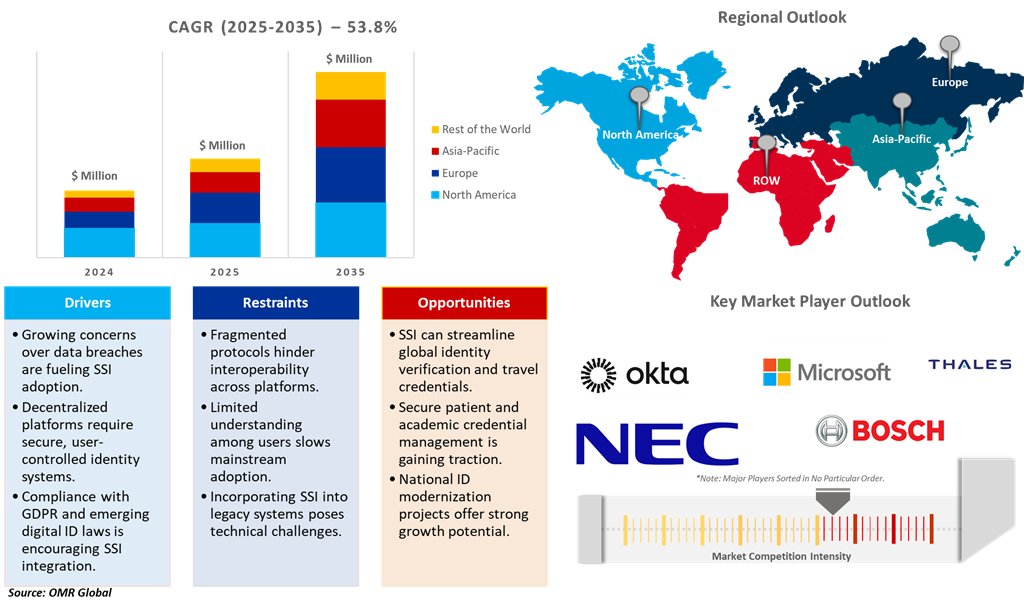
Self-sovereign identity market size was $1.7 billion in 2024 and is anticipated to grow at a CAGR of 53.8% during the forecast period (2025-2035). The global self-sovereign identity sectors. Identity solutions that enable users to safeguard their identities are even more necessary as a result of the growing dependence on online platforms. Increased privacy regulations and compliance to address emerging use cases are driving enterprises to adopt more decentralized frameworks to provide more flexibility to secure data and reduce identity fraud. Regulation and market-driven decentralization around privacy-enhancing trends transforming identity. As blockchain technology, verifiable credentials, and end-user-supported digital wallets are more widely used, faster and more reliable verification is possible.
Market Dynamics
Decentralized Identity Frameworks Gaining Institutional Acceptance
Decentralized identity frameworks are used by governments and businesses around the globe to support digital sovereignty and data security. In industries such as banking, healthcare, and public services, some exemplary organizations are putting SSI frameworks into practice. For instance, Microsoft introduced the ION decentralized identity network, that users can manage their digital identifiers and controls directly without reliance on third-party software solutions or central authorities. Using this model, users can create tamper-proof and verifiable credentials and are able to eliminate costly intermediaries, such as banks, as trusted verifiers. The expected ability to digitize verification when managing access to assets while complying with data protection requirements is accelerating global adoption. Considering that identity theft, data breaches, and data misuse continue to be significant issues, adopting a decentralized and trustless infrastructure provides a timely and scalable solution.
Technology Providers are Developing Real-World Applications of SSI
Technology companies are leading the way in building real tools for implementing Self-Sovereign Identity systems. For instance, Validated ID launched VIDchain, a platform for the secure issuing and validating of digital credentials. VIDChain can be used in practical situations, such as in higher education and in corporate HR departments, to validate qualifications or employment history. Overall, these applications mitigate administrative friction and improve trust in the credentialing process. Feasible applications of verifiable credentials and decentralized identifiers (DIDs) could enable organizations to have greater sovereign control of their identity data.
Market Segmentation
- Based on the offering, the market is segmented into solutions and services.
- Based on the identity type, the market is segmented into non-biometrics and biometrics.
- Based on the vertical, the market is segmented into BFSI, IT and telecom, government, real estate & construction, healthcare, retail and e-commerce, travel & hospitality, and other.
Solutions Segment to Lead the Market with the Largest Share
The SSI market is showing notable momentum, driven largely by the continued proliferation of solutions specifically designed to facilitate decentralized identity management. The emergence of these solutions introduces the idea of credential ownership, thereby minimizing the reliance on third parties for verification systems. Organizations are utilizing SSI platforms to enhance the back-end workflows of identity-based verification to comply with privacy regulations. For instance, Trinsic provides an SSI development platform that is an end-to-end solution for developers to issue, verify, and securely store verifiable credentials. These tools have the potential to eliminate duplication in user identity checks and reduce the amount of risk in exposing data. These tools are being utilized to integrate the SSI capabilities with enterprise systems for employee access control and customer onboarding. The popularity of the modular, API-based SSI solutions is affecting enterprise IT decisions. This trend creates a more secure and resilient identity ecosystem across many industries.
BFSI: A Key Segment in Market Growth
The BFSI sector is rapidly embracing SSI as more users demand secure and self-controlled mechanisms of identity verification. Financial Institutions are utilizing SSI by enabling an easier digital onboarding process and a reduced risk of identity fraud. For instance, the Bloom Protocol allows banks to comply with changing privacy regulations by validating user credentials without physically storing any private information about individuals. These solutions allow for a reusable KYC framework, lowering operational costs and increasing the overall customer experience. As such, decentralized identity tools are core layers within financial services to enhance their authentication processes. This move represents a great focus on privacy-preserving and audit-ready identity infrastructure in the sector.
Regional Outlook
The global self-sovereign identity market is further divided by geography, including North America (the US and Canada), Europe (the UK, Germany, France, Italy, Spain, Russia, and the Rest of Europe), Asia-Pacific (India, China, Japan, South Korea, Australia and New Zealand, ASEAN Countries, and the Rest of Asia-Pacific), and the Rest of the World (the Middle East & Africa, and Latin America).
Growing Demand for Complex Diagnostic Solutions in Europe
The SSI market is growing in the European market. This growth is facilitated by the legislative and regulatory commitment to digital identity and the enforcement of privacy. Legislation such as eIDAS 2.0 has prompted institutions to consider the use of decentralized identity solutions that have user consent and control to increase compliance. For instance, Validated ID created a system, VIDchain, on information that is within European compliance standards while permitting trusted and secure credential management. It has been observed that the proportion of institutions using SSI credentials has grown, even though institutions such as public sector organizations and universities started investing in SSI systems for credentialing procedures. Furthermore, member states are giving priority to the cross-border interoperability of digital identities.
North America Region Dominates the Market with a Major Share
North America is experiencing rapid growth in the SSI market as organizations are utilizing decentralized identity frameworks for security, privacy, and regulatory frameworks. Businesses are beginning to use SSI, although it reduces the risks that come with a central identity management system that is frequently necessary. For instance, Microsoft's launch of the ION network illustrates the commitment in North America to scalable and blockchain decoupled identity systems. SSI technologies have broad potential across many industries, including health care, finance, and government, to support improved authentication and user control of data. The focus on interoperability and verifiable credentials facilitates digital trust across digital platforms.
Market Players Outlook
The major companies operating in the global self-sovereign identity market include Microsoft Corp., NEC Corp., Okta, Inc., Robert Bosch GmbH, and Thales Group, among others. Market players are leveraging partnerships, collaborations, mergers, and acquisition strategies for business expansion and innovative product development to maintain their market positioning.
Recent Developments
- In October 2024, the European Blockchain Partnership (EBP) launched its first pan-European SSI initiative to define a common framework for mining decentralized identifiers throughout Europe. The EBP, which received government support and is ultimately a cross-border initiative, is a reflection of the increasing prominence of public-private partnerships aimed at accelerating the adoption of SSI for reliable digital engagement that preserves privacy in commerce and government.
- In August 2024, Microsoft partnered with NEC Corp. in Japan to introduce a cardless digital employee ID for 20,000 workers, allowing users to manage their own identities using a smartphone with facial recognition and Microsoft Entra Verified ID integration. The digital employee ID enhances productivity and workplace security while demonstrating Microsoft's commitment to privacy-preserving, decentralized identity credentials that use blockchain technology and open standards such as W3C Verifiable Credentials.
- In November 2023, Ping Identity announced that it entered into a partnership with ConnectID to bring its digital identity solution to the PingOne Cloud Platform to provide privacy-first digital identity verification and experiences that empower users to own and control their identity data, while meeting the needs of both organizations under Australia's Trusted Digital Identity Framework (TDIF), to meet the increasing need for secure, self-sovereign identity in a regulated environment.
The Report Covers
- Market value data analysis of 2024 and forecast to 2035.
- Annualized market revenues ($ million) for each market segment.
- Country-wise analysis of major geographical regions.
- Key companies operating in the global self-sovereign identity market. Based on the availability of data, information related to new products and relevant news is also available in the report.
- Analysis of business strategies by identifying the key market segments positioned for strong growth in the future.
- Analysis of market-entry and market expansion strategies.
- Competitive strategies by identifying ‘who-stands-where’ in the market.
- Report Summary
- Current Industry Analysis and Growth Potential Outlook
- Global Self-Sovereign Identity Market Sales Analysis – Offering | Identity Type | Vertical ($ Million)
- Self-Sovereign Identity Market Sales Performance of Top Countries
- Research Methodology
- Primary Research Approach
- Secondary Research Approach
- Market Snapshot
- Market Overview and Insights
- Scope of the Study
- Analyst Insight & Current Market Trends
- Key Self-Sovereign Identity Market Trends
- Market Recommendations
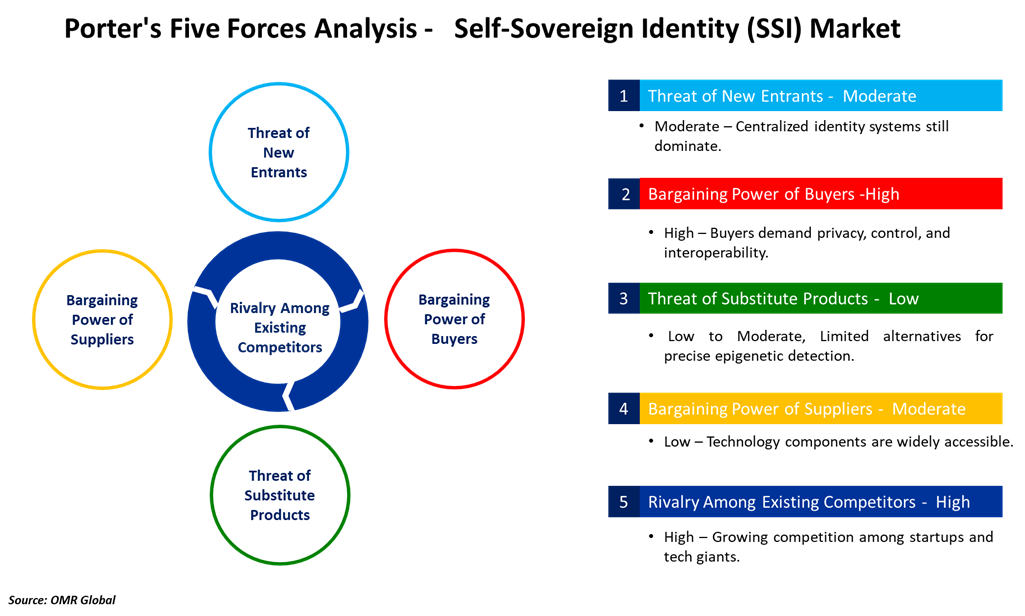
- Porter's Five Forces Analysis for the Self-Sovereign Identity Market
- Competitive Rivalry
- Threat of New Entrants
- Bargaining Power of Suppliers
- Bargaining Power of Buyers
- Threat of Substitutes
- Market Determinants
- Market Drivers
- Drivers For Global Self-Sovereign Identity Market: Impact Analysis
- Market Pain Points and Challenges
- Restraints For Global Self-Sovereign Identity Market: Impact Analysis
- Market Opportunities
- Opportunities For Global Self-Sovereign Identity Market: Impact Analysis
- Market Drivers
- Competitive Landscape
- Competitive Dashboard – Self-Sovereign Identity Market Revenue and Share by Manufacturers
- Self-Sovereign Identity Product Comparison Analysis
- Top Market Player Ranking Matrix
- Key Company Analysis
- Microsoft Corp.
- Overview
- Product Portfolio
- Financial Analysis (Subject to Data Availability)
- SWOT Analysis
- Business Strategy
- NEC Corp.
- Overview
- Product Portfolio
- Financial Analysis (Subject to Data Availability)
- SWOT Analysis
- Business Strategy
- Okta, Inc.
- Overview
- Product Portfolio
- Financial Analysis (Subject to Data Availability)
- SWOT Analysis
- Business Strategy
- Robert Bosch GmbH
- Overview
- Product Portfolio
- Financial Analysis (Subject to Data Availability)
- SWOT Analysis
- Business Strategy
- Thales Group
- Overview
- Product Portfolio
- Financial Analysis (Subject to Data Availability)
- SWOT Analysis
- Business Strategy
- Top Winning Strategies by Market Players
- Merger and Acquisition
- Product Launch
- Partnership And Collaboration
- Microsoft Corp.
- Key Company Analysis
- Global Self-Sovereign Identity Market Sales Analysis by Offering ($ Million)
- Solutions
- Services
- Global Self-Sovereign Identity Market Sales Analysis by Identity Type ($ Million)
- Non-Biometrics
- Biometrics
- Global Self-Sovereign Identity Market Sales Analysis by Vertical ($ Million)
- BFSI
- IT and Telecom
- Government
- Real Estate & Construction
- Healthcare
- Retail and E-Commerce
- Travel & Hospitality
- Other (Media & Entertainment)
- Regional Analysis
- North American Self-Sovereign Identity Market Sales Analysis – Offering | Identity Type | Vertical | Country ($ Million)
- Macroeconomic Factors for North America
- United States
- Canada
- European Self-Sovereign Identity Market Sales Analysis – Offering | Identity Type | Vertical | Country ($ Million)
- Macroeconomic Factors for Europe
- UK
- Germany
- Italy
- Spain
- France
- Russia
- Rest of Europe
- Asia-Pacific Self-Sovereign Identity Market Sales Analysis – Offering | Identity Type | Vertical | Country ($ Million)
- Macroeconomic Factors for Asia-Pacific
- China
- Japan
- South Korea
- India
- Australia & New Zealand
- ASEAN Countries (Thailand, Indonesia, Vietnam, Singapore, And Other)
- Rest of Asia-Pacific
- Rest of the World Self-Sovereign Identity Market Sales Analysis – Offering | Identity Type | Vertical | Country ($ Million)
- Macroeconomic Factors for Rest of the World
- Latin America
- Middle East and Africa
- Company Profiles
- Affinidi Pte. Ltd.
- Quick Facts
- Company Overview
- Product Portfolio
- Business Strategies
- Bloom HoldCo LLC
- Quick Facts
- Company Overview
- Product Portfolio
- Business Strategies
- Cheqd Foundation Ltd.
- Quick Facts
- Company Overview
- Product Portfolio
- Business Strategies
- Danube Tech GmbH
- Quick Facts
- Company Overview
- Product Portfolio
- Business Strategies
- Dock Labs AG
- Quick Facts
- Company Overview
- Product Portfolio
- Business Strategies
- Evernym, Inc.
- Quick Facts
- Company Overview
- Product Portfolio
- Business Strategies
- Fractal ID
- Quick Facts
- Company Overview
- Product Portfolio
- Business Strategies
- io
- Quick Facts
- Company Overview
- Product Portfolio
- Business Strategies
- Indicio
- Quick Facts
- Company Overview
- Product Portfolio
- Business Strategies
- Metadium Technology Inc.
- Quick Facts
- Company Overview
- Product Portfolio
- Business Strategies
- Microsoft Corp.
- Quick Facts
- Company Overview
- Product Portfolio
- Business Strategies
- Monokee Srl
- Quick Facts
- Company Overview
- Product Portfolio
- Business Strategies
- NEC Corp.
- Quick Facts
- Company Overview
- Product Portfolio
- Business Strategies
- Northern Block Inc.
- Quick Facts
- Company Overview
- Product Portfolio
- Business Strategies
- Okta, Inc.
- Quick Facts
- Company Overview
- Product Portfolio
- Business Strategies
- Ping Identity
- Quick Facts
- Company Overview
- Product Portfolio
- Business Strategies
- Robert Bosch GmbH
- Quick Facts
- Company Overview
- Product Portfolio
- Business Strategies
- Sovrin Foundation
- Quick Facts
- Company Overview
- Product Portfolio
- Business Strategies
- Sphereon International BV
- Quick Facts
- Company Overview
- Product Portfolio
- Business Strategies
- Spruce Systems, Inc.
- Quick Facts
- Company Overview
- Product Portfolio
- Business Strategies
- Thales Group
- Quick Facts
- Company Overview
- Product Portfolio
- Business Strategies
- Trinsic Technologies Inc.
- Quick Facts
- Company Overview
- Product Portfolio
- Business Strategies
- Validated ID S.L.
- Quick Facts
- Company Overview
- Product Portfolio
- Business Strategies
- Verida Network
- Quick Facts
- Company Overview
- Product Portfolio
- Business Strategies
- Affinidi Pte. Ltd.
1. Global Self-Sovereign Identity Market Research and Analysis by Offering, 2024–2035 ($ Million)
2. Global Self-Sovereign Identity Solutions Market Research and Analysis by Region, 2024–2035 ($ Million)
3. Global Self-Sovereign Identity Service Market Research and Analysis by Region, 2024–2035 ($ Million)
4. Global Self-Sovereign Identity Market Research and Analysis by Identity Type, 2024–2035 ($ Million)
5. Global Non-Biometrics Self-Sovereign Identity Market Research and Analysis by Region, 2024–2035 ($ Million)
6. Global Biometrics Self-Sovereign Identity Market Research and Analysis by Region, 2024–2035 ($ Million)
7. Global Self-Sovereign Identity Market Research and Analysis by Vertical, 2024–2035 ($ Million)
8. Global Self-Sovereign Identity For BFSI Market Research and Analysis by Region, 2024–2035 ($ Million)
9. Global Self-Sovereign Identity For IT and Telecom Market Research and Analysis by Region, 2024–2035 ($ Million)
10. Global Self-Sovereign Identity For Government Market Research and Analysis by Region, 2024–2035 ($ Million)
11. Global Self-Sovereign Identity For Real Estate & Construction Market Research and Analysis by Region, 2024–2035 ($ Million)
12. Global Self-Sovereign Identity For Healthcare Market Research and Analysis by Region, 2024–2035 ($ Million)
13. Global Self-Sovereign Identity For Retail and E-Commerce Market Research and Analysis by Region, 2024–2035 ($ Million)
14. Global Self-Sovereign Identity For Travel & Hospitality Market Research and Analysis by Region, 2024–2035 ($ Million)
15. Global Self-Sovereign Identity For Other Vertical Market Research and Analysis by Region, 2024–2035 ($ Million)
16. Global Self-Sovereign Identity Market Research and Analysis by Region, 2024–2035 ($ Million)
17. North American Self-Sovereign Identity Market Research and Analysis by Country, 2024–2035 ($ Million)
18. North American Self-Sovereign Identity Market Research and Analysis by Offering, 2024–2035 ($ Million)
19. North American Self-Sovereign Identity Market Research and Analysis by Identity Type, 2024–2035 ($ Million)
20. North American Self-Sovereign Identity Market Research and Analysis by Vertical, 2024–2035 ($ Million)
21. European Self-Sovereign Identity Market Research and Analysis by Country, 2024–2035 ($ Million)
22. European Self-Sovereign Identity Market Research and Analysis by Offering, 2024–2035 ($ Million)
23. European Self-Sovereign Identity Market Research and Analysis by Identity Type, 2024–2035 ($ Million)
24. European Self-Sovereign Identity Market Research and Analysis by Vertical, 2024–2035 ($ Million)
25. Asia-Pacific Self-Sovereign Identity Market Research and Analysis by Country, 2024–2035 ($ Million)
26. Asia-Pacific Self-Sovereign Identity Market Research and Analysis by Offering, 2024–2035 ($ Million)
27. Asia-Pacific Self-Sovereign Identity Market Research and Analysis by Identity Type, 2024–2035 ($ Million)
28. Asia-Pacific Self-Sovereign Identity Market Research and Analysis by Vertical, 2024–2035 ($ Million)
29. Rest of the World Self-Sovereign Identity Market Research and Analysis by Region, 2024–2035 ($ Million)
30. Rest of the World Self-Sovereign Identity Market Research and Analysis by Offering, 2024–2035 ($ Million)
31. Rest of the World Self-Sovereign Identity Market Research and Analysis by Identity Type, 2024–2035 ($ Million)
32. Rest of the World Self-Sovereign Identity Market Research and Analysis by Vertical, 2024–2035 ($ Million)
1. Global Self-Sovereign Identity Market Share by Offering, 2024 Vs 2035 (%)
2. Global Self-Sovereign Identity Solutions Market Share by Region, 2024 Vs 2035 (%)
3. Global Self-Sovereign Identity Services Market Share by Region, 2024 Vs 2035 (%)
4. Global Self-Sovereign Identity Market Share by Identity Type, 2024 Vs 2035 (%)
5. Global Non-Biometrics Self-Sovereign Identity Market Share by Region, 2024 Vs 2035 (%)
6. Global Biometrics Self-Sovereign Identity Market Share by Region, 2024 Vs 2035 (%)
7. Global Self-Sovereign Identity Market Share by Vertical, 2024 Vs 2035 (%)
8. Global Self-Sovereign Identity For BFSI Market Share by Region, 2024 Vs 2035 (%)
9. Global Self-Sovereign Identity For IT and Telecom Market Share by Region, 2024 Vs 2035 (%)
10. Global Self-Sovereign Identity For Government Market Share by Region, 2024 Vs 2035 (%)
11. Global Self-Sovereign Identity For Real Estate & Construction Market Share by Region, 2024 Vs 2035 (%)
12. Global Self-Sovereign Identity For Healthcare Market Share by Region, 2024 Vs 2035 (%)
13. Global Self-Sovereign Identity For Retail and E-Commerce Market Share by Region, 2024 Vs 2035 (%)
14. Global Self-Sovereign Identity For Travel & Hospitality Market Share by Region, 2024 Vs 2035 (%)
15. Global Self-Sovereign Identity For Other Vertical Market Share by Region, 2024 Vs 2035 (%)
16. Global Self-Sovereign Identity Market Share by Region, 2024 Vs 2035 (%)
17. US Self-Sovereign Identity Market Size, 2024–2035 ($ Million)
18. Canada Self-Sovereign Identity Market Size, 2024–2035 ($ Million)
19. UK Self-Sovereign Identity Market Size, 2024–2035 ($ Million)
20. France Self-Sovereign Identity Market Size, 2024–2035 ($ Million)
21. Germany Self-Sovereign Identity Market Size, 2024–2035 ($ Million)
22. Italy Self-Sovereign Identity Market Size, 2024–2035 ($ Million)
23. Spain Self-Sovereign Identity Market Size, 2024–2035 ($ Million)
24. Russia Self-Sovereign Identity Market Size, 2024–2035 ($ Million)
25. Rest of Europe Self-Sovereign Identity Market Size, 2024–2035 ($ Million)
26. India Self-Sovereign Identity Market Size, 2024–2035 ($ Million)
27. China Self-Sovereign Identity Market Size, 2024–2035 ($ Million)
28. Japan Self-Sovereign Identity Market Size, 2024–2035 ($ Million)
29. South Korea Self-Sovereign Identity Market Size, 2024–2035 ($ Million)
30. Australia and New Zealand Self-Sovereign Identity Market Size, 2024–2035 ($ Million)
31. ASEAN Economies Self-Sovereign Identity Market Size, 2024–2035 ($ Million)
32. Rest of Asia-Pacific Self-Sovereign Identity Market Size, 2024–2035 ($ Million)
33. Latin America Self-Sovereign Identity Market Size, 2024–2035 ($ Million)
34. Middle East and Africa Self-Sovereign Identity Market Size, 2024–2035 ($ Million)
- Printable version
- No restriction to number of users within the company