Spain Electric Bus Market


Spain Electric Bus Market Size, Share & Trends Analysis Report by Bus Type (Hybrid Electric Bus, Fuel Cell Electric Bus, and Battery Electric Bus), By Battery Type (NiMH, Li-ion, and Others), By End-User (Urban and City Transit, School and Staff Transport, Intercity and Long-Distance Travel, Airport Shuttle, Other Applications), Forecast Period (2025-2035)
Industry Overview
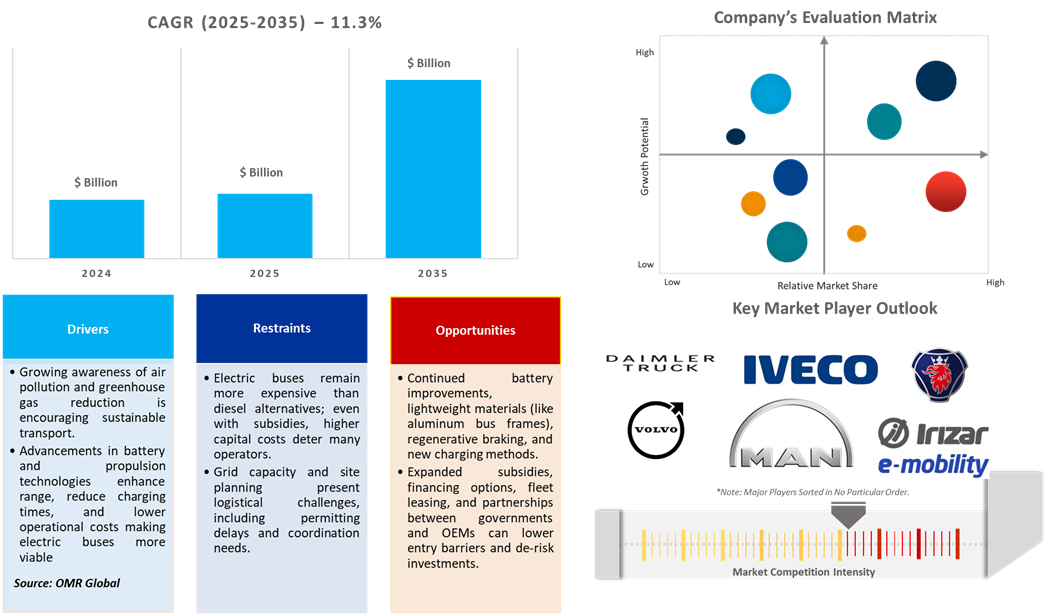
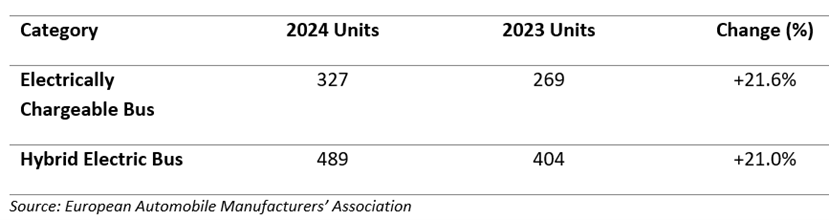
Spain electric bus market was valued at $1,355 million in 2024 and is projected to reach $4,397 million by 2035, expanding at a CAGR of 11.3% (2025–2035). Growth is being driven by rising sales and registrations, investment in charging infrastructure, and strong government support through schemes and incentives. According to the European Automobile Manufacturers’ Association, electrically chargeable bus registrations in Spain increased by 21.6% in 2024, while hybrid electric bus registrations rose from 404 units in 2023 to 489 in 2024, a 21% year-on-year increase. Overall, 4,355 buses and coaches were registered in Spain in 2024, up 16% from 2023.
- Mercedes led the market with 1,077 units (+13.8%, 25% share), followed by Iveco (532 units, +13%), MAN Truck & Bus (435 units, +19%), and Scania (426 units, -8%), together accounting for 56% of total registrations.
- Other notable performers included Volvo (331 units), Irizar (275 units, +27%), Temsa (180 units, +40%), and King Long (130 units, +155%).
- Solaris saw a sharp decline (102 units, -64%). Alfabus entered strongly with 107 units in 2024 compared to none in 2023.
- In total, 2,462 complete buses and 1,893 buses with bodywork were registered in Spain during 2024.
Market Dynamics
Rising Investment in Sustainable Transportation Projects
Spain is increasing its electric bus adoption beyond major urban centers, with regions prioritizing sustainable transport solutions. Catalonia is emphasizing cleaner transport by introducing electric buses on regional and suburban routes, bridging the gap between city services and interurban travel. For years, urban centres such as Barcelona have led the way in electrifying buses. Advancements in battery capacity and charging technology have enabled operators to adopt electric buses. The regional government also made an investment in new fleets with the installation of both depot-based and ultra-fast charging stations, for longer route journeys. Projects such as the electric feeder buses are making journeys emission-free, replacing older diesel models with modern vehicles that reduce noise and air pollution while improving passenger comfort. These changes cut greenhouse gas emissions by an estimated 800 tonnes a year. Alongside fixed routes, Catalonia is also moving towards electrifying flexible transport options. Demand-responsive services, like the one connecting Olot with villages in la Vall d’en Bas, have swapped diesel minivans for small electric buses that can handle a full day’s service.
Enhanced Passenger Comfort in Electric Buses
The need for convenient public transportation is growing tremendously, and passenger comfort is a deciding factor for the future of transportation. Electric buses, with innovative technologies and contemporary designs, are changing the traveling experience. Lower noise levels and integrating smart features, these developments make public transport more sustainable and increasingly appealing for passengers. Companies like Karsan provide innovative solutions in their electric buses to improve passenger comfort. All Karsan models are equipped with climate control systems, silent motor technologies, and ergonomic interiors to meet passenger satisfaction requirements. Karsan electric buses also come equipped with smart connectivity solutions, offering real-time journey information and charging facilities for passengers' devices.
New Bus Registrations – Spain
Market Segmentation
- Based on the bus type, the market is segmented into hybrid electric bus, fuel cell electric bus, and battery electric bus.
- Based on the Battery type, the market is segmented into NiMH, Li-ion, and Others.
- Based on the end-user, the market is segmented into urban and city transit, school and staff transport, intercity and long-distance travel, airport shuttle, and other applications.
Lithium-ion Batteries Segment to Lead the Market with the Largest Share
Electric buses that run on lithium-ion batteries are coming into wide use in order to reduce CO2 emissions. Lithium-ion batteries for electric buses offer several advantages compared to other bulk lithium battery types or traditional internal combustion engine buses. Lithium-ion batteries have a higher energy density, offering more energy storage capacity in a smaller and lighter package. Lithium-ion battery is a representative of modern high-performance batteries, and has attracted much attention for its high specific energy, low self-discharge, long cycle life, no memory effect, and environmental protection.
The types of lithium batteries mainly include ternary lithium batteries, lifepo4 batteries, lithium cobalt oxide batteries, lithium titanate batteries, and lithium manganese oxide batteries. Among them, the ternary lithium battery and LiFePO4 battery are the two mainstream electric bus batteries at present. BYD's most of electric bus batteries are mostly lithium iron phosphate batteries.
- In January 2024, COBRA, in partnership with IREC, developed Spain’s first cobalt-free lithium-ion battery for electric vehicles.
Urban and City Transit: A Key Segment in Market Growth
This segment in the market is expanding rapidly, fueled by high urban population density, electric buses procurement by city transport operators, and demand for public transport. According to the World Bank, in 2024, the urban population of Spain amounted to 39.9 million and had densely populated areas such as Madrid, Barcelona, Valencia, and Seville, where urban transit plays an essential role in mobility solutions. According to the European Commission, in 2024, EMT Madrid (ES) transported nearly 476 million passengers across its 229 municipal bus routes. Daytime services transported 462 million passengers, while night transport took 7.3 million passengers. EMT has introduced 18 new lines and continues its electrification efforts, currently operating 36 fully electric lines, with more planned for 2025. The project emphasizes the role of urban electric bus networks in meeting the transportation needs of Spain’s expanding urban population and fulfilling sustainable mobility targets.
- In July 2025, Valencia (EMT) ordered 84 modern city buses from MAN Truck & Bus - including 57 fully electric Lion's City 12 E and 27 Lion's City 18 with MAN Hybrid technology.
- In April 2025, the public transport provider EMTUSA from Gijón in northern Spain ordered four electric city buses from Irizar. The operator has opted for the Irizar IE model, each 12 metres long.
Market Players Outlook
The major companies operating in the Spain electric bus market include Daimler Truck AG (Mercedes-Benz AG), IVECO S.p.A., MAN Truck & Bus SE, Scania CV AB, AB Volvo, Irizar E-Mobility S.L., and Solaris Bus & Coach sp. z o.o. Market players are leveraging partnerships, collaborations, mergers and acquisitions strategies for business expansion and innovative product development to maintain their market positioning.
Recent Developments
- In October 2024, Arriva introduced 21 new electric buses in Madrid, manufactured by BYD, combined with the electrification of its second depot in Móstoles. This initiative was a part of a $21.6 million investment marked at further decarbonising actions in the Spanish capital.
- In April 2024, Madrid's municipal transport company (EMT Madrid) launched an electric charging station in the southern Carabanchel district. The project supplies power to 118 buses simultaneously. This recent installation brings the total number of charging points in Madrid's city centre to 260.
- In May 2023, BYD, together with Castrosua, produced an eBus at an official presentation ceremony in Spain. The electric buses combine BYD’s advanced electric chassis technology with Castrosua’s expertise in bus bodybuilding.
The Report Covers
- Market value data analysis of 2024 and forecast to 2035.
- Annualized market revenues ($ million) for each market segment.
- Country-wise analysis of major geographical regions.
- Key companies operating in the spain electric bus market. Based on the availability of data, information related to new products and relevant news is also available in the report.
- Analysis of business strategies by identifying the key market segments positioned for strong growth in the future.
- Analysis of market-entry and market expansion strategies.
- Competitive strategies by identifying ‘who-stands-where’ in the market.
1. Report Summary
• Current Industry Analysis and Growth Potential Outlook
• Spain Electric Bus Market Sales Analysis – Bus Type| Battery Type | End-User ($ Million)
1.1. Research Methodology
• Primary Research Approach
• Secondary Research Approach
1.2. Market Snapshot
2. Market Overview and Insights
2.1. Scope of the Study
2.2. Analyst Insight & Current Market Trends
2.2.1. Key Spain Electric Bus Industry Trends
2.2.2. Market Recommendations
3. Market Determinants
3.1. Market Drivers
3.1.1. Drivers For Spain Electric Bus Market: Impact Analysis
3.2. Market Pain Points and Challenges
3.2.1. Restraints For Spain Electric Bus Market: Impact Analysis
3.3. Market Opportunities
3.3.1. Opportunities For Spain Electric Bus Market: Impact Analysis
4. Competitive Landscape
4.1. Competitive Dashboard – Spain Electric Bus Market Revenue and Share by Manufacturers
• Electric Bus Product Comparison Analysis
• Top Market Player Ranking Matrix
4.2. Key Company Analysis
4.2.1. Daimler Truck AG (Mercedes-Benz AG)
4.2.1.1. Overview
4.2.1.2. Product Portfolio
4.2.1.3. Financial Analysis (Subject to Data Availability)
4.2.1.4. SWOT Analysis
4.2.1.5. Business Strategy
4.2.2. IVECO S.p.A
4.2.2.1. Overview
4.2.2.2. Product Portfolio
4.2.2.3. Financial Analysis (Subject to Data Availability)
4.2.2.4. SWOT Analysis
4.2.2.5. Business Strategy
4.2.3. MAN Truck & Bus SE
4.2.3.1. Overview
4.2.3.2. Product Portfolio
4.2.3.3. Financial Analysis (Subject to Data Availability)
4.2.3.4. SWOT Analysis
4.2.3.5. Business Strategy
4.2.4. Scania CV AB
4.2.4.1. Overview
4.2.4.2. Product Portfolio
4.2.4.3. Financial Analysis (Subject to Data Availability)
4.2.4.4. SWOT Analysis
4.2.4.5. Business Strategy
4.2.5. AB Volvo
4.2.5.1. Overview
4.2.5.2. Product Portfolio
4.2.5.3. Financial Analysis (Subject to Data Availability)
4.2.5.4. SWOT Analysis
4.2.5.5. Business Strategy
4.2.6. Irizar E-Mobility S.L.
4.2.6.1. Overview
4.2.6.2. Product Portfolio
4.2.6.3. Financial Analysis (Subject to Data Availability)
4.2.6.4. SWOT Analysis
4.2.6.5. Business Strategy
4.3. Top Winning Strategies by Market Players
4.3.1. Merger and Acquisition
4.3.2. Product Launch
4.3.3. Partnership And Collaboration
5. Spain Electric Bus Market Sales Analysis by Bus Type ($ Million)
5.1. Hybrid Electric Bus
5.2. Fuel Cell Electric Bus
5.3. Battery Electric Bus
6. Spain Electric Bus Market Sales Analysis by Battery Type ($ Million)
6.1. NiMH
6.2. Li-ion
6.3. Others
7. Spain Electric Bus Market Sales Analysis by End-User ($ Million)
7.1. Urban and City Transit
7.2. School and Staff Transport
7.3. Intercity and Long-Distance Travel
7.4. Airport Shuttle
7.5. Other Applications
8. Company Profiles
8.1. Beulas S.A.U
8.1.1. Quick Facts
8.1.2. Company Overview
8.1.3. Product Portfolio
8.1.4. Business Strategies
8.2. CAF
8.2.1. Quick Facts
8.2.2. Company Overview
8.2.3. Product Portfolio
8.2.4. Business Strategies
8.3. Ebusco
8.3.1. Quick Facts
8.3.2. Company Overview
8.3.3. Product Portfolio
8.3.4. Business Strategies
8.4. IVECO S.p.A
8.4.1. Quick Facts
8.4.2. Company Overview
8.4.3. Product Portfolio
8.4.4. Business Strategies
8.5. Irizar E-Mobility S.L.
8.5.1. Quick Facts
8.5.2. Company Overview
8.5.3. Product Portfolio
8.5.4. Business Strategies
8.6. Karsan Otomotiv San. ve Tic. A.?.
8.6.1. Quick Facts
8.6.2. Company Overview
8.6.3. Product Portfolio
8.6.4. Business Strategies
8.7. Kiepe Electric GmbH
8.7.1. Quick Facts
8.7.2. Company Overview
8.7.3. Product Portfolio
8.7.4. Business Strategies
8.8. MAN
8.8.1. Quick Facts
8.8.2. Company Overview
8.8.3. Product Portfolio
8.8.4. Business Strategies
8.9. Scania CV AB
8.9.1. Quick Facts
8.9.2. Company Overview
8.9.3. Product Portfolio
8.9.4. Business Strategies
8.10. Solaris Bus & Coach sp. z o.o.
8.10.1. Quick Facts
8.10.2. Company Overview
8.10.3. Product Portfolio
8.10.4. Business Strategies
8.11. SWITCH Mobility
8.11.1. Quick Facts
8.11.2. Company Overview
8.11.3. Product Portfolio
8.11.4. Business Strategies
8.12. Tata Hispano Motors Carrocera, S.A.
8.12.1. Quick Facts
8.12.2. Company Overview
8.12.3. Product Portfolio
8.12.4. Business Strategies
8.13. Unvi Carroceros, S.L.
8.13.1. Quick Facts
8.13.2. Company Overview
8.13.3. Product Portfolio
8.13.4. Business Strategies
8.14. Youtong
8.14.1. Quick Facts
8.14.2. Company Overview
8.14.3. Product Portfolio
8.14.4. Business Strategies
8.15. Zenob? Energy Limited
8.15.1. Quick Facts
8.15.2. Company Overview
8.15.3. Product Portfolio
8.15.4. Business Strategies
1. Spain Electric Bus Market Research and Analysis by Bus Type, 2024–2035 ($ Million)
2. Spain Hybrid Electric Bus Market Research and Analysis, 2024–2035 ($ Million)
3. Spain Fuel Cell Electric Bus Market Research and Analysis, 2024–2035 ($ Million)
4. Spain Battery Electric Bus Market Research and Analysis, 2024–2035 ($ Million)
5. Spain Electric Bus Market Research and Analysis by Battery Type, 2024–2035 ($ Million)
6. Spain NiMH Battery Market Research and Analysis, 2024–2035 ($ Million)
7. Spain Li-ion Battery Market Research and Analysis, 2024–2035 ($ Million)
8. Spain Other Battery Market Research and Analysis, 2024–2035 ($ Million)
9. Spain Electric Bus Market Research and Analysis by End-User, 2024–2035 ($ Million)
10. Spain Electric Bus for Urban and City Transit Market Research and Analysis, 2024–2035 ($ Million)
11. Spain Electric Bus for School and Staff Transport Market Research and Analysis, 2024–2035 ($ Million)
12. Spain Electric Bus for Intercity and Long-Distance Travel Market Research and Analysis, 2024–2035 ($ Million)
13. Spain Electric Bus for Airport Shuttle Market Research and Analysis, 2024–2035 ($ Million)
14. Spain Electric Bus for Other Application Market Research and Analysis, 2024–2035 ($ Million)
1. Spain Electric Bus Market Research and Analysis by Bus Type, 2024 Vs 2035 (%)
2. Spain Hybrid Electric Bus Market Share Analysis, 2024 Vs 2035 (%)
3. Spain Fuel Cell Electric Bus Market Share Analysis, 2024 Vs 2035 (%)
4. Spain Battery Electric Bus Market Share Analysis, 2024 Vs 2035 (%)
5. Spain Electric Bus Market Research and Analysis by Battery Type, 2024 Vs 2035 (%)
6. Spain NiMH Battery Market Share Analysis, 2024 Vs 2035 (%)
7. Spain Li-ion Battery Market Share Analysis, 2024 Vs 2035 (%)
8. Spain Other Battery Market Share Analysis, 2024 Vs 2035 (%)
9. Spain Electric Bus Market Research and Analysis by End-User, 2024 Vs 2035 (%)
10. Spain Electric Bus for Urban and City Transit Market Share Analysis, 2024 Vs 2035 (%)
11. Spain Electric Bus for School and Staff Transport Market Share Analysis, 2024 Vs 2035 (%)
12. Spain Electric Bus for Intercity and Long-Distance Travel Market Share Analysis, 2024 Vs 2035 (%)
13. Spain Electric Bus for Airport Shuttle Market Share Analysis, 2024 Vs 2035 (%)
14. Spain Electric Bus for Other Application Market Share Analysis, 2024 Vs 2035 (%)
- Printable version
- No restriction to number of users within the company