UK Generic Drug Market


UK Generic Drug Market Size, Share & Trends Analysis Report by Route of Administration (Oral, Topical, Injectable, and Inhaler), and by Application (Cancer, CVD, Musculoskeletal, Infectious Diseases, Neurology, Diabetes, and Others), Forecast Period (2025-2035)
Industry Overview
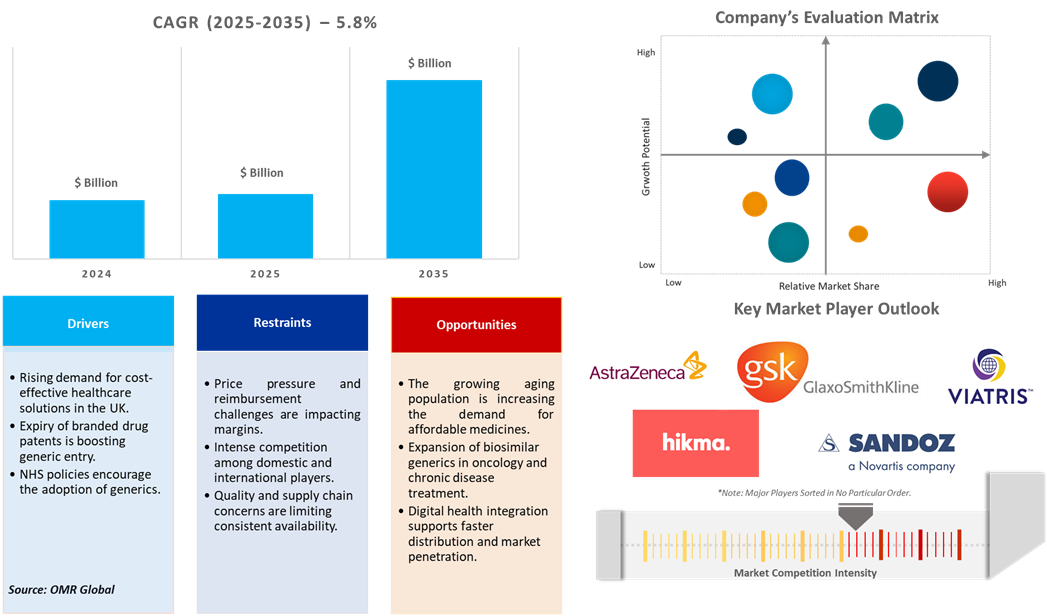
UK generic drug market was valued at $28.2 billion in 2024 and is projected to reach $52.8 billion by 2035, growing at a CAGR of 5.8% during the forecast period (2025–2035). The UK generic drug market is driven by increasing demand for inexpensive treatment across a range of therapeutic classes. As the pressure on the National Health Service to manage healthcare expenditure is increasing, resulting for cost-effective replacements for branded medicines. Companies such as Teva UK and Accord Healthcare are expanding their presence by providing a wide range of generics that enhance patient access. Growth is also propelled by expirations of patents on top-tier pharmaceuticals, opening the door for new players. Similarly, regulation and UK procurement policies tend to increase the usage of generics to provide sustainability of the healthcare system.
Market Dynamics
Rising Adoption of Cost-Effective Therapies
The UK healthcare system continues to prioritize the use of generics as part of cost-containment strategies. The growing demand in the NHS has led to wider access to cost-effective medicines. For instance, Accord Healthcare has broadened its oncology and cardiovascular care offerings to meet patient demand. Such growth offers patients access to life-saving medicines at a lower fraction of the price of the actual brand. This movement indicates a precise shifting toward affordability without compromising on medicinal benefit.
Market Expansion Through Patent Expirations
Patent expiries of leading-selling branded medications are making way for generics. This has allowed manufacturers to bring cost-effective therapies to key therapeutic areas. These opportunities have been harnessed by Teva UK in generics launches in neurology and respiratory therapy. Healthcare managers use these strategies to save costs without compromising on treatment. With the increasing number of patents nearing expiry, the UK generic drug market is poised to expand consistently.
Market Segmentation
- Based on the route of administration, the market is segmented into oral, topical, injectable, and inhaler.
- Based on the application, the market is segmented into cancer, CVD, musculoskeletal, infectious diseases, neurology, diabetes, and others.
Oral Segment to Lead the Market with the Largest Share
The oral segment remains at the forefront of the UK generic pharmaceutical market, led by extensive patient preference for capsules and tablets owing to the convenience of use. Operators like Teva UK actively deliver oral generics over a broad therapy range, facilitating easy access to treatment for patients. The good uptake of affordable oral forms has prompted hospitals and pharmacies to increase their dependency on generics.
For instance, Mylan (Viatris) has further reinforced this segment with its wide range of oral drugs. Stable supply and cost-competitive pricing are assisting in reducing the pressure on the NHS. This is a trend that reflects the increasingly significant role of oral generics as the foundation of affordable healthcare within the UK.
Cancer: A Key Segment in Market Growth
The cancer segment has been a key growth driver in the UK generic pharma market, with growth in demand for affordable oncology therapies climbing strongly. Accord Healthcare has been driving this, providing commonly prescribed generic oncology medicines that decrease patient treatment costs by a very big margin. Greater prevalence of cancer has resulted in more utilization of generics by healthcare providers and treatment units.
- Sandoz offers a portfolio of cancer generics that ensures continuity of care nationwide. The emphasis on biosimilars and oncology generics is facilitating increased access to innovative therapies. As a result of these advances, the oncology segment is determining the future of generic drug uptake in the UK.
Market Players Outlook
The major companies operating in the UK generic drug market include AstraZeneca, GlaxoSmithKline Plc, Hikma Pharmaceuticals, Sandoz Group AG (a division of Novartis), and Viatris Inc., among others. Market players are leveraging partnerships, collaborations, mergers, and acquisition strategies for business expansion and innovative product development to maintain their market positioning.
Recent Developments
- In August 2025, the Medicines and Healthcare products Regulatory Agency (MHRA) approved teplizumab (Tzield) to delay the onset of Stage 3 type 1 diabetes (T1D) by an average of three years in adults and children aged 8 years and older with Stage 2 T1D. Teplizumab is the UK’s first-ever approved immunotherapy for type 1 diabetes. Stage 3 T1D is when people usually begin to experience blood sugar problems and are diagnosed with the condition, which often requires lifelong insulin treatment.
- In July 2025, MHRA approved elinzanetant (Lynkuet) for the treatment of moderate to severe vasomotor symptoms (hot flushes) associated with the menopause. Elinzanetant is a new non-hormonal medication that works by calming these signals in the brain, helping bring the body’s temperature control back into balance. It may also help improve sleep problems that often come with menopause. This medicine is administered in capsule form, to be taken orally.
- In July 2024, ViiV Healthcare, the specialist HIV company majority owned by GSK, with Pfizer and Shionogi as shareholders, announced new maternal safety and pregnancy outcomes and pharmacokinetic (PK) findings from the HIV Prevention Trials Network (HPTN) 084 open-label extension (OLE) evaluating cisgender women in sub-Saharan Africa who became pregnant while using Apretude (cabotegravir LA for PrEP) for HIV pre-exposure prophylaxis (PrEP). Apretude (cabotegravir LA for PrEP) is approved for use in multiple countries, including the US, EU, UK, Canada, Australia, and South Africa. Submission to other regulatory agencies is ongoing.
The Report Covers
- Market value data analysis of 2024 and forecast to 2035.
- Annualized market revenues ($ million) for each market segment.
- Country-wise analysis of major geographical regions.
- Key companies operating in the UK generic drug market. Based on the availability of data, information related to new products and relevant news is also available in the report.
- Analysis of business strategies by identifying the key market segments positioned for strong growth in the future.
- Analysis of market-entry and market expansion strategies.
- Competitive strategies by identifying ‘who-stands-where’ in the market.
1. Report Summary
• Current Industry Analysis and Growth Potential Outlook
• UK Generic Drugs Market Sales Analysis – Route of Administration| Application ($ Million)
1.1. Research Methodology
• Primary Research Approach
• Secondary Research Approach
1.2. Market Snapshot
2. Market Overview and Insights
2.1. Scope of the Study
2.2. Analyst Insight & Current Market Trends
2.2.1. Key UK Generic Drugs Industry Trends
2.2.2. Market Recommendations
3. Market Determinants
3.1. Market Drivers
3.1.1. Drivers For the UK Generic Drugs Market: Impact Analysis
3.2. Market Pain Points and Challenges
3.2.1. Restraints For the UK Generic Drugs Market: Impact Analysis
3.3. Market Opportunities
3.3.1. Opportunities For the UK Generic Drugs Market: Impact Analysis
4. Competitive Landscape
4.1. Competitive Dashboard – UK Generic Drugs Market Revenue and Share by Manufacturers
• Battery Product Comparison Analysis
• Top Market Player Ranking Matrix
4.2. Key Company Analysis
4.2.1. AstraZeneca Plc
4.2.1.1. Overview
4.2.1.2. Product Portfolio
4.2.1.3. Financial Analysis (Subject to Data Availability)
4.2.1.4. SWOT Analysis
4.2.1.5. Business Strategy
4.2.2. Hikma Pharmaceuticals
4.2.2.1. Overview
4.2.2.2. Product Portfolio
4.2.2.3. Financial Analysis (Subject to Data Availability)
4.2.2.4. SWOT Analysis
4.2.2.5. Business Strategy
4.2.3. Sandoz Group AG (a division of Novartis)
4.2.3.1. Overview
4.2.3.2. Product Portfolio
4.2.3.3. Financial Analysis (Subject to Data Availability)
4.2.3.4. SWOT Analysis
4.2.3.5. Business Strategy
4.2.4. GlaxoSmithKline Plc
4.2.4.1. Overview
4.2.4.2. Product Portfolio
4.2.4.3. Financial Analysis (Subject to Data Availability)
4.2.4.4. SWOT Analysis
4.2.4.5. Business Strategy
4.2.5. Viatris Inc.
4.2.5.1. Overview
4.2.5.2. Product Portfolio
4.2.5.3. Financial Analysis (Subject to Data Availability)
4.2.5.4. SWOT Analysis
4.2.5.5. Business Strategy
4.3. Top Winning Strategies by Market Players
4.3.1. Merger and Acquisition
4.3.2. Product Launch
4.3.3. Partnership And Collaboration
5. UK Generic Drugs Market Sales Analysis by Route of Administration ($ Million)
5.1. Oral
5.2. Topical
5.3. Injectable
5.4. Inhaler
6. UK Generic Drugs Market Sales Analysis by Distribution Channel ($ Million)
6.1. Cancer
6.2. CVD
6.3. Musculoskeletal
6.4. Infectious Diseases
6.5. Neurology
6.6. Diabetes
6.7. Others
7. Company Profiles
7.1. Accord Healthcare Ltd.
7.1.1. Quick Facts
7.1.2. Company Overview
7.1.3. Product Portfolio
7.1.4. Business Strategies
7.2. ADVANZ PHARMA Corp.
7.2.1. Quick Facts
7.2.2. Company Overview
7.2.3. Product Portfolio
7.2.4. Business Strategies
7.3. Almus Pharmaceuticals Ltd.
7.3.1. Quick Facts
7.3.2. Company Overview
7.3.3. Product Portfolio
7.3.4. Business Strategies
7.4. AstraZeneca
7.4.1. Quick Facts
7.4.2. Company Overview
7.4.3. Product Portfolio
7.4.4. Business Strategies
7.5. Aurobindo Pharma Ltd.
7.5.1. Quick Facts
7.5.2. Company Overview
7.5.3. Product Portfolio
7.5.4. Business Strategies
7.6. Bell's Healthcare
7.6.1. Quick Facts
7.6.2. Company Overview
7.6.3. Product Portfolio
7.6.4. Business Strategies
7.7. Chanelle Pharma
7.7.1. Quick Facts
7.7.2. Company Overview
7.7.3. Product Portfolio
7.7.4. Business Strategies
7.8. Crescent Pharmaceuticals Ltd.
7.8.1. Quick Facts
7.8.2. Company Overview
7.8.3. Product Portfolio
7.8.4. Business Strategies
7.9. Dr. Reddy's Laboratories Ltd.
7.9.1. Quick Facts
7.9.2. Company Overview
7.9.3. Product Portfolio
7.9.4. Business Strategies
7.10. Essential Pharma
7.10.1. Quick Facts
7.10.2. Company Overview
7.10.3. Product Portfolio
7.10.4. Business Strategies
7.11. Flamingo Pharma (UK) Ltd.
7.11.1. Quick Facts
7.11.2. Company Overview
7.11.3. Product Portfolio
7.11.4. Business Strategies
7.12. GlaxoSmithKline Plc
7.12.1. Quick Facts
7.12.2. Company Overview
7.12.3. Product Portfolio
7.12.4. Business Strategies
7.13. Glen Clova Scientific Ltd.
7.13.1. Quick Facts
7.13.2. Company Overview
7.13.3. Product Portfolio
7.13.4. Business Strategies
7.14. Glenmark Pharmaceuticals Europe Ltd.
7.14.1. Quick Facts
7.14.2. Company Overview
7.14.3. Product Portfolio
7.14.4. Business Strategies
7.15. Hikma Pharmaceuticals PLC
7.15.1. Quick Facts
7.15.2. Company Overview
7.15.3. Product Portfolio
7.15.4. Business Strategies
7.16. Manx Healthcare Ltd.
7.16.1. Quick Facts
7.16.2. Company Overview
7.16.3. Product Portfolio
7.16.4. Business Strategies
7.17. OctaGenix Ltd.
7.17.1. Quick Facts
7.17.2. Company Overview
7.17.3. Product Portfolio
7.17.4. Business Strategies
7.18. Pfizer Ltd.
7.18.1. Quick Facts
7.18.2. Company Overview
7.18.3. Product Portfolio
7.18.4. Business Strategies
7.19. Rx Farma Ltd.
7.19.1. Quick Facts
7.19.2. Company Overview
7.19.3. Product Portfolio
7.19.4. Business Strategies
7.20. Strides Pharma UK Ltd.
7.20.1. Quick Facts
7.20.2. Company Overview
7.20.3. Product Portfolio
7.20.4. Business Strategies
7.21. Teva UK Ltd.
7.21.1. Quick Facts
7.21.2. Company Overview
7.21.3. Product Portfolio
7.21.4. Business Strategies
7.22. Thornton & Ross (STADA UK)
7.22.1. Quick Facts
7.22.2. Company Overview
7.22.3. Product Portfolio
7.22.4. Business Strategies
7.23. Wockhardt UK Ltd.
7.23.1. Quick Facts
7.23.2. Company Overview
7.23.3. Product Portfolio
7.23.4. Business Strategies
7.24. Viatris Inc.
7.24.1. Quick Facts
7.24.2. Company Overview
7.24.3. Product Portfolio
7.24.4. Business Strategies
7.25. Zentiva Group, a.s.
7.25.1. Quick Facts
7.25.2. Company Overview
7.25.3. Product Portfolio
7.25.4. Business Strategies
1. UK Generic Drugs Market Research and Analysis by Product, 2024–2035 ($ Million)
2. UK Oral Generic Drugs Market Research and Analysis, 2024–2035 ($ Million)
3. UK Topical Generic Drugs Market Research and Analysis, 2024–2035 ($ Million)
4. UK Injectable Generic Drugs Market Research and Analysis, 2024–2035 ($ Million)
5. UK Inhaler Generic Drugs Market Research and Analysis, 2024–2035 ($ Million)
6. UK Generic Drugs Market Research and Analysis by Application, 2024–2035 ($ Million)
7. UK Generic Drugs For Cancer Market Research and Analysis, 2024–2035 ($ Million)
8. UK Generic Drugs For CVD Market Research and Analysis, 2024–2035 ($ Million)
9. UK Generic Drugs For Musculoskeletal Market Research and Analysis, 2024–2035 ($ Million)
10. UK Generic Drugs For Infectious Diseases Market Research and Analysis, 2024–2035 ($ Million)
11. UK Generic Drugs For Neurology Market Research and Analysis, 2024–2035 ($ Million)
12. UK Generic Drugs For Diabetes Market Research and Analysis, 2024–2035 ($ Million)
13. UK Generic Drugs For Other Application Market Research and Analysis, 2024–2035 ($ Million)
1. UK Generic Drugs Market Share by Product, 2024 Vs 2035 (%)
2. UK Oral Generic Drugs Market Share by Region, 2024 Vs 2035 (%)
3. UK Topical Generic Drugs Market Share by Region, 2024 Vs 2035 (%)
4. UK Injectable Generic Drugs Market Share by Region, 2024 Vs 2035 (%)
5. UK Inhaler Generic Drugs Market Share by Region, 2024 Vs 2035 (%)
6. UK Generic Drugs Market Share by Application, 2024 Vs 2035 (%)
7. UK Generic Drugs For Cancer Market Share by Region, 2024 Vs 2035 (%)
8. UK Generic Drugs For CVD Market Share by Region, 2024 Vs 2035 (%)
9. UK Generic Drugs For Musculoskeletal Market Share by Region, 2024 Vs 2035 (%)
10. UK Generic Drugs For Infectious Diseases Market Share by Region, 2024 Vs 2035 (%)
11. UK Generic Drugs For Neurology Market Share by Region, 2024 Vs 2035 (%)
12. UK Generic Drugs For Diabetes Market Share by Region, 2024 Vs 2035 (%)
13. UK Generic Drugs For Other Application Market Share by Region, 2024 Vs 2035 (%)
- Printable version
- No restriction to number of users within the company